

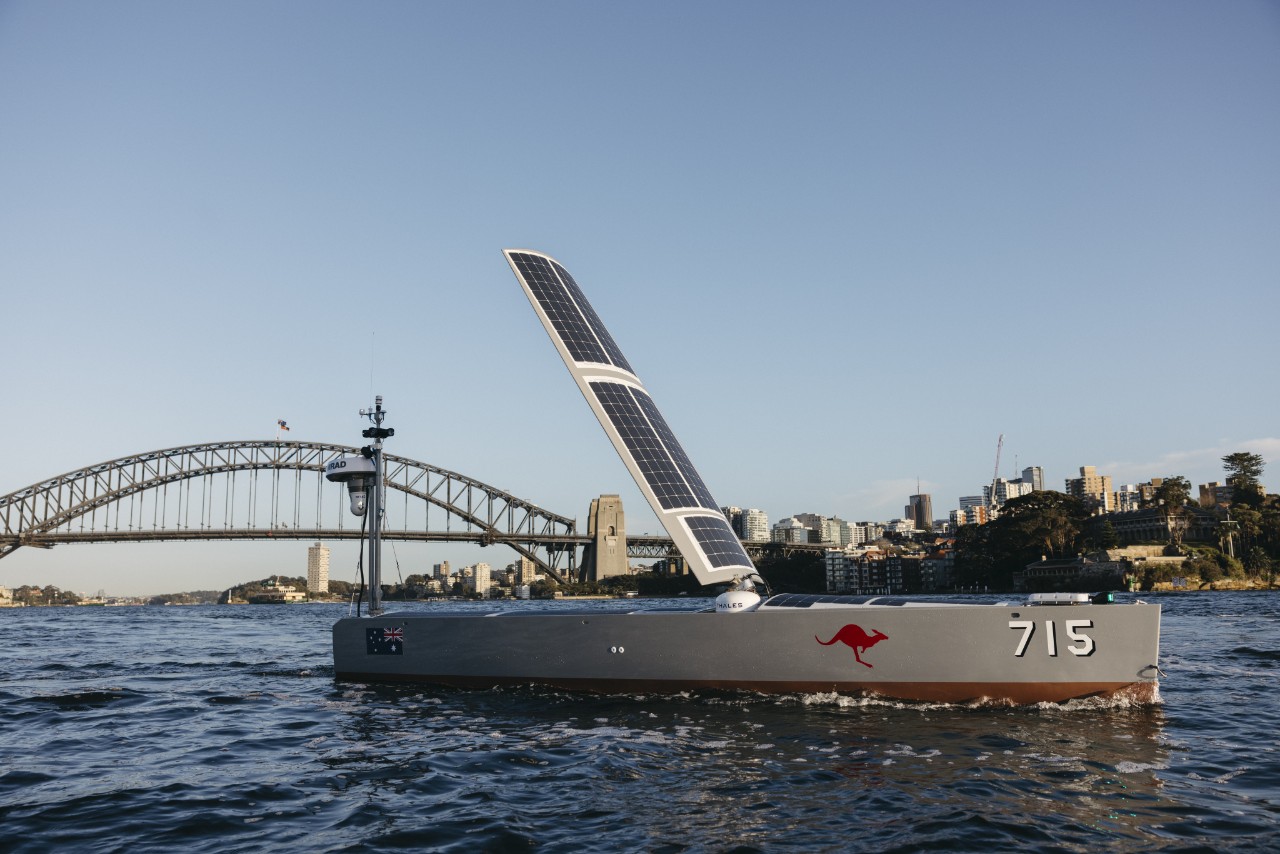
An uncrewed surface vessel designed to remain at sea for months at a time is being positioned as a low-cost, persistent layer for maritime surveillance and anti-submarine operations, according to Ocius.
Speaking to the UK Defence Journal at UDT 2026, Robert Dane, CEO of Ocius Technology, said the company’s Bluebottle vessel combines solar, wind and wave power to operate continuously without the need for refuelling.
“It’s basically a 24-foot sailing type yacht that uses solar, wind and wave power,” he said, adding that the Royal Australian Navy has already deployed 15 systems from Darwin on a continuous basis for around 21 months, with a further 40 on order under a programme valued at approximately $176 million.
The vessels are currently used primarily for above-water surveillance, supporting border and coastguard operations by monitoring activity across Australia’s exclusive economic zone, often operating between 100 and 400 miles offshore.
Dane said the next tranche of systems will expand into anti-submarine warfare roles, including the deployment of towed sonar arrays to detect underwater activity, extending the platform’s role into ISR and undersea sensing.
“The new order… will be focusing more on anti-submarine warfare or deploying arrays to significant depths,” he said.
A key feature of the platform is endurance and persistence. Bluebottle vessels typically remain at sea for around two and a half months, with some deployments extending to six months, enabled by their use of renewable energy and fuel-free operation.
This approach also reduces acoustic signature, supporting what the company describes as high-fidelity underwater surveillance while remaining difficult to detect.
“The first thing is, it can be out there for months at sea,” Dane said, arguing that this shifts how navies approach surveillance tasks.
Rather than relying solely on crewed ships for routine patrols, Dane said the system adds a complementary layer that reduces demand on higher-value assets.
“We sort of look at it like we’re the fire alarm and the crewed vessels are the fire brigade,” he said. “They don’t have to be out there doing boring patrol work.”
Cost is also a factor, with Dane stating that operating a Bluebottle is roughly a thirtieth of the cost of deploying a crewed vessel, while maintaining continuous coverage across a distributed network.
Ocius has also secured international traction beyond Australia, with vessels sold to the Royal New Zealand Navy and additional systems being supplied via a US prime contractor, while discussions are ongoing with other allied users.
To support operations in higher latitudes, including the North Atlantic, the company is developing hybrid variants with diesel-electric capability to account for reduced solar availability in winter conditions.
Dane said the concept has evolved over decades, but is now focused on defence applications, particularly persistent ISR, critical infrastructure monitoring and undersea surveillance in contested environments.
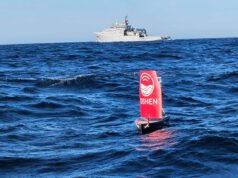


“he Royal Australian Navy has already deployed 15 systems from Darwin on a continuous basis for around 21 months, with a further 40 on order under a programme valued at approximately $176 million”
That is very interesting that they have had the volume of usage and therefore data back from it.
So is a lot of Bluebottles buzzing called a ‘swarm’ ?