

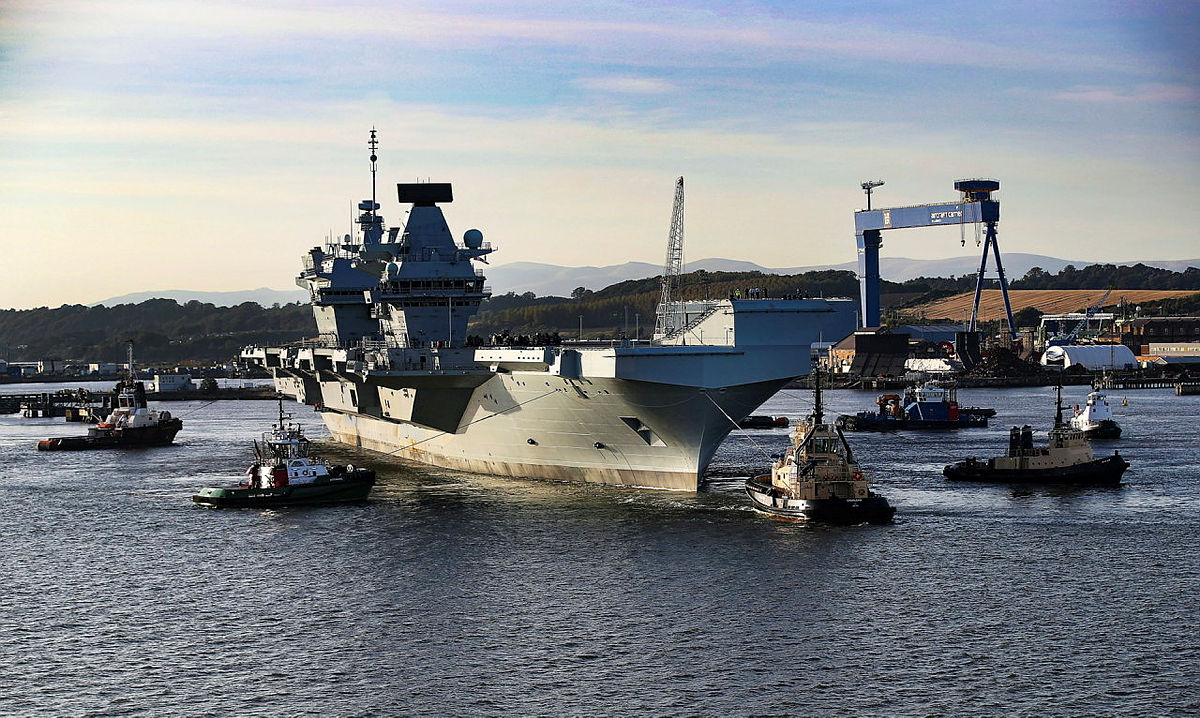
Temporary airspace restrictions have been introduced over the Firth of Forth ahead of the departure of HMS Queen Elizabeth from Rosyth.
A Restricted Area (Temporary) will be in force between 19 and 24 April 2026 in the vicinity of North Queensferry, covering operations linked to a Royal Navy aircraft carrier. The measures, introduced under Article 239 of the Air Navigation Order 2016, are intended to support national defence and security during the vessel’s movement.
Under the restrictions, unmanned aircraft are prohibited from flying below 1,400 feet above mean sea level within a defined area over the Firth of Forth between 0100 on 19 April and 2300 on 24 April. The regulations explicitly do not apply to manned aircraft.
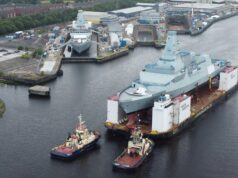
HMS Queen Elizabeth has been in Rosyth since entering a planned dry dock and maintenance period in August 2025. The work forms part of the carrier’s routine lifecycle and includes inspections, upgrades and certification activities that require the vessel to be out of the water.
HMS Queen Elizabeth
HMS Queen Elizabeth is the lead ship of the Royal Navy’s Queen Elizabeth-class aircraft carriers and one of the largest warships ever built for the UK. Ordered in 2008 and constructed at Rosyth, the vessel was commissioned in December 2017 and entered operational service in 2020. With a full load displacement of around 80,600 tonnes and a length of 284 metres, the carrier is designed to project air power globally and support a wide range of maritime operations.
The ship is built around an integrated electric propulsion system and can carry a tailored air wing centred on F-35B Lightning II aircraft alongside helicopters including Merlin, Wildcat and Apache. It is equipped with systems such as the S1850M long-range radar and Artisan 3D radar, and is defended by Phalanx close-in weapon systems and 30mm guns. The carrier can accommodate around 1,600 personnel and is designed to operate as the centrepiece of a UK Carrier Strike Group.



Is she armed with 30mm guns? if so how many?
Didn’t the government say that they won’t be fitting the 30mm to the carriers?
Yes they did, for some bizarre reasons know only to the tea lady at the MOD.
Following an investigation by the Telegraph, MOD has confirmed that Yes it was the Tea Lady who decided not to fit them as she prioritised a new Tea Urn. Her boss drinks lots of Tea so he briefed the Minister that all due diligence was carried out in the decision process but for reasons of National Security the reasons couldn’t be disclosed.
Well it’s as good a reason as we would need to increase the crew a bit !
I’ve gained $17,240 only within four weeks by comfortably working part-time from home. Immediately when I had lost my last business, I was very troubled and thankfully I’ve located this project now in this way I’m in a position to receive thousand USD directly from home. Each individual certainly can do this easy work & make more greenbacks online by visiting
following website—.,.,.,.,.—>>> JobatHome1.Com
Ha ha – well said. A totally bizarre decision and only explained by your incite – the decision was made by a tea lady in the MOD. QEC were designed for , wired for and from the start fitted FBNW. Given that the prevalent threat as being demonstrated pretty much every day in the Gulf is Shaheed type drones why on earth not fit the only in service system in naval service that has been demonstrably able to shoot such things down. We have plenty of guns available. You only have to take a trip to Portsmouth to see the number of newly decommissioned Type 23 moored up.on graveyard row. Each would have been fitted with 2 x MSI D30M – please don’t tell me we threw away the guns when we decommissioned the ship. Every in service RN frigate and destroyer is fitted with the Phalanx 30mm D30M combo and most of our RFA too. Why on earth are our two remaining capitol ships not ???? For chr*st sake just get on with it and fit the f*cking guns. 🏴👎🇬🇧
It may be the single most bizarre decision ever… because there can be no justification.. it’s a good system that is perfect against the most prevalent 21c risk ( surface and air drones) and as you say we have tons of them. It’s essentially pittance to protect an irreplaceable strategic asset.
Simply because of lack of budget. For the same reason, they’re the only carriers in the world without missiles (well the Italian Trieste is FFBNW at least).
It cannot be that, this a system we have lots of and they are designed for them to be placed…
Well you need to manage the ammo, people to remotelly operate them, maintain them. Hassles that they don’t want to deal with. These carriers are barebones
Every time I look at the carriers I see the places weapons should be, is it maybe we have no nuts and bolts 🤔🤔🤔
They’re concerned (apparently) with the 30 mms hitting her own(non existent) escorts.
That’s the official line on the 30 mm guns for the carriers
Typically moronic.
So it was reported, so why does say they already have them?. Who is right and who is wrong? And which report was wrong?.
Author simply read the wikipedia page too fast and didn’t see that the 30mm were not installed.
fuck off to a trainspotting site.
The government say we’ll be getting 11nsubmarines tp
And enough escorts to go with it and a government with the spine to use them or they’re just ornaments for sightseers around Pompey dockyard. I’ll always believe that we would have been better off with three smaller carriers properly fitted out with ACATOBATwhat they say BAR and point defence systems
georgecan you stop these scams getting onto the site please?
12 DS30M Mark 2 cannons, including 8 for the QEC, were ordered from MSI-DSL in 2015 and all had been delivered by 2019. The cannons for the QEC actually went straight into storage to save money on maintenance and operating costs. Presumably they have either now been sold as surplus, or absorbed into the pool of guns used to outfit the remaining T23’s, the River B2’s and soon the T26’s.
Shipped to Ukraine?
Some of the older ones certainly were.
Which is why I don’t think we have the numbers of them that many would assume.
If someone actually gave the basic self defence guns for the carriers to Ukraine that is criminal.
I suspect, but don’t know, that a lot of the older 30mm guns/mounts were given to UKR.
There was an MoD press release that some 30mm had been gifted.
Basically anything we had that wasn’t in use or bolted down was gifted.
Bear in mind there were loads of them from the Albions, T23s, bunch of decommissioned RFAs, as well as the old GoalKeeper systems.
it doesn’t appear that western kit has made much of a difference in the war.
we have numerous DS30M cannon in storage behind fountain lake taken from the withdrawn T23.
Ah the wise clever bean counters and other fools always win, A time will come when they will need those now not fitted guns by then it will be too late. No excort in world stops every thing, some thing always gets through. Even if by sheer weight of numbers or simple bad luck.
Should fit the sea ram system to the carriers just as useful as a phalanx on each corner
If they can not afford to fit 30mm guns we already have they defo will not buy a system we do not have
even if they should. the SEARAM is in use by navys all around the world and will be a standard fit to all american warships. compact system which would take such little room, makes perfect sense for the RN.
the navy are not to going buy a new weapon system, when it can not afford to fit 30mm guns we already have.
wise???????? are you on that columbian marching powder again? we keep reading of multi million pound contracts have been awarded to companies for upgrades to the carrier window wipers. the ones with the fallopian tubing. i liked the q e episode when a poor young sailor was sent to the WRNS mess to see if they had any fallopian tubes that weren’t being used.
you on medication?
don’t have they can be cross decked not buy them , weve already got them on the T23. monmouth an montrose ere stripped of weapons when they were inned in fareham creek, they’ll be in the dockyard with their harpoons and guns.
The government say we’ll be getting 11nsubmarines too
-4
Well, forget the 30mm and put a pair of 40mm on then?
iour dreams.
be good if it could.
Now that the plight of the navy is in the glare of publicity and money is now available. Wouldn’t it be worth it to say that both bulwark a d Albion would remain in service with theRN?
they will never be saved,
Should offer them in a swap with Egypt for one of their mistrsals.
Should have had Cats and Traps and Atomic warp drive and Sea Typhoons.
There, that about covers It.
(again).
You missed out Nuclear powered!
I upgraded It with “Atomic Warp Drive” 😁
i only learned the othe other day about charles de gaulle nuclear power wa supplied from a former suffren SSN. i’d like to know if a option such as this was ever considered.
Booo !!!!! the UK sucks 😂
When she returns to Pompey those stealth Frigates that George wrote about on April 1st will have to be moved up to F Fountain Lake Jetty or have they ?.
With cats and traps, the RN could operate a proper carrier air wing. In terms of range and maneuverability, the B variant is the least capable of the three. Plus, it’s landing weight is limited to its vertical thrust, which means it may have to dump fuel and weapons in order to land on the carrier. Operating the Hawkeye AEW would give you the naval eyes in the sky.
Correction: Operating the Hawkeye AEW aircraft would give you the best naval eyes in the sky.
Genius.
In all the years since these ships were first conceived, no-one has ever come up with this.
😁
You get what you pay for.
Exactly we cant afford it, any other news today?
we pay too much and get little to show for it.
You don’t know what a proper carrier air wing is judging by that summary.
A proper carrier air wing includes a proper AEW solution. Despite that condescending tone, even you cannot deny that fact.
There are other ways of doing ‘proper AEW’ than the E-2. Tiltrotors, multiple STOL drones, unmanned helicopters, maybe even airships. We don’t have a lot of money so better to spend the budget on the air wing, which we can change, than the carriers and get left with no planes.
Wind the clock back to 1990’s when QEC was designed and they were meant for Blair’s ‘moral’ wars – not fighting peer enemies.
They would never have got ordered with cats’n’traps.
And now we need then to fight in the North Atlantic for which the ramp is once again superior to catapults. I am however worried that STOL landings in heavy weather will be difficult especially with the low wing loading of the MQ9B (only a little more than a Fairey Swordfish and a much weaker structure).
“ MQ9B (only a little more than a Fairey Swordfish and a much weaker structure)”
Modern composites and alloys are orders of magnitude stronger than the wire and timber of previous generations.
If they are fighting in the high north essentially we could use land based strategic air..
Floating a wedge tail over a carrier would be profoundly more effective than any organic carrier based AEW.
One one the most effective ways to support the carrier would be land based strategic air especially as we don’t really sea it as a global asset.. I’m really because of our air bases anywhere we really need the carrier we could have strategic air..
Remember a wedge tail can stay on mission for 18 hours.
If we purchase a reasonable number of wedge tails you could have 24/ coverage within a few thousand kms of any UK airbase..
Unless you have bases all over the world where you can station and maintain them, you’ll need a large amount of Wedgetails (more than 5) to cover the full range of missions they’re required to do plus covering for the CSG. This is why why carrier-borne solutions are reuqired. They can maintain rotations between the theater and the carrier that wedgetail cannot do as they’ll need to refuel far away at some point.
From the point of view of the high north, Atlantic, Med and even Indian Ocean we do.. the big issue would be Pacific Ocean and more and more my view is that’s not going to be our game.
Without proper AEW, your shiny air wing won’t be able to deploy in contested zones.
Take Italy for example, they also have shiny new F-35Bs but their carriers can’t realistically deploy without NATO. Italy is worse off when it comes to AEW, they gave up on using the Merlin so they have no AEW solution. Their diesel submarines dont have the range or speed to leave Europe, therefore they rely on NATO escort. Having F-35s cannot make up for these flaws. Of course it works for Italy because their defence budget is 2x lower than the UK and they’re a coalition army. But the UK wants to be a great power, Falklands didn’t require direct military intervention from allies since the UK had what it took to deal with it alone.
That’s not the case anymore.
Alternatives AEW methods are all failures, it’s that simple. You can’t reinvent the wheel. Have you ever seen an Osprey with wings and bladed folded for storage or when the wings tilt during take-off? Where do you find the space for the antenna? Not to mention that an AEW conversion would be a billion dollar quest that the US won’t fund as they have no need for it. So unless the UK, Italy and Japan agreed to fund it ..
STOL drones that can take-off and land from the QE carriers (so light drones) don’t have the payload capacity or power generation required for advanced radars. Drones that can suitably replace an Hawkeye exist but they also need catapults as they weigh several tonnes and you’d also want traps and an angled deck for them to land. Drones are still vulnerable to jamming while an Hawkeye can still fly through a heavily jammed environment thanks to the radar operators onboard who will do the proper adjustments.
Unmanned helicopters would have the same problem that the Merlin ASaC has: too slow, can’t fly high or long enough, can’t power powerful enough radar arrays. This is why the Merlin ASaC uses an ancient mechanically scanned radar that isn’t much different from the 70s Searchwater radar of the Sea King, they don’t require as much power as electronically scanned radars (PESA or AESA) and are less cooling intensive which is why they can fit inside and inflatable balloon. But mechanically scanned radars won’t detect supersonic/hypersonic/stealthy threats or sea-skimming missiles well enough in the 2030s. They can’t track as many targets and as fast as electronically scanned radars so drone swarms may be challenging.
This is why CATOBAR carriers are considered the only true form of carriers. STOVL carriers are glorified helicopter carriers for as long as they don’t have a proper AEW solution and their air wing suffers from payload and range penalties from the lack of catapults.
“ Unmanned helicopters would have the same problem that the Merlin ASaC has: too slow, can’t fly high or long enough,”
The altitude limit of Merlin rests with non pressurisation.
“can’t power powerful enough radar arrays.”
Merlin has three turbines.
“This is why the Merlin ASaC uses an ancient mechanically scanned radar that isn’t much different from the 70s Searchwater radar of the Sea King,”
That isn’t really correct. There were lots of developments of SearchWater including for NIMROD AEW. Whilst it does mechanically move the radar around it is a great deal more sophisticated in its present iteration.
“they don’t require as much power as electronically scanned radars (PESA or AESA) and are less cooling intensive which is why they can fit inside and inflatable balloon.”
E3 uses a rotating radar
On a turbo prop.
“But mechanically scanned radars won’t detect supersonic/hypersonic/stealthy threats or sea-skimming missiles well enough in the 2030s. They can’t track as many targets and as fast as electronically scanned radars so drone swarms may be challenging.”
That simply isn’t true as it depends on the receiver and software.
“The altitude limit of Merlin rests with non pressurisation.”
Wrong, even if you pressurize it, an helicopters simply won’t fly as high as a turboprop/turbofan plane. That’s just how physics work. Air gets thinner with altitude making it harder to generate lift, using more power to fly high will reduce your range even further while making you very vulnerable. Planes like Hawkeyes are designed to cruise at high altitude while helicopters can generate more lift at low/medium altitude. Therefore there’s a fundamental difference in how they operate that makes helicopters inadequate for the job, they’re not gonna realistically fly at 9000 meters for hours anytime soon.
“Merlin has three turbines.”
Doesn’t matter, it still comes out at less than the Hawkeye. You’re not gonna have enough power for a modern and decently sized AESA radar plus the various other instruments AND their cooling system while trying to fly as high as possible for as long as possible.
“That isn’t really correct. There were lots of developments of SearchWater including for NIMROD AEW. Whilst it does mechanically move the radar around it is a great deal more sophisticated in its present iteration.”
Still inferior to modern PESA/AESA radars. There’s no sugarcoating it. And the potency of a radar is relative to its size, the one inside Crowsnest isn’t that big.
It was modernized but is still based on the old Sea King radar. It was a quick and cheap solution presented by Thales. The MoD could not refuse.
“E3 uses a rotating radar
On a turbo prop”
And?
“That simply isn’t true as it depends on the receiver and software.
It is true, you just don’t want to accept it.
Yes Italy have no ASaC. They also have no large carriers so that sort of makes sense, they have one USMC style F35 LHD and one Invincible style small carrier.
The serious AEW osprey proposal (it competed against Crowsnest) would have had a rotating AESA radar slung beneath the fuselage. There was also a proposal for a pylon-mounted radar but as you say the wings and rotors would not have been able to fold. That’s more of a problem for the USMC as the QEs have very large hangars but it is a problem for providing 24/7 coverage.
For STOL, of course I am referring to the MQ9B STOL AEW design. Yes it can’t replace Hawkeye one to one but is vastly cheaper to operate per flight hour and is also more compact when folded. So while the French, with what you would consider a true carrier, only carry two E2Ds and try to maintain continuous coverage with them (doubt), the QEs could carry 4-6 AEW drones and have three in continuous operation to try to match the coverage- and it would still be cheaper.
Yes, helicopters can only ever be a stopgap. The new Proteus drone will probably have the capacity to carry an early warning module and a lot of endurance but would probably end up only being used from escorts, not the carriers.
Airships of course would trump even the E-2D, I have it from HAV that Airlander could theoretically carry the E-7 radar setup, but will be a bit further away.
The size of the carrier doesn’t matter when it comes to AEW. The aircraft capacity and maybe sortie rate are the only difference between their carriers and the QE class, QE class can’t do something that the Italian carriers can’t do. At the end of the day, both navies deploy in the Atlantic, Indo-pacific and Middle East therefore they both need AEW.
The Osprey with pods would be the only viable solution but again, cost is the issue. The cost to operate a bare Osprey is already much higher than a helicopter, helicopters that both nations already can’t acquire in sufficient numbers, and their conversion to AEW duty would require a fortune.
If we’re getting into hypotheticals, then there’s room for 3 Hawkeyes on the French carrier, they’d need to acquire one more to have a spare one so that point is moot. Maintaining 24/7 coverage is useless if that coverage is of poor quality and carriers don’t launch operations 24/7 anyway.
Helicopters were a stopgap after the Falklands and they should’ve never been carried over to the QEC.
Aircraft capacity is important for AEW, however. Because F35 is so much bigger than Harrier the Italians will struggle to get more than 8 jets and 6 helicopters onto Cavour, and similar for Trieste because it’s an LHD. For continuous AEW coverage that really cuts into the ASW capacity. The difference in ambition is who we might be facing up against; we are much more likely to get in a shooting war with Russia, who would be firing hypersonic missiles at the carriers. To warn against those we really, really need something better than Crowsnest and the Italians don’t, as much.
I think you misunderstand the purpose of carrier AEW. It isn’t to support your own operations like AWACS on land, though that’s partly how the USN do it, but to spot sea skimming missiles, ships and low flying aircraft behind the horizon from your own AAW escorts. Hence 24/7 coverage is essential, the enemy aren’t just going to play nice within the alloted working hours.
ASW is the duty of the of the ASW frigates that coompany the carrier. The Italians don’t use their carriers primarily for that duty anymore since they now have a sizeable fleet of FREMMs with NH90s. Cavour and Trieste can both carry at least 16-18 F-35 and 4 helicopters. Trieste was designed to operate the F-35.
Italians are in the same bag as the UK, both will be facing the same threats.
CATOBAR carriers are power projection carriers so yes projecting your radar coverage as close to the land as possible is important for them, the french do it too.
Crowsnest will be inadequate for any mission that isn’t just bombing Syria or Afghanistan if you can’t rely on your allies’ eyes.
ASW Helicopters. It’s much more cost efficient to host all but a couple of the tasks group’s helicopters on the carrier, with Merlin the frigates don’t do the final localising and destruction of the sub so carrying lots of ASW helicopters is important. That’s just as much the case for self defence as in the 1970s RN sense.
When I talk about fitting jets onto the carrier it’s all about what’s efficient to operate. Yes you can stuff jets on until the hangar’s full like we did in the Falklands but that causes lots of problems with hangar Tetris and airframes getting in each others’ way, not to mention being very crew intensive. So I suspect the limits are closer to what I said just as our carriers will usually have 24 F35 and 10 Merlin rather than their design limit of 60 aircraft.
The UK is much closer to Russia than Italy and much more likely to be dragged into a war with China. Deny it if you like but the threat levels are different.
Carriers are fundamentally fleet weapons and the sort of situation where AEW is at its limit will be a naval war, not standing off a coastline. For that the AEW will remain near, but not directly over, the CBG.
the invincibles before the sea dart systems were removed, were a far better design for what the navy really did need. smaller nimble vessels with good ASW capability via her choppers.very economical and a high availability rate. shame they weren’t a tad bigger for a bigger air wing
And if the “proper” AEW solution isn’t organic? If the RAF provides AEW just as it provides tanking, does that suddenly make QE a proper carrier? What if the RN has an auxiliary carrier whose only function is to keep fixed-wing drone AEWs in the air? Does that somehow change the carrier itself? What if the F-35Bs had drop tanks?
The carriers themselves are fine provided we understand and mitigate the limitations, by spending money. It’s the overall carrier group capability that we need to invest in. Where any particular element is found is less important.
“what if, what if, what if…”
CATOBAR carriers don’t have to rely on the air force for tanking, they have on-board refueling solution either through buddy refueling or the planned refueling drones for the US Navy (the french navy seems interested as well).
Part of this was timing as no one would build new carriers with steam catapults when there was the promise of emals, BUT emals is just coming into reliability after a long time and it costs ££ who can really afford cats n traps carriers even though it is the top option. It’s an exclusive club. Pleased for real navies with real carriers, but uk carriers are arguably good enough so long as toilets work.
Toilets work but the propulsion system is another matter…
subject is unlikely to go away.
a correctly configured wing, and what made it wasn’t given enough due thought i saw a rendering of a QE carrier without a ski ramp and it looked well, like a proper aircraft carrier take the ugly ramps off get EMALS and th f 35c
I don’t take Roberts comment as being condescending.
He has served on 3 Aircraft Carriers in his career! Therfore, his opinion on all things carrier has weight.
“Proper carrier air wing” 😂
🤣
Lasers and a pub
better then no carriers , even with compromises . we just need the aircraft to fill them up , or it is a waist .
Or may I respectfully venture….a waste.
I think I read somewhere recently that we have 47.
How many do you want?
Well 150 was the original plan. That got downgraded to 138 and now we only have 47 after losing one overboard. Like the number of combat ready surface ships available it’s all become a joke. My grandfather who fought and died whilst serving on board the Roysl Navy in WW2 would be disgusted by what they have done to our once proud and mighty navy.
respect to him and all who served with him.
If you want to consistently field 24 fast jets on the carrier at short notice, you’d need 72, according to the rule or 3. With 47, you can just about manage 16.
Yep 72 is the minimum in 3 front line squadrons and the OCU.
Which is why the ALPHA order makes absolutely no sense whatsoever.
No military sense, perhaps. It makes excellent political sense for both the government and the RAF.
Unless you are a penny pinching bureaucrat at Number 11 Downing Street.
No this was the RAF.. they have been after the A for ages… as they see it it’s a leg in to proper A front line squadrons.
the red haired girl in accounts do you mean? fat chance of that.
No sense at all this was proper RAF and RN interservice fuckery.
More than annoying as we are all saying a 72 F35B buy is the credible capability.
After that buy a load of A’s for RAF.
Are we not contractually committed to 72b less whatever for political folly F35A’s
No, if we wanted 24 front-line aircraft, we would need a total of 50.
If we wanted 36, we would need a total of 72.
Combat air doesn’t work on the one-third system ships do, it has a completely different maths equation
Whatever the RN wants or thinks it deserves, it is going to get 62 F-35Bs.
However they want to present their ORBAT, they will get 30 frontline jets to provide 3 squadrons.of 10. The remainder will go into squadron maintenance, the OEU, the OCU etc.
42 Jim, that is the correct answer.
Only time before our QECs go Galatic!
the red haired girl in accounts do you mean? fat chance of that.
How many Harriers were went to the Falklands?
Sea Harriers?
The point was the two carriers were rammed with Harriers and Sea Kings.
One of the reasons for having big cab facilities on everything else and multi spots on RFA’s and Albions was to disperse the cab operations.
About 36, each carrier taking about 18 if memory serves. Mainly FRS1 Sea Harriers but I think there were a small number of GR3’s on board as well.
170 pls
If it is true that only a third of the F-35B fleet is mission capable due to maintenance issues (per the national audit office), then those 47 aren’t enough for 24 jets on the carrier, especially since some are used by the RAF.
You’d need at least 60 and good maintenance to ensure that 24 are available at all times. For the wartime complement of 36 and the surge complement of 48, you’d need 80-100.
The french manage to get 24 jets on their carrier with only a fleet of 41 Rafale M but that’s because their carrier is not always at sea (neither is PoW) and their maintenance schedule is great as recently demonstrated.
But the UK got 2 carriers for the sole purpose of always having one at sea (in reality the maximum availability you can get with 2 carriers is 90% of the time), so the investment in the second carrier is wasted if you don’t procure enough jets.
🤦🏻♂️
And enough escorts to go with it and a government with the spine to use them or they’re just ornaments for sightseers around Pompey dockyard. I’ll always believe that we would have been better off with three smaller carriers properly fitted out with ACATOBAR and point defence systems
It’s an argument, but I would have liked something such as the America range – and prescient would that have been now we have lost the Albions / Argus / Ocean…
Not the America per se, but that concept that could carry F35Bs but which had greater utility.
the ginger girl in account wouldn’t stump up the cash but a build under licence would be great.
The carriers seem to generate the most opposing views and when we had 3 carriers would this have been true, obviously no internet then. Wondering whether we would venture further afield into an active war zone without long range land based AEW presently. Agree on board AEW is best.
I think the problem is the frustration from watching the wind-down of so many other capabilities in the RN. When you ‘appear’ to be the thing eating the money, you take the most shots. I say ‘appear’ in this case because it has been repeatedly reported that Trident takes the lion’s share of UK defense money, but there are far fewer people crying about that.
I’m annoyed to see that nations like Norway have received their full order yet we’ve not. Oolitics yet we haven’t.
I am more inclined to think that drone technology, accelerating as it is, that cats and traps and will soon be archaic. We invented the angled deck… and we invented the ski slope. And now we’ve invented the cat-and-trapless carrier. Let’s fight today’s and tomorrow’s wars, (if we have to fight at all) not past ones. So many posts on here on various subjects show many folk who are firmly welded to the mid-20th Century.
Mid 19th Century in some cases…
🤣
😂😂😂
Hardly. If your ‘drone tech’ actually wants to be worthwhile instead of marginal, it will also need either Cats and Traps or STOVL. A fast jet drone capable of carrying the same payload as an F-35 is not going to be able to return aboard the ship safely without traps or STOVL. The drones that you see doing it are not survivable in a contested environment. USAF lost eight Reapers over Iran, and even the Houthis were able to consistently shoot them down. And before you say ‘cheap’, at a certain point your ‘cheap drone’ becomes very expensive if you lose enough of them.
(a) Nobidy claimed they’d carry the same payload as an F35, and clearly won’t if you count the pilot as part of it.
(b) Doh, same laws of physics apply to UUV as manned ones, so either STOVL/SRVL or some kind of launch/capture device.
(c) They lost a dozen Reapers, which is better losing a dozen F15s doing the same job. Drones are expendable, pilots not so.
(d) They lost their cheaper drones. They only lost one Triton and none of their stealthy MQ-180 drones.
(e) “And before you say ‘cheap’, at a certain point your ‘cheap bullet’ becomes very expensive if you fire enough of them.” 🤣
a) A drone carrying less payload than an F35 is not going to be of very much use. Might as well fire cruise missiles.
b) I wasn’t the guy saying that these things won’t need cats and traps. Doh.
c) But they wouldn’t have lost a dozen F15s. That’s the point.
d) At some point, a cheap drone is no longer cheap if you lose enough of them.
e) Not sure what your point is. It’s very true that 15 Reapers at $8mill per is no longer ‘cheap’. 🤣🤣🤣🤣🤣🤣🤣
(a) That’s just a stupid comment not supported by any facts. The F35B can carry 6,800kg. By your logic we should scrap the Apaches as they can only carry 1,800kg.
(b) You did say it’s need cats/traps or STOVL. Yeah, and the sun will rise in the east tomorrow morning 🤷🏻♂️
(c) They would have potentially lost up to a dozen F15s had they not used Reapers. Add to that, to recover the crew of just one F15 they lost a further: 4x Little Birds, 2x C130J Hercules, 1x A10 Thunderbolt, and 1x HH-60W Jolly Green II.
(d) At some point everything, no matter how cheap, becomes cheap if they lose enough if them. That’s a facile argument.
(d) Reaper $8m, F15E $90m, MC-130J $100m… even the most innumerate can see it’s cheap by comparison.
The Reaper first flew around 2001. That’a over a quarter of a century ago. Technology has shifted a long way. We have to stopping cpunting apples and pears and calling them the same thing. Will all the new stuff work… well that’s all to play for and not guaratnteed.
Physics hasn’t changed. The Reaper works well for STOVL because it has long, straight wings. It can’t fly very fast. No ‘new tech’ is going to change that. You need swept wings to fly fast, but they don’t work well for short landings. Again, there is no ‘new-tech’ to solve that. There’s a reason the Chinese put arrestor gear and catapult on the Type 076.
Blinkered thinking.
The Shield AI X-BAT is a swept-wing, jet powered, tail-sitter.
shield.ai/x-bat/
Which is small and doesn’t carry much. In spite of the baloney put out by the developer, it is not carrying the same payload as an F-35. Nor will it carry much when taking off vertically. Physics doesn’t go away by us wanting it to. For the same size and form factor, a plane using aerodynamic lift is going to carry more, fly farther, and go faster than something trying to take off and land vertically.
Wanting something to be true because it would be ‘new’ and ‘innovative’ is, in fact, blinkered thinking.
Just calling things “baloney” when you can’t disprove through facts what others arguments… I can see that working in peer-reviewed papers or legal arguments 🤣
CATOBAR is the most flexible design actually. You can launch anything with CATOBAR be it turbofan jets, turboprop planes, light drones or heavy drones. Therefore CATOBAR is actually future proof!
Any American CATOBAR carrier can tomorrow become a drone carrier and carry hundreds of drones instead of fighter jets without much modification.
STOVL carriers cannot do that as drones cannot generate enough lift on their own to take off, well only the light turboprop ones and you’ll still want an angled deck. STOVL design is very rigid.
And STOVL/VTOL drones are going to be less effective znd more expensive than CTOL drones. The same that we’re seeing today with the F-35B vs F-35C, Super Hornet or Rafale.
Except CATOBAR can only launch in lower sea states than STOVL.
And your catapult is a single point of failure. If it goes down, you’re without any CAP.
Large CATOBAR carriers can launch and recovery up to sea state 6. It’s not like sea states can’t be anticipated, they have onboard weather stations.
US CATOBAR carrier have 4 catapults separated in 2 isolated systems. The chances of all 4 catapults being down at the same time are extremely slim.
You’re thinking about the whatnot instead of considering the fact that the pros of CATOBAR far outweigh the cons and that the pros of STOVL don’t hold a candle to the pros of CATOBAR. You only go STOVL if you can’t afford CATOBAR, not because you may or may not launch in higher sea states. Sacrificing AEW for that doesn’t make sense.
“Large” – you mean Nimitz/Ford class carriers.
Yes 4 catapults, all requiring the electrical system to be able to charge their disk alternators. What happens when the electrical system can’t supply that? Zero launches.
That’s ridiculous. If your power system is failing like that then your carrier is about to sink very soon. STOVL or CATOBAR doesn’t matter at this point. The power systems themselves have multiple redundancies. You think a $10B platform isn’t designed for maximum redundancy?
You’re looking for the most extreme 0.1% chance of happening scenarios to justify STOVL over CATOBAR?
What if the thermal coating on STOVL carriers is damaged? No landings. If a single F-35 crashes during SRVL, both the deck and possibly the islands could be damaged as there’s no angled deck or emergency barricade like on CATOBAR carriers. Those are far-fetched situtations like yours.
So you’re writing off a carrrier as ‘sunk’ if the electrical system temporarily goes down? 🤣😂😂🤣
Well your $10bn carriers new toilet system doesn’t appear to have any redundancy and needs a $0.5m acid-flush on a regular basis to remain remotely functional.
Nor the laundry system judging by recent experience 😂
If the thermal coating is damaged they can still land and take-off. As demonstrated by F35Bs using Nimitz carriers without any thermal coating.
If a plane crashes on a Nimitz/Ford then you won’t have time to erect the barricade. It’s only of use if you know the aircraft attempting to land has issues already and has been deployed in advance.
Hmm… which is going to cause the most damage when crashing? An aircraft landing with a forward speed of:
(a) 0 speed – F35B vertical landing,
(b) 60 knots – F35B SRVL, or (c) 160knots – F35C
Damage is damage. The first part of your comment made me lose all interest in engaging with you. Grow up.
STOVL carriers are only considered by navies that can’t afford CATOBAR carriers, that’s a fact. Now if that hurts your ego, that’s not my problem.
So you would abandon as “sunk” a warship that losses electrical power. I assume you’ve not heard of damage-control and the ability to fix things while still at sea.
Keep-up with your intelligence-free chanting that “STOVL is for those who can’t afford CATOBAR”.
Here’s a few more you: “4 legs good, 2 legs bad”, “make America great again”.
(Assuming you’re able to keep more than one in your head at any moment.)
You’re ridiculous, I’m not american and good luck doing any form of damage control on the QEC as they operate with a skeleton crew, under the guise of “automation” (or cost savings).
Don’t reply further please. I only interact with adult people.
Wow you really are unhinged from reality.
1,600 for the QE Class is not a ‘skeleton’ crew.
I didn’t say you were American nor did I say you were a pig – the Animal Farm reference obviously flew straight over your head. I was just supplying you with more mindless chants for you to recite. Because accuracy and truth are never requirements for these things.
Good to see.
There is nothing wrong with our carriers themselves, it is the lack of weapon types on their primary weapon and limited capability of rotary ASCS.
Hopefully both areas will improve soon.
Yes and lack of carrier-borne tanking.
If the carriers are in the High north they can easily be covered by land based MRTTs from Iceland, UK, and Norway.. mabye even the Faroes, A better solution all round?
Well, yes, a solution of sorts, assuming you have an MRTT allocated. In ‘surge’ conditions our ‘surge inventory’ of 5 extra A330 units, pulled back from civilian use, and equipped with hose and drogue could do it. We could go on thinking about different scenarios but my original point was ensuring a self-sufficient air-wing, with it’s own ability to fuel jets after launch. An allocated MRTT is probably more of a viable option assuming your airfield is not denied, than allocating an E-7 to carrier support. 3 E-7s means Hobson’s Choice for someone.
Any war we’re involved in the High North will be a Nato war, so I’d be looking at all of Nato’s IFR assets. I agree entirely about the lack of AEW and let’s hope for more E7s. Talking of which…. It is interesting ( to me anyway!) that the US airforce’s initial E7s are being in built in Birmingham by STS… not something that has generated much comment on here. But then that’s good news and the trolls don’t like that sort of thing!!
As far as an airwing goes it seems that drone refuelling a/c are well under development. Again, do they need to be ship launched in the High North?… further south is a very different matter, of course. Perhaps when Mandelmania has subsided we’ll finally get the DIP. I’m not holding my breath, even so
And who is responsible for the hopelessly slow integration of UK weapons on to what is the F35 Boondoggle?
LM / US Govt. And perhaps our negotiators who should have taken a leave out of the Israeli book and asked for the source code.
The UK is the fault of this. They won’t pay for anything… The Americans and the Israelis have figured it out. Check the scoreboard
🤣
But the MoD and fanboys keep telling that the UK has access to the source code and can integrate weapons independently?
Well the MoD doesn’t exactly say that but they said the UK had a sovereign access to the jet.
Nothing wrong with the carrier, all ships have problems and get round them. Biggest problem is lack of F35’s and hawheye type plane that carrier could carry. RN doesn’t have enough support ships including for fuel,food and munitions plus a destroyers that can sail for more than 3 weeks
I’ve gained $17,240 only within four weeks by comfortably working part-time from home. Immediately when I had lost my last business, I was very troubled and thankfully I’ve located this project now in this way I’m in a position to receive thousand USD directly from home. Each individual certainly can do this easy work & make more greenbacks online by visiting
following website—.,.,.,.,.—>>> JobatHome1.Com
So 9 months in Rosyth. Go back a decade, and the Carrier Alliance was still claiming that the carriers would only need a short docking period for hull survey, maintenance and recertification every 6(!!!) years. The RN and MOD was a bit sceptical and even got RAND to do a report which apparently came up with some scary numbers, but ultimately the MOD wanted to believe the Alliance as it just didn’t have the budget for traditional lengthy docking periods every few years.
So that means POW will be in Rosyth in a month or two then lol let’s face it we cannot have 2 carriers in service and available at the same time , simply put its a joke we cannot send both carriers out as we don’t have enough surface fleet vessels to protect them also not enough aircraft and probably not enough sailors to crew both .
The whole point of building 2 carriers was to rotate them so that one is always available. The intention wasn’t to generally have both available at the same time.
However, seeing as PoW is shortly going to the High North, they will both be available at the same time for a while. HMS PoW isn’t due any long maintenance until next year.
🤥
The navy has been found seriously lacking in recent months, a period it could have shined. However optics aside, the RN really is very strong. Once the new frigates are in service and the support ships it will again be the second strongest in NATO. Just a perfect storm right now of poor political decision has resulted in a terrible transition from old to new.
The UK is the fault of this. They won’t pay for anything… The Americans and the Israelis have figured it out. Check the scoreboard
What? Americans and Israel have made everyone’s life worse with no positive. Score card is the US mid term which is overwhelming as against their actions
So thousands of Iranian missiles and military industry heavily damaged is no positive? in which side are you on?
Just motivated them to make more to defend themselves. Not a positive
The Israel PM has wanted a war with Iran since the 80s and he cornered the US into joining. Rather than thought out strategy on how to do it, we have this mess. With Iran still sending missiles and drones daily, it has not worked I don’t see any positives in this war. Combined with making Iran a bigger threat and even more aligned with Russia and China, we now have the end of NATO. Anyone thinking this war is a positive is a russian troll
🤡
It’s going to take years for this to happen. By the time we get anything like a credible number of ships to sea the technology world will have moved on and drone / unmanned technology combined with satellite imagery will have the upper hand. Large ships in open water will be sitting ducks and very difficult to defend.
True but equally carriers operate miles from the coast and so would require more expensive drones to reach them, reducing the saturation risk. The marlet equipped wildcat is looking ideal for that scenario, just need to upgrade them to have networked radar capability and realistically as with the Falklands the RN still lacks 24/7 air based radar. Crosnest is ok but it can’t be sustained tor any period of time
Is that carrier going to fight in the Middle East?… Oh wait!.. somebody else already did it. Britannia rules the waves.. my God what an embarrassment
NO has carriers in the straights its too confined, too exposed. some policing in the Indian ocean by america. bibi and trump only could plan day 1 not anticipate day 2
Do you know rules America? Israel. That’s the country you spend billions on and for what?? It shouldn’t come as a surprise to you that thick and dumb Americans get played by foreign governments. No UK or European leader was stupid enough to believe that WMD or regime change shit again.
Let’s see the scorecard…… Iranian regime still in place, Iran has greater leverage than it did over Hormuz, still has nuclear materials, American bases in the middle east destroyed and American ‘protection ‘ shown to be a mirage, oil prices catastrophically high, world economic growth damaged, allies turning away from the US, American consumer prices rising and jobless increasing, American strategic interests completely destroyed. China increasing its influence worldwide. Religious fanatics running the Pentagon.
Please point out ‘the win .’ Without using crayons.
Ouch. Poor Ray – sometimes the truth hurts to hear.
No we’re because we’re not so stupid as to start an illegal war that we cannot win, unlike Donald ‘Jesus’ Trump 🤣
The M.O..D … Which has always, especially since being semi-privatised, stood for … ‘Moronic Organised Disaster.
Always able to take a Small, under-funded Pot – and Squander It. The ‘Ajax APC’ being only the latest £Million Pound folly; the only Army Vehicle Capable of Disabling More Army Personnel Than The Enemy.
Here’s an idea … We Sack The Top Two Levels of Mis-Management, and replace with Ukrainians; give One a £pound of funding and he’ll return £2.50 of Value – A MUCH BIGGER BANG FOR OUR BUCKS.