

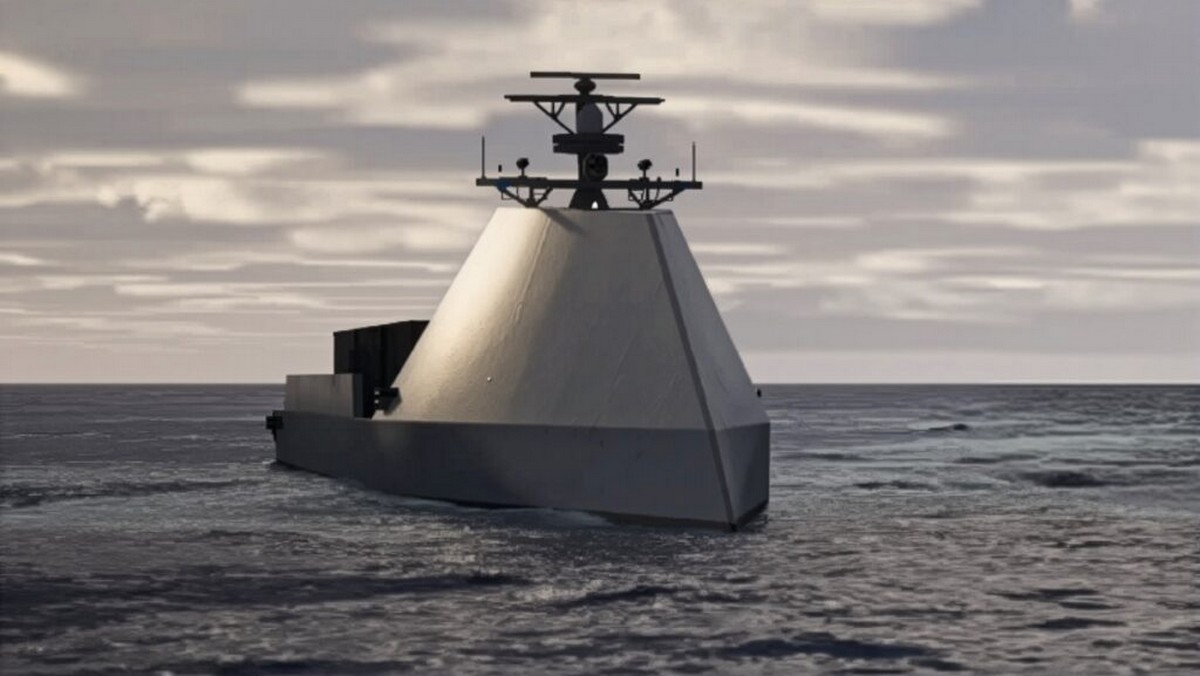
Huntington Ingalls Industries has outlined a significant shift in how it sees its role in supporting the U.S. Navy, positioning itself as a broader integrator of crewed warships, autonomous systems and digital warfare capabilities, in addition to being a conventional shipbuilder.
During a media briefing ahead of the Sea-Air-Space 2026 exposition, senior executives described a transition aligned with the Navy’s evolving “hedge strategy”, which centres on distributing combat power across a mix of platforms rather than concentrating it in a smaller number of high-value assets.
At the core of HII’s approach is a three-part structure: traditional crewed vessels, autonomous systems, and what the company describes as mission-enabling technologies. These include command-and-control systems, electronic warfare capabilities, cyber tools and sensor integration frameworks intended to connect platforms across domains.
Eric Chewning, Executive Vice President for Strategy, said the company is seeking to move beyond its historical identity. “We are known as our nation’s largest shipbuilder, but we are also a world leader in unmanned naval systems, and we want to make sure you understand that part of our story too.”
That repositioning comes as the U.S. Navy places increasing emphasis on speed of capability delivery and the ability to scale force structure rapidly. HII said it is attempting to respond by increasing output from its shipyards, with throughput rising by 14% in 2025 and a further increase targeted this year through investment in infrastructure, workforce expansion and supply chain distribution.
Alongside this, the company is placing weight on unmanned systems as a means of extending operational reach. Its REMUS family of unmanned underwater vehicles and developing unmanned surface vessels are intended to operate alongside crewed ships, forming what executives described as tailored force packages.
Duane Fotheringham, President of unmanned systems, said: “We’ve delivered over 750 REMUS vehicles… 90% of those vehicles that we have delivered over the past 25 years are still in operation today.”
A central element of the concept is the use of open architecture systems to link sensors, platforms and weapons. John Bell, Chief Technology Officer, said: “Our mission is to deliver the technology that enables this strategy built on openness, modularity, intelligent autonomy and seamless integration across manned and unmanned systems.”
Systems such as the Minotaur command-and-control platform and the Odyssey autonomy framework are intended to provide a shared operational picture and allow multiple unmanned systems to be controlled and coordinated simultaneously.
The company also highlighted the development of containerised payloads, including missile launch systems and directed energy capabilities, which can be deployed across different vessels. This approach is intended to allow forces to be reconfigured more quickly, without requiring major platform modifications.
Chris Bishop, Chief Growth Officer for mission technologies, said: “Mission-enabling technologies are no longer supporting actors in the war fight. They are strategic differentiators.”


A move at getting some of the contracts BAE gets maybe? 👀
I’ve gained $17,240 only within four weeks by comfortably working part-time from home. Immediately when I had lost my last business, I was very troubled and thankfully I’ve located this project now in this way I’m in a position to receive thousand USD directly from home. Each individual certainly can do this easy work & make more greenbacks online by visiting
following website——>>> http://www.giftpay7.vip