

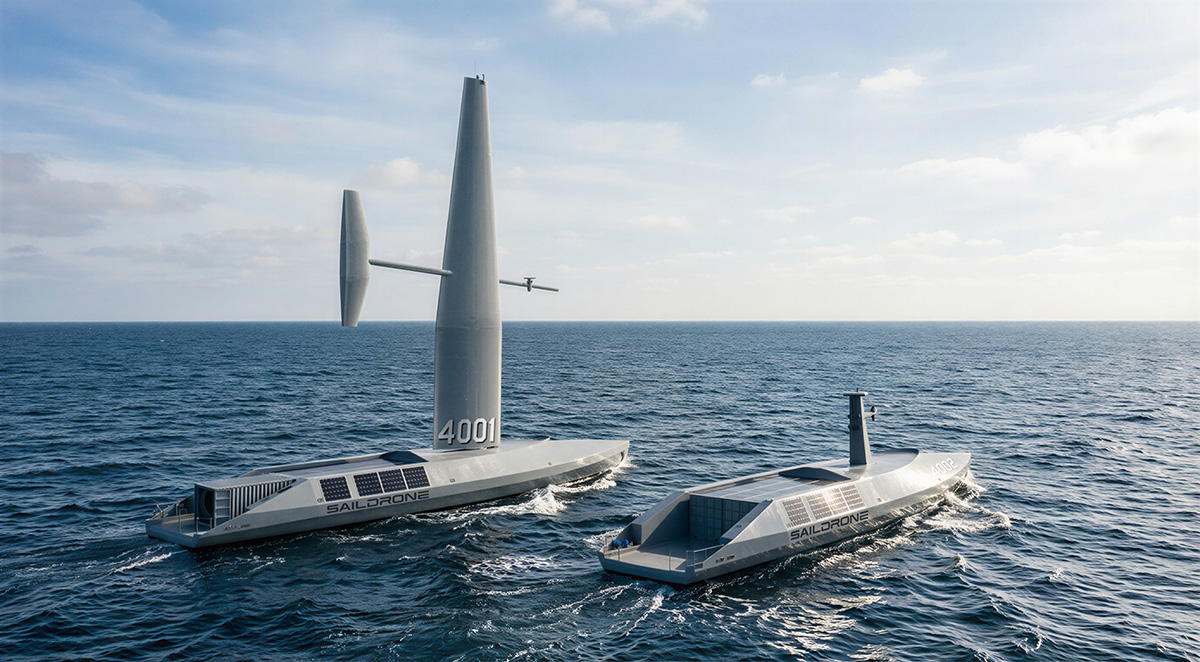
Saildrone has revealed a new high-speed unmanned surface vessel (USV) design intended for naval operations, including anti-submarine warfare, intelligence gathering and strike missions, the company stated.
The new platform, named Spectre, represents a larger and more capable evolution of the company’s existing USV family, following two years of development drawing on more than a decade of operational experience.
At 52 metres in length and displacing around 250 tonnes, Spectre is significantly larger than previous Saildrone platforms and is designed to operate at speeds of up to 30 knots. The vessel is configured for multiple mission types, with two variants planned: a “Silent Endurance” version using wind-assisted propulsion for extended, low-signature operations, and a “Stealth Strike” variant designed for higher-speed and kinetic roles.
According to the company, the platform combines wind, solar and diesel propulsion, with twin shaftlines enabling near-silent electric propulsion at lower speeds. Higher-speed operations are supported by diesel engines producing up to 5,000 horsepower. The vessel is also designed to carry a range of payloads, including containerised systems, sonar arrays and missile launchers.
Richard Jenkins, Saildrone’s founder and CEO, said: “Spectre is the result of 25 years of continually pushing the boundaries of what’s possible. A unique design evolved through the hard lessons of operational experience in the real world.”
He added: “Spectre is not a craft hurriedly readied to meet a particular RFP, but diligently evolved over multiple years to meet the operational requirements of our customers and fill critical capability gaps in the ASW domain.”
The design has been tested using scale models in tow tank trials in Denmark, with the company stating that performance characteristics have been validated under a range of sea conditions. The vessel has also received Approval in Principle from the American Bureau of Shipping under high-speed naval craft standards.
Saildrone is working with Lockheed Martin to ensure compatibility with a range of payload systems. Paul Lemmo, Vice President at Lockheed Martin, said: “Spectre represents a transformative step forward for naval surface warfare.”
He added: “Its endurance, payload flexibility, and seamless integration with advanced missile and sonar systems will give the US Navy a persistent, low observable USV that can deliver on a spectrum of maritime missions.”
Construction of the platform is expected to take place in Wisconsin through Fincantieri Marine Group, with capacity to build up to five vessels per year. The first unit is expected to begin sea trials in early 2027.


Wow that’s big. The largest single-masted sailing vessel ever built is 80m long and it’s as long (but not as tall) as the Bayesian yacht that capsized off Sicily a couple of years ago. Also significantly larger than the J class racing sloops. With no way of furling the sail that’s monstrously big and will be extremely imposing.
I like the sound of sailing ASW, though I doubt it will like North Atlantic storms.
Probably more expensive than both of those (If It ever leaves the “Drawing Board”).
The Bayesian had her keel raised. This will also have smaller fewer and more watertight hatches. The big issue with the Bayesian was her mast was too tall giving an AVS of 72 degrees without the keel down and a DFA of 42 degrees, again without the keel down. Neither of which apply to this drone. I think the sail is a bit of gimmick because tacking would kink a towed array reducing the effectiveness as an ASW platform.
Plenty of cargo ships are now using ‘sail’ assisted propulsion with aero foils of this nature which obviously are more flexible in use and ai assisted for effluence and safety. I was literally looking at this subject yesterday (at that scale at least) but unfortunately can’t find the link in my history. I hadn’t realised it had become so prevalent tbh.
AI can’t magically making sailing into the wind possible. You have to tack if you want to follow a course, that puts bends into a tail which defeats the purpose.
I wasn’t implying that this would capsize, just referring to a large single-masted vessel that was in the news relatively recently. The force in really heavy weather even on a fully feathered mast would be huge though, it will be interesting to see how they manage that.
Surely it depends on how big a towed array they can fit? If the detection range is long enough then to monitor a single submarine the blind time during tacking will be a small enough fraction of the total not to matter because they can travel in one direction for longer, no? The sail is the auxiliary propulsion for long distance transits anyway so it isn’t supposed to be the main thing tactically.
When you tack is decided by the wind direction. If you are trying to do a Target Motion Analysis you need to steer courses to localise the target(s). If you have a sail that interferes with the task, you can do the same job better without sail assist.
Back in the day, sponsors would provide trophies for competitions designed to promote development of new technology such as the Schneider Trophy. It would be interesting to see a competition for uncrewed sailing vessels sailing around the world.
Yes had one for aerial platforms, surprised we haven’t seen one for sea drones but I guess the parameters are less easily defined than simply how far you can fly.
There are lots of rule classes for offshore yacht racing that manage to allow innovation and development without being too restrictive. IMOCA 60, the Moth class etc. A USV competition would probably be slightly more relaxed than those.
If I became a billionaire this is 100% what I would be doing (that and giving grants to random aerospace startups) because Britain creating cool stuff is what made it powerful and will do so again.
have you tried any of the Schemes on here ?
I’m making $200 per second now.😁
Google paid $200 a hour on the internet..my close relative has been without labor for nine months and the earlier month her compensation check was $51005 by working at home for 10 hours a day….. Everybody must try this job now by just use this
GOOD LUCK.:) http://www.giftpay7.vip
Info about “windwings” for cargo vessels suggests they can be folded down
By the Crew ?
Doesn’t a sail require to zig zag in order to catch the wind? What about a Flettner rotor to generate electricity?
I’m gonna hazard a guess and say a fold down is likely automated….
I got the impression that “windwings” (as with a flettner rotor) are somehow ‘assistive ‘ and not like a conventional sail.
Does the flettner rotor produce electricity? After a quick swat I came away thinking it requires a motor to turn but something to do with it’s size and aerodynamics means it pulls/pushes the ship with sufficient force to exceed the value of the energy used to power it’s revolutions.