

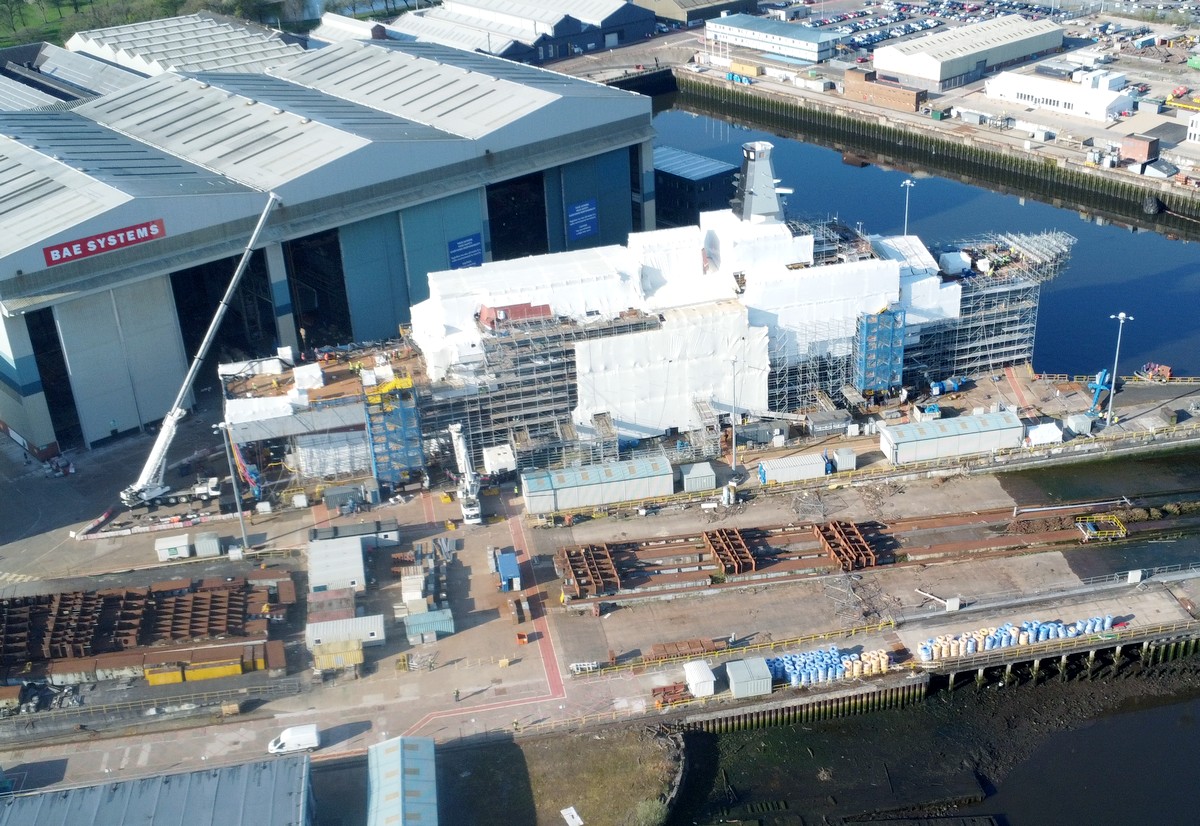
Decades of last-minute and stop-start defence procurement have hollowed out the shipbuilding skills pipeline in Scotland, senior industry figures told the Scottish Affairs Committee on Wednesday, with BAE Systems confirming that the workforce on the Clyde has a significant generational gap in experienced workers as a direct consequence.
SNP MP Dave Doogan raised the issue directly during the session, arguing that the pattern of procurement across successive governments had done lasting damage to the desirability of a shipbuilding career and to the skills base that underpins it, saying that people of his generation remembered workers being regularly put out of work in Govan when contracts came and went and that the lasting effect of that was still being felt today.
Doogan pointed to the fleet solid support contract, awarded to a Spanish-led consortium rather than a solely UK yard, as emblematic of a broader procurement culture that he described as “thudding, clunking, grudging allocation of orders at the last minute”, saying it had “a detrimental effect on skills and the desirability of a career in defence.” He also noted that the government no longer had a shipbuilding tsar or a visible shipbuilding pipeline, and that the Type 23 was on its knees while the Type 31 and Type 26 were not coming right behind it as a properly managed drumbeat of orders would require.
He told witnesses that if there had been a sustained drumbeat of orders running through Govan and Scotstoun from the early 1980s onward, people who started apprenticeships in 1982 would have been able to see out full careers without being laid off, producing a very different skills dynamic today, and asked BAE’s Neil Holm directly whether he was wrong in that analysis.
Holm confirmed the picture, telling the committee that the shipbuilding workforce was experiencing exactly the kind of generational gap that stop-start ordering produces, describing it as a “bathtub of experience” in which a large cadre of workers who came up through the Type 23 and Type 45 programmes had retired or were retiring, a young demographic was now coming through, but in the middle there was a significant gap caused by the lack of sustained investment and funding in the intervening years, adding that “it is challenging to regenerate capability after a period of under-investment.”
Holm said BAE had around 500 people in early careers out of a total workforce of 5,000 in the naval ships business and that while the company was going as fast as it could on early career recruitment, it was constrained by the number of experienced people available to mentor and train them, saying that sustainable throughput through generations was one of the key things the industry needed and that it was “absolutely dependent on long-term sustainable work going through our capabilities.”
Babcock’s John Howie said the same pattern applied at Rosyth, where the absence of a confirmed UK programme to follow the Type 31 was already forcing the company to think carefully about how many apprentices it could responsibly take on, telling the committee that it was “really simple: the need for long-term contracts” and that it was “never a good thing to take someone on, put them through an apprenticeship but then not offer them a job at the end of it.”
The witnesses agreed that the skills challenge was ultimately an industry responsibility to fix but that it required government to provide the platform and long-term certainty to make it possible, with Holm saying the alignment between industrial strategy and defence procurement was “deeply important” and that a close link between the two would deliver huge benefits for the industry and the wider economy.












Probably one of the worst problems at the moment. Decisions need to be made, not buried. There are tens of thousands of people looking over their shoulder wondering if they are going to be next for the chop and tens of thousands more not able to get into engineering jobs.
Couldn’t agree more with the content of this article, been there, done that. It isn’t a party political issue, governments of all stripes are guilty of this issue.
This is a long standing problem, rearing its head with depressing regularity; governments, MoD and Treasury are all part of the problem. How many of the people making decisions these days have real life experience or qualifications relevant to any kind of manufacturing? How many have even had a job other than in the public sector?
Very few from my dealings with the MOD in the past. It could take weeks for the MOD to make a decision that a private company could make over the phone in a cople of days.
The impact of this approach to procurement on the relevant defence industrial enterprise is well understood by plenty of people in MOD. The politicians are the problem here- ultimately if they won’t release the funds to permit a steady procurement drumbeat- or listen/care when they are told what the consequences are- there’s nothing anyone else can do about it.
“thudding, clunking, grudging allocation of orders at the last minute”
Excellent description 👍
We are led by idiots – is the right answer.
Does anyone in HMG ever reply to this beyond the “biggest sustained increases since Cold War” crap?
The short term ‘bean-counter’ thinking of how can we save money for the next couple of years is behind a lot of this. Saving using and allocating funding should be part of long term strategic planning and not to do with what can be gained from the stock market or financial manipulation. The time it takes to ramp up supply chains, productions and design skills, factory or manufacturing faciltities precludes this idiotic focus on short termism. The same applies to health, and is probably endemic in Whitehall thinking. Funding and consequent political thinking over 4 or 5 year cycles is woefully insufficient. The focus on high end high tech bells and whistles doesn’t help. It may have been valid while we had technical manufacturing capacity through the 70s, 80s and declining in the 90s, but nowadays the ability to adequately supply large quantities, as seen as needed in Ukraine and even today over Iran, is crucial. As we saw during WW2 ample supplies of cheap functional equipment, left to individual units to adapt and use as required is fundamental to battlefield success, and one of the principal reasons for Germany’s ultimate demise – they focussed on limited quantities of first class gear. That ability to use cheap and cheerful stuff is why assymetrical warfare wins out.
Babcock got rid of 300 of us now complaining not enough skills.
And that is the simple truth, you maintain an industry and you maintain efficiency by establishing a clear steady process of production and steady demand.. it’s not rocket science if your demand is all of the place any industry will both be wildly inefficient and unable to meet demand.
All government really has to do is decide how much shipbuilding capacity the Uk needs.. then order a steady drumbeat to maintain that capacity..
Consider a fleet like a house.. your ship building is your foundation, your ships are the walls and the crews are the roof.. until you build and maintain good foundations you cannot build and maintain walls and without walls you cannot have the roof.. but if you don’t build walls and maintain a roof your foundations get washed away.. at present we keep focusing on the roof.. “ but we don’t have enough crews” to build ships ( the walls ) and without walls and a roof the foundations got washed away so we cannot build walls and so cannot maintain the roof we are so obsessed about that stops us building the walls..
Until essentially we go back and understand what is needed to main the foundations ( industrial capacity and steady order book to maintain it) then put that inplace we are aways going to cycle through collapsing walls and roofs..
Essentially we need to take a leaf from Italy.. just build it and if you can sell it, do so as build more, but no matter what keep building.. at all cost preserve the foundation to the level required.
At least Scotland still has a couple of centers capable of building complete ships. The [surface] ship building industry south of the boarder as been decimated apart from Cammell Laird and Appledore both of which seem to be focusing on supplying blocks to other yards. With Cammell Laird’s tie up with A&P also highlighting their move towards maintenance and refit work.
Cheers CR
Trouble is, there is not much alternative to start-stop procurement re. boats.
The govt will only order ‘so many’ for the RN. They won’t just ‘produce more orders’ willy-nilly to fill gaps in manufacturing pipelines. The only way to fill the gaps; is to try and sell boats to somebody else, ie. somebody who will actually buy one. The government are not that entity as it stands.
I don’t know where I’ve heard this, but it seems to me govt are only buying enough boats to replace the ones that go out of service. They are not looking to expand the fleet generally speaking.
We can discuss whether govt is right or wrong about this, but with any form of goods, it’s a case of supply and demand. If the demand simply isn’t there, then there will always be some kind of a ‘stop’ to production.
Unfortunately those the realities.
P.S.
If you think govt will buy boats willy-nilly you are deluded. You’ve seen yourself how penny-pinching the treasury are.
If the government replaced the ones going out of service, we wouldn’t be in this mess. The issue is no long term planning and determination to see it through, it’s all save money now with promises to spend more on the future but the future never comes