

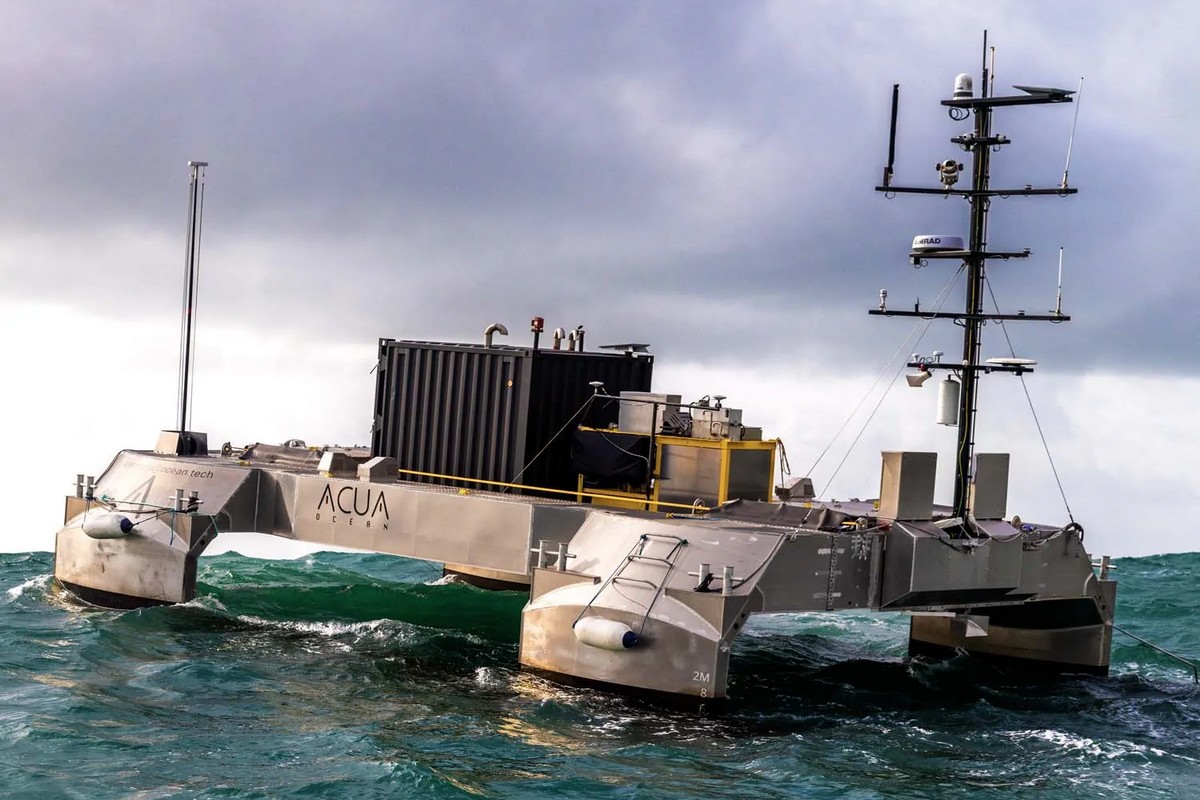
The Royal Navy has completed a four-month technology demonstration programme with small and medium-sized enterprises focused on autonomous and uncrewed systems for anti-submarine warfare, as part of the broader Atlantic Bastion programme to develop a hybrid underwater capability in the North Atlantic.
According to the Royal Navy here, companies were invited to showcase off-the-shelf equipment across a range of capability areas including seabed acoustic detection systems, uncrewed surface vessels fitted with acoustic and towed arrays, remote operation centres with AI integration, drones equipped with sonobuoys, crewed and uncrewed subsea robots operated from ashore, and gliders and acoustic floats, with all systems required to be commercially available and deployable within the anti-submarine warfare domain.
Rear Admiral Rich Harris, Director Develop for the Royal Navy, said the demonstrations were “about proving that the latest technology is ready to secure the North Atlantic and our nation’s most sensitive waters”, adding that the Navy was “integrating crewed and uncrewed systems with digital decision-making to accelerate the Royal Navy’s transition to a hybrid navy, strengthening our readiness today and ensuring we are warfighting ready for the challenges of tomorrow.”
Captain Chris Hill, Atlantic Net Programme Director, said the programme had been “pivotal in providing the Royal Navy with a focused understanding of cutting-edge developments across the anti-submarine warfare landscape”, adding that industry support “far surpassed our expectations” and had left those developing Atlantic Bastion with “a wealth of exploitable knowledge.”
The programme sits under Atlantic Bastion, which is investing in advanced underwater sensors, autonomous platforms, lethality capabilities and a digital architecture to link those systems into a cohesive operational network, and forms part of the Royal Navy’s broader push toward a hybrid fleet in which traditional crewed warships operate alongside uncrewed technology across air, surface and subsurface environments.
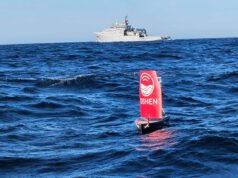

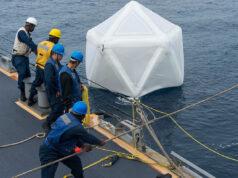


The pictured drone is an interesting design, that was reportedly quite effective at it’s role due to a focus on stability on speed. Pioneer, I think the name is (may be wrong)?
All well and good but I’ve got doubts about all this new fangled technology lasting for long in the north Atlantic seas
You plonk them over cables and gas pipes and listen. They aren’t meant to be particularly mobile.
One per 1000 miles of each ?
Good article in NLO. I could imagine a network of them, placed in position and serviced by a small fleet of North Sea style support vessels. Kind of autonomous, mobile oil extraction platforms.
ACUA Pioneer, it’s SWATH so can only do 6 knots or so but that means (the manufacturers claim) that it has the seakeeping performance of a monohull of three times its length and 10 times its displacement. Handy in the North Atlantic, but SWATH vessels also have a hard limit where the waves begin to slam onto the central platform, which is really bad but can sort of be designed out.
Payload is one TEU or two 10-foot containers. ASW mechanisms so far tested are sonobuoy dispensers, longer endurance acoustic floats and SEA Kraitline thinline towed array.
Atlantic bastion seems to be moving pretty quickly and in the right direction.
All well and good. But t it does not replace and a needed huge increase in naval fleet! This Country needs to get real!
I’ve gained $17,240 only within four weeks by comfortably working part-time from home. Immediately when I had lost my last business, I was very troubled and thankfully I’ve located this project now in this way I’m in a position to receive thousand USD directly from home. Each individual certainly can do this easy work & make more greenbacks online by visiting..
following website—.,.,.,.,.—>>> JobatHome1.Com
Ha, just for a moment there I thought It said “ACME” like the failed products Wile E Coyote used to use against the Road rummer.
Meep Meep. !
“Runner” ffs !
Bring back the edit feature.
There’s a new Wile E Coyote film coming where he sues the Acme company for their failed products. Shame we can’t do the same for AJAX
😁
isn’t this what SOSUS did fifty years ago.
Technology must have advanced to make an extended network of fixed sea bed sensors easier to implement. But maybe not so sexy for the Customer or lucrative for the suppliers.