

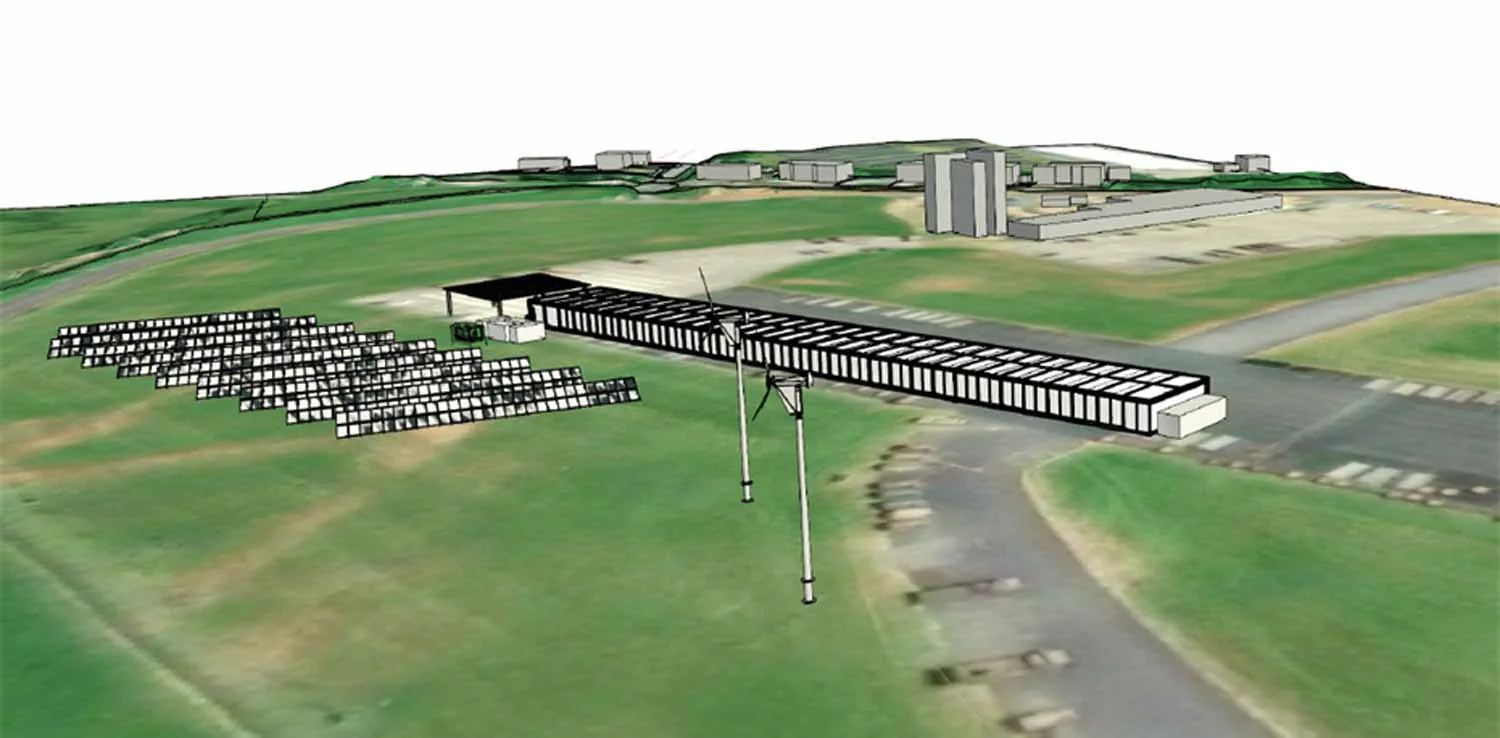
The Royal Marines are to install renewable energy micro-grids at two of their bases to power new combat rifle ranges, reducing reliance on the National Grid and cutting energy costs, the UK Defence Journal understands.
Small energy farms comprising two 15-metre wind turbines and solar panelling will be created at Norton Manor Camp near Taunton, home to 40 Commando, and Royal Marines Base Chivenor, home to the Commando Logistic Regiment and 24 Commando Royal Engineers. Electricity generated will be stored in battery storage systems on site and used to power the ranges, with any surplus fed back into the National Grid.
The two modular 100-metre ranges will support individual and collective training for UK Commando Forces, covering marksmanship through to house and building clearance tactics. The First Sea Lord, General Sir Gwyn Jenkins, formally opened the facility at Norton Manor’s Anzio Range last week.
The power demands of the ranges are considerable. During live training, each range consumes around 136 kilowatts, equivalent to approximately 18 family homes, amounting to around 220 megawatt hours annually and an electricity bill of more than £50,000 per year. Powerful ventilation systems account for a significant portion of that demand, required to prevent dangerous build-ups of lead and other harmful substances during close-combat training involving constant fire, smoke and flash-bang devices.
According to the Royal Navy, the remote locations of both sites and limited existing electrical infrastructure made connecting to the grid expensive and impractical, making the micro-grid approach the preferred solution. The renewable energy primary source will also reduce carbon emissions associated with the high-demand facilities and ensure training for high-readiness warfighting forces is not interrupted by potential disruptions to the National Grid.
Lieutenant Colonel Christopher Emptage RM, from Navy Force Generation, said the project “demonstrates how innovation and cross-government partnership can deliver direct operational advantage, strengthening our warfighting resilience by ensuring critical training continues regardless of disruption to external energy systems.” He added that the work advances Defence’s contribution to national Net Zero objectives while delivering “a more efficient, sustainable, and cost-effective foundation for future capability.”










So both these locations were due to be thrown away in announced defence cuts, from quite a few years ago.
Hopefully this means they’ve been rescinded.
Bootnecks need their own ranges mate….they cannot shoot so are barred from Stanta.
Ouch! 😆
😇😇
I’ve gained $17,240 only within four weeks by comfortably working part-time from home. Immediately when I had lost my last business, I was very troubled and thankfully I’ve located this project now in this way I’m in a position to receive thousand USD directly from home. Each individual certainly can do this easy work & make more greenbacks online by visiting
following website—.,.,.,.,.—>>> JobatHome1.Com
Well at least the Royal marines don’t need a sticker with point this end towards enemy on the rifles like the pongos.
And the only rifling the RAF do is the bedside cabinet looking for batteries for the ann summers purchase.
Marines are just sailors pretending to be infantry.
It’s a no Brainer, both sites are Sun Traps and Windy.
I could probably supply enough power for both at the moment ☀️☀️☀️☀️☀️☀️☀️.
Should keep off too much ale in this weather Sunny Jim
Ha ha… Solar Is (was) my Thing… Alcohol no more !
Glorious weather here today, just been out for a two wheel blast before It gets too hot.
Have a great day Smickers. 👌👌👌
Too hot … 😂🤣😂🤣😂🤣, ya’ killing me.
Ahh, magenta pops up, as if by magic 🤦♂️…. Mr Ben used to do something similar.
32 degrees on a 1200cc bike that gives off huge levels of engine heat, wearing all the gear in traffic and around town is something every biker struggles with. ☀️☀️☀️☀️
Just thought you might need some basics to help you understand.
I bet you are now going to tell us you are a biker too ? 🤔
Halfwit,
Yes, was a rider. First bike was a 65’ NSU Quickly found dumped around 73/4’, got that running.
Then bought my first bike a Yamaha SR185 “Exciter”, released in late 1981, mini-cruiser, featuring pull-back handlebars, a stepped seat, and a teardrop tank, it gave novice riders a factory “chopper” or cruiser look using a pint-sized 185cc single-cylinder engine, ‘maxi maroon’ paint. Bought new in 81’ but alas, I’m afraid to admit that drugs led to this purchase, crazy story, involving Purple Pebbles, not for publication though. Hilarious mock 185cc chopper.
Before long I saw the errors of my way (not the Purple Pebbles) the bike and within the year I had bought a Kawasaki GPz 250 Belt Drive, lightweight, air-cooled 249cc parallel-twin, a quiet, low-maintenance Kevlar belt-drive system. Good fun, but as soon as the 250cc licence restriction to a maximum engine capacity of 250cc limitation ceased I bought a Honda CX500 Turbo. Went from belt drive to shaft drive in one fell swoop. The CX500 Turbo was the world’s first mass produced turbocharged motorcycle and the first Honda bike to feature a programmed fuel injection system, a liquid-cooled V-twin engine and low-maintenance shaft drive, and that shaft drive and the bike was smooth and trouble free; although the front mounted turbo’s heat played havoc with the wiring harness, rubber hoses and vacuum lines. A good one is worth a motza these days.
After a few years and some outback Australian tours up and down the East coast, I needed to move up to more grunt, bought a used Honda CB1100F a 84’ model ‘Super Bol d’Or’. It came with a Hondaline frame mounted touring fairing and its low CB1100F clip-ons had been swapped out for a set of factory Honda CB900F2 handlebars; the fully faired touring version of the 900. That fairing worked a treat for touring, especially on endless highways or the harsh wind swept open roads across Western NSW and Eastern South Australia, or following the ‘long paddocks’ aka Stock Routes; the historical practice of farmers and “cockies” using the unfenced, grassy roadsides as a giant, free paddock to graze and move livestock to market, particularly during droughts and temps pushing above 40°+C.
Today primarily those Eastern stock routes are known as a popular 610 kilometre self drive/ride touring route spanning from Echuca-Moama on the Murray River to Wilcannia in outback New South Wales. The Long Paddocks features several unique aspects, you can still occasionally see modern day drovers moving livestock on horseback along the roads. The ride takes you through distinct environments, including the Hay Plains renowned as the flattest place in the Southern Hemisphere.
The CBF was a ‘heavy steel’ bike, yet, felt reasonably light in town. In retrospect I should have bought a Goldwing back in those days as I loved them and still do … well it was either a Goldwing or a Laverda RGS 1000 Executive, my dream/fantasy bike (even had a private factory tour in Vicenza march 91’).
After about five years of CB fun I moved into 4×4 Landcrusiers/Patrols doing outback touring/exploring … now I keep my two wheel fun to purely to Vespa/Aprilia scooters when faffing around Southern Europe. Scooters in Australia are only for the immediate locality, as the ‘tinlids’ don’t respect riders … unless your a bikie, part of a gang; Rebels, Comanchero, Mongols, Bandidos … then they will drive their car off the road, just to let you by.
So yes, you are not the only motorcyclist in the world, been there and done that, got the t-shirt … from Ace Cafe, North Circular in 97’.
Cool Story, I remember the NSU, GPZ 250 and the beautiful CB 750/900/1100 range and the CX Turbo was my dream bike in 83. The 125 law came in 1982 in the UK, made my GSX250ET, worthless over night, next bike was Suzuki GS850G Shafty then I just stuck with bikes going through all the fastest bikes and more miles than I can recall and I’m now 47 years riding, had way too many to list here, got 7 at the moment, including Aprilia Tuono V2 1000, Yamaha FJ1200, Suzuki GSXR 1300 Hayabusa, Triumph Daytona 1200, Honda MSX125/226 Grom (probably the fastest in England) Sur-ron E bike, Suzuki ZR50 X1 and I’m looking for a CX650 Turbo and a VF1000R. I’m am a member of the 200mph (204 on my modified ZZR1400 was the fastest) club and Heat Is still my worst enemy, especially In Traffic, even though you laughed at my comment !
Funny thing was, I just really believed I was the only biker in the World.
Publicity Stunt..? What’s the Catch..? Is it in DIP..?
We Appear More Intrested in Net Zero than our Defence…!
How are we supposed to pronounce your name ? I’m having awful trouble 🤔😁.
Seriously though, It’s a terrific Idea to use the Sun and Wind, after the Initial costs, It’s all free, storing all the excess In batteries Is a no brainer.
Half Tempted to do Some Wind And Hot Air Jokes About the MOD…!
Go for It… This place needs more fun.
It’s way too stuffy.
The hot air is available in huge quantities from the DIP discussions….sn inexhaustible supply.
So you don’t think the MoD should save money on things like electricity… FFS 🤦🏻♂️
I think you miss much of the point.
It makes sense to power defence sites off-grid. Makes them more resilient.
As we’ve seen in Ukraine, energy infrastructure is a major target, one one that keeps getting hit over and over again.
If important infrastructure, either military or civilian, can be powered locally by solar, wind etc then it’s going to be more resilient to attacks against our energy infrastructure. Russia’s missiles and drones can hit power stations because they’re static and huge! No way could they reliably hit something like a bank of solar panels or wind turbine.
Keeping the UK reliant on fossil fuels just guarantees our energy dependence on other countries and on shipping routes that could be compromised in war.
Look how many countries are affected by the US/Iran war and the closure of the Strait of Hormuz.
FFS 🙄
I can make you rich! Earn $4000 a day! Buy/sell Elvis’s old socks!
Righties against renewable power even when it makes perfect sense 🤦♂️
It’s normally the “No good when It’s not sunny” types that seem to believe their own brain cell !
Batteries store what Is not used and then you use It when the Sun’s gone ! 😁
More likely those on the right are far smarter and understand that reliable and constant electricity cannot be produced by simply putting up wind turbines and solar panels, even with battery storage.
Ask the Germans, they got into a terrible mess trying that, so much so they had to ration electricity, and shut down factories etc, in a desperate attempt to keep the lights, and heat on for it’s citizens, over a winter period where there was little sun, and two months of very little wind
Do you think there is a market in Germany for selling both Dry and Honey roasted peanuts to go with their beer?
The possibilities for wind are endless especially if encouraged to make wind for German energy!
German energy saving was as a result of a sudden cut in Russian gas following the invasion of Ukraine and specifically the destruction of the Nord Stream 1 pipeline, not the roll out of renewables but hey, don’t let the facts get in the way.
Deary me 🤦♂️
And you know that what you just posted is a pack of lies?… 🤥
Made where ? China no doubt. An absolute disgrace UK are not manufacturing these and nothing to be proud of advertising it.
🤦♂️🤦♂️🤦♂️🤦♂️🤦♂️🤦♂️🤦♂️🤦♂️🤦♂️🤦♂️🤦♂️🤦♂️🤦♂️.
Another stupid comment 🤦🏻♂️
It’s all about the cost/benefit study…which, of course, we will never see.
Research papers indicate:
‘Using a manufacturing facility…with a 5 GWh electricity consumption to test the model, the results show that such a manufacturing site fully powered by renewable energy is approximately 22 % more expensive than the conventional case.’
And then factor in through life costs including degradation of performance over time/replacement/recycling costs for the renewable generator units and batteries.
You know it’s going to cost the taxpayer more…and you know that the environmental pollution from necessary rare metals mining is extensive but overseas…so that’s okay then…
It can be justified re self sufficiency but how high a weighting has that traditionally been given for these kind of facilities in any compliancy matrix?
But great news anyway because everyone is obviously very keen on that ever increasing tax burden…or not really…
Links to said “Research papers” please Matt.
I like a good larf. 😂
Just Google Renewable Energy Hub.
Links on here disappear to the moderator.
Cobblers.
Renewable energy is between 40% and 60% cheaper based on levelised costs over lifetime. This figure reduces if the cost of grid upgrades are factored in but it is still overall much cheaper.
I don’t like renewable energy infrastructure as it’s makes mess of the landscape but there is no arguing against the cost benefit and it will get cheaper still.
Or not really…
If renewable energy was cheaper, private companies would be wading into the sector. They are not…holding off until the Government caves and gives them guaranteed inflated prices:
‘In the period 2002 to the present, the total cost to the electricity consumer of those renewable electricity subsidy schemes that we can quantify has amounted to approximately £220 billion (in 2024 prices), equivalent to nearly £8,000 per household.
The annual subsidy cost is currently £25.8 billion a year, a sum equivalent to nearly fifty per cent of UK annual spending on defence.
Subsidy to renewable electricity generators now comprises about 40% of the total cost of electricity supply in the United Kingdom.
The total subsidy cost per unit of renewable electricity generated has risen by nearly 50% in real terms since 2005 and now stands at approximately £200/MWh. This contradicts government and industry claims that renewables are becoming cheaper.’
Simply Google the Renewable Energy Hub to find this out for yourself.
and what do you base those comments on?
Congratulations on spouting a pack of lies that are hilarious in their ridiculousness.
This chaps off his trolley. Jeesus H Christ
🤦♂️🤦♂️🤦♂️🤦♂️
Rod Liddle’s article of 16 May 2026 refers:
‘The unstoppable rise of stupidity’
Yes, you certainly make that clear enough.
Deary me. 🤦♂️
Not only have you not consulted the Renewable Energy Hub but you demonstrate that you have no idea what point Mr Liddle is making.
This is basic stuff:
‘Installing a self-contained wind, solar, and battery unit costs £25,000 to £40,000+ upfront. By contrast, a standard UK National Grid connection costs £1,500 to £5,000 for urban properties, though rural connections can spike to £10,000–£50,000. Off-grid requires replacing batteries every 8–15 years’
Batteries are expensive to buy, expensive to replace, expensive and difficult to recycle and an environmental/ecological disaster particularly in the developing world. The mining of rare earth’s is deleterious to the health of those mining it and the working conditions, employment practices are a disgrace.
But apart from all of that, the pursuit of net zero is a reslly good idea…if you are stark raving mad…
Not only do you have no clue what you are talking about but you failed to see what I did for a living. (make up some more bollox If you wish about that).
What you have just written here is complete and utter bollox. Lies and false facts quoted In complete Ignorance that I find rather sad.
But please carry on making your wildly ridiculous claims, I’m pissing myself with your “£25,000 – £40,000+ upfront” statement/quote.
Seriously fella, I should quit now before you totally embarrass yourself. (Maybe you should use another name now ?)
… can’t fscking belive you are quoting from Liddle, one of the UK’s most disrespected, commie/trotskyist/marxist turned right wing populist cranks on the UK political scene.
Liddle doesn’t have a blueprint for a better world; his extremism is entirely destructive rather than constructive. He uses pitch-black humor, hyperbole, and deliberate cruelty to smash the ideas of others. Because he positions himself as an anti-ideologue who deals only in “doubt,” he frees himself from ever having to provide actual, workable solutions to complex problems like the energy transition.
His past and present collide, he takes the raw, aggressive energy of 1980s class warfare, the classic Marxist fight against the bourgeoisie and completely repurposes it. Instead of fighting corporate CEOs or billionaires, he targets middle-class liberals, vegans, and climate scientists. He frames solar energy and environmental targets not as a scientific necessity, but as a malicious luxury hobby forced upon the struggling working class by a “woke” metropolitan elite.
Ultimately, his extremism is deeply tied to his personal brand and psychological need for validation. Having blown up his own respectable career at the top of the BBC. The BBC’s whole brand is built on the appearance of absolute, unshakeable institutional neutrality. The moment the editor of their most important news show (Today programme) became a loud, biased political actor in public, he became completely radioactive to them. he left after his Guardian article 2002, a scathing attack on the Countryside Alliance, they gave him ultimatum stop or go … and here is the part that shows just how left wing bias the BBC is – The head of BBC radio news at the time, Stephen Mitchell, also framed the ultimatum publicly in slightly softer corporate speak, though the meaning was identical –
“Rod did not have to go. He had a choice. I would have been more than happy for him to continue editing the Today programme if he had ceased to write the column that had caused the problem.”
The BBC were perfectly happy to keep a guy running their most powerful, agenda-setting news programme who openly harbored deep, sneering contempt for a massive portion of the British public (the rural working- and middle-class marchers). By telling him he could stay as long as he kept his mouth shut in The Guardian, the management essentially admitted – We don’t care if our top editors hold deeply partisan, sneering, left-wing views, we just care if the right-wing newspapers catch them admitting it.
Mitchell climbed even higher up the corporate ladder, eventually becoming the Deputy Director of BBC News. But in 2012, he was forced into a sudden, ignominious retirement with absolutely no payout due to his role in the catastrophic Jimmy Savile scandal. The independent investigation (The Pollard Report) found that Mitchell was the specific executive who removed a massive Newsnight investigative expose into Savile’s history of child abuse from the BBC’s internal “risk register” by burying the investigation. Liddle’s mate, like for like, toxic.
Having been cast out of polite society following messy personal scandals, he leaned entirely into becoming a pariah. He found a lucrative niche by telling a frustrated segment of the public exactly what they wanted to hear.
He’s a Crank. By bouncing across the political horseshoe, from the far-left Socialist Workers Party to the Populist Right, he has poisoned his own data. Even when he touches on a valid point about the economic hardships ordinary people face, the argument becomes immediately toxic because he is the one saying it. He is a man who traded genuine intellectual respect for the cheap, loud applause of the fringes, achieving a highly profitable infamy, but cementing his status as a textbook media crank.
Liddle constantly writes columns slamming the “greedy globalist elites” and the “metropolitan establishment” for destroying Britain. Yet, he is paid hundreds of thousands of pounds a year by the ultimate globalist media corporations … the exact machines that pioneered the hyper-capitalism he blames for ruining working-class towns.
The right-wing papers don’t care about his left-wing economic theories because they know his readers only click for the cultural rage. They hire him to perform a specific function – to write an inflammatory, anti-woke, anti-climate-change piece that triggers people’s anger, generates millions of clicks, and sells advertising space.
He plays the part of the brave, independent outsider fighting the system, but he is entirely dependent on the billionaire owned press ecosystem to fund his lifestyle. He’s an old-school socialist who outsourced his bank account to the hard right.
WTF ?
Ermm, you appear to be trying to comment under another name but have answered yourself with the same name.
Thought so.
Halfwit,
Im repying to Monro, I usually put who Im replying to at the top of my comments (if i remember to), as it gets confusing on UKDJ as to who is replying to whom. I failed this time to do so. Sorry.
The comments section on UKDJ uses a basic, nested plugin format – WordPress, which famously turns into a visual nightmare once a thread gets more than a few replies deep. Because the formatting limitations squeeze the text further and further to the right, it becomes almost impossible to visually track the “chain of custody” of an argument without explicitly labeling your interlocutor. So sometime, by tagging a user in a reply when deep into a long comment string, I don’t use the “Reply” button, but create a new comment and write – RE: [Username xxx] comment on [Topic xxx] above: (Blah, blah, blah …) this stops the the disscussion becoming so compressed. that its just pointless, and gives it ’space to breathe’ as the discussion resets to the left-hand side.
Given that UKDJ attracts a highly opinionated mix of military veterans, geeks, and political contrarians, debates in those threads escalate fast. Manually tagging my recipient at the top does two things the site’s layout fails to do … It stops cross talk, it prevents another user from swooping in, reading my comment out of context, and assuming my critique was aimed at them. It also forces accountability, as it keeps the specific person i’m replying to on the hook, making it much harder for them to dodge my point or claim they didn’t see it.
Of course everyone is free to dodge my points.
Ha, no It’s my bad !
I confused both your names and Avatars…… Sorry !
Anyway, I do feel that Monro has no Idea what he’s banging on about, other than reading some crackpot’s own clueless ramblings.
I could sell a 12KW DIY Solar Kit including the panels, Batteries, Controllers, Cables and Inverters for £4000. That would provide enough electric to power an average house for a good 9 months of the year and partially for the remaining 3 months.
Either way It pays for Itself In a couple of years and the Batteries don’t fail In the time he seems to believe, nor do the Panels.
But It’s fun reading his stuff though.
Halfwit.
… all good mate.
Dont think it pays for itself that quick. When I looked into it break even was about 8 years.
Does that factor in recycling and getting rid of the kit at end of life though?
Most people pay waaaaaay over the odds for the package. That’s why you believe It takes so long to break even. The fact Is, It’s all so very cheap If you research and Do It Yourself.
I realised that and sold Off Grid Kits for DIY.
It’s the same with Double Glazing …. way too many gullible people belief the Hard Sell Hype and part with stupid amounts of money when they can do it for fractions of the cost.
But hey ho !
‘Commercial installations often face more rigorous demands. Businesses with high energy consumption may cycle their batteries multiple times a day to manage “peak shaving”, reducing the expensive “demand charges” from the grid during high-use periods.
For businesses, a 10-15 year lifespan is still the standard expectation, with many systems designed for easy modular replacement of individual cells.
“end of life” for a solar battery doesn’t mean it simply stops working. Instead, it refers to the point where the battery’s capacity to hold a charge drops below a certain percentage (usually 70% to 80%) of its original capacity. At this stage, while the battery still functions, it may no longer meet the full energy demands of your property.
The four primary factors that influence degradation:
Depth of Discharge (DoD): This refers to the percentage of the battery used relative to its total capacity. While older lead-acid batteries could only be discharged to 50% without damage, modern lithium solar batteries can often handle a DoD of 80% to 95%. Staying within the manufacturer’s recommended DoD is vital for longevity.
Temperature: Heat is the enemy of battery life. Chemical reactions inside the battery accelerate at high temperatures, leading to faster wear. Conversely, extreme cold can reduce a battery’s efficiency.
Cycle Frequency: Every time a battery charges and discharges, it completes a “cycle.” Most manufacturers guarantee their products for a set number of cycles or a specific number of years, whichever comes first.
Maintenance: While solar batteries are largely “set and forget,” ensuring they are kept clean and that the software/firmware is updated via a monitoring app can prevent glitches that might strain the cells.
Solar panels:
The average operational lifespan of a solar panel has increased from around 20 years in 2007 to 25-35 years in 2025…More data is needed to understand when, why, and what volumes of solar panels are reaching end of life, but weather damage and installation errors are expected to accelerate end-of-life issues.
There are many considerations on whether to voluntarily replace solar systems before their end of life. Some consumers and plant operators may choose to upgrade their solar panels before the warranty period expires.
Cumulative PV waste in the United Kingdom is projected to be between 1.5 million tons by 2050.
Recycling costs: UK gate fees at PV CYCLE UK, Recyclesolar (Stafford), and Solarcycle Europe (Sheffield) ran between £14 and £24 per crystalline-silicon module in early 2026
“between 1.5 million tons” requires another number to be “between”… “per crystalline-silicon module”, how big are these modules and do they come in different sizes?
Low effort statistical slop
“between 1.5 million tons” requires another number to be “between”… “per crystalline-silicon module”, how big are these modules and do they come in different sizes?
Low effort statistical slop
Always looks a bit silly, being rude and then cocking things up yourself, doesn’t it.
There is no edit function available on here.
‘between 1.2 and 1.5 million tons’
Other estimates are available.
‘To meet the 2050 target of 90 GWpeak, there needs to be sustained average annual installation of ∼5–10m individual PV modules over the coming decades, the majority of which are likely to be silicon-based technologies. Many current PV modules are nearing the end of their lifespan or are on sites selected for “repowering”, and, based on our estimates, cumulative end-of-life UK PV module numbers will exceed 100m (∼2m tonnes) by 2050. The tonnage of UK solar waste is expected to exceed the current pan-European solar waste recycling capacity by 2035, demonstrating the need for further investment in recycling infrastructure and capacity. Domestic processing of this waste would enable retention of contained high-value or critical materials within UK supply chains, but this requires technical infrastructure to be in place.’
Standard Residential Panels:Dimensions: ~1.7m × 1.0m (e.g., 1700 × 1130 mm)Wattage: 350W – 450W
Typical Use: Standard UK household roof installations.
Large Residential / Commercial Panels:Dimensions: ~2.0m to 2.3m long × 1.1m wideWattage: 500W – 650W+
Typical Use: Larger homes with ample roof space, commercial warehouses, and ground mounts’
Basic stuff: ‘Solar batteries come with a hefty upfront cost. The actual cost will depend the size of the battery…You’ll likely need two batteries during the life of your solar panels. Batteries last around 15 years, while solar panels last about 25 years.’
So, realistically, a twenty year write off to include replacement of the entire battery storage unit at ten years…
‘Professor of Economic Policy at the University of Oxford Dieter Helm has argued that the costs associated with addressing the problem of intermittency has been ignored by “almost every calculation of the costs for these renewables’..it is going to cost consumers and voters quite a lot more than they have been told to expect…
House of Lords Nov 2024
‘Why when solar and wind are supposed to be nine times cheaper than gas are electricity prices in the UK amongst the highest in the world? Why when the UK is supposed to be a fast track to this promised cheap net zero electricity by 2030 are large industrial users struggling? Why is Grangemouth in trouble? Why is the steel industry in such bad shape that it has be bailed out and nationalised? Why have fertiliser and petrochemical companies and now biofuels all reached for the exit?…almost all of the supply chain is imported.
Renewables are not cheap when their system costs are properly measured. Marginal costs might be near zero, but a renewables-based system already needs almost twice the capacity as the old coal plus gas plus nuclear system, even though demand has fallen. To produce roughly the same amount of firm power, a renewables-based system already requires lots of new transmission lines, which were not needed in the past for the same demand, as well as a host of upgrades. It requires batteries and storage and lots of back-up gas standing mostly idle, as well relying heavily on imported electricity via the interconnectors to keep the lights on.’
‘The National Energy System Operator’s (NESO) own modelling implies gross cash costs of £7.6 trillion for the transition, or more than £9 trillion once the carbon costs of emissions are included. Even these figures, the paper argues, are likely to be underestimates given recent failures of offshore wind projects and rising financing costs.
The paper concludes that Britain has embarked on one of the most expensive economic transformations in its history without honest accounting or proper scrutiny. If net zero is to command lasting public support…voters must be told the true scale of the costs and trade-offs involved.’
David Turver, project management professional, and engineer
But the real problem?
‘…academics…might recognise findings that contradict their idiotic assumptions, will shelve those findings because they are not ‘useful’ politically…Down below those debauched shitgibbons…our education system…knowing stuff from which one can then advance an argument is of no matter…
The facts don’t matter…’
Rod Liddle : ‘The unstoppable rise of stupidity’
Monro,
You grab Helm’s arguments about the hidden system costs of solar and wind, and then pretend his conclusion is “the green transition is a joke.” In reality, Helm’s conclusion is that we should be pouring money into nuclear power to handle the baseline, rather than relying on gas to back up intermittent panels and blades.
All the adults know that to get rid of fossil fuels, renewables must be paired with a massive, heavy-metal backbone of nuclear power.
If you use Nuclear to provide back up to renewables, then you don’t need the renewables.
Nuclear plants must operate inflexibly and at capacity factors close to 90% to recover their investment costs, implying that operational flexibility – even if technically possible – is not economically viable.
Basically you are talking out of your Arse.
Nothing you are saying here Is even remotely true.
Dear o dear o dear. 🤦♂️
‘…academics…might recognise findings that contradict their idiotic assumptions, will shelve those findings because they are not ‘useful’ politically…Down below those debauched shitgibbons…our education system…knowing stuff from which one can then advance an argument is of no matter…
The facts don’t matter…’
Rod Liddle : ‘The unstoppable rise of stupidity’
With the wind in Arbroath they could power the whole of the Condor with a couple of wind turbines
Don’t really care about the green element and nor should the MoD, but always a good idea to add extra resilience.
Battery plant replacement after ten years, whole system replacement after twenty years may not sound particularly resilient to many…? The alternative, a grid connection with back up stand by generators would, arguably, be a great deal more resilient long term, and through life costs a great deal less, many might surmise…
Nope.
Not true.
Yet again you are talking out your arse. 😂
I would be surprised if the battery is only good for 10 years, but a generator might be the cheaper option. I’ve never been a big fan of intermittent energy generation at a grid level, not sure about micro levels though.
Gradual Degradation: Batteries do not just stop working at their end date; they simply hold less energy over time. Operators will often augment a site with new modules or adjust software controls to maintain output.
Warranties: Most top-tier commercial manufacturers offer performance guarantees ensuring 60% to 80% capacity retention for 10 to 12 years.
Maintenance: Routine maintenance (checking HVAC, fire suppression, and battery management systems) typically costs roughly 2% of the initial capital expenditure
“Maintenance: Routine maintenance (checking HVAC, fire suppression, and battery management systems) typically costs roughly 2% of the initial capital expenditure”
For what size of installation?
You can look all this stuff up for yourself.
In a spirit of helpfulness:
‘A routine maintenance estimate of 2% of initial capital expenditure (CAPEX) typically applies to commercial and utility-scale Battery Energy Storage Systems (BESS), ranging from large-scale containers in the 1 MW to 50+ MW range up to massive multi-megawatt grid-scale installations.
For residential or small-scale commercial setups (e.g., a 10 kW to 50 kW installation), the 2% rule breaks down. Because these smaller projects do not benefit from the economies of scale that dedicated on-site technicians and bulk contracts provide, actual maintenance as a percentage of initial cost is much higher (often 3% to 5%).’
Oh!
‘…but an official admission from the Intergovernmental Panel on Climate Change (IPCC) that a set of key assumptions promoting a climate ‘crisis’ since 2011 are “implausible”. The notorious set of always-improbable RCP8.5 ‘pathway’ assumptions which fed into computer models trying to measure an unmeasurable climate are no more…’
‘What matters today is that the group with official responsibility for developing climate scenarios for the IPCC and broader research community has now admitted that the scenarios that have dominated climate research, assessment and policy during the past two cycles of the IPCC assessment process are implausible. They describe impossible futures.’ May 2026
‘…how we shall miss all this copy aimed at the idiot short of a village.’
Dead horses stand a better chance of living again than anything you are writing here.
Just shut up you fool.
Jeesus man 🤦♂️
Monro,
Your excerpt touches on a significant, real, and highly technical debate within the climate science and policy communities. The plausibility and misapplication of “worst-case” emissions scenarios, specifically Representative Concentration Pathway 8.5 (RCP8.5) and its updated counterpart, SSP5-8.5.
The quote reflects a perspective popularised by climate policy researchers (such as Roger Pielke Jr. and Zeke Hausfather) regarding how these scenarios have transitioned from “business-as-usual” markers to baseline implausibility.
A breakdown of the context, the nuance, and what is actually happening in the scientific community provides a clearer picture.
What is RCP8.5, and Why is it Called “Implausible”? …
When the IPCC introduced the RCPs for its Fifth Assessment Report (AR5) in 2014, RCP8.5 was designed as a high-end scenario. It represented a future with rapid, unmitigated global development heavily reliant on coal, leading to an additional 8.5 W/m² of radiative forcing by 2100.
Over time, researchers realised the assumptions embedded in RCP8.5 had decoupled from real-world trends (Van Vuuren, 2026). To hit those numbers, humanity would need to dramatically increase its coal usage over the 21st century. Instead, global coal consumption peaked around 2013, renewable energy costs plummeted, and global climate policies were widely adopted.
Because of these real-world shifts, the climate science community widely acknowledges that RCP8.5/SSP5-8.5 is highly improbable, if not practically implausible, as a representation of our current trajectory (Wynes et al. 2024).
The word “admission” makes it sound like a scandal or a hidden truth being exposed, but the reality is more of a transparent evolution in peer-reviewed science.
In the IPCC’s Sixth Assessment Report (AR6, published 2021–2023), the panel explicitly noted that the likelihood of high-emissions scenarios like RCP8.5/SSP5-8.5 had been substantially reduced by recent policy changes and clean energy deployment. Furthermore, the group coordinating the new scenarios for the upcoming Seventh Assessment Report (ScenarioMIP for CMIP7) has actively re-evaluated the design of these pathways to ensure they focus on more plausible futures, explicitly responding to the widespread critique of these extreme baselines (Van Vuuren, 2026).
The real issue is “Business-as-Usual” vs. “Worst-Case”. The quote correctly identifies a massive problem in how climate science has been communicated to the public and utilised in economic models:
The scientific intent of RCP8.5 was created to explore a hypothetical high-risk pathway to see how Earth’s climate system would respond to extreme stress (a useful tool for physical climate models).
The policy misapplication, because RCP8.5 generated the most dramatic and alarming data, it was heavily overused in impact, adaptation, and economic vulnerability literature. For years, thousands of papers treated RCP8.5 not as a “worst-case nightmare scenario,” but as the default “Business-as-Usual” (BAU) trajectory (Wynes et al., 2024). This typical of the lazy/inept media across many scientific reports.
This over-reliance led to media headlines and policy papers framing a highly unlikely, catastrophic future as our definitive destination if we didn’t act, rather than evaluating our actual current trajectory, which is tracking closer to a 2.5°C to 3°C warming scenario by 2100 (Wynes et al., 2024).
Does This Mean the Climate Crisis is “No More”? This is where the provided excerpt overcorrects and introduces its own bias. The quote implies that because the extreme scenario is implausible, measuring the climate is “unmeasurable” and the idea of a crisis is gone. This is a logical fallacy.
Dropping an impossible 4°C – 5°C global warming scenario by 2100 does not mean we are safe. A “plausible” warming of 2.5°C or 3°C still presents severe, systemic risks to global infrastructure, biodiversity, coastal cities, and agricultural stability.
An analogy, if you will … Imagine a doctor warning a patient that if they keep up their current lifestyle, they have an 85% chance of a fatal heart attack (RCP8.5). After a few years, the patient cuts back on fast food and walks more. The doctor updates the chart; the 85% fatal heart attack is now implausible, but they still have a very high risk of chronic heart disease if they don’t keep improving. The threat hasn’t vanished; it has just been recalculated based on new data.
The quote is entirely right to criticise the scientific and media obsession with RCP8.5, and it accurately reflects that modelling agencies are moving away from it because it describes an impossible future (Van Vuuren, 2026).
However, using this course correction to claim that climate change risks are unmeasurable or non-existent is an exaggeration. The science is simply tightening its focus onto the realistic, middle-of-the-road dangers we actually face.
In short individual activists, media outlets, and some policymakers absolutely weaponised the scenario to force government action, but mainstream climate scientists as a whole did not maliciously “invent” it as a scare tactic.
Instead, what happened was a combination of scientific convenience, poor communication, and institutional incentives that created a feedback loop that became very difficult to break.
The critical failure wasn’t that scientists used RCP8.5; it was that they allowed it to be labeled as “Business-as-Usual.”
In the 2010s, thousands of scientific papers and media articles incorrectly claimed that RCP8.5 represented what would happen if humanity simply “did nothing” or continued on its current path. In reality, hitting RCP8.5 required humanity to actively abandon natural gas and renewables and aggressively transition back to coal to a degree that was fundamentally unrealistic.
Mainstream scientists didn’t correct this mislabeling quickly enough.
The controversy around RCP8.5 is less about scientific fraud and more about how science gets distorted when it becomes politically useful. A worst-case scenario that was meant to be an explanatory tool for computers became a political cudgel for policy. By over-relying on a catastrophe that real-world economics had already rendered impossible, institutions unintentionally damaged public trust when the math finally had to be corrected.
The fact is that real-world economics defeated the model. The reason the scenario was dropped is rooted in hard economic data, not political ideology.
– The model’s assumption was that RCP8.5 assumed that by 2100, the world would experience an unprecedented five-fold increase in coal use, largely abandoning green tech and natural gas.
– The Reality though is that global coal consumption actually peaked more than a decade ago; around 2013. Since then, the cost of solar and wind energy has plummeted by 80–90%, and nearly every major government implemented some form of climate policy.
tl;dr –
The data changed, so the scientists changed their models. That is how the scientific method is supposed to work.
All the usual Aunt Sallys
There is no ‘climate crisis’. There never has been. Mortality from extreme climatic or atmospheric events decreased by more than 90% in the last century, while the world population increased.
‘One of the most striking features of Earth’s climate history is its rhythmic natural structure. Throughout the Holocene, we observe:
multidecadal oscillations (~60 years),
centennial fluctuations,
millennial‑scale cycles such as the Eddy cycle,
and the Hallstatt–Bray cycle.
These patterns appear in ice cores, marine sediments, tree rings, and historical documents. They also correlate with solar and astronomical proxies. These cycles are not speculative; they are among the most robust features of paleoclimate research.
…current GCMs (General Circulation Models) do not reproduce these oscillations with the correct amplitude or timing.
This is not a minor detail. If models cannot capture the natural background variability of the climate system, then attribution regarding the global warming from 1850–1900 to the present becomes inherently uncertain, because any unmodeled natural contribution to the warming (for example due to solar activity increase during the same period) necessarily reduces the fraction of warming that can be confidently assigned to anthropogenic forcings. And if the anthropogenic contribution to past warming is smaller than assumed, then its contribution to future warming — and therefore the associated climate risk — must also be proportionally reduced.’
Oh!
‘Net Zero push has seen costs balloon and staff numbers surge by up to 382% across Britain’s top four energy quangos…
Ofgem, the Climate Change Committee, the North Sea Transition Authority (NSTA) and Low Carbon Contracts Company (LCCC) have all exploded in size over the past decade…
Among the biggest beneficiaries is the little-known LCCC, which administers the UK’s multi-billion-pound annual Net Zero subsidies to generators.
It has seen its headcount soar by 382% from 49 employees to 236 staff while costs have also tripled…
Those costs are set to more than double by 2029 as more subsidised wind, solar and other projects…come into operation.
Similarly, regulator Ofgem saw expenditure rise by 237% from £77 million to £260 million while its headcount more than doubled from 907 staff to 2,276, making it one of the largest energy regulators in Europe.’