

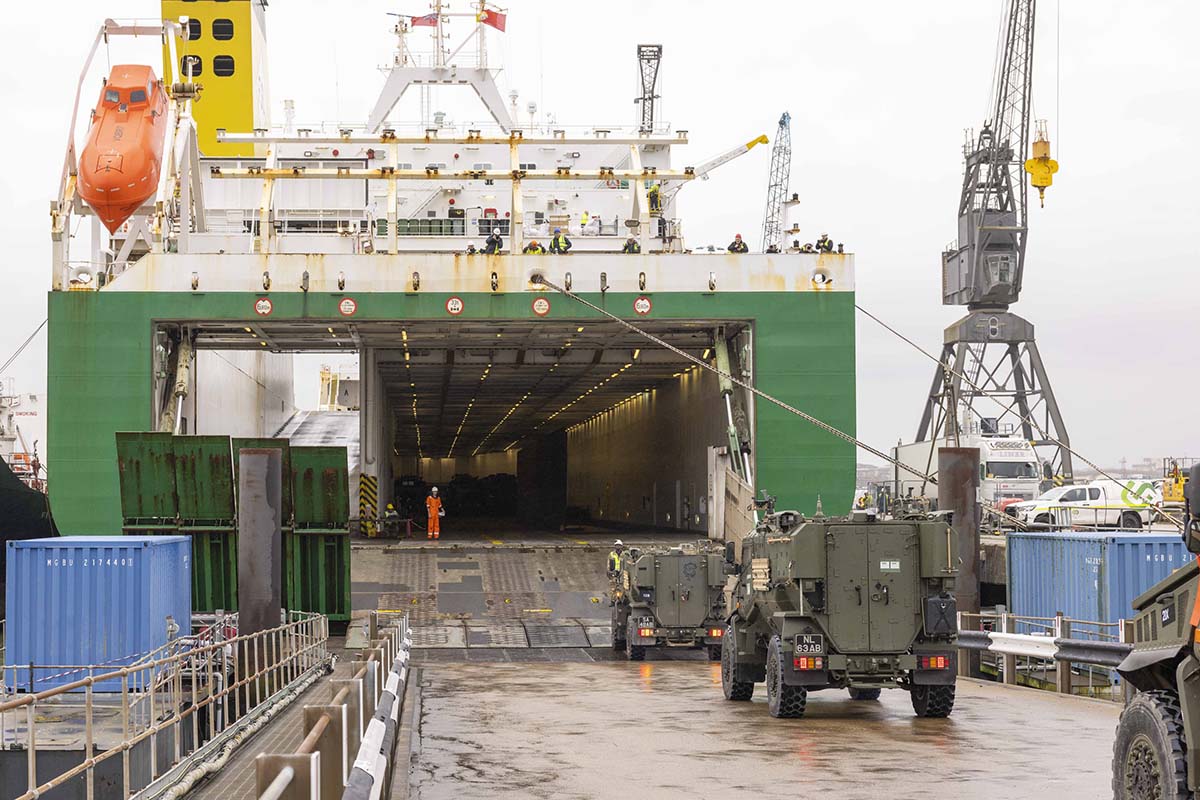
A new Council on Geostrategy primer warns that NATO’s supply lines in the Wider North are dangerously exposed to strike and sabotage, with frontline collapse a real risk in any major conflict.
NATO can no longer assume a permissive environment for logistics operations across Europe, according to a new primer published by the Council on Geostrategy, the UK Defence Journal understands.
The paper, Sustainment under Strike and Sabotage: Contested Logistics in the Wider North, was authored by William Freer, Research Fellow in National Security at the Council on Geostrategy, and Charlotte Kleberg, Director at Wallenius Lines and an Adjunct Fellow at the organisation. It argues that failure to secure supply lines in the event of a conflict risks delays to reinforcement, heavy pre-battle attrition of critical assets, and a potential collapse in frontline combat effectiveness.
The analysis identifies four key challenges facing NATO’s logistics posture in the Wider North: geographic chokepoints, thin lift margins, limited militarily useful infrastructure, and a critical lack of dedicated defences for supply lines.
The paper is published against a backdrop of growing concern about the vulnerability of European infrastructure to sabotage, drone strikes and long-range missiles. Decades of post-Cold War underinvestment and a heavy reliance on just-in-time commercial models have left supply chains across the continent exposed in ways that were not considered a serious risk until Russia’s full-scale invasion of Ukraine in 2022.
The primer’s examination of what could happen in an Article 5 scenario draws on declassified Cold War planning assumptions to illustrate the scale of the sustainment problem. In the 1980s, the British Army estimated that a division with four artillery battalions would consume around 35,000 155mm shells per day, meaning a deployed corps could burn through tens of thousands of rounds daily. Ukraine is currently estimated to be firing around 5,000 shells per day, a figure constrained in part by the need of its NATO allies to maintain their own stockpiles.
On the question of reinforcement, the paper notes that while NATO’s Enhanced Forward Presence will soon include a brigade in Lithuania, a brigade in Latvia and a battlegroup in Estonia, there are currently no permanently forward-deployed forces in Norway, Sweden or Finland. Corps-level formations such as the ARRC in the UK could reinforce, but moving them at scale under contested conditions presents significant challenges.
The authors urge NATO to integrate commercial capacity more effectively, harden infrastructure, establish dedicated logistics defences, and embed contested logistics assumptions into exercises. The paper also calls for the establishment of mobile air defence and counter-uncrewed aerial systems forces to protect supply lines.












Thank god for this “think” tank report. I’m sure no one in NATO thought that Russia might try and go after rear area logistics. 🤦♂️
And it’s certainly a great base line for 155 ammunition requirements, to use an overwhelmingly artillery heavy british division, fighting a one day war against the third shock army as a realistic planning assumption for what we might face today with a Russian army that is current using e scooters to conduct kamikaze assaults.
If we tried to fire 30,000 155mm rounds in a day our artillery barrels would melt. 30,000 artillery shells is what the entire coalition force fired in Iraq in 1991 to destroyer the worlds fourth largest army.
Great job guys, keep up the good work 😀
I’ve gained $17,240 only within four weeks by comfortably working part-time from home. Immediately when I had lost my last business, I was very troubled and thankfully I’ve located this project now in this way I’m in a position to receive thousand USD directly from home. Each individual certainly can do this easy work & make more greenbacks online by visiting
following website—.,.,.,.,.—>>> JobatHome1.Com
“Mr. President, we must not allow… an e-scooter gap!”
Maybe one of our Infantry Battalions could be so equipped to give battlefield mobility.
What a load of complete crap, who do you bother to post this sort of rubbish? Who are you trying to impress, some new poster?
He actually has a point the entire British army is only capable of firing about 28,000 155mm shells before its entire force of archers would need new barrels.
And sustained fires wise the British army can only fire 1050 155mm shells an hour and that’s every gun at maximum sustained rate of fire.
So chances of the entire british army firing 35,000 155mm shells in one day is functionally zero.. cannot be done unless someone gives them a load of 155mm artillery systems.
“Who do you bother to post this sort of rubbish” ?
Erm, I think he “bothers” you mainly, going by your comment ?
Relax David, It’s just a Forum, It’s not serious.
Hey, David! You’re back. Not seen you post for yonks.
I see the click-baiting headline department is out in force. Diminishes a good article.
👍 Halfwit got a ‘telling off’ from Sunray for a similar comment yesterday, so stand by!
It’s OK, he never gets my double meaning Intentions, just like 90% of the “members” on here.
Hopefully he saw all the Spammers though 🤔😁😎
People need to chill out bro! We’ve got 1,000 roboboats confirmed, and now the RAF are buying combat bouncy castles!
Ha. I saw pretty much all of that yesterday at “Sandbanks” … well I saw lots of Inflatables and boats and Ice Creams… We need more Ice.
Today’s bit of useless non defence related Info is ….. It’s a Yellow Daytona 1200 day, going to get the Triumph out for a blast around the local area, then off with the rear wheel for a new set of Chain and sprockets.
I bet Nobody else on here will be “Hooning” around the countryside with a great big grin.
‘Hu Ning’
That’s the Chinese version.
We did have a Hu Janus turn up a week ago but I think he disappeared up his own….. 😁
Hmm.
Sunray?! 😅
Why is George Sunray? 😂
Ha, Sunray as in the radio callsign for ‘the boss’.
You’re right to question it though, George is at the top of the hierarchy, so CDJS?!
CDJS!!
As in…
CDS
VCDS
CGS
CAS
CNS 1SL
ACDS
DCDS
And now CDJS, he’s definitely arrived.
🤣 Love it.
Thanks for the explanation.
We could use either, both made me laugh.
👍🤣
B1!!! Greg, mate, you’re in fine form . 🤣
Just needs to work on his Humour though….. Laughing Is good therapy and not just for Christmas. 😎
Think I’ll soon get banned (again) though.
Court, and Defence, is a serious place and a serious subject.
CDJS, codename Sunray, is a serious journalist, and a successful one at that.
There is always room for the court jester though.
The “Jesting” is only a cover act mate…. 😎
Do you have a NATO Reporting Name yourself then?!
Bungalow One (Nothing upstairs) 🤭
“Big Cheese”
👊
Were you at Coopers Hill today then?! 🧀
Nope but I did get Into a pickle at Sandwich !
Realistically some of the fear/ alarm from this article are known to NATO.
SDSR acknowledged GBAD has to improve. Problem is HMG are doing bugger all about mobile air defence or defending our critical national infrastructure.
Defence systems such as radar guided Bofors, 30mm DS30s, 20mm and even HMG turrets are easily within our prodigious defence budget and capable of downing UAVs at a respectable cost. Instead £1 billion on switching to eco fuels. I must be missing something.
When is Defence Investment Plan being published?
Seems like never….more dithering, lack of leadership, lack of a coherent plan.
Hopefully these Point Class can also have Paladin style Sea/Terrahawk 30mm, Phalanx and even Rapid Sentry/LMM added if needed and not just have nothing.
when the Point class are not being used for MOD business, they can be charted out for civilian use, so having a weapons fit might well be an issue . Also built to merchant ship standards, not military
I didn’t realise they were chartered. Thought a bit more permanent. But if on military ops or in a conflict zone they’d surely need some defensive armaments even if only bolted on? Might need some fully specced T31 to cover for them.