

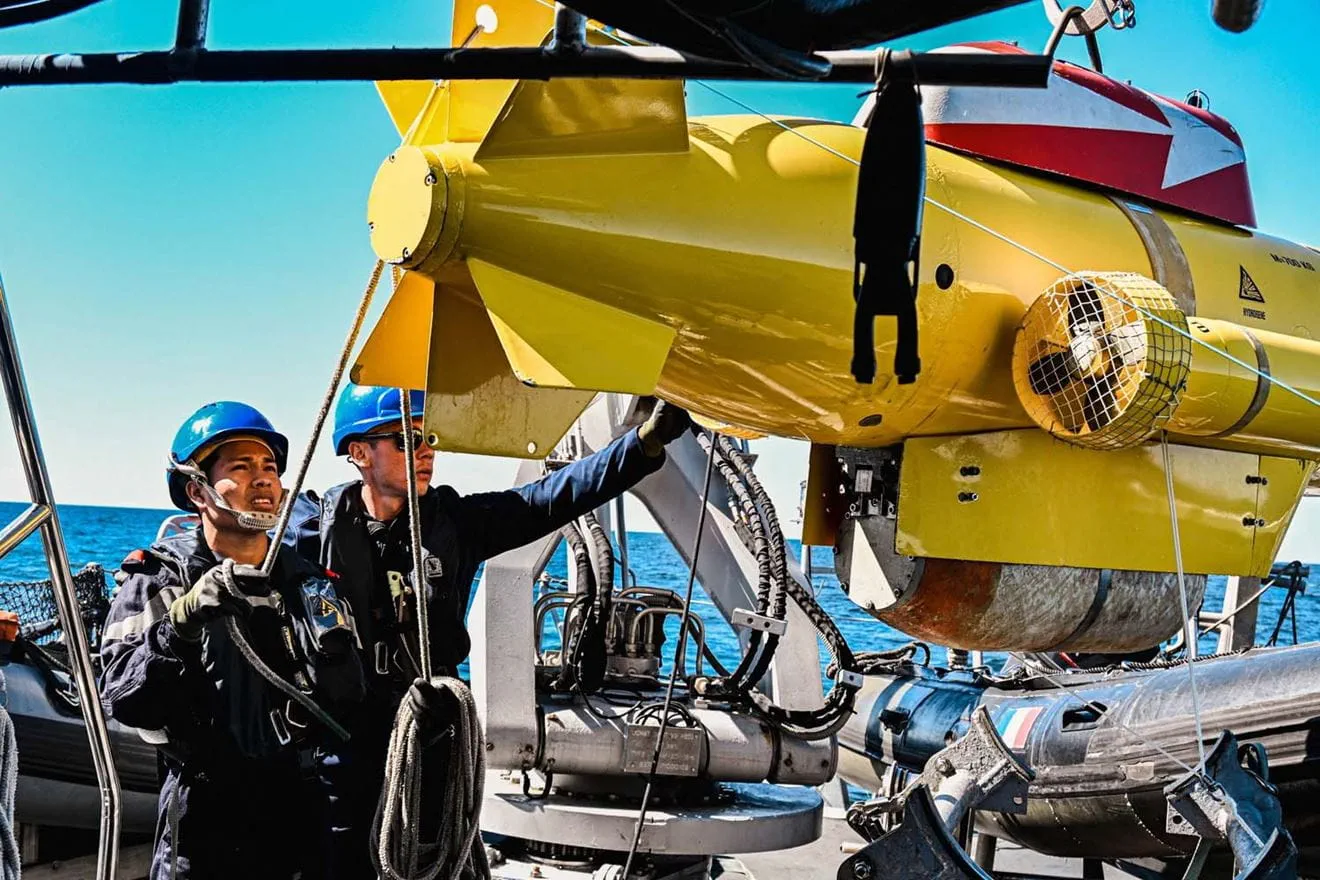
Royal Navy divers have been working with NATO allies to clear historic unexploded ordnance from the Gulf of Riga during Exercise Open Spirit, the UK Defence Journal understands.
Delta Squadron of the Royal Navy’s Diving and Threat Exploitation Group deployed to the gulf, a historically significant body of water in the Baltic Sea, to detect and neutralise munitions dating back to the First and Second World Wars. The exercise brought together ships, diving teams, autonomous and uncrewed equipment and nearly 400 personnel from Canada, the United States, Germany, Spain, Latvia, Lithuania and Ukraine.
The Gulf of Riga presents a particular challenge for clearance operations. Relatively shallow at 54 metres at its deepest point but covering an area roughly four times the size of Hampshire, the gulf remains littered with naval mines and other hazardous munitions from past conflicts. Safe access to the waterway is considered vital for commercial shipping, with Riga port handling nearly 2,500 vessels annually, as well as for the local fishing community.
During the exercise, Delta Squadron employed the Artimis Pro handheld sonar to help divers identify objects in low-visibility conditions on the seabed, alongside the VideoRay Defender remotely-operated vehicle. Lieutenant Christopher Gray, Officer in Charge of Delta Squadron, said conditions on the seabed were extremely difficult, but noted that divers could be seen “grow more confident in their role as a mine clearance diver each time they dive on a target.”
Gray added that “the opportunity to use their skillset to help other nations coupled with the chance to travel and experience different countries and cultures is why all these divers joined the Royal Navy as a mine clearance diver and represents the fulfilment of their career aspirations.”
Exercise Open Spirit 26 marks the sixth consecutive year that Delta Squadron has attended the exercise. The gulf’s proximity to Latvia, an NATO member state on the alliance’s northeastern flank, gives the clearance work an operational dimension beyond maritime safety alone, with the region having taken on heightened strategic significance since Russia’s full-scale invasion of Ukraine in 2022.




An opportunity to bemoan yet another lost reputation for the RN being the best of navies to be able to do the job. We’ve given away sweepers with years of service left in them low running costs, small crews and always available to be able deployed at immediate notice the wrong people have too much influence in too many places
Low running costs?
They cost a bloody fortune to run!
Lots of bespoke kit on both classes that needed upgrades or replacing.
Lucky the hull GRP is sound for at least 50 years… The stuff inside it… Nope… 😉
Many thanks to the Polish Navy for agreeing to host the DTXG on the Kontradmirał Xawery Czernicki (511). But another sad sign of the RN’s traumatic decline in recent years. I suppose HMS Stirling Castle may have been earmarked for the the exercise, but she is of course stuck in Gib, having gutted herself of equipment in order to fit out RFA Lyme Bay as a mothership for autonomous mine-hunting systems.
Starmer, Healey, Pollard, Cairns, HMG, will need to get their Grandstanding in.
So never mind if one assets been robbed so another can deploy, or that an asset cannot be in multiple places at once.
Equally as scary, they’re still talking about deploying in Brigade strength to Ukraine. What with, and given that an army of 110k could barely roule a combat Brigade for Helmand, then God help us.
It won’t be a combat Bde, sure, but where are these personnel coming from without robbing elsewhere?
On Stirling, she cannot deploy, so no wonder a Bay is being used.
On DTXG, and the old Fleet Diving Squadron, they’ve never had a dedicated vessel anyway AFAIK? So i don’t see the issue here in the Baltic?
Another Proteus, the second MROSS, is also in limbo, hopefully still alive in the DIP.
>On DTXG, and the old Fleet Diving Squadron, they’ve never had a dedicated vessel anyway AFAIK
Yes and no. They used to have ready access to a UK naval service owned, leased or retained vessel. To save a token amount the DXTG is now reduced to begging a lift on allied ships – German, Dutch and now Polish. Caveating the current deployment on Lyme Bay as very much an exception.
>Another Proteus, the second MROSS, is also in limbo, hopefully still alive in the DI
Hopefully indeed, but Scott seems to have been retained and refitted as a make-do second MROSS. I doubt if a replacement will be approved this side of 2030.