

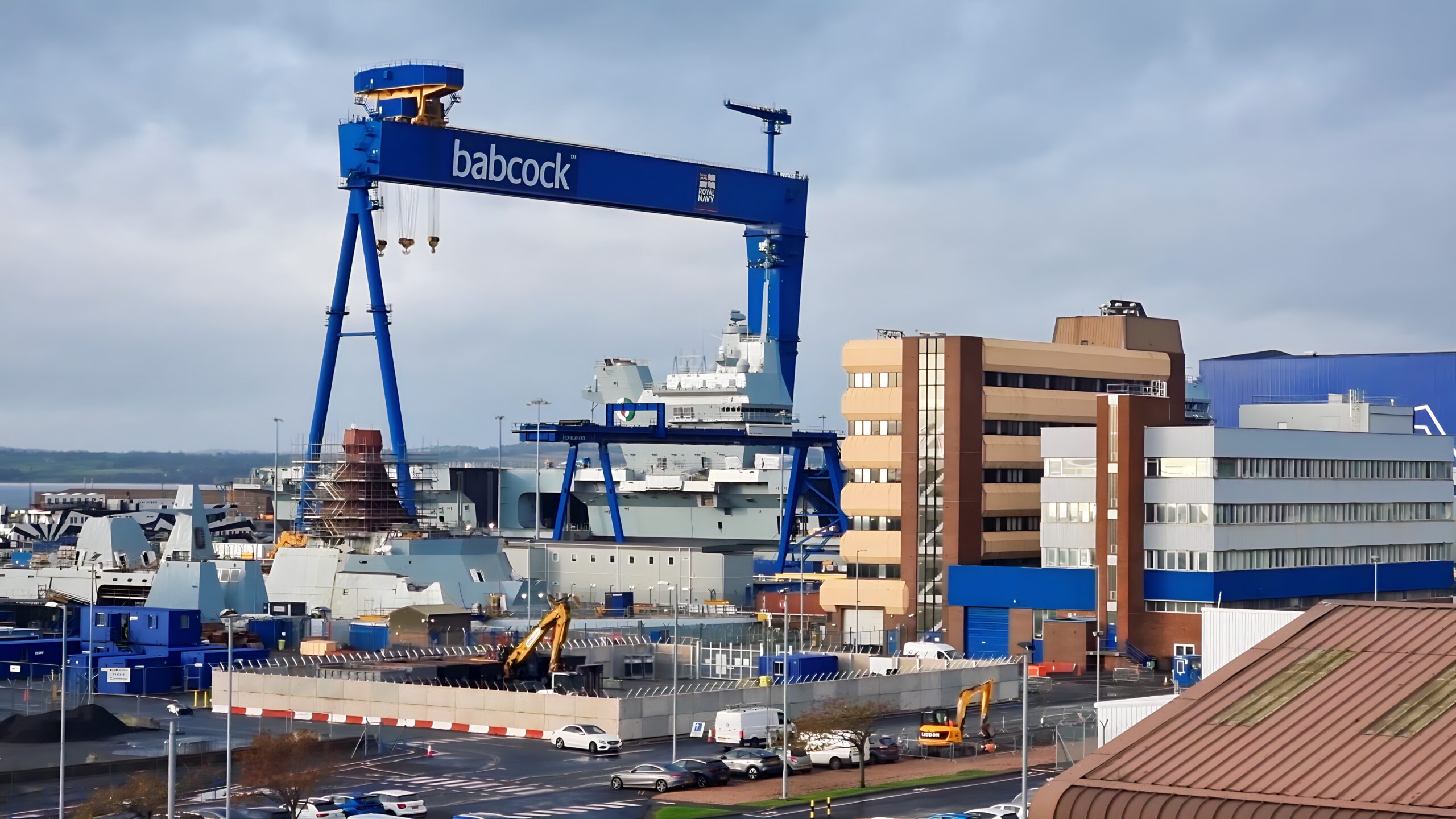
Babcock has warned that there is currently no UK programme confirmed to follow the Type 31 frigate at its Rosyth facility, raising concerns about the long-term pipeline of work at one of Scotland’s most significant shipbuilding sites, the Scottish Affairs Committee heard on Wednesday.
John Howie, Babcock’s Chief Corporate Affairs Officer, told the committee that the company was actively pursuing export programmes to fill the gap, but said it was wrestling with the decision of whether to take on more apprentices without certainty of long-term domestic work, saying “it is really important for us that we do not bring in early-career workers without the certainty that there is a job at the end of it for them.”
The Type 31 programme, which sees five Inspiration-class frigates built for the Royal Navy at Rosyth, has been a significant source of work for the facility, and the absence of a confirmed successor programme raises questions about how Babcock will sustain the workforce and industrial capacity it has built up, at a time when the government has been stressing the importance of a continuous shipbuilding drumbeat to maintain sovereign capability and skills.
On the follow-on question, Howie was direct about what the industry needed, saying “it is really simple: the need for long-term contracts” and describing it as a matter of policy that it was “never a good thing to take someone on, put them through an apprenticeship but then not offer them a job at the end of it.”
He said that in an ideal world, in partnership with the MoD, Babcock would be recruiting significantly more apprentices than it currently could, but that the Rosyth situation meant that theoretically by the time the fifth Type 31 was finished the demand would tail off, saying “hopefully we will fix that with some export orders” but that as a nation the solution required government and industry working in partnership so that people could be brought in “with the certainty that there will be long-term, secure jobs there for them.” He noted that apprentices cost money in the early years before they were able to contribute, making them an expense as well as an asset, and that this was the area where more needed to be done together between government and industry.
Howie said the company currently received around 3,500 applications for 150 apprenticeships each year, but noted that around 95 per cent of those applications came from within existing travel-to-work areas, with recruitment becoming significantly harder beyond those established industrial heartlands in Fife, Argyll and Bute and the central belt.
He suggested the industry was looking at an apprentice and graduate clearing system that would allow oversubscribed companies like Babcock and BAE to pass high-quality applicants they could not accommodate on to smaller firms that lacked the resources to run their own recruitment campaigns, saying the other applicants were not poor quality, just that there was no space for them.
On the broader skills picture, Howie said ADS was monitoring 10,000 live vacancies across the sector and that Babcock alone would need between 3,500 and 4,000 people in Scotland over the next decade due to normal attrition, with an entire generation approaching retirement. He said the company employed 5,000 people in Scotland with a wage bill of £260 million last year, paying around 50 per cent above the regional average in salary terms in Fife and Argyll and Bute, and supporting around 10,500 jobs in total across the wider supply chain and local economy, but said defence had a perception problem that started in schools, saying “sometimes, ideologically, we teach people that defence is bad and unethical”, making recruitment away from established employment centres particularly challenging.
To address the pipeline, Babcock had launched a programme targeting people not in education, employment or training, bringing 300 people into the Rosyth business through that route with an equivalent programme now rolling out at the submarine base on the Clyde, and a pre-apprenticeship programme in Argyll and Bute targeting schoolchildren aged between 14 and 16, with nearly 92 per cent of those who went through it going on to apply for and secure modern apprenticeships with the company.
Howie was also asked about why the defence industry did not do more to communicate the levels of remuneration on offer, with SNP MP Dave Doogan describing pay in the sector as astonishing and an outlier that nobody knew about. Howie said that because the industry spent government money, it did not like to look like it was “splashing the cash”, and tended to focus instead on the value, complexity and interest levels of the work, though he acknowledged that more needed to be done to communicate what a career in defence actually paid and what it involved in modern terms, saying the industry fundamentally understood that “the skills challenge is ours to fix” and was looking to government to provide a platform that made that task easier rather than harder.
Howie also warned that planned changes to English language requirements for overseas workers, raising the standard to B2, would be “massively damaging for the shipbuilding industry in Scotland”, saying the company currently relied on overseas workers in the short term because there were simply no UK workers available for certain roles, and that the new requirement would mean recruiting welders who had the same level of English as a university lecturer, adding that Babcock was working with the Minister for Migration to try to find a workable solution while acknowledging the government’s policy intent.





Where is the D.I.P.?
I know the D.I.P is overdue, but part of me thinks they’re waiting for the outcome of the local elections.
No if anything they want it before the local elections.
Does the DIP come under the ban on announcing things to close to the locals or is that only for General Elections?
Only for general elections.
Sorry Jim but you are completely wrong on that one, it’s General Elections, Local Elections and referendums. If you go onto the Gov website it’s called the “Pre Election period of sensitivity” (that’s PC most folk including the Chairman of the select defence committee called it “purdah” when he asked the PM if DIP would be beforehand). Needless to say he didn’t get a straight answer from Starmer.
2026 dates are :-
16/04 to 07/05 English Elections.
26/03 to 07/05 Scottish Elections
08/04 to 07/05 Welsh Elections
It makes perfect sense when you think about it as the Government could just make announcements about jobs, investment etc etc to influence the various elections.
I actually spent a lot of time before I retired looking at how Westminster and its odd rules work and 9/10 I could figure out when major Defence or Industry announcements would happen.
FYI The next window for a DIP announcement is between 13th May and 16th July so between the State Opening of Parliament and Summer Holidays.
Honestly it’s not HMG No1 Defence priority at the moment, saving their Bacon is 🤥
Well they’re so fucking late, they’re barred from announcing something that could have shored up his votes in the key defence areas, but no, he’s fucked it by letting Rachel from Customer Services demand an engine of growth from defence, despite the country being on a war fighting footing per her boss.
Clearly they have decided they are too weak to make any domestic cuts so they are praying for a 3rd Party fund to come to the rescue and move the problem off books….
That said cuts to the benefits bill are urgently needed before other budgets fall apart after decades of being strangled to fund NHS and Benefits.
Letting a good run here with Bancock fizzle out. Is there any update on the Denmark and Sweden orders? Even with Babcock, have they got any other export orders? What about NZ? What about the replacements for the B1s?
Local elections are going to be a blood bath for labour. Reform is going to win big. No point making a decision around them.
That’s what I mean. They might just wait for the result, and depending on whether to bother to publish it, or drag it out so the next Government can deal with it.
Next gov is 3-4 years away, it won’t be dragged that long. Just a question of if it will actually be useful or not. I wouldn’t be surprised if it was a load of words and no detail.
3 years away. It does look like Defence has edged its way into third position ahead of Health, according to YouGov.
The BMA has destroyed any remaining public goodwill with their 26% bumper pay rise demand – the send bumper pay rise…..
That bit of goodwill the NHS itself didn’t piss up the wall with its inability to do simple things well.
Give them a T31 contract
Unlikely
Why? It seems likely that that was the original plan. Build 5 and if they work well build another 5, 10 or 15.
It’s not been successful it’s turning out to be a financial mess. Luckily for the tax payer it’s a fixed rate contract but any follow on would be multiple of the price. A combo of less MOD gifted kits available for any additional ships and any docks wanting make a profit.
Well we will see if lucky for the tax payer, the ships having been finished yet, so plenty of time for dust to settle and it be discovered the contract was badly designed.
IMHO a better idea would be to bite the bullet, press ahead with a T26 based AAW T83 design and speed up the 13 / 16 ship T26 build process by adapting the T45 / QE block build idea. So get Rosyth building blocks for T26 and assist with fitting out.
It’s not cost effective or efficient to build blocks across multiple yards. If it was then BAE would start making blocks in Portsmouth.
Govan still has room for new facilities anyway, not that they’d need it.
If the focus is on cost and speed, then the government should focus on Fergusons and CL building their own vessels, and buying some OPVs from Babcock if exports don’t come through.
this won’t happen, but when i was a little boy, the local factory had a heavy fabrication bay where all kinds of stuff was banged together. if tenders were put out to build certain compartmenta for ships in build then anywhere near to the (for shipping to the yards on the Clyde. costs may be lowered build times improved another cog in the supply chain and more work for companies to benifit from all over the country.
The type 31 was designed and specified for low end, out of area, peacekeeping type operations. That world has gone. Buying more would be madness.
Don’t think thats right. Just look at the US light frigate program. Basically a T31 lookalike.
FF(X) is considerably more lightly armed than a T-31. But that’s out of desperation to get something into service and working with the constraints of the Legend Class cutter, not sound operational planning.
No it wasn’t.
Not really. They are very capable of taking a decent weapons fit, that was the whole idea. Whether the government orders more is another question entirely.
Exactly this.
Madness
Whats mad about it
Type 31 design is highly flexible large platform not a cheap patrol vessel
Look at Poland and Indonesia
I have hopes for Chile building them and although Denmark and Sweden have gone quiet on it for the moment they are ivery nterested I hope for a Rosyth built Danish order
We need more Type 31 build announced in the DIP for the RN and others
Type 31 is an oversized corvette. Not a frigate. It has no place in the current world and the current state of the RN, which is starved for warships. Would’ve been better to simply build beefed up OPVs like a Batch 3 River class instead. The best decision to take for the T31 would be to outfit it with at least 32 Mk 41 VLS cells (like the Iver Huitfeldt and Polish T31) and turn it into an air defence frigate, its radar is definitely capable enough. It would alleviate the T45 woes and allow Britain to finally have a sufficient fleet of destroyers/air defence frigates.
T83 might get in the way. the Clyde is already logjammed with the frigate orders for the T26. if its true and one of our own T26 SLOTS ARE ALLOCATED TO PRODUCTION TO SAY NORWAYS ORDER squeezing T83 MIGHT PREVENT THE EXPANSION OF THE t31 projec
Get the T31s out to sea and prove they are a good piece of kit. Government must be a little wary of investing more money in ships which have no proven record for the RN. We have had a few issues to iron out with carriers and T45s. The proof is in the eating?
Then the government are not thinking logically, but when do they do that? We pay a lot for start-stop, including in the quality of the first restart. Even if HMS Venturer isn’t perfect, and the odds are it won’t be, that tells you nothing. It’s the first warship Babcock have build from scratch, and in a shipyard that has never built a full warship from scratch before either.
Continuous production is more important, provided the manufacturer is showing goodwill. We will only be able to judge quality reasonably when we see the third ship. But it’s too late to wait to order the next batch by then. If we don’t have faith, and if we gap again, we make Babcock fire their workforce and idle the shipyard, meaning when we get around to ordering the next batch, it will be overpriced and quality impaired too, because it involves another restart. When youth unemployment is over 10%, anything that forces employers to throttle back on apprenticships needs a good hard rethink.
When one considers the billions wasted every year on complete nonsende and ineptitude. The cost of another 3 frigates on order is absolute peanuts
Yes, totally and before they start spending millions on drone type ships. If the UK wants more presence in amd around the world it’ll need more ships. The T31/A140 is useful, adaptable and affordable.
One hundred per cent Andy…BUT?
lobby stronger for an increase of the T31 order.
D.I.P doesn’t mean what we think. In reality it stands for Dithering In Perpetuity.
Gives them an alibi for not increasing defence funding as needed (right now) so they can push all the expenditure to the right, i.e. after the next election, when it may well be somebody else’s problem.
👍😊
Thank you for explaining that so succinctly.
I hope you don’t mind if I use that in future?
No problem. My roots are in shipbuilding (back in the day) but I still care when our national interest is sabotaged by a mixture of ignorance and stupidity, which is more than can be said about our Ruling Class. Rant over!
To be honest it might not be all that of a misfortune. We simply no longer have the experience and knack of building A1 vessels these days. I remember I was brought up in the shadow of Cammell Laird in the fifties when we could and did build right.
Sorry! What do you call the type 26 then?
T26 being build for 10 years?
Nonsense.
“knack of building A1 vessels these days”
The Type 45, QE Class, and Type 26 all indicate otherwise.
The confidence in export orders must have dropped then. IIRC at one point Nick Hine was saying that Babcock might not bother competing for MRSS because exports would fill their order book for the foreseeable future.
It’s gone very quiet about the prospect of a Danish order hasn’t it? Meanwhile between the French and Greek orders the FDI is picking up some momentum, be interesting to see who gets the Swedish order.
I mean, the FDI is the better choice pretty much all round if they want something quick and capable.
That depends on how advanced AH120’s design is. The French order book for FDI runs out in 2032 so slightly later than T31; if the French want to try and sell it on an early delivery basis they will have to give ships off the line which means that the Swedes won’t be able to select any of their own equipment.
The order book is a bit of a moot point, given that AH120 is mostly a new design and therefore will probably take longer to build than simply adding a couple more FDI hulls onto the French line.
The French have a good system going with FDI, don’t they? Hopefully Babcock can demonstrate an ability to ramp up production (perhaps using the new build shed) but fitout is a huge bottleneck.
Or perhaps even a very thin bottleneck?
That’s normal before down select. The Norway deal was like that too.
Not necessarily, BAE were banging the drum about eurofighter assembly ending in Warton, even though they were/are very confident in multiple export orders.
Those in charge of this country have no sense of history, no sense seeing where we have gone wrong . Why we can’t just have a new frigate in build every year with incremental improvements slowly incorporated so there is a steady stream of new ships available.. it’s not that expensive. The yards can keep skilled workers working and once ships reach ten years of age just sell them on with a new ship replacement..no major refits much cheaper and keeps fleet at higher levels of availability too . We then supply spares To the navies who bought the older ones ..it’s not rocket science . We could also offer to build ships for us navy . They are struggling to build fast enough.
…almost the same issue and why Bae didn’t splash out on a big build hall early on.
If Babcock runs out of orders and has to cut right back on apprenticeships or even the whole shebang it will likely stop ANY firm from investing in infrastructure…just to build half a dozen ships once every 10 years.
Just saying.
Get them to knock up some Batch3 Rivers with a 57mm gun, decent radar and FFBNW CAMM…and a Peregrine with martlet.
AA
Wonder how much BAE would charge for Babcock to build their design?
For who? There’s no orders
New PM followed by new Government would need show some form of activity. Failure to act decisively on defence and other things would likely kill off the Government permanantly.
What government?
I can’t think of any decisions that have been made recently!
My point exactly.
BAe cancelled the “Frigate Factory” when the number of T26 was cut from 13 to 8, TBH who can blame them when HMG had let them down 3 times on the Trot and cost them millions and massive jobs losses.
In less than 10 years various parties cut orders for T45 12 to 8 to 6, Astute 12 to 8 to 6 (forced to grudgingly increase to 7 when the DNE read them the riot act (RR and BAe) re sustainability of UK Sovereign ability to build SSBN and reactors), so the T26 cut was the last straw.
It is the whole problem with a total lack of defence industrial strategy driving costs upwards.
The medium helicopter fiasco is the latest example. Rather than asking what is the most cost effective way of doing this it is a £1Bn to spend in UK what can we get for it – dreadful way to negotiate!
Bae didn’t cancel the new Type 26 infrastructure options at Scotstown and Govan. The Treasury did.
As I said all along, the national shipbuilding strategy is a sham.
All the experience and hard work in developing those highly skilled jobs thrown on the junk heap.
How about an order for another 5? This time with bow sonar, one less mission bay section and more VLS.
There is no mission bay “section” it’s under the flight deck.
I’ve made that mistake in the past.
One less ‘boat bay’ then ….
Why
Duh, to make room for VLS
No one does VLS wider that 8 across at the centerline
The Indonesian variant removed a boat bay to fit 64 cells, now, they are Turkish Roketsan cells and they do have slightly different diementions. There is a concept model of an Arrowhead that does have, I think, Lockheed Exls launches or mk57 next to the 32 cells which required a boat bay to be removed.
I’ve gained $17,240 only within four weeks by comfortably working part-time from home. Immediately when I had lost my last business, I was very troubled and thankfully I’ve located this project now in this way I’m in a position to receive thousand USD directly from home. Each individual certainly can do this easy work & make more greenbacks online by visiting
following website—.,.,.,.,.—>>> JobatHome1.Com
Well, Leonardos “warnings” forced HMG to cave in and order a minimal number of AW149, so maybe we will see another batch of T31 after the first.
I’d not hold my breath, mind.
I suspect all of the Navy’s efforts will be expended on the Atlantic Bastion efforts (T92 and SSNs), FADS and MRSS. To be effective ASW assets as many have said the T92s are going to have to be thousand tonne ships so the budget for those will eat into any that might go into T31. Babcock can be given MRSS to build if the RN requirement turns out to be for a smaller ‘strike frigate’ design.
The issue is that the first T31 hasn’t been handed over….we all said that they had to get #1 right before getting a follow on order.
That said, everything seems to be back to being reactive.
It wouldn’t be acceptable for Labour to chuck ship yard workers on the scrap heap after they had been recruited by Conservative funded programs.
Unfortunately production lines for warships don’t work like that. If you wait until the first T31 is passed sea trials then the supply chain will already be shutting down.
If #1 had been delivered on time then batch II could have been ordered…..
But it hasn’t been so…..
And “production lines” for warships don’t really exist.
The reality is it’s not a nice to have more escorts.. 19 is simply not enough. The RN always needed 30+ that did not go away as a baseline. Now maybe the fact the T45s are so affective and even a baseline frigate AAWs are go enough that we could cut down from 12 to 6 AAW destroyers.. but that does not reduce the need for those 6 lost hulls to be replaced by other hulls.. and the frigate numbers should never have been cut.. so yes maybe the old 12 AAW destroyers 10 ASW frigates and 10 GP frigates could be modified.. but you still need 30+ ships… even if you swap out 6 AAW destroyers for GP ships.
Personally I would like to see 15 type 31 variants built over the next 15 years… that would give the navy the mass backbone to support the higher end T26 and T45…
Do you think the drones may have an impact on the need for frigates and destroyers? With Atlantic bastion the navy is focusing on output instead of input I.e do I want a frigate or do I want something that can detect and trail a submarine. Do I want a destroyer or do I want a radar picket and missile silos.
The weakness I see with the current drone control system is that it is reportedly a satellite based system and we know Putin has an ASAT weapon that the Russian’s demonstrated just before they invaded Ukraine. They have the ability to knock out LEO satellites and we we are increasingly using LEO constellations of satellites in polar orbits to give good coverage of northern latitudes.
If the satellite communications get taken out, we will need as many frigates and destroyers as we can get our hands on to enable the control and exploitation of the drones.
Any which way you cut it the RN is way too small and that point has been made time and time again, even by PM’s cross to the house!
They should order 3x T31 with a bow sonar and keep the lines running. If the first of class works order a couple more with bow sonar and more Mk41 VLS and up grade batch 1 as they come up for their first refit. While they are at it they should order at least another couple of T26, with both classes equipped to provide control capabilities of the Atlantic Bastion drones.
Cheers CR
Drones on the high seas are a complete untested concept.. the reality is a drone is an adjunct to a warship not a replacement.. it makes the warship more effective.
It’s just another version of the T45 trap.. yes 1 T45 is far more effective at protecting a single point than 2 even 3 T42s but 6 T45s does not replace 12 T42 because capability does not replace mass.. it’s a different part of the equation of maritime power and naval conflict..
Sounds like you are totally unaware of the work done primarily in China & USA.
I’ve followed those programs for ages as much as you can with the Chinese programmes.. and the most telling thing is that over a decade of hard work has lead to China committing almost nothing to construction of any kind of deep water autonomous ship.. and if China finds something that works they serial produce the crap out of it… all China has is experimental 1 offs it’s still playing around with.. in the meantime it’s launching 10+ destroyers and frigates a year and upped its SSN production capacity to 4-6 a year.. so yea we know exactly where China is putting its money as one of the leaders in autonomous systems…
I have no doubt in the china seas are littered with massive numbers of small sensor drones and yea China is even working on armed sub surface drones… but it’s not looking at blue water capabilities it’s looking to essentially replace or enhance its attritional green water capabilities..
China is laser focused on mass crewed capabilities for blue water activities..
1 T45 is more effective than 12 T42s. T42 performed extremely poorly in the only real conflict it ever took part in. 3 T42s failing to shoot anything down in three separate areas are significantly inferior to a T45 successfully engaging multiple targets in a single area.
Old Chestnuts !!!
1 T45 can only be effective in 1 place at any 1 time.
Pretty much like happens nowadays given that they spend most of the time in port/refit/maintenance/rectification.
12 T42s are effective in 0 places at any one time. Hence their abysmal performance in the South Atlantic.
Well on that basis, maybe we should have just bought the one T45 then If
1x T45 Is better that 12 T42’s ?
I think that accusation is a bit unfair. The RN used 5 T42s during the 1982 Falklands War, Sheffield, Coventry, Glasgow, Exeter and Cardiff. Two were sunk (Sheffield and Coventry), one badly damaged (Glasgow) and the two others (Exeter and Cardiff) managed to get away unscathed. Sheffield did not down any Argentine aircraft, whilst Coventry did, right up to being hit by the three bombs that helped to sink her. Glasgow was lucky, after her Sea Dart had a system failure, leaving her exposed to an Argentine attack. Although hit by two bombs, both failed to explode. But caused enough damage to force her out of the War. Cardiff had a pretty quiet war, whilst Exeter, managed to down quite a few Argentine aircraft.
Sheffield, Coventry, Glasgow and Cardiff were all Batch 1 T42s that used the Type 965 radar. Which by 1982 was hopelessly obsolescent. It did not have any doppler filtering nor did it have a decent moving target indication capability. Which meant in choppy seas or against a land backdrop, the clutter would successfully hide threats. This problem was fixed by the Type 1022 radar fitted to the Batch 3 T42s, then retrofitted to the Batch 1s and Batch 2s.
HMS Gloucester during Gulf War 1 managed to shoot down a Silkworm missile aimed at the USS Missouri battleship.
The T42 was not without its faults, Both the Batch 1 and 2s were too small, so upgrading them was very difficult, due to the lack of space. The cycling rate for the twin arm launcher was too slow for engaging a number of low flying targets that popped up over the horizon. But the main criticism of the T42s, was the lack of investment in them. Prior to the Falkland’s, they were soldering on with the crap Type 965 radars. Which was originally designed in the 1950s, it was ok-ish for medium altitude long range detection. But its low level limitations were well known. The Type 1022 was first tested in the 1970’s and fitted to Exeter in 1978. There should have been plenty of time to replace the Type 965 radars already fitted to T42s with the newer Type1022. But, the perceived threat was always from Soviet high altitude bombers dropping weapons like the Kh22 or Kh32 anti-ship cruise missiles, so there was no urgency.
If Sheffield, Coventry, Glasgow and Cardiff had the Type 1022 radars, they would have been significantly more successful in detecting Argentine threats and perhaps suffered far less.
The T42’s cramped size, did lead to the T45 being designed to be much roomier, but also easier to include upgrades and modifications. The Sylver vertical launch system was used to overcome the issues with recycling the twin arm Sea Dart launcher. But also more consideration was given to the ship’s ability to counter pop-up threats from the horizon. Fitting Sampson as high as possible to extend the radar horizon, Phalanx CIWS to begin with, along with Aster 15, with its very high impulse speed and ability to hit targets behind the ship. A lot of lessons were derived from the T42s, which went in the T45s.
They did not fail to shoot anything down
Coventry a Puma SA.330L and two A-4 Skyhawks.
Exeter shot down four aircraft: two A-4 Skyhawks, a Learjet 35A and a Canberra bomber.
Cardiff accidentally shot down of a British Gazelle helicopter
Gloucester shot down an Iraqi Silkworm missile targeting USS Missouri in desert storm
“ or do I want something that can detect and trail a submarine.”
The second part of that isn’t a drone – with a nuclear reactor a submarine will easily outrun the drone in a moderate sea state?
Yep
The best thing to trail an SSN is an SSN…
Hear me out
RR Advanced Modular Reactor in a CETUS
The ship needs to be quite large for any kind of reactor propulsion.
Not to mention that the public would not support a collection of unsupervised nuclear reactors swimming around the ocean. It’s a bad idea from a political perspective.
There is that too….
This member of the public wholeheartedly supports the concept of unsupervised nuclear reactors. They’re already quite widespread, there’s one particularly radioactive example currently President of the United States.
MSubs Moray then? I was being mostly tongue in cheek but given the lack of escorts it’s a problem that will have to be solved.
“Trail” implies the target is unaware of the trailing.
Buying ships intended for low end peacekeeping ops doesn’t give mass. It just creates a collection of death traps. The very last thing we need is more Type 31s.
No navies need a mix..because mass matters small navies lose wars to large navies. Why do you think the USN is lurching towards building a glorified coastguard cutter.. because its having a massive panic over being out massed.
Calling a type 31 a death trap is not really correct.. there are many far less capable frigates on the worlds oceans.. yes it needs a bit of an upgrade, 24-36 CAMM, NSM and a thin line sonar and you have a very good combatant.. not everything needs to be very high and and T31 does not need to only have 12 CAMM.
If you think the US glorified cutters will in anyway contribute to a war winning effort, you are sadly deluded.
Or the Type 31’s.
So the whole USN are utterly delusional.. the PLAN with its vast numbers of corvettes are utterly delusional… that’s an opinion your allowed to have.
Interesting leap of logic there 🙄
Not really.. since every major navy has been looking at mass.. and building ships at different levels of capability.. not just HMS massive.. because they know it’s not just a couple of gold plated wonder ships that win wars.. it’s a pyramid..
Look at that PLAN surface combanant fleet
3 carriers
10 cruisers ( they call them destroyers but they are cruisers at 14,000 tons
50 destroyers ( 6000-7,500 tons)
50 frigates ( 4000-5000 tons)
70 corvettes ( 1500 tons)
90 fast attack craft ( 300-500 tons)
Pyramid.. because not every ship needs to be a 14,000 ton cruiser or 7000 ton multi mission destroyer.
But maybe they are wrong.. but if they are why is the US so worried about its lack of numbers and building a glorified coastguard cutter as a GP frigate it can knock out quickly and cheaply and has abandoned its do it all high end 7000 ton frigate.
I will tell you why because the USN has done the analysis and the thinking and knows what wins maritime based wars.. it’s even published it and openly shared its anxiety.. because the answer alway come to numbers.. when equality competent navies fight wars its numbers that have alway made the difference.. even if the smaller navy had better ships it lost.
Totally disagree.
T31hulls are very capable they just need the right bits screwed onto them.
Type 31 as being built vs Type 31 in your imagination. Big difference.
Personally I’d like them to leverage Babcocks investment to assist with the T26 programme to get those 13/14 ships built, sub contract Blocks and some fitting out to them and accelerate the build timescales. It isn’t as if BAe haven’t experience of this way of building / delivery T45 and QE worked out quite well.
IMHO the Elephant in the room is we need more AAW assets more than either extra T26 or T31 (I wish that wasn’t the case but we just don’t have sufficient yards to build both at pace).
Let’s be honest the Russian Navy isn’t what it was and 13 RN & HNoMS T26 plus 15 RCN derivatives is quite a force (plus the SSN(A) TBC). IMHO Drone Ships and a T26 based T83 would make sense with continuity and overall costs.
A jump to 30+ sounds big and expensive. An incremental increase to around mid 20s might be more achievable if you add a T31B2 x 3-5 but if also the MRSS x 3-6 plus the 5 OPVs and maybe B1 replacement will give you a mixed bag of 30+.
You’d be better off using T31 BI as a River replacement.
These are at least ships that can be used as a part of a CSG etc
As an OPV they would be massively over specked and costly to operate.
Whilst it is true they are too much for constabulary roles we are moving into a war(ish) time and with the limited shipbuilding capacity as well as budget we have to choose, very quickly, what we want as we can’t build all things.
So we either fight a war with an OPV or a fully fitted out T31 with Mk41 and NSM + a light weight tail of some kind.
I know which I would choose to be in.
RN has to move away from being spreadsheetists into war fighters and OPVs are no use at all for blue water fighting and for that we need mass of mid spec GP ships of which T31 is a very good example when augmented by T45/26.
“Whilst it is true they are too much for constabulary roles …”
But that was what the MoD said they were designed to do 🙄
But I’m really talking about a generation long rebuilding, your looking a the last ship of that T31 push finishing its second stage trials in the 2042 timeframe..
And I’m with supportive, in the end I would simply not replace the batch 2s like for like, in the end they are more ship than you need for security around the EEZ and local infrastructure and not enough ship for higher end Patrol work or when it gets serious.
A new order of 5 T31s in 2027 and then a second order in 2035 is not really expensive or even in reality very ambitious.
How many similar sized countries are planning 30+ escorts for their Navies? The Italians are planning 21, and the French have 15. Both have far better MCM and amphibious capabilities. The RNs only available amphib is currently acting as the only expeditionary MCM mothership. Both of those capabilities are far more important than chasing fantasy fleet numbers of frigates.
Italy will have 21 high end escorts then it will have what are going to be a load of corvettes, 3000 ton 110 meter vessels that will include Anti ship missiles and air defence missiles, meduim gun and small ship flight ( what the RN would have once called a patrol frigate) . It’s going to have about 12 of these modern well armed large corvettes in two different designs.
So actually the Italian surface fleet will have around 33 major surface combatants in the 2030s… and Italy is a smaller poorer nation than us that expects far less from its navy in terms of deployment.
Italy also doesn’t have the nuclear costs, though they are talking about looking at SSNs or a CVN (though current economic disruption might have knocked that back), so they don’t have the massive drain in the budget.
But they still run 2 Carriers around the 30,000 mark and have plans for around 40F35Bs as as you say they are now looking at a nuclear powered CATBAR as its next generation carrier in the 2040s
They also have a conventionally powered submarine programme, a new program for 2-3 16,000 ton amphibious vessels..
But most telling of all their defence budget is tiny compared to the UK 27-28 billion pounds vs 62 billion…
The fact is they have a larger more modern surface combatant fleet with a 30+ major combatant ambition on less than half the budget show something about how far the UK has fallen in its will to have a navy with mass.
That is not true. The Vivaldis are 95m and are armed only with guns. They are planning for 8 EPCs, which are still not frigates. They are smaller, cheaper and have less crew than a T31.
There is a reason they are buying corvettes and not building more GP frigates.
Yes the reason they are going for corvettes and not GP frigates is they don’t expect their navy to operate in every ocean.. and actually they are very clear they are planning to add anti air missiles to the Vivaldis.. so ok 4 of the 12 will be 95m and not 110 m that’s hardly changing the point is it.. Italy is deploying navy around the 30 mark for the 2040s..
They are buying GP frigates. The Thaon di Revels are GP frigates. They are choosing to buy a large number of corvettes instead of more frigates. The River OPVs have been far more useful for the RN than 1 more T26 would be.
The 4 Vivaldis on order are not planned to have missiles added.
The French Navy is expected to operate in every ocean, and they still only have 15 escorts. They are also planning for 22 OPVs. More frigates is one of the last things the RN needs. MCM motherships, MRSS, River B1 replacements are all needed before a second batch of T31.
The RN only operates regularly in every single ocean because of the River OPVs. Without them the RN would almost never operate anywhere outside of the North Atlantic/North Sea/Med/Middle East.
But again historically many of the French OPVs have essentially been patrol frigates especially the Floreal class.
And that’s my point the RN is being forced to deploy in far oceans with inadequate ships.. after all what would you rather patrol in a B2 rivers or a Floreal class or even better one of the new corvettes France is planning to build.
The Thaon di Revels are not a GP frigate as all Italian PPAs are going to be full capability, that’s a very high end radar set, including anti ballistic missile capabilities, towed array sonar, aster 15 and 30, strike and anti ship missiles, light weigh torpedoes an guns, that makes them multi mission ( all purpose frigates ).. only the PPA light was essentially a GP frigate.
The Floreals are frigates that were downgraded to OPVs. Their Exocets were removed, and other than guns, all they have is some VSHORAD.
Of the 22 OPVs in 3 separate classes that France will operate, only the 6 EPC will have missiles, and even then they will be short range SAMs. They aren’t going to be deployed anywhere a River wouldn’t be deployed. What threats does a River B2 face in the South Atlantic/Pacific/Med/Caribbean that some starstreak missiles will solve? Guns can shoot down a limited drone attack. Missiles, a drone swarm, ballistic missiles, Torpedos etc. wouldn’t be stopped by one or two LMLs.
Thaon di Revels are GP frigates. It doesn’t change my point anyway. Italy is choosing to buy OPVs/Corvettes instead of buying more Thaon di Revels outfitted with whatever.
The French Navy has 3 LHDs and is planning for 6 MCM motherships. The Italians have 5 amphibs and are planning for 4 MCM motherships. As yet, MRSS hasn’t seemed to have progressed at all, and the only word on the MCM motherships is that they’ll be based on a Norwegian design.
Italy has 4 amphibious warfare ships. Of those, 3 are the San Giorgios which are FREMM sized, and one of them is an inactive training ship. The original design used deck parking for vehicle storage, and the rework they recieved means you basically have a choice between any significant vehicle carrying, or using the deck for helicopters (they lack elevators so can’t store helicopters below decks even if the hangar was big enough). Trieste, the only really viable amphib for anything beyond shipping troops to Croatia, doubles as a carrier.
What is your point here? San Giorgio’s aren’t amphibs because they’re small and have no hangar? They’re being replaced in the next 10 years by 3-4 16.5k tonne LPDs anyway. Cavour can carry hundreds of troops and has landing craft.
The only available British amphib doubles as the only expeditionary MCM mothership. It is undeniable that the Italian Navy has a far better amphibious capability.
My point is that 1) Your numbers are wrong. 2) Even if your numbers where correct they don’t tell the full story and are misleading about what Italy’s amphibious capabilities are.
Just as in your second sentence: you are being misleading: the LxD program is for 2 ships with an option of a third that hasn’t been taken up yet. Not 3-4. It’s also not funded, and off in the distant future, probably after the Vulcano resupply ships, so construction starting in the 2030’s. So not really relevant, especially as multiple FREMM’s and PPA’s are rolling off the stocks first, perhaps even DDX.
“Cavour can carry hundreds of troops” Oh, so now apparently we are counting Italian Carriers as Amphibious assets but not British Ones? Even though the QE’s are capable of carrying nearly 1000 embarked troops compared to Cavour’s reinforced company group of 350?
Oh and here we go, yet another bit of “accidental” misleading to round it off “The only available British Amphib.” So now we are at a point where we are counting every Italian amphib, even if it has been relegated to a training role, not paying any attention to the actual lift capacity of said amphibs, because a hull is a hull, and counting the Italian carrier as an Amphib, while in Britain if an Amphib is in refit or alongside for downtime it doesn’t count, and of course you couldn’t possibly count the Aircraft carriers, those have to carry aircraft, not land troops.
Oh and of course apparently the unfunded LxD project that will materialise in the 2030’s at some point counts (with a small inflation on the number of hulls under order) but the 6 MRSS’s the UK has at a similar stage of development don’t…
Last sentence:
No. A Bay and a QE loaded up with Chinooks and troops is going to represent a better amphib capability than a single San Giorgio and Cavour. The Bay alone carries more troops and vehicles than San Giorgio and Cavour combined.
1. 3 San Giorgio’s, Trieste and Cavour makes 5.
2. I’m not misleading anyone. It is undeniable that the Italian Navys amphibious capabilities are better than the RNs.
“the LxD program is for 2 ships with an option of a third” ❌ The Italians want 2 amphibious groups each with 2 LXDs
“It’s also not funded, and off in the distant future” ❌ There is a clear funding plan with €1.2b to be spent next year.
“probably after the Vulcano resupply ships, so construction starting in the 2030’s” ❌ They will enter service before the second batch of Vulcanos, and construction is to begin within the next few years, and unlike with British shipyards, it won’t take 20 years for Fincantieri to build them.
“multiple FREMM’s and PPA’s are rolling off the stocks first, perhaps even DDX” ❌ That is irrelevant, Fincantieri has 8 shipyards in Italy. Escorts are made in Riva Trigoso, large Naval ships are made in Castellammare di Stabia.
“Even though the QE’s are capable of carrying nearly 1000 embarked troops” ❌ That is not true, I’m not sure where you even got that number from. It is actually 250. The difference is that it was a primary design feature in Cavour, that’s why it has landing craft too. It was a last minute addition to the QEs, and doesn’t even feature on HMS QNLZ.
“even if it has been relegated to a training role” ❌ None of them have. They are temporarily assigned that role, tomorrow they could deploy as an amphibious vessel. The RN has to decide whether it wants an amphib or an expeditionary MCM mothership. When the lone available Bay deploys as one, the RN has none of the other.
MRSS has no design, no funding, no shipyard that has been selected etc. The design for the LXD has been selected, as has the shipyard, and there is a clear funding plan.
The two RN/RFA amphibious vessels that are available and have been to sea in the last year (Mounts Bay and Prince of Wales) can carry 606 troops and 950 in overload. The 5 Italian amphibs that are available and have been to sea in the last year can carry over 2,000 troops and likely over 2,500 in overload. They have significantly more landing craft, and can carry a similar number of vehicles. The only aspect the RN has them beat is the number of aircraft they can carry.
You’ve managed to be incorrect/misleading on nearly every point you’ve made which is very impressive. Better luck next time buddy!!!!
Also Lol:
250 is the Royal Marine compliment a Queen Elizabeth embarks for normal day to day Carrier ops, in an Amphibious Assault role the number of ground troops carried is 900.
Yes I got that you are dishonestly counting their carrier as an Amphib asset but not the UK ones. I covered that. Do keep up. You are misleading and now I’m convinced delibereatly so.
Italy might want 2 Amphib groups with two LxDs but that’s not what’s on the order book, so again, dishonesty from you.
The project has not been funded, it is in the same state as MRSS with just a plan to spend money at some point in the future.
Escorts are currently under construction and will, in regards to your conversation withn Jonathan, continue rolling off the stocks before money is ever spend on LxD. You know that was the point I’m making.
QE troop transport is true, that is the actual number of Troops they can carry. I think it’s a bit wild that you think a 65,000t ship only has space for 250 troops. Both ships are capabale of operating in an Amphibious role, and it was hardly a last minute addition since with the planned withdrawl of Ocean it was always the intention that the helicopter lift aspect of Amphibious assault was going to go to the Carriers.
San Giusto is relegated to a training role. I get it puts your panties in a twist but that’s just where it sits. Not my problem you seem allergic to facts.
Oh and then theres a hugely erronious load of crap at the end there. Because again, dishonset skunk, you are counting EVERYTHING ITALY COULD CONCIEVABLY HAVE vs what is operational in UK service right this moment. Italy does not have 5 Amphibs. It has 3, and if it decides not to have a carrier (again dishonestly crying about the UK having to decide between an MCM mother ship and an Amphib and acting like Italy doesn’t have the smae dilemma with it’s carrier) it has 4.
Prince of Wales and Monunts bay in Overload carry about 1,500 between them, when you make an HONEST apples to apples comparison, the Bay’s alone carry 2400 troops in overload, and then add in 1,800 more on the carriers. So make up your mind: What’s the comparison you want to make; the entire lift capability that each navy has, or what both navies can lift at any given time.
It’s either 2 QE’s and 3 Bays vs Cavour, Trieste, and 2 San Giorgios, or it’s a QE and a Bay vs Trieste and a San Giorgio. Make up your mind which comparison you want to make because if you compare all of Italy’s Amphib ships against the one the UK has available to sail right now I will continue to call you dishonset AF.
Learn to have an honest conversation, then come back.
😭😭😭 you genuinely have the IQ of a melon. The most embarrassing thing from your post is your claim on the San Giusto. Please just google Orion 26 before you embarrass yourself again.
The Cavour is designed to carry a battalion of marines, and has 4 landing craft. It is designed for amphibious warfare.
0 MRSS are on the order book so the UK will never get any MRSS? The Italians want a fleet of 4 LXDs, with €1.2b funding set aside in 2027. As yet 0 funding has been set aside for MRSS.
HMS Prince of Wales was modified in order to be able to better support the LPH role. The QEs have 1,600 berths, of which over 700 are for the crew. Hundreds more are needed for the air wing, and when operating with a full air wing there is no room left over for any troops anyway. Even a reduced air wing wouldn’t leave much room.
San Giusto is not relegated to the training role. It just took part in Orion 26 in the amphibious role. It’s genuinely so embarrassing that you were so confident in saying that, when a simple google search proves you wrong.
All 5 Italian amphibs are available, and all have been to sea in the last year. Only Lyme Bay is available of the 3 Bays. Mounts Bay hasn’t been to sea since March last year, and Cardigan bay hasn’t been to sea since October 2024.
In order for a QE to carry 900 troops in overload, it would have to shave off crew members, carry zero aircraft, and not be the flagship of the deployed fleet. I guess the Royal Marines can just jump off and swim to shore.
It’s 1 Bay (currently acting as an MCM mothership), and HMS PWLS, against Cavour, Trieste and the 3 San Giorgio’s.
HMS QNLZ doesn’t have the widened access routes for fully armed marines that PWLS does.
It’s 1 Bay (currently acting as an MCM mothership), and HMS PWLS, against Cavour, Trieste and the 3 San Giorgio’s.
^this is all I needed to read. You are incapable of being honest. There is zero point in even giving the rest of your lying rant any attention if you can’t make an honest apples to apples comparison.
Grow up. Learn to have a honest conversation. Then maybe we can talk.
😂😂😂
You cannot respond because then you would have to accept about being wrong about the San Giusto. The ship that just took part in an amphibious exercise isn’t an amphib, but Cardigan bay that hadn’t put to sea since 2024 is the best amphib in the world. Your IQ is comparable to that of a baboons.
Honestly, not shocked that someone with your lack of intellect and honesty would choose to not understand the difference between “can’t” and “won’t”
As I said, grow up, learn to have an adult conversation. Bye.
You cannot respond because in order to do so, you’d have to admit you were wrong about the San Giusto, which would be too much for your ego to handle, especially considering how arrogantly sure of yourself you were. Your ego is also the reason as to why you have to get the last word in.
Learn to make an apples to apples comparison like an adult, and I’ll bother to read your replies.
Just saw this so I’ll respond.
“Also Lol:
250 is the Royal Marine compliment a Queen Elizabeth embarks for normal day to day Carrier ops, in an Amphibious Assault role the number of ground troops carried is 900.”
That is incorrect. Not once has a QE ever carried 900 ground troops, nor will it ever. The minimum crew is already 700. In addition to that it also has to carry the CSG command component, and hundreds of aircrew. The QEs do not carry 250 ground troops regularly either.
Learn to make an apples to apples comparison like an adult, and I’ll bother to read your replies.
Learn to use google. The apples to apples comparison is the number of available amphibs. Which in this case is Trieste, Cavour and 3 San Giorgio’s against 1 Bay and 1-2 QEs even though HMS QE doesn’t have the widened access routes for troops. If you are going to respond, you don’t have to accept being incorrect about San Giusto, you just have to refer to 3 San Giorgio’s instead of 2.
Learn to make an apples to apples comparison like an adult, and I’ll bother to read your replies
😂😂😂
You got the most basic info incorrect. The first google result for San Giusto is it taking part in Orion 26, and you still thought it was an inactive training ship. Your ego won’t let you admit that you were wrong, and now it is forcing you to get the last word.
Learn to make an apples to apples comparison like an adult, and I’ll bother to read your replies. (Amzaing this concept is beyond you).
😂😂😂
The 4 Vivaldis on order are not planned to have missiles added”
It specifically has an area set aside for MBDA Albatros NG medium-range air defense system.
And the T45s have an area set aside for strike length VLS. So what?
The Vivaldis on order are not planned to have missiles added.
They are actually running a program to assess viability and when.. it’s more thought out than leaving a hole
Sell on the initial five to NZ and Chile, then order another five of the same for the RN, built from the outset with Mk41 (or a sonar instead).
Given the selection by Australia of the Mogami, I’d be doubtful that the RNZN will go Type 31 tbh, and aren’t their current frigates relatively recently finished their midlife upgrades? Chile might be an option alright though. But as pointed out a Batch 2 is likely to be more expensive even without extras.
I hope Babcock aren’t on’t give up on the T31 for NZ. The Mogami for NZ though a very capable ship might prove expensive either direct from Japan or later from Aus. I think their Anzac frigates have had a relatively newish upgrade (radar & CAMM) but they could do with getting 2×4 NSM each like with the RANs for a bit more clout.
*don’t
They could well be expensive, but who knows what the price tag for a “batch 2” T31 or Arrowhead 140 will actually be depending on what spec? I mean as you say the RNZN Anzac’s had a midlife only a couple of years ago, and aren’t planned for replacement currently till the mid 2030’s so not a great timescale for Babcock right now.
A Danish export order for T31 would clarify options. For the UK to order frigates ‘on spec’; for sales stock as it were, would require a massive increase in faith and a cultural transformation. Mon Dieu!
Why should the UK subsidize NZ or Chile?
It would be subsidising UK shipbuilding. The French and Italians have done it with their FREMMs, and the Germans are planning to do it with their F128s.
I’ve gained $17,240 only within four weeks by comfortably working part-time from home. Immediately when I had lost my last business, I was very troubled and thankfully I’ve located this project now in this way I’m in a position to receive thousand USD directly from home. Each individual certainly can do this easy work & make more greenbacks online by visiting
following website—.,.,.,.,.—>>> JobatHome1.Com
There was an article recently about no British yards bidding for an upcoming calmac ferry contract. Lord of the isles replacement. I don’t understand why yards like Babcock don’t bid for these? Can they only build warships? Doesn’t make sense to me.
I guess it’s down to not enough hull numbers to justify. Or if they do get type 31 orders, they would have to get a single design out of the way cost them to reconfigure the building hall. Babcock does have the Victoria class disassembly contract and a carrier dry dock contract for 10 years at Rosyth, ok, it’s not ship construction, but it justifies keeping Rosyth open. I may be wrong.
It’s the same reason that Land rover doesn’t make trucks and BAE land systems doesn’t make bulldozers. Building a ferry and a warship is completely different.
The yard capacity should be used to build Type 26 so as not to delay vessels for the RN to satisfy the Norwegian order. Sadly I can’t see this happening.
If the RN doesn’t want more lower end T31 and if the T31 can’t cheaply be turned into something more capable then the design might be dead. It will end up filling the role of the Rivers.
It would be obscene to lose the yard and skills so Babcock might end up constructing a larger USV, a couple for trials would tide the workforce over and allow the MOD to produce endless power points and claim cutting edge..
Other than that , what else is there? Some of the Norwegian designed multi role vessels ?
A couple of ships to monitor cables?
Block work for an Argos Replacement ?
Could it build the Project Euston barge?
The T31 can be anything you want it to be its father and grandfathers are AAW frigates, ASW frigates and littoral strike frigates..
It could be given any number of CAMM, NSM or a thin line sonar.. it’s a large 6000 ton modern frigate hull.. its limit is what the RN wants to put on it.
And its latest iteration as a drone command ship. I wonder how expensive that one is?
Yes, it could be anything it you make a vastly more expensive version of it. As it stands for £250m , it has Tacticos CMS and a budget Radar, and not a lot else. A more capable sensor and sonar suite adds how much?
There is no guaranteed budget to upgrade the 5.
How much does the crew size increase with additional sonar, considering manpower is the issue.
If they start nearing £800m to £1b with a 5 million development period , on a ship that is a 2000 era design , launched by the mid 2030s , then a clean sheet option might be more cost effective, if the govt actually wanted to boost escort numbers.
Adding more CAMM is going to be very little, NSM is not an expensive upgrade. A containerised towed array in the mission bay is not going to be expensive.. these are not major changes..
The mission bay has an access hatch on the starboard side, the bay itself just being a 120m square space under the flight deck.
Could you tow a sonar array from a side hatch? The winching gear and TAS on a T23 is about 30 tonnes and the ship is designed for the stress
A lightweight system could be packed into a shipping container, but it would require an access point on the stern. That would be a redesign of compartments, and be dependent on where the structural girders are.
Then rafting for the diesels, which apparently could be done…at cost.
The Absolom layout would be a better fit for that.
The only towed system that seems feasible is from a USV boat, such as the Krait system.
Yes you can uparm a Type 31 with NSM, more CAMM and or Mk41, but for ASW ?
No new ships. No new orders.
The reality I’m ‘fraid.
Given the military necessity for UK defence to have a strong RN, follow-on T31 batches (plural intended) would be the logical decision to make and finance; however HMG incl. the inept MoD cannot get there.
.
.
Even if the RN cannot be grown quick enough, completed vessels could be rotated into the active fleet with the older units refitted and put into reserve (imagine that) until crews are available. Additionally, with a rolling production line, hulls become cheaper to build and export orders would follow such a commitment to the defence industry from HMG; just like they did with the Leanders, Oberon classes; such a production line would obviously allow for capability enhancements with each subsequent batch – This would also address the often reported scenarios where russian (lower case text lack of respect intentional) navy vessel escorting shadow fleet vessels through UK waters out match the RN assets shadowing them, perhaps even allowing the talked about interceptions of said shadow fleet vessels with impunity.
The solution is obvious. Order a couple more T31’s. It might even be a selling point for any interested navies to know there are extra ships on the the way. Even if there are no takers the RN gets to keep them. A win -win.
Can we make it at least 3? Lol.
Can I hear 4??
Absolutely no surprise. It has been clear for years that T32 (aka T31 B1) was unfunded and wouldn’t happen. I have low expectations for DIP. Export orders (Denmark, Sweden, Chile, New Zealand …) is the only way Babcock Rosyth will survive as a ship builder.
What a funny way to run an island nation during a time of greatly increasing tensions: stop building boats and scrap the ones you have. Oh well, at least we’ve got a few auxiliary tankers shadowing Putin’s fleet, that’ll send the Russians a message.
Yes, less ships, less presence, less capabilities, less flying the flag, less standing on the world stage and less real ability in upholding international law and order. Eighty percent (is a fugure often quoted) of world trade still goes by sea. Not sure if the UK economy is more export or import dominant but its dependent on the trade flows and the security of it all and being an island. Why shrink, you need muscle to stand up to bullies and adversaries trying to call more of the shots.
Agreed we need more Frigate mass but until UK Gov places orders (Only 3 sets of Mk41 and 5 Mk45 ordered so far?? For new vessels) to cover ALL aspects of RN frigate replacement we go round in circles.
If we are committed to protecting the UK and the Overseas Territories we need mass.
Seems to me another U-Turn by the Government. 24 months ago Mr Starmer said they would do thing differently by putting the best interests of Country First. Quite blatantly not true, the Starmer-Reeves-Healey Triumvirate need to go!! Yet again with a party with a large majority we get too Much Politics!!!
The RN need more hulls and fast so JFDI!!!
I feel confident that on his state visit to the US, the King will sell Trump on the Babcock – HII Armor Bastion proposal, that Babcock will be building more T31s for the RN and that HII will licence build the T31 for the USN 🙂
Not only Rosyth but what about Harland an Wolff, once the support ships are built what then. Currently 3 yards with only one with an order pipeline (ignoring Barrow).
Conservatives – Party of Defence cuts
Labour – Party of Defence ambivalence
-“but said defence had a perception problem that started in schools, saying “sometimes, ideologically, we teach people that defence is bad and unethical”-
i repeat myself. The immense damage that the education complex and journalism does.
This is exactly the problem with UK shipbuilding being too defence dependent and the government of the day.
Historically, yards didn’t rely on one customer they built naval ships and civilian vessels in between contracts. That kept skills alive and avoided these gaps.
If there’s no follow on warship work, the answer shouldn’t just be “we need more government orders.” It should be high value civilian work:
offshore wind vessels ,research ships ,Large ferries ,specialist vessels ,autonomous vessels
There’s real demand there for this work in markets that value quality of work as much as price to built the ships and it uses many of the same skills.
A healthy shipbuilding industry shouldn’t be waiting for government work to survive it should be able to win work commercially as well.
The real issue is the UK no longer supports that kind of mixed shipbuilding model.
No other country supports that type of shipbuilding model. Naval Group isn’t going to start building ferries at Lorient when they finish with the last FDI. Fincantieri won’t start building OSVs at Riva Trigoso if their order book were to run out.
Why would any commercial company buy a vessel from a shipyard that’s never built a ferry/OSV?
Ridiculous and totally avoidable, as per the NSS we should have a fully funded committed shipbuilding plan that refreshes the fleet every 25 yrs. this equates to 1 submarine every 18 months on a proposed fleet of 17 (5 SSBN + 12 SSN), 1 complex warship (25), 1 OPV/small vessels (25), 0.5 large vessel / RFA (12) + 8 unmanned systems (all types) per annum (100)
This is hardly fantasy fleets stuff, its the minimum realistic volume of manned assets for an island nation with a proper regional blue water navy (79 + 2 carriers = 81)
Reversing the manpower cuts is going to be a challenge, but this is over 25 yrs so time to do it.
The total lack of a clear committed plan is part of the problem with defence, HMT just don’t get defence inflation & the MOD don’t get project management
This situation is totally avoidable
It’s all very well building these and more but we also need a Government that can get Onboard and give defence some serious direction for the future. Not just ships but people to crew them.
It’s staggeringly obvious that we have way too few of either.
And sort out the RFA pay ffs.
Two Tides, tied up at Portland again today, Portland must be raking it in.
(fun trip was had on “Trump” the 1200 earlier, the Jurassic coast Is a bikers dream… apart from the Scamera Vans.)
Time the uk orders another 5, we don’t have the warships now to escort the carriers, never mind other work the navy needs to carry out
European defense (uk included) is in a coma. Soon it will be the funeral.
How do you figure that? Defence spending is going up across the continent, hardware and consumable procurement is expanding across pretty much everything.
You wouldn’t think it would be difficult for a government to prioritise something as important as Defence of the Realm over something so trivial as breakfast clubs but here we are. I refuse to take anyone in the Labour Party seriously until threy grow up and start doing the essential work of running a state.