

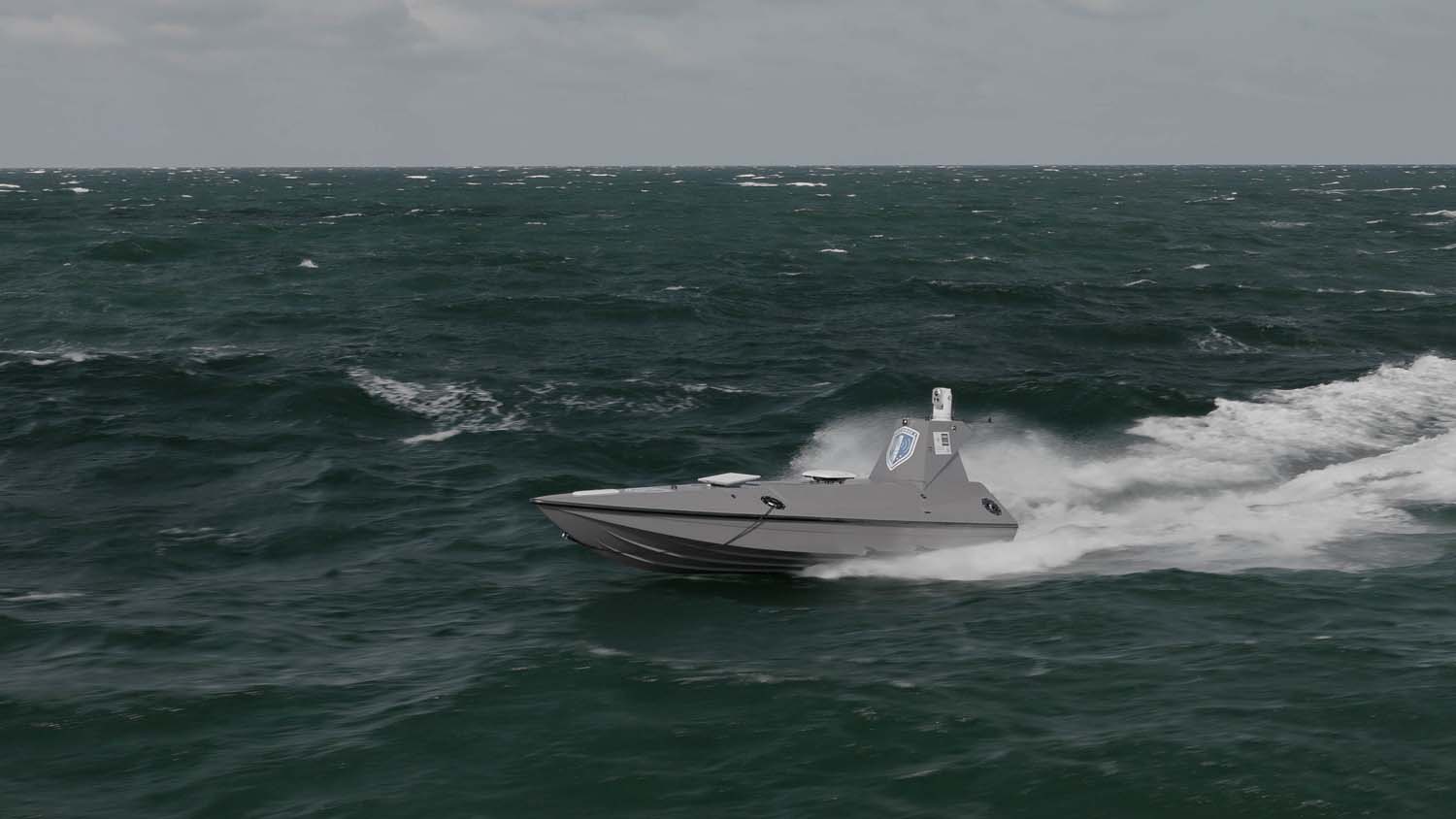
Drive past the perimeter of a certain naval base and peer through the fence and you can already see twenty Kraken K3 Scout uncrewed surface vessels, delivered and in service.
For Captain Adam Ballard, the Royal Navy officer responsible for Project Beehive, that is what success looks like. “There’s been a lot of cynics on the internet going, yeah, they’re going to run a competition and nothing’s ever going to happen,” he says. “Or they’re going to buy it but it’s going to take four years to deliver. We’ve gone from an RFI out to industry, through a tender process, to 20 boats in Pompey Dockyard in about five or six months.”
Project Beehive is the £12.3 million programme putting Kraken USVs into the hands of the Coastal Forces Squadron and 47 Commando Royal Marines. It was designed as a proving ground, somewhere to test ideas with real hardware in real conditions, and Ballard is open about the uncertainty on where this will lead, telling me, “I have this phrase when I walk around Navy command headquarters. Let’s have some humility and go, I don’t know.”
The boats are, by conventional naval standards, small at 8.4 metres long, displacing under 2,500 kilograms and carrying 600 kilos of payload in a modular bay that can be swapped out in around ninety minutes, turning an ISR platform into an electronic warfare or surface warfare platform in roughly the time it takes to watch a film. Ballard has a phrase for it. “It’s the Toyota Hilux of the seas. With 600 kilos of payload, you can just have a whole bunch of imagination.”
The flexibility goes further than the payload bay as modules can be built, shipped anywhere in the world in the back of a plane and bolted into a boat that is already there. Kraken is also developing an air dispatch option, a parachute pack that will allow the payload modules to be dropped from an A400 transport aircraft. Extended range fuel tanks, recently completed, push the operational range beyond the standard 650 nautical miles. “For context, that’s basically driving from Portsmouth to Estonia on one tank of fuel,” Ballard says. “Really meaningful distances.”
Launch and recovery systems are in final trials that will allow the boats to deploy from Type 26 and Type 31 frigates, providing a force protection screen through narrow choke points, meeting asymmetric threats at a fraction of the cost of conventional platforms. The integration goes further still. The boats can operate over satcoms and mesh radios and will be able to plug directly into the Commando Forces Network, meaning a Royal Marines raiding party going ashore can have USVs fully integrated into their own network.
“A lot of people look at USVs around the world and see them as just an independent little boat that goes and does something,” Ballard says. “A lot of our money, a lot of our time and effort is integrating these into the joint force. This is not just a pet toy project, this is a proper part of the Navy.”
He reaches for an analogy from air power, saying that “I can now deploy my loyal wingmen from my Type 26 or my Type 31 and provide that force protection screen around my task group. A frigate can now take its own task group with it. That’s kind of unheard of in naval warfare.”
The boats carry their own GPUs, meaning AI models can be run on board. Ballard is careful about what he says next. “I’m not talking about a lethal autonomous weapon system. But a level of platform autonomy that starts to lift operators, lets humans do what humans are good at, which is context and really difficult things, and lets the AI do the dull, dangerous, dirty stuff.”
But it is the learning, more than the hardware, that Ballard returns to, and the Royal Navy has found more to work through than expected. Three iterations of the USV operator training course have been completed and formally endorsed by the Maritime Coastguard Agency. A contract has just been signed for a virtual training environment designed not just for skills but for mission rehearsal. The ground control station interfaces needed significant rethinking once real operators sat down in front of them. “It’s really different sitting in front of a screen looking at a visualisation of the sea than it is standing on the bridge that I did for 20 years,” he says.
Communications remain difficult regardless of what the brochures say, and Ballard is pointed about the gap between what commercial satellite systems promise and what they actually deliver at sea. “Everyone thinks these systems are perfect the whole time. They’re not. We’re spending a lot of time developing robust reversionary comms plans.”
And then there is the question nobody thought to answer beforehand and which, it turns out, nobody has answered at all. What is the legal status of an uncrewed surface vessel? Is it a warship? “There is no legal precedent,” Ballard says. “We’re figuring that out.”
He is also clear about the limits of what lessons can be taken from Ukraine. “The Black Sea is a lake. You don’t get sea states in the North Atlantic like you do there. What are the right things for me to learn? Small USVs in the Norwegian fjords, the Baltic, the North Sea, the English Channel, brilliant, ideally suited. But the deep Atlantic, that’s where the much larger platforms and traditional crewed assets absolutely have a path and a place.”
Beehive, though, was never meant to be the destination and Ballard is explicit that the funding now flowing into remote and autonomous systems represents the next step, with much of that money going not into new hulls but into the digital architecture that connects them, what he describes as a maritime fighting web. “A lot of money in that area will go into the digital architecture that actually turns these from a really great science experiment into a weaponised fighting part of the joint force, integrated into a maritime fighting web,” he says, and in that framing Beehive starts to look less like a programme in its own right and more like a deliberate on-ramp to something considerably larger.
The sequencing of how capability gets added to the boats is equally deliberate and Ballard is almost scientific about it, describing a crawl-walk-run approach where you start ISR only, prove that works, add sensors, prove that works, then put effectors on, with nothing moving forward until the previous step has been validated in real conditions. What makes this possible at all is the contrast with how crewed platforms work, because spiralling new capability onto something like a Type 45 is a years-long billions-of-pounds undertaking whereas with a generic unmanned hull you can make the same bounds in six to nine month intervals. “I’m not buying a frigate or destroyer programme,” he says, “so we can make those bounds super fast.”
That pace is also changing who the Royal Navy buys from, and Ballard makes a point of saying the service is now committed to engaging small and medium enterprises on genuinely equal terms with the large defence primes, not because one model is superior but because both now have what he calls a definitive place. Kraken is itself an SME and the fact that twenty vessels were delivered in under six months is for Ballard proof of concept for that procurement philosophy just as much as it is proof of concept for the technology itself. “We are going to interface with small and medium enterprises as much as we interface with the big primes,” he says, “and I’m not saying one’s better than the other.”
On whether twenty boats are enough, the answer is more nuanced than a simple yes or no. There was an argument for going to, for example, fifty straight away, he acknowledges, or for mixing the smaller Kraken boats with a handful of much larger vessels from another company, but he is dismissive of that approach. “I think that’s a really foolish thing to do,” he says. The logic comes back to the same humility he keeps returning to throughout the conversation, because for roughly twelve million pounds you get a really good starting point and you get to learn things you simply could not have anticipated sitting in a procurement office. Go straight to fifty and you lock in mistakes you haven’t made yet, produce payloads for problems you don’t fully understand yet, and buy yourself out of the flexibility that makes the whole programme valuable in the first place. “I don’t want more yet. I will do, but not yet, because I want to learn. What do I now know about these things? Let’s make the next bound informed by that. I genuinely think you will see us operating something bigger before the end of this calendar year.”
On why he cares so much, the answer is not what you might expect from a naval officer whose actual job is force generation for the fleet and who describes this as a side project. He looks at it through the lens of naval history.
“If you consider the major transitions in naval warfare, ships of the line to Warrior, Dreadnought, battleship to missile destroyer, all of those major transitions, you haven’t just instantly overnight eliminated what came before. But what I genuinely believe you’re seeing here is the vanguard of the next major transition in naval warfare. This, for the Royal Navy, is another Dreadnought moment.”




It’s the future whether we like it or not. But it shouldn’t be an excuse for the treasury to cheap out and cancel any of the planned frigates. These add mass yes but not in the same way that a frigate or destroyer does. High low mix and adaptability will be key.
Exactly.
I’m waiting to see them being used to escort the next Russian sail by’s in the Channel, instead of River, as that stretch of water was quoted.
Imagine a Russian vessel shadowed by a RN frigate through the Channel, but with a screen of UVs monitoring the Ivan on all sides, and another screen of UVs protecting the frigate.
Yes, I’m in full support of this stuff. As said, as long as they don’t hide behind it as an excuse for not having enough conventional assets.
We need both.
Looking forward to seeing every RN ship with it’s own small flotilla.
I’ve gained $17,240 only within four weeks by comfortably working part-time from home. Immediately when I had lost my last business, I was very troubled and thankfully I’ve located this project now in this way I’m in a position to receive thousand USD directly from home. Each individual certainly can do this easy work & make more greenbacks online by visiting
following website—.,.,.,.,.—>>> JobatHome1.Com
I agree, sounds much more effective than a single River class escorting a Russian destroyer. Beehive sounds way more effective in the straits of Hormuz than any frigate or destroyer could be as well.
The best way to counter enemy submarines is with a submarine
The best way to counter enemy planes is with a plane.
Why would anyone think drones would be any different, it’s drones that wrecked the Black Sea fleet and its drones that the USN is scared of in the Straits of Hormuz. Beehive is the best solution to it. Thank god we are ahead of the curve and have it in place already. Another real world beater from the UK
Honestly, using these for monitoring and escorting is a no brainer
Really nice article, this Ballard guy seems an excellent fit for the job.
I wonder how the RN is going to square the circle of the procurement urgency combined with the problems of diving into a massive but before ironing our the problems.
100% 👍🏻
Same way we did it in Jackie Fischers day, small batch procurement, innovation and not being too worried about failure
Except Fisher’s failures killed hundreds of RN sailors at Jutland.
The lead times for shipbuilding put a hard limit on how fast we can iterate for the larger platforms, we will have to jump before looking if we want to increase mass quickly. Spreading the purchases across several types linked by the common command web (the really lucrative part for industry, I imagine) would be sensible.
*buy
Interesting article. Great that small steps are providing answers to questions not thought of.
Larger USV for T26 & T31 will ask different questions about numbers carried and launch and recovery if the smaller types are less capable in higher sea states.
The one thing that Ballard doesn’t perhaps appreciate is that these cynics would have been equally critical of Warrior, Dreadnought, etc, etc.
Some people just can’t stand change.
Yes, seems to be most people over 50 😂
Ageist !
Hey! I’m nearly 60 🫣
(That said I still pretty much act like I’m a 30-something)
I was actually replying to Jim but this place does confuse at times.
I’m 62 but still feel like a 21 year old… my wife won’t let me have one though.
The old ones are still the best !
Wives?
Interesting comments on limitations of control links and the different challenges of open ocean operations. A welcome contrast to some of the more far fetched ambitions in recent speeches.
It’s so refreshing to hear someone excited by drones but actually acknowledging limitations of current technology as well as basic physics like distance and sea state.
There’s definitely a purpose for drones, nobody can deny it, but so much of what we’re currently hearing is fanciful delusions about having a 200 tonne drone that can somehow trail a RFN sub travelling 30 knots in high sea state whilst equipped with radar strong enough to detect a ballistic missile 500km away.
Seeing that there are some problems development but realistic people out there who want to discover the limitations without spending billions and to find the best roles for these has made a wonderful read. Obvious ones would be escorting Russian warships in the channel, the payload of 600kg can allow for 30-40 Marlets depending on launcher weight so a few around a russian warship would be incredibly threatening. Alternatively a cheap, surveillance boat for Hormuz where it’s cheap enough if it’s sunk doesn’t matter. And Ballard seems to acknowledge where these will work well or not.
I found three things that stood for me:
Firstly, I was impressed with Ballard’s approach and willingness to say, “I don’t know”. That just goes underline where the RN is with autonomous vehicles, the early stages of a very steep learning curve, which in turn requires rapid iterations so it makes sense to buy modest batches. It will be great if he does get his hands on something bigger by the end of the calendar years as well.
Secondly, I noted his comment about the role for crewed frigates and destroyers still being in the Atlantic. No doubt larger autonomous vehicle will have a role in those deep waters, but I suspect that distance from the shore and the communications issues he alluded to will provide some interesting challenges. I wonder if large(ish) frigates and destroyers with space given over to autonomous vehicle C2 will still be needed for sometime, long with a few big old fashioned radar masts for effective radar horizon reach. 1SL comments about ever increasing platform size may have given some (e.g. accountants) the wrong idea that big ships have had their day. I would say that is wrong on many levels, especially in the rough deep waters on the North Atlantic which are only going to get rougher as the seas warm up. In those conditions size matters. The sea is the common enemy – underestimate it, misunderstand it or ignore it and it will try to kill you or worse, someone else!
Finally, his comment about current spend being focused on software and systems related development rather than platform procurement caught my eye. This type of work and spend tends to go unnoticed but it is the key enabler these days. If his teams take good progress in this area and he gets the larger platforms by the end of this year or early next year with the developed tools and systems we could finally start to see something of real substance emerging – a return on the investment of our money…
Nice to note that the Royal Marines are also integrated into the work. I imagine they would welcome having a few autonomous vessels riding shotgun on raiding missions, etc..
Really nice article, thanks George.
Cheers CR
Dreadnought is a slightly unfortunate analogy. The Dreadnought ‘revolutionised’ naval platforms, making all pre-Dreadnought battleships obsolete at a stroke. It wasn’t until Jutland a decade later that they were really tested in combat however, where they could best be described as an expensive disappointment.
Dreadnoughts were disappointing at Jutland because they were facing other dreadnoughts, not pre dreadnoughts. Had we been fielding the QE or Iron Dukes against pre dreadnoughts it was have been such a quick victory that Tsushima would look like a phyric victory for Japan.
And Beaty was stupid, and parliament didn’t let Jellicoe do live fire testing with rounds pre war due to cost reasons, the result of which meant we didn’t know our rounds were defective.
Not really suitable except in a boating lake. How will it survive in your average atlantic gale, also great until your enemy uses an empty weapon then they won’t work, on board computer systems fryed. Just an excuse to cut costs with smoke and mirrors.
Depends on what we assign them to do. In the North sea sub hunting they have absolutely no place, but, escorting a Russian warship through the channel with a payload of 50 Marlets in the bay to free up the proper escorts, or as a cheap “who cares if it’s lost” surveillance vessel in Hormuz, they can be quite effective.
I do agree some, possibly 1SL and definitely the Treasury are looking to tiny drones as a cost cutting measure to pretend capability isn’t being cut. However there certainly are ways drones can be useful, we just need to acknowledge the limitations.
Ok in a duck pond ..don’t forget a stale loaf for the birds .
HMS Temu
Sounds fun but it has to be able to destroy stuff to be any use and a beehive has millions of bees, given our historic funding models for the armed forces we will be lucky to get ten
The key takeaway here from all comments: Captain Ballard is doing a great job and communicating the nature and aspects of it very clearly. No management-speak, buzzwords, acronyms, word salads etc, just plain speaking but never dumbing it down.
Hopefully this part of his career sees its potential delivered, and that the rest of the service benefits from him as he progresses up the ladder.