

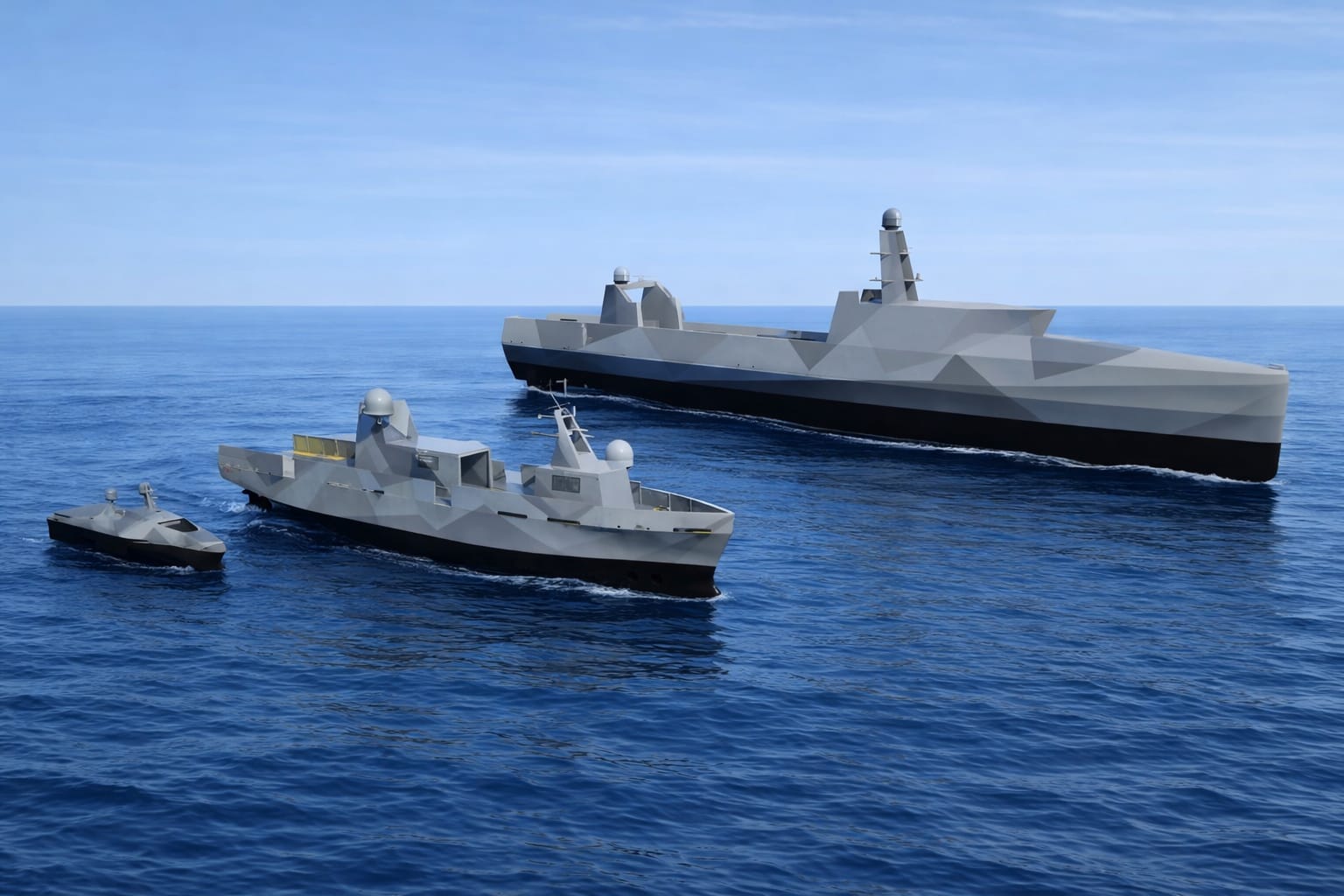
The shift to a hybrid navy will fundamentally change how command is exercised at sea, with commanding officers moving from being the best-informed individual on a ship to managing competing streams of information across a digital network, according to a paper published by defence consultancy BMT at the Combined Naval Event at Farnborough.
The paper, titled Squaring the Circle on Hybrid Navy and authored by Jake Rigby, Head of Innovation and Research at BMT, alongside Andy Kimber and colleagues, identifies cultural acceptance and doctrine shift as one of nine critical decision points that must be resolved if the hybrid navy vision is to be delivered.
Mike Williams, BMT’s Principal Operability Consultant, sets out the challenge in stark terms: “Command will change from a CO being the best-informed individual in a ship to being the arbiter of competing truths across a digital network.”
The paper argues that the shift from platform-centric to effects-centric warfare means that command and effect will no longer always be co-located. As sensing, decision-making, and effect are distributed across crewed and uncrewed assets, the coherence of the battlespace picture at the tactical edge will inevitably reduce.
Future commanders, BMT argues, will have to accept tactical ambiguity and delegate authority further down the chain than current doctrine demands, with mission command by design becoming central to how the hybrid navy operates.
The implications for command accountability are significant. Disaggregated force structures will challenge existing frameworks, with the gaps between operational command, technical authority, and legal authority requiring redefinition. Commanders will also need to become fluent in multi-domain operations across subsurface, surface, space, and cyber environments as a matter of routine rather than occasion.
BMT identifies a particular gap in the current decision support landscape. While tools such as AEC2 are being developed to enable faster decision-making, they are focused on individual warfare spheres such as air defence. There is currently no decision support tool for the command function at either unit or task group level, and unlike applying a navigation rule or identification criteria, command is not a binary function. A commander’s professional experience and instinct cannot yet be replicated, and BMT notes there has been no successful attempt to capture command experiences in a form that could be used to train AI tools.
The paper calls for tomorrow’s commanders to be trained today in systems thinking and multi-domain operations, and for doctrinal work to be conducted in parallel with technical development to establish where command authority will reside in the hybrid navy. Operational lessons from the use of autonomous systems in Ukraine and the Persian Gulf, particularly the experience of Combined Task Force 59, are cited as relevant starting points.
BMT’s broader argument in the paper is that the hybrid navy transition represents a doctrinal, organisational, and technological shift on a scale not seen since Admiral Fisher’s early twentieth-century reforms, and that the direction of travel is clear even if the pathway remains uncertain. The paper identifies nine trade space tensions that must be resolved, ranging from scale versus depth and survivability versus expendability, to sovereign supply chain versus deliverability. The command and doctrine question, BMT argues, is as fundamental as any of the technical challenges, because without resolving who commands what and how, no combination of platforms and sensors will deliver the operational coherence the hybrid navy requires.





I’ve gained $17,240 only within four weeks by comfortably working part-time from home. Immediately when I had lost my last business, I was very troubled and thankfully I’ve located this project now in this way I’m in a position to receive thousand USD directly from home. Each individual certainly can do this easy work & make more greenbacks online by visiting
following website—.,.,.,.,.—>>> JobatHome1.Com
I’ve gained $17,240 only within four weeks by comfortably working part-time from home. Immediately when I had lost my last business, I was very troubled and thankfully I’ve located this project now in this way I’m in a position to receive thousand USD directly from home. Each individual certainly can do this easy work & make more greenbacks online by visiting
following website—.,.,.,.,.—>>> PayAtHome1.Com
I’ve gained $17,240 only within four weeks by comfortably working part-time from home. Immediately when I had lost my last business, I was very troubled and thankfully I’ve located this project now in this way I’m in a position to receive thousand USD directly from home. Each individual certainly can do this easy work & make more greenbacks online by visiting
following website—…,.,…..,.—>>> PayAtHome1.Com
I hate to rain on everyone parade but whilst I can see smaller units being built quickly – the larger units would need a considerable amount of time to build meaning the weakest link in this chain means nothing would be happening for some considerable time.
Stop messing about and start building now. We can worry about the tech to link them all whilst the build is going on.
Errr. It’s not as simple as that Mark.
There is little if any need for larger units in the next decade at a minimum. The largest unit envisaged at present is the type 91 which in itself is only 2-3,000 (t) and its only truly needed as a T45 replacement towards the end of the next decade.
Every other system we are envisaging in this hybrid navy is small boat size.
Better to just keep making incremental buys like we are doing already with beehive and see where things go.
Hold up. T91 is NOT the T45 replacement, it is to work alongside T83 unless plans change dramatically. What effect that has on the T83 design is a whole different debate. Ideally T91 would start to work alongside T45 by the early-mid 2030s but that is dependent on yard capacity.
There is also T92, the other large USV, as an ASW sonar carrier.
Ssshhh, don’t spoil it !
👍
The push to turn the RN from an expeditionary asset ( if needed ) to a local ASW defence force continues.
Comprised of small boats, that’s where it headed.
A mix of conventional assets is required along with these Sloop types.
I agree, the frigate mafia has been pushing for the RN to give up expeditionary warfare for some time, the constant over playing of the aircraft carriers cost being the reason we don’t have enough frigates but then never being able to define how many frigates we needs and what is the point in frigates if they don’t have air cover.
With the US largely disappearing from the world stage and Europe our carriers are more important than ever. Europe and Canada have frigates coming out of their ears. ENATO members and Canada have around 130 frigates and destroyers which is almost double what the US navy has and about 50% over China.
Europe lacks nuclear submarines and large aircraft carriers. That’s what we should focus on alongside amphibious capabilities.
Agreed, Jim.
Plus lots of Drone types, and RFA enabling types.
Still need a certain number of Escorts though, we’re too short.
Agree Daniele, need more escorts for sure
“The US is “disappearing” from the world stage. You’ve written a lot of stupid, ignorant things, but that takes the cake.
By the way, Canada has 12 frigates, the newest of which is 30 years old.
In late 2025, the Royal Canadian Navy reported that about 54% of its frigates, submarines, Arctic/offshore patrol ships, and coastal defence vessels were considered “unserviceable” due to technical issues and crew shortages
Jim, now you’ve upset the “Fake Yank” again.
Naughty step for you my boy…..
😂
My point was that T91 would be good to have alongside the T45 but it’s not a necessity program until T45 is replaced.
It would be a risk to wait and try to do the whole of FADS in one go, better to have the first T91s working alongside T45 while the kinks being ironed out. Not an absolute necessity, just sensible IMO.
Hi TJ, if the T31s after CIP will have the T91 capabilities plus more, having the heli deck, mission bay, bigger radar etc are they actually necessary? Any idea on their actusl price compared to a frigate?
Even the Babcock MNP AH140 variant could be a good multi-role ship to have some of maybe with a decent CAMM (24-36) farm on the upper deck to complement the forward mk41s.
Yes QuentinD63 they are
necessary
T91 at estimated 2.5 – 3K Tonnes is well bigger than a River class B2 at 2.0 Tonnes. The Type 91 will match the absolute largest footprint of a Batch 2 River-class ship; like HMS Tamar or HMS Spey but will likely be wider, deeper, and heavier to accommodate heavy missile silos instead of the open deck space and light arms found on the patrol vessels. It all about adding mass (more platforms) to the RN fleet as a whole and to supplement fire power to ships like T31s, even post their CIPs. They will be cheaper and faster to build… and infinitely easier to upgrade across their various systems.
“A commander’s professional experience and instinct cannot yet be replicated”,
This to me sums up the whole thing and I think hybrid is an expensive and dangerous path to take.
Indeed…
Some decades ago a young thruster successfully got his Frigate into SSM range of an American carrier and scored a ‘tres Bon’ kill on an exercise.
How? He lit up his ship and displayed nav lights like he was a merchant ship and sailed past it on ‘innocent passage’ – the Task Group escorts assumed he was a ‘harmless merchantman’ and ignored him while looking for the OPFOR FFG.
AI cannot think out of the box.
Hi folks hope all is well.
Obviously as time goes on and the future of warfare will change and appers to be changing very fast indeed. From what I can gather, ships will become smaller and require less personnel. However, for the complex deployments, there will be a need for large amphibious type of craft to carry the amounts of troops and all the kit.
In respect to the Type45 replacement, this i envisage will be under constant review, and may be a completely different ship when the finished product hits the water.
Cheers George
Hello George, no not really, everyone Is picking on me and I’m all upset.
Oh and Who flipping knows…. It’s all getting rather daft what with Ping and Putin and Chump running rings around the rest of us.
I think we need a War.
High time to realise that the UK can no longer finance even medium sized armed forces. The French are better at generating more assets and have larger armed forces. The same applies to Italy and Germany. The UK is a busted flush. It’s time to create a well equipped defence force and dispense with pretending to be a major actor on the world stage. The UK can no longer afford it no more than it can afford to sustain nuclear weapons.
“Gone fishing, on a wednesday afternoon, gone fishing, you’ll get a bite here very soon”
(It’s a song !)
Well thats funny because we spend more on defence than all the nations mentioned. we just need better value for it.
Also if Nato wants the UK nuclear screen then they should contribute
Your comment on what we can afford is highly political. Fracking the massive Bowland shale would pay for all we could wish for. Ed Milliband is a Communist and is serving his political masters to perfection.
All these drone ships and subs. Do they have a decent speed and range to keep up with an escort? If not there might be a need for a combined tender/oiler/mother ship just for them? Hopefully they can entangle themselves from a well placed fishing net…of the large kind…and out run a foreign fishing trawler? And all these containers on board. We are assuming they’re all interconnected to each other with useful stuff inside as there’s no one around to open their doors and on these images we can’t see any openings in their roof.
It rather depends on the model of Escort.
A 1.3 CVH Is rather slow whereas a Cosworth Escort Is bloody nippy, I think the 2.1 Pinto RS would be the best all rounder but they now cost a fortune.
Hope this helps 😊
Lol…no it doesn’t help but thanks for trying anyway.
Can’t they focus a bit more on getting the T26 and T45s done, T31 CIP sorted as a priority? Drones don’t fly the flag or do ports visits very well unless they’re attacking something!
If communications fail at crucial moment what will you do? send “sea pigeons”?
Can anyone riddle me this?
Hoe does these 2,000 tonne wunderwaffe carry enough fuel to keep up with a 9,000 tonne DDG blasting around the Nodth Atlantic doing 20-30 knots?
They have Battery powered Oarsmen as backup.
Hybrid Navy = Toy Navy = Coastal Navy = Cheap Navy = Crap Navy
I did discuss this a bit in another thread.. command and legal definitions is a fundamental issue..
Now in a hot war it not a problem.. but commissioned warships spend 99% of their time not in hot war but being the legal representation of their nation on the high seas and or engaged In constabulary and more importantly grey warfare..
It’s easy to have a drone armed in a war with ROE to shoot at the enemy when it appears.. what’s the legal basis for a drone shooting at a civilian ship in peacetime just about to run into it.. or a coast guard ship spraying it with a water cannon.. that’s why commissioned warships have a legally responsible CO who is essentially the embodiment of that nation at that point.
It’s why yes drones have massive uses as
1) an adjunct to a commissioned warship.. companions essentially to expand the commissioned ships capabilities..
2) as mobile ISRAR networks
3) in a hot war as one way attack platforms
Potentially with a drones you can keep your commissioned warship simple cheap with a small crew.. essentially making it the minimum you need to do a commissioned warship function ( that’s a Rivers 2 with a bit more self defence) then all the capabilities sit on companion drones…
Sadly I see this whole “drone ship” concept being viewed by governments as a means to reduce manpower and manned ships even further than they already have as a means of saving even money that they would rather spend on welfare. In truth the manpower and number of manned combatants in many navies needs to rise by 50% or more. Drone ships should be seen as a way to make those ships more lethal and effective, weapons and sensor wise.
Take the Royal Navy for example, Government(s) may well end up funding drone-ships whilst not increasing the overall size of the fleet.
Concurr….
30 years ago a McD engineer discussing drones
‘Drones are utterly fearless, they cannot be put off, and will die happily on demand, and as a final act, they will crash into the target to complete their mission if the Queen requires it of them’.
Drones should not be seen as cheap regular warships. They are 100% expendable extensions of the mother ship,