

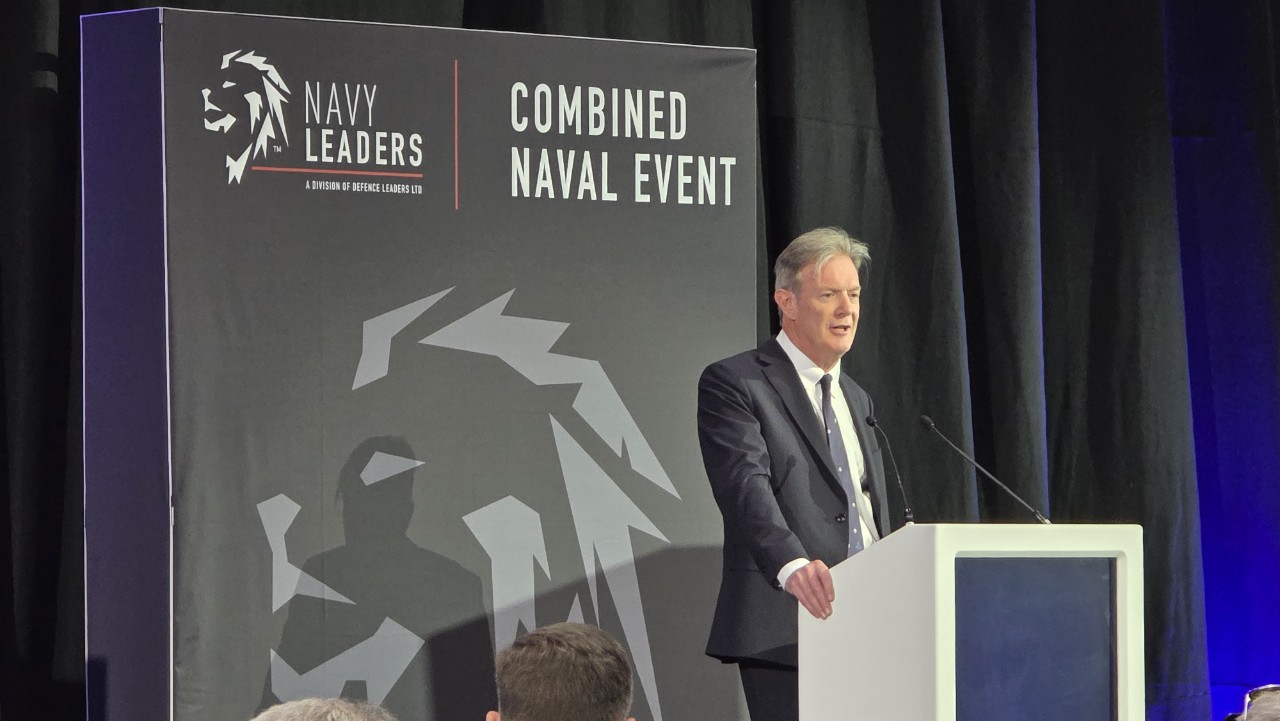
Sir Nick Hine, Chief Executive of Babcock Marine and former Second Sea Lord, used a keynote address at the Combined Naval Event in Farnborough to set out Babcock’s vision for integrating crewed and uncrewed systems under what he described as commanded autonomy, arguing that maritime advantage in this decade will not come from waiting to regenerate traditional mass alone.
A sharp distinction between autonomy as a concept and what Hine called autonomy under authority ran through the speech as its central principle.
“The key distinction is between disconnected autonomy and commanded autonomy. By commanded autonomy I mean autonomy under authority, where humans remain firmly responsible for intent, authorisation, escalation and accountability, while machines contribute persistence, speed, distribution, and decision support. Autonomy without command is vulnerability. Autonomy under authority is advantage.”
The urgency of the situation, Hine argued, was not in question. “Today’s war zones have provided irrefutable evidence — low-cost distributed systems probe, persist, and saturate, exposing weaknesses in traditional force structures, often at a tempo that outpaces conventional procurement cycles. No allied navy will simply grow a bigger fleet quickly enough to match the pace of threat. It takes years to grow the ships and submarines of any navy, and I can testify to that from bitter experience. There is quite simply more need at that pace than the traditional programmes can fulfil.”
The hybrid fleet, in Babcock’s proposition, sits alongside existing programmes rather than replacing them. “It’s important to remember this is an and, not an or. These are in addition to our existing programmes.” The strategic logic Hine set out was pretty clear, he said: “Advantaged outcomes with scale, persistence, and data, not platforms alone. Scale, because distribution creates affordable mass, more sensors, more presence, more decision points, and more dilemmas for an adversary. Persistence, because uncrewed systems can sustain coverage and extend watch time in a way that humans simply cannot match. And data, because the side that can collect, process, and act on information faster will set the pace.”
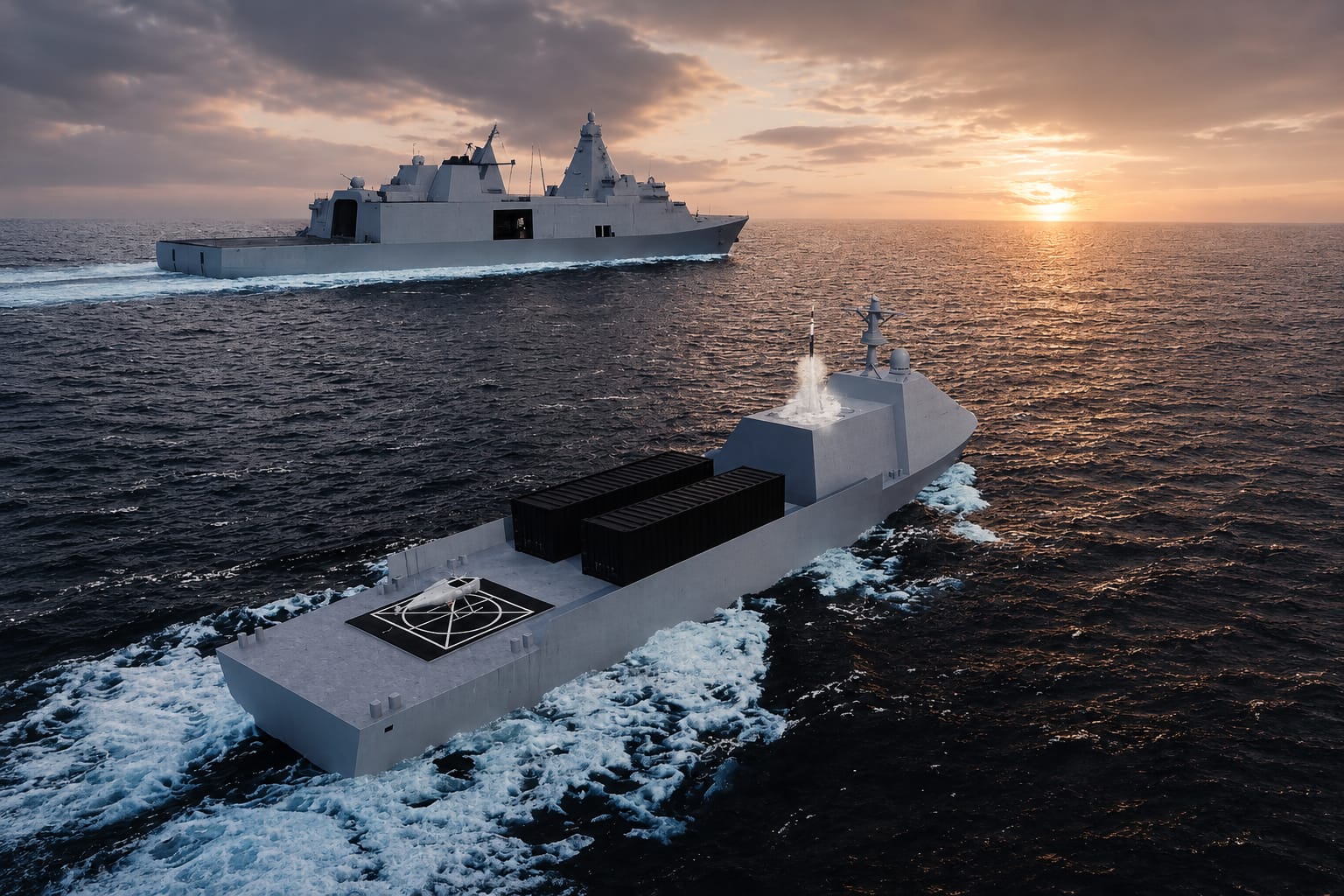
Babcock’s industrial solution is called Armor Force, the Autonomous and Remote Maritime Operational Response Force, a concept Hine said he began designing while still serving in the Royal Navy. Announced by Babcock in December 2025, it is an architecture of disaggregated systems and platforms designed for independent operations and connected by digital capabilities.
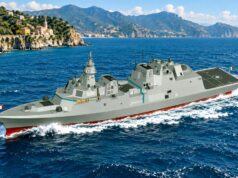
The overall solution comprises a Type 31 frigate configured as a Common Command Vessel, large uncrewed surface vessels that can operate autonomously or under remote control, and modular containerised Persistent Operational Deployment Systems, known as PODS, for rapid capability deployment and mission autonomy. The autonomy and mission orchestration layer is provided by Arondite’s Cobalt Operating System, which integrates crewed and uncrewed platforms into unified fleets commandable from sea or shore. HII’s Romulus family of uncrewed surface vessels forms the large USV element of the force. The architecture is built on open and allied standards, with interoperability and interchangeability central to the offering.
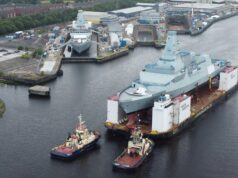
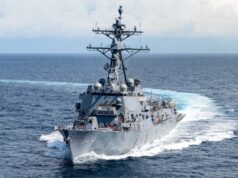
Its centrepiece is the Common Command Vessel, a crewed ship directing a distributed network of uncrewed systems and modular payloads. Slides shown at CNE depicted the Arrowhead 140 in this role, commanding Bastion, Shield, and Strike roled uncrewed surface vessels. “A high-value crewed ship becomes a common command vessel able to command a distributed force of uncrewed systems, modular payloads and mission packages at sea or from ashore under sovereign control. That reframes the value of the warship. The ship is not diminished, the ship is multiplied, because it can direct far more sensing and effect than it can carry organically, and each ship becomes a task force, one that is reconfigurable depending on the task.”
Armor Force is built around three realities Hine set out in sequence. Integration trumps invention, because the advantage comes from joining platforms, sensors, and command into one coherent system. Spiral development beats long cycles, with annual uplifts of capability, refreshable payloads, and modular integration allowing forces to field, learn, and improve continuously. Sovereign control and coalition interoperability must coexist, with nations retaining authority while contributing to coalition effect without bespoke re-engineering every time.
“Bolting uncrewed systems onto legacy concepts without integration simply imposes new seams, new cyber surfaces, new training burdens, and the risk of coordination failures. The hybrid navy is not simply a proposal to buy more drones.”
Sovereignty, Hine argued, is a practical concern rather than a rhetorical one. “Sovereignty is not just about who owns the hull. Sovereignty lies in the command and withdrawal architecture, the software assurance regime, cyber resilience, mission data integration pathways, and through life adaptability. Governments will expect to be able to know who was responsible for an effect in an alliance context.”
Beyond interoperability, Hine pushed toward what he described as his favourite concept, interchangeability between allied nations. “Interoperability is talking on the same radios. Interchangeability is the ability to move capability seamlessly between allies and partners.” The practical picture he painted was concrete. “Imagine a Norwegian uncrewed surface vessel being resupplied and redeployed from a Royal Navy platform in support of a wider NATO task, or a Danish crewed platform controlling a Royal Navy uncrewed platform with weapons targeted by a Dutch controller. This is interchangeability in action, creating deeper coalition resilience.”
“Hybrid and autonomous fleets cannot wait. The navies that succeed will be those that can integrate faster, adapt more quickly, and work with allies at greater scale and with greater resilience, because the demand is already there and it is beyond what the current model can fulfil alone. If we do that well, the result will be stronger deterrence, more resilient fleets, and a more credible allied maritime posture for the decade ahead.”


Difficult to argue with the logic here.
I’ve gained $17,240 only within four weeks by comfortably working part-time from home. Immediately when I had lost my last business, I was very troubled and thankfully I’ve located this project now in this way I’m in a position to receive thousand USD directly from home. Each individual certainly can do this easy work & make more greenbacks online by visiting
following website—.,.,.,.,.—>>> JobatHome1.Com
Nobody cares, so SHUSH.
I think is nice they are making greenbacks.. not sure why they are telling us but it’s nice for them.
I doubt there making anything other than the money they might gain off unsuspecting people who forget the principle that if it looks too good to be true ….
A little surprised this site hasn’t filtered this stuff out
I’ve gained $17,240 only within four weeks by comfortably working part-time from home. Immediately when I had lost my last business, I was very troubled and thankfully I’ve located this project now in this way I’m in a position to receive thousand USD directly from home. Each individual certainly can do this easy work & make more greenbacks online by visiting
following website—..,,.,.—>>> PayAtHome1.Com
I keep looking for orders but I can’t CNE.
waisted, literally waisted on here. 😁
Bloody hell. lol
😁
waste, or waist? Engage your brain…
‘Shorts fired! Shorts fired! Contact! Wait out!’
Hu Janus can’t even spell his own name 😁😁😁
Poor Hu, he went to all that effort to set up a new name, just to comment on my little old silly post too.
Hey JJ, fancy a pint ?
Ah, so it’s one of your arch nemeses, Hu Ndercover, is it. Hu Isit?
A beer would be nice after reading all these crazy comments of everyone arguing over toy boats and Star Trek! We all need to calm down and Hu Nite!
I blame Grinch !
Ah ok, well whoever it is, they seem to have done a Hu Dini now anyway!
Waist to hips always an important ratio
I often Shoot from the Hip but my aim is seldom accurate !
“ A high value crewed ship …able to command ..a distributed force…at sea or from ashore”.
If these under command autonomous platforms can be controlled from ashore, why do we need an expensive manned mother ship at all?
Just an example of the nonsense being spouted by people who should know better. Key questions remain unanswered-
* why will a platform full of modern sensors and payloads and meant to be persistent be significantly cheaper than a manned platform?
* if you can’t keep current manned ships at sea because of maintenance demands, how do you do so with unmanned platforms that won’t have the advantage of ongoing maintenance by the onboard crew?
* how do you achieve persistence if RAS can’t be undertaken?
* how do you prevent your unmanned platforms from being seized by an enemy?
The lesson from Ukraine is that large numbers of very cheap drones can have a decisive effect. Autonomous surface vessels won’t be cheap throw away items. They will need the same time consuming and expensive maintenance as manned platforms.
So far this is just fantasy fleet stuff.