

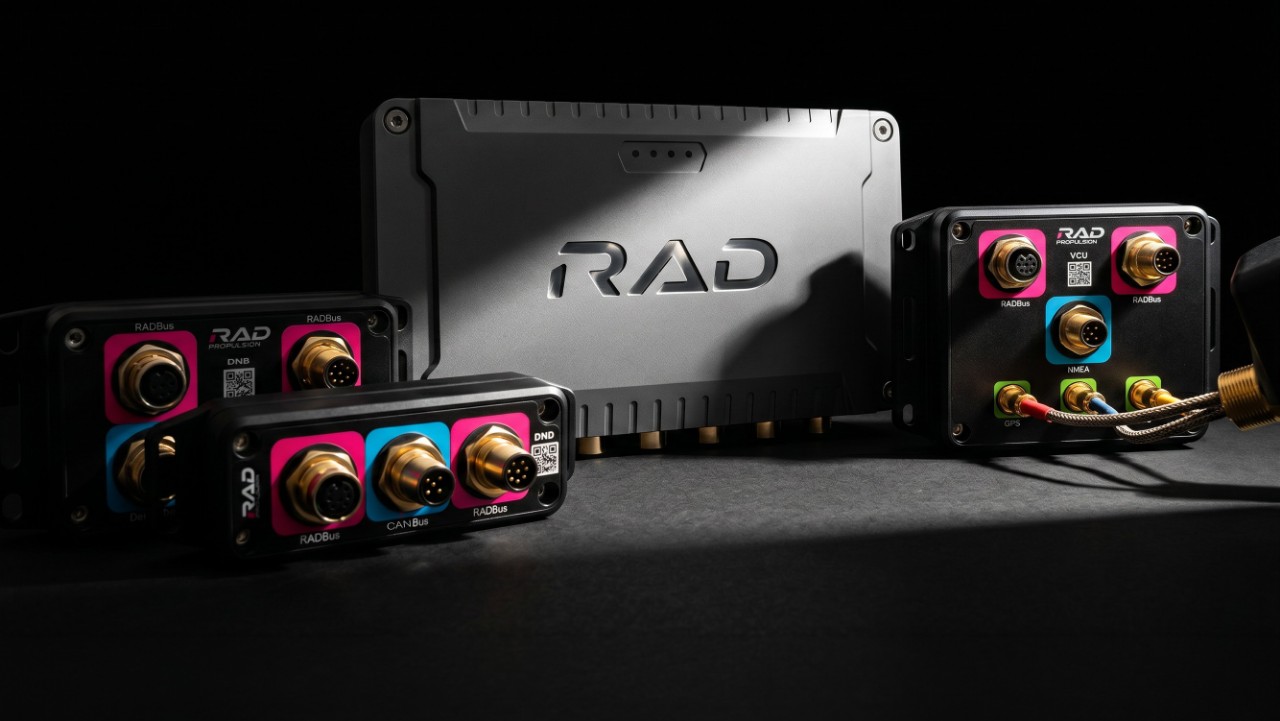
UK marine technology company RAD has used the Combined Naval Event at Farnborough to launch its Autonomy Core product, in what the company describes as an important step in its expansion into the defence sector, the company stated.
The Autonomy Core is designed to make vessels remotely controllable by providing an interface layer between vessel engines and onboard systems, connecting to an IP network via satellite, Wi-Fi, or cellular solutions. The system integrates with existing propulsion and onboard equipment without requiring its replacement, offering what RAD describes as a practical pathway to advanced marine autonomy without compromising on safety or control.
Dan Hook, CEO of RAD, said the product had been a long-planned development. Speaking to the UK Defence Journal at CNE, he explained that the company had been developing its electric propulsion systems for three to four years, with the control system always designed with future autonomous capability in mind. “We’ve provided an out of the box control system that can be easily retrofitted to existing boats or onto new builds,” he said. Hook’s background includes founding ASV, one of the earliest companies in the autonomous surface vessel sector, where building unmanned boats was, in his words, a big part of his career. “When we established RAD about five years ago, the plan was always to be a sort of dual-use type product, so our equipment’s equally at home on an aquaculture farm off the coast of Norway as it is on a defence application in the Middle East or further afield.”
Hook said the company had positioned its Autonomy Core specifically to support the hybrid navy ambitions of the UK and other navies, pointing to the large number of boat builders capable of delivering smart unmanned and electric hybrid vessels. “There are hundreds and thousands of boat builders out there that are very capable of delivering smart unmanned and electric hybrid boats” to support those programmes, he said, and RAD’s system was designed to give them the control and autonomy layer to do so simply and at scale.
The system enables Degree 3 autonomy out of the box, meaning fully remote vessel control without an onboard crew. Degree 4 autonomy, in which a vessel makes independent navigational decisions using advanced situational awareness, can be layered on through partner systems via an embedded Autonomy Gateway. A built-in fallback mechanism allows operators to remotely take control and initiate a get-me-home function should a higher-level system fail, ensuring loss of autonomy does not mean loss of control.
Hook also spoke about the broader trends driving demand for the technology. “There’s been a huge push into the use of electrification. Electric propulsion systems are a massive topic for different reasons in different sectors. Here in the defence sector, a lot of it is about underwater acoustic signature, above water propagated noise, thermal signature, but also reliability, maintainability, and endurance and efficiency. You’ll see more and more of these unmanned systems being diesel electric, fuel cell electric, and we’re really in a good place to supply the drives and control systems for that.”
Alongside the product launch, RAD has appointed Chris Shepherd as its defence and security mission systems director. Hook said Shepherd joined the company approximately a month ago. “I’ve known Chris for many, many years. We used to work together on our mine hunting boat development, so he’s joined us really to accelerate our growth, build our relationships with more of the primes, the end users, and build up the awareness of RAD.”
The Autonomy Core is propulsion agnostic, compatible with modern digital engines or legacy systems via appropriate gateways, and available in multiple deployment packages from basic remote control through to fully integrated autonomy-ready configurations. RAD says it is developing further hardware and software to support IP networking, switching, and situational presentation as the product matures.








I’ve gained $17,240 only within four weeks by comfortably working part-time from home. Immediately when I had lost my last business, I was very troubled and thankfully I’ve located this project now in this way I’m in a position to receive thousand USD directly from home. Each individual certainly can do this easy work & make more greenbacks online by visiting
following website—.,.,.,.,.—>>> JobatHome1.Com
I’ve gained $17,240 only within four weeks by comfortably working part-time from home. Immediately when I had lost my last business, I was very troubled and thankfully I’ve located this project now in this way I’m in a position to receive thousand USD directly from home. Each individual certainly can do this easy work & make more greenbacks online by visiting
following website—..,.,..,.—>>> PayAtHome1.Com