

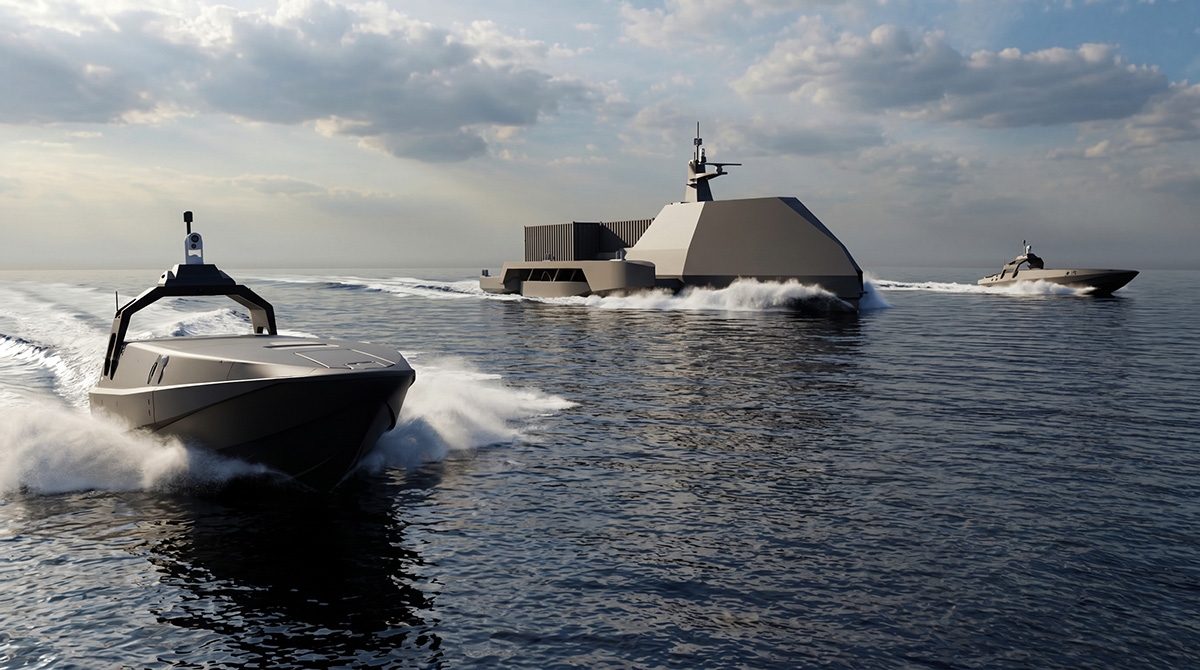
Kraken Technology Group has warned that covering the High North effectively will require significant mass rather than a patchwork approach, in written evidence to the Defence Committee’s Defence in the High North inquiry, arguing that persistent monitoring of the GIUK Gap requires enough uncrewed vessels to cover the entire operating area.
The British company, which was recently awarded a £12.3 million contract to deliver 20 vessels to the Royal Navy’s Surface Flotilla under Project Beehive, said it strongly supported the Royal Navy’s Atlantic Bastion concept and its focus on integrating autonomous systems into UK maritime capability, describing the pivot to a Hybrid Navy as the right approach to reducing risk to human crews in hostile environments. However it was clear that the scale of the task demanded genuine mass, saying “a patchwork approach will not be sufficient” and that persistent monitoring required “enough mass to cover the entire operating area.”
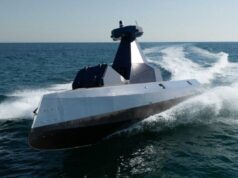
The characteristics that make uncrewed surface vessels compelling, including modularity, autonomous operation, reduced human risk and affordability at scale, are relevant across all maritime theatres, Kraken told the committee. The company pointed to recent events in the Middle East as underlining that these requirements were not unique to the High North, with similar needs arising in the Baltic Sea and Mediterranean. Its K3 SCOUT was described as payload-defined and truly modular, with the same hull re-roled according to theatre or mission “without changing the underlying vessel.”
Harsh weather, icing, fog and degraded communications place additional demands on platforms intended for the High North, and Kraken acknowledged that capabilities for the region required appropriate hardening. The company said its vessels were designed to manage high sea states and remain operational when weather deteriorated rather than sheltering in harbours, and that where required they could be fitted with an extended climate kit including de-icing integrated into the deck lay-up and cooling for engine bay components in extreme conditions.
The UK’s High North strategy aligns strongly with the government’s economic priorities, Kraken argued, saying that generating uncrewed mass strengthened the UK’s industrial base and that its systems had strong export potential globally. The ability to re-role platforms across theatres through different payloads was described as improving both value for money and export potential, particularly where interoperable allied requirements created demand across partner nations.
Founded in 2020, Kraken has undergone trials with the MoD, demonstrated with NATO Task Force-X in the Baltic and been awarded a $49 million contract from US Special Operations Command. Alongside the K3 SCOUT, the company produces the K4 MANTA uncrewed surface-subsurface delivery platform and the K5 KRAKEN maritime precision engagement platform.




“enough mass to cover the entire operating area.”
That is precisely correct. It needs to be like a web, an early warning AI network that cannot be bypassed.
All machines can be bypassed.
SOSUS
Now known as IUSS, I believe.
Yes, I brought this up before, but was effectively
told that as it’s US controlled it’s no longer relevant.
Though I’ve not heard that the RN and RAF are no longer at Dam Neck so Northwood and NATO still get the data?
Ok let me get this straight: we need Atlantic Bastion to guard GIUK, in order to protect the American supply ships that we’re now fairly certain won’t actually be coming?
The thing that makes AB unique is that many of the intended assets are mobile. If we need to cover the GIUK gap, we can do. If we want to push the Russians further from the British coast in order to reduce the threat of cruise missiles, we can do that as well, simply by pushing those mobile assets out past the GIUK gap and establishing the line further north. If we detect a submarine presence in a specific area, the line can be surged forward in places to constrain a particular boat.
In short, AB doesn’t just protect convoys like it’s 1985. It’s much more an active ASW weapon, rather than a static defensive line.
Sounds a bit like a surface wolfpack.
What we need is enough mass to escort tankers we need PAST the yank blockade which is already buggering our oil supply (because Milibrain won’t let us get our own) and will doubtless be deployed to prevent is keeping the Falkland islands and it’s oil
North Sea Oil is a busted flush. Future production would now only make a marginal difference to our energy security.
Renewables, perhaps supplemented with nuclear and batteries as a base-load, are the way to go if we want to reduce our dependency on foreign hostile states’ (e.g. Russia, Gulf and USA) fossil fuels. We haven’t scratched the surface of what’s possible with renewables (and we never will if the luddites of the Tory/Reform axis scam and sleeze their way into power).
(That said, I do accept that we’ll still need to import a small amount volume of hydrocarbons to produce plastics etc but that’s would be only a tiny fraction of our current imports).
Even with wind trbines, nuclear andsolar we still need oil, north sea oil is at least useful if only as an export. Better to have some of our own than import it all – especially as importing it means paing for it and transporting it – at strategic risk and extreme cost. ALL our naval ships should be converted to nuclear asap.
I’ve gained $17,240 only within four weeks by comfortably working part-time from home. Immediately when I had lost my last business, I was very troubled and thankfully I’ve located this project now in this way I’m in a position to receive thousand USD directly from home. Each individual certainly can do this easy work & make more greenbacks online by visiting
following website—.,.,.,.,.—>>> JobatHome1.Com
There’s no way K3 would be useful for Atlantic Bastion. It’s the size of a RIB, could only carry a few sonobuoys a couple of hundred miles.
Their biggest USV is 18m and has a 10,000kg payload, but it’s designed for speed so my guess is that it would be underwater most of the time in big waves.
Yeah I feel the same. Looks like they have great products but they don’t seem appropriate for the TAS USV and glider combo that seems to be forming.
What Kraken says us correct but there no way that there will be even resources to cover 10% of the area permanently. UK would need a significant cultural change.
Besides Kraken also don’t have boats and ships with size for that and even less the RN have the mother ships designs.
Out of curiosity how many usvs could an Albion LPD handle? I believe it exercised with these very same or similar usvs? Why let a sizeable ship like Albion go to waste at the wharf while waiting years before any MRSS? Spend a few quid to regenerate her, as done with Argus, then sell her at a later date and higher price. Plenty of spare ex T23 equipment to access. Use it