


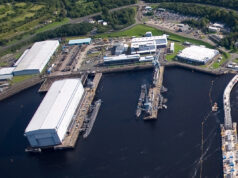
The leader of the Scottish Liberal Democrats has called for defence procurement to be placed at the heart of Scotland’s industrial strategy, warning that Scotland currently lacks the skills pipeline needed for the defence jobs of the future, in an interview at Babcock’s Rosyth shipyard.
I asked Cole Hamilton why defence industrial skills mattered so much for Scotland right now. He was clear, quite simply, the country was already living in the early days of a new Cold War, and Scotland did not have the skills pipeline for the jobs a serious investment in defence would create.
He pointed straight to Babcock as his example, noting the shipyard had hired 300 Filipino welders because “it’s just not the skills workforce in Scotland” and said he wanted to ensure that did not happen again. The answer, in his view, was putting defence “at the heart of the Scottish Government’s skills pipeline and their consideration of a skills strategy.”
He was more specific about what that looked like in practice than many politicians tend to be on the subject. The destroyers, frigates and anti-submarine vessels the UK would need in future should be built in Scottish naval yards and “welded together by Scottish skilled workers that we need to start training now” he said, describing it as needing to be at the heart of an industrial strategy that the SNP, he argued, had simply never delivered. The Cold War framing was deliberate too, he added: “we can turn that reality into a virtuous benefit to Scotland’s economy” if defence procurement is handled correctly.
On the SNP’s approach to defence, which he has previously described as squeamish, he used the continuous at sea deterrent as his central example. Liberal Democrats, he acknowledged, wanted to see a world free of nuclear weapons, but he was unambiguous that this was not the moment to act on that instinct. With Russia having been active near UK subsea cables the previous month, the UK was “not in a position to join Vladimir Putin at the disarmament talks table” and the Scottish Liberal Democrats were committed to a deterrent that was independent and “not reliant on an unstable United States government” protecting the country around the clock.
His recent trip to Ukraine came up, and it clearly sits close to the surface when he talks about any of this. He drove part of a convoy of seven ambulances for delivery to Ukrainian armed forces for immediate use on the front lines, describing the conflict as “just three tanks of diesel away” and Ukraine as “the last line of defence between the free democracies of the West and Russian expansionist tyranny.” He was blunt about what that demanded: the UK needed to “arm to the teeth” to give Ukraine the material, expertise and training needed to defeat Putin, saying “it’s not just about holding him back, it’s about finishing him off.”
He is sanctioned by the Kremlin for his work supporting Ukraine and frustrating Russian interests in Scotland. A Ukrainian refugee lived with him for nine months. “I have seen the human cost of this war,” he said. “We need to support them at every level.”
Finishing up, I asked what his message was to the Scottish public, beyond the defence industry itself, on why any of this mattered. He said the starting point was accepting that “we’re just not living in the world we were” and that the Cold War framing was not hyperbole but a description of the present reality, one that could turn hot and was already being fought across multiple domains, from daily cyber attacks by Russia and China to Russian submarines near critical undersea infrastructure.
Putin, he said, “if he succeeds in Ukraine, won’t stop at Kyiv, and he won’t stop at Eastern Europe either.” Scotland’s answer, in his view, was a skills pipeline ready for naval yards, aircraft and drone technology, the last being an area where Scottish companies were already working alongside Ukrainian firms and leading the way. “We need to be ready,” he said, “for the threats and challenges of the future.”










Yet more grandstanding. Totally outside the remit of the Scottish parliament.
Yep but 99.9% of the electorate won’t know that – which is what they are counting on.
I wonder how much the Filipino welders in question are getting paid. Maybe there is a legitimate shortage in this case, but it is not uncommon for people who don’t want to just pay the going rate for a particular skill-set complaining about a ‘shortage’.
Precisely. I know a welder who decided to set up his own firm rather than hoing and working in the shipyards because they were paying less than the little engineering company he was originally at.
I’m sure the SNP is helping people from the oil and gas industry that the SNP said is on the decline.
I’ve gained $17,240 only within four weeks by comfortably working part-time from home. Immediately when I had lost my last business, I was very troubled and thankfully I’ve located this project now in this way I’m in a position to receive thousand USD directly from home. Each individual certainly can do this easy work & make more greenbacks online by visiting
following website—.,.,.,.,.—>>> JobatHome1.Com
And if you got into power you’d do exactly the opposite, wouldn’t you….
NOT the Brightest Party in a Very Dimwit Parliament…!
I Wonder With Rumors of a Reshuffle Perhaps PM Would Consider HEALEY for CHANCELLOR ..!
PM has Not many options if Rachel goes..! I know he can’t Count Frigates or Destroyers..!!.But then Again Few if Any in the Cabinet can…! Otherwise has a lot Politically Going for Him….?