

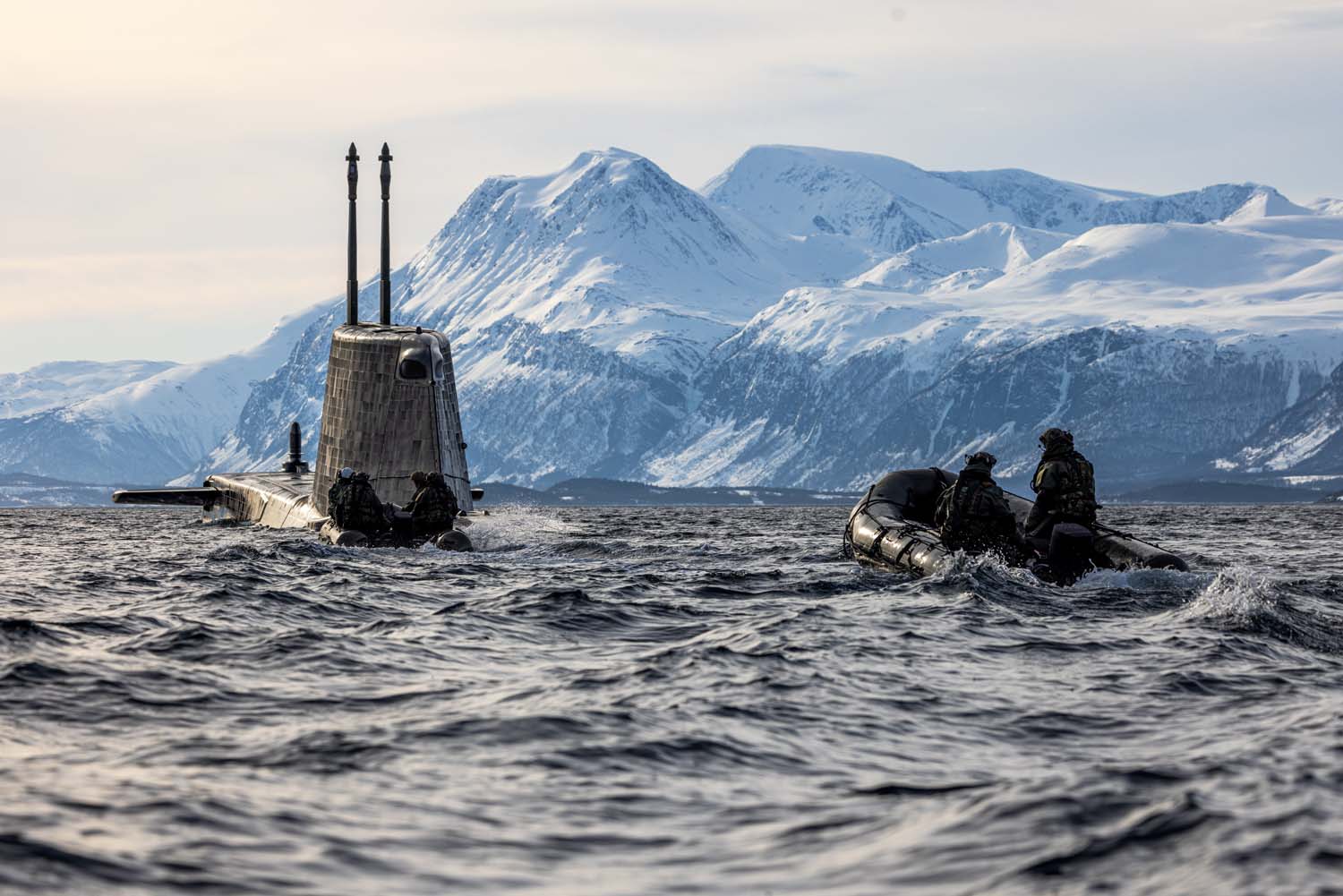
The Ministry of Defence has told the Defence Committee’s High North inquiry that the UK is currently the largest contributor to Arctic-capable NATO forces after the United States, warning that the post-Second World War Atlantic advantage is at risk and confirming that the first Atlantic Bastion sensors will be in the water in 2026.
Russia represents “the most acute near-term threat” to the region, the submission states, having re-established Cold War-era bases, expanded airfields, strengthened the Northern Fleet on the Kola Peninsula and introduced restrictive navigation measures along the Northern Sea Route contrary to international law. China is also identified as a long-term concern, with its investments in ports, undersea cables and dual-use scientific infrastructure combined with “an emerging nuclear icebreaker capability” carrying “intelligence and strategic implications.” Climate change is described as “the overarching global risk, reshaping maritime access, exposing natural resources, and increasing competition for hydrocarbons and critical minerals in newly accessible or disputed areas.”
Atlantic Bastion, Atlantic Shield and Atlantic Strike are described as forming “a coherent triad for the Euro-Atlantic”, with Bastion focused on protecting sensitive waters and NATO lines of communication with an undersea focus, Shield contributing to air defence from the UK’s north, and Strike assuring “the capacity to retaliate and generate advantage.” Bastion is described as “defined, near-term and resourced through novel partnering” with first sensors expected in the water this year, and options taken forward will be aligned to the Defence Investment Plan and deployable from Type 26. Uncrewed escorts operating alongside Royal Navy warships are expected within two years, adding “sensors, decoys and weapons capacity – scalable mass for sustained presence in the High North/North Atlantic.”
The Royal Navy acknowledges it is operating under increasing pressure, warning that “the post-WWII Atlantic advantage is at risk” and underlining the need to step up. Current strengths are identified as nuclear deterrence assurance, the Type 23’s anti-submarine warfare focus, maritime patrol aircraft and ISR in support of NATO, and the Commando Force’s position as “the Nation’s cold-weather experts; the only force able to operate at scale in the High North.”
The RAF’s contribution is detailed across a range of exercises and deployments. Typhoon trials in Finland tested the aircraft’s ability to operate from snow and ice-covered runways, building on earlier trials from Finnish roads in summer conditions. Chinook crews deployed to Bardufoss in January 2026 more than two hundred nautical miles inside the Arctic Circle, training in mountain flying, underslung load operations and engineering support in sub-zero temperatures. Later in 2026, Exercise Dynamic Mongoose, described as NATO’s largest annual anti-submarine warfare exercise, will take place in Iceland supported by P-8A Poseidon aircraft, while Exercise Ramstein Flag in Sweden, Norway and Finland will be supported by Typhoon, Voyager, A400M and signals units.
The UK will also fill the Director Operations role in the new NATO Combined Air Operations Centre North-West in Bodø, Norway, described as “vital to the UK’s role in Command and Control of the NATO Regional Plan North-West.”
The Lunna House agreement with Norway is described as “a transformational step” that expands the UK’s sensor-to-shooter coverage across the North Atlantic and reinforces a shared ability to monitor and counter Russian undersea activity, while also supporting high-skill UK shipbuilding. The MoD also notes it is “delighted to see companies like Saab collaborate with a host of UK Industry” on capabilities such as Gripen aircraft, as part of a broader commitment to supporting JEF nations with their future procurement needs.
The submission closes with a commitment to what it calls an always warm industrial base, saying investment in advanced exportable technologies including space systems, maritime surveillance, autonomous platforms, secure communications and cold-weather engineering had clear civilian and commercial uses alongside their defence applications, and that the UK’s approach in the High North was “an example of how defence investment can protect the country, support allies and help build a more productive, competitive UK economy.”


I’ve gained $17,240 only within four weeks by comfortably working part-time from home. Immediately when I had lost my last business, I was very troubled and thankfully I’ve located this project now in this way I’m in a position to receive thousand USD directly from home. Each individual certainly can do this easy work & make more greenbacks online by visiting
following website—.,.,.,.,.—>>> JobatHome1.Com
Excellent news, It’s great to know we are up for a fight against aggressors wishing to take territory In the North.
Greenland will sleep well tonight.
It’s great we are moving fast on Atlantic bastion, first sensors in the water this year is a great achievement.
Great comments by the MOD. We are all sorted.
Loads of assets including T23 to see off the Russian menace.
The DIP will just be the icing on the cake then…
AA
Disclaimer…this post contains ironic adult humour.
“Ironic Adult Humour” Is seldom appreciated nor Is It barely recognised here.
I believe It doesn’t fit with the narative.
Three nteresting Hi North initiatives BUT, no extra funding, no additional assets, no D.I.P. and no Action Plan for another year. Perhaps we’ll know more next Friday?
Well we can all sleep well
“Second largest contributor of Arctic capable forces.”
Really?
Classic MoD, delouse after anything HMG say. A nice spin take diverting from the lack of assets.
I’m genuinely curious as well. Is it true that Sweden and Norway have fewer Arctic capable ground forces? Fewer Arctic capable Naval and air forces?
You’d have assumed all their armed forces would be so trained, given their climate?
Would be fun if MoD list what forces we have that are Arctic capable. And if they are deployed elsewhere, as the UK has more commitments than the nordic countries, then what?
Shhh, you’ll wake the Canadians up😊
Lol. Actually, great point! My mind was focused on ENATO.
Ha, I do rely on you to get my “Points” mostly.
There are a few others here also but most are missing the correct Wavelength whilst some just miss It completely and go direct for the Jugular !
Canada most probably has a large claim given much Of It lies within said area ? (not sure If the person who made this statement knows that ?)
You rely on me….that’s worrying!
Laurel and Hardy? The Two Ronnie’s, Cannon and Ball?
Butch and Sundance ?
Terry and June 😁
June Whitfield, a great.
I was her postman briefly…and she was also a Wimbledon fan! 🥰
Victor and Margaret might be more appropriate with this place!
We are awake. Lots going on up there.
There were a lot of analyses being done on European versus US Arctic readiness a few months ago, and the US didn’t have anything like as much as the Scandinavians do, but they were trying to increase the numbers. Finland were building them some ships as for some reason they’ve been having issues building their own. They are also cycling more of their troops to do Arctic training. I wonder what proportion of the Finnish army are Arctic trained.
I have no idea.
So much for second only to the US then.
‘Climate change is described as “the overarching global risk, reshaping maritime access, exposing natural resources, and increasing competition for hydrocarbons and critical minerals in newly accessible or disputed areas.’
The MoD may very well be basing its planning on a false premise:
‘Arctic sea ice extent has been running at below-normal levels since the middle 1990’s at which time there was an important shift in the Atlantic Multidecadal Oscillation (AMO) to one featuring warmer-than-normal sea surface temperatures in the North Atlantic Ocean. The Arctic sea ice extent headed steadily downward after that shift and reached its lowest point in 2012 at levels not seen before during the satellite era which goes back to the late 1970’s. Since then, Arctic sea ice extent has held rather steady with a general sideways trend during the past decade or so.’
It’s frankly a false statement, look how stretched the Airforce for example is just providing air defence in the Eastern Med and Mid East. The Navy for example could not get a destroyer to the Med.
As for the army were do I start.
We are in trouble and it’s not going to get better whilst the government is in office, projects delayed or stuck in concept planning now I hear project Rayburn has slipped and a decision on the new rifle will not be made for 4 years.
You can see what’s happening the big decision on re- arming has been kicked down the road to the end of parliament, this current crop are leaving the difficult and important decisions to the next incumbents.
So to say we are o ly second to the US when it comes to the defence of the high North either nieve or at the very least arrogant.
And they say stand up is dead, clearly not in the dusty wastelands of the MOD offices around the land. All that WFH gives them more time to pen sit-coms too, I cant wait for Faulty Tanks an hilarious comedy about a pile of junk that has tried but failed to drive as far as Torquay without exceeding operational parameters.