

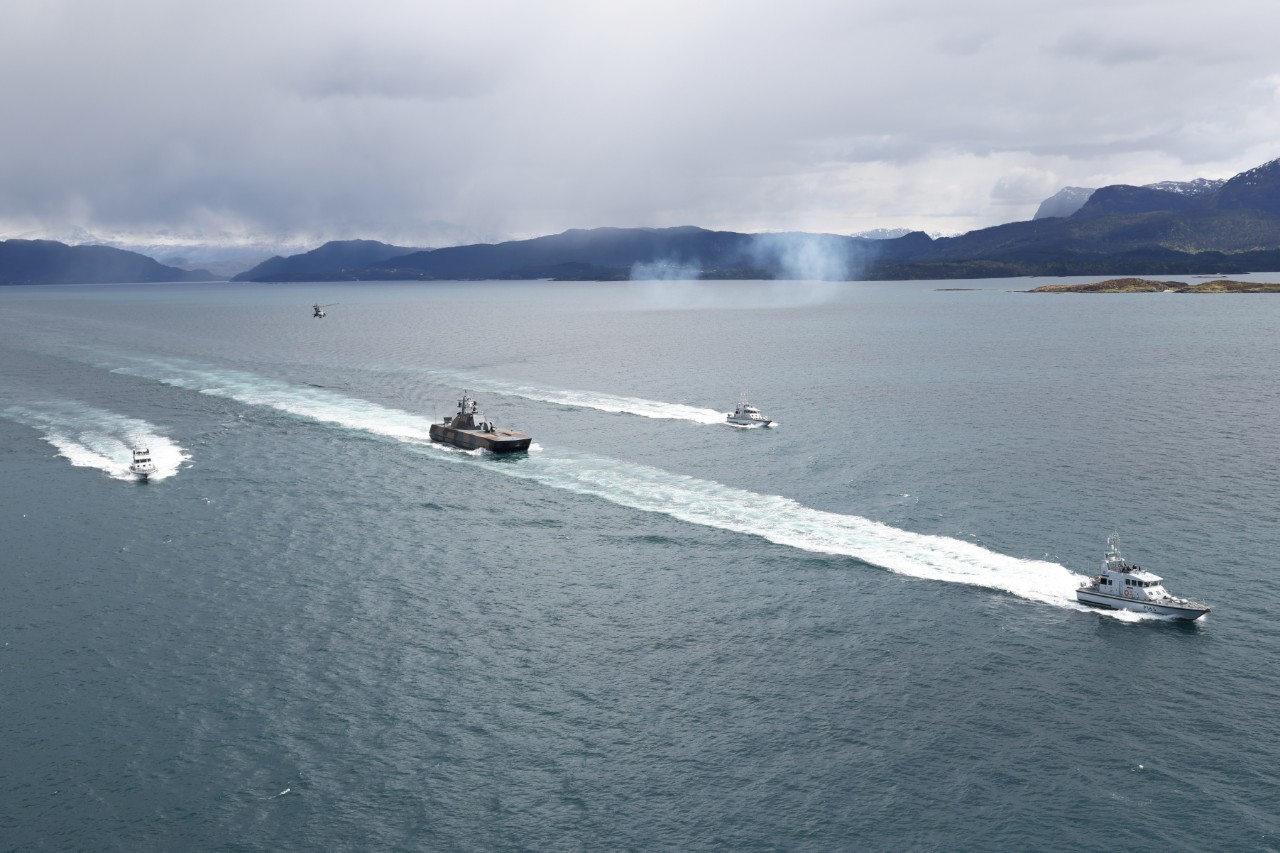
Royal Navy Wildcat helicopters have completed three weeks of exercises in the fjords around Bergen, developing drone, missile evasion and fast-attack boat tactics alongside the Royal Norwegian Navy during Exercise Tamber Shield.
Run under the banner of the Joint Expeditionary Force, the UK-led coalition of northern European nations, Tamber Shield has been conducted for several years with the consistent aim of developing tactics for dealing with fast, agile threats in narrow waters. The 2026 edition introduced two new elements: 700X Naval Air Squadron’s Puma drones and RAF electronic warfare specialists from Spadeadam in Cumbria.
The RAF specialists simulated infrared and radar-based missile threats, giving helicopter crews live practice of evasion tactics including the dispensing of chaff and flares. The Puma drones from 700X scouted ahead of the Wildcats, identifying potential targets and threats and feeding information directly into the aircraft cockpits, increasing both crew survivability and engagement effectiveness.
Wildcats from 815 Naval Air Squadron, armed with Martlet missiles, operated from both Haakonsvern, the home of the Royal Norwegian Navy, and the flight deck of HMS Duncan, which was escorting HMS Prince of Wales. Lieutenant Hal Wotton of 815 Naval Air Squadron said the exercise “has been extremely beneficial,” adding that it “allowed us to refine our tactical development, using the challenging environment of the fjords to simulate realistic threat scenarios, including ambushes and counter-fast-patrol-boat engagements.”
Three Royal Navy fast patrol boats, HMS Archer, Biter and Example, worked alongside the Norwegian Navy’s heavily-armed Skjold-class corvettes in simulated cat-and-mouse engagements against the air assets. Able Seaman Rob Scott, on his first deployment with HMS Biter, described the exercise as “an exciting experience” that provided “a valuable and interesting experience working alongside other UK forces and Norwegian personnel.” He singled out one moment in particular: “Hiding in a fjord when we successfully spotted a Wildcat helicopter and were able to ‘kill’ it by simulating a surface-to-air missile attack was particularly enjoyable.”
Aircrew who had not previously done so were also given the opportunity to conduct torpedo runs, dropping Sting Ray torpedoes in the fjords. Beyond the combat training, the exercise included winching crew onto the confined deck spaces of the P2000 patrol boats and a joint visit to Bergen, where both navies participated in commemorations marking 82 years since the city’s liberation at the end of the Second World War.
In parallel, a second exercise was run at 815 Squadron’s home base at RNAS Yeovilton in Somerset, testing a mesh network designed to seamlessly share data between drones, helicopters and headquarters. The system is intended to speed up targeting decisions, particularly against fast-moving swarm threats, and is expected to feature increasingly in future Tamber Shield iterations and front-line operations.




many predicted the end of helicopters after the start of Ukraine, but their mission is evolving as very effective drone hunters with a combo of guns and/or rockets
If the AAC Wildcats’ role get replaced by Apache drone ‘wingmen’ might they have another career as drone hunter?
I’ve gained $17,240 only within four weeks by comfortably working part-time from home. Immediately when I had lost my last business, I was very troubled and thankfully I’ve located this project now in this way I’m in a position to receive thousand USD directly from home. Each individual certainly can do this easy work & make more greenbacks online by visiting
following website—.,.,.,.,.—>>> JobatHome1.Com
Did anyone predict the complete end of helicopters? I saw a lot of predicting the end of frontline helicopters for manuever and attack, but not for anything rear echelon where the manpads threat is much more limited.
People predict the end of equipment categories all the time, it’s almost never the case. It’s too easy to overlearn a lesson; tanks are more vulnerable due to drones but can’t be replaced, helicopters hae been vulnerable to MANPADS for half a century but are still vital. Battleships were one of the few situations where a category actually became obsolete.
De Ja Vu moment ?
According to Forces News, the P2000’s are “small but pack a mighty punch”!!! It’s another depressing sign of the RN’s collapse that P2000’s, armed with a GPMG, are now seriously referred to as being formidable frontline naval units, rather than training vessels primarily for the RNR and URNUs. At least stick a GAM-B01 20mm light cannon on them, in the right light it might be mistaken for something useful by a fishing boat or people smugglers!
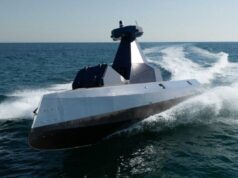
Scholarship question: what’s the difference between an Archer, a MGB and a Kraken USV? Maybe we should bring back the MTB to give the Russian frigates in the Channel something to exercise the mind.
It just so happens M81 was moved from her mooring next to HMS Warrior a while back. I thought she might be re-activated, maybe to cover the Channel !
Did you mean F81 Sutherland? Marine tracker shows her in Lisbon, I think.
Kraken K3s are 2.5 tons displacement, max speed 55 kt, uncrewed, unknown weapons fit; a WW2 MGB was 100 tons, max speed 40 kt, heavily armed; and P2000s are 54 tons, 25 kt, lightly armed or virtually unarmed (some have permanent GPMGs, some not). Three very different boats.
Just musing on the variety of small boats dashing around fjords, coasts and straits and wondering what, if anything we might see in the DIP.
Indeed. AAC Wildcats could / should be integrated with Martlet and Sea Venom. They can operate as a defensive screen behind the front line and/ or around around coastal areas. …either in home waters or overseas. Larger Surface drones and larger long range strike arial drones will be a threat..and not necessarily where RN vessels are operating.
Plus their 20mm, there should be plenty spares around or some other RWS. Would a 30mm fit?
.
The T31s, in their ‘ patrol frigate’ role will need a HMA2 Wildcat with Martlet and Sea Venom. I think there have been trials of UAVs carrying StingRay, but I can’t help thinking that if T31s end up playing in the N.Atlantic then the Bastion sensor network might provide targeting info to T31 based Wildcats. They don’t have the organic detection or endurance of the T26 based Merlins but we do have a lot more of them.
Indeed. Can also see a case for a T26 deployed afar on its own carrying both a Merlin and a Wildcat. Some redundancy in delivering Stingray, but also the ability to deal at distance with both airborne and surface drones.