

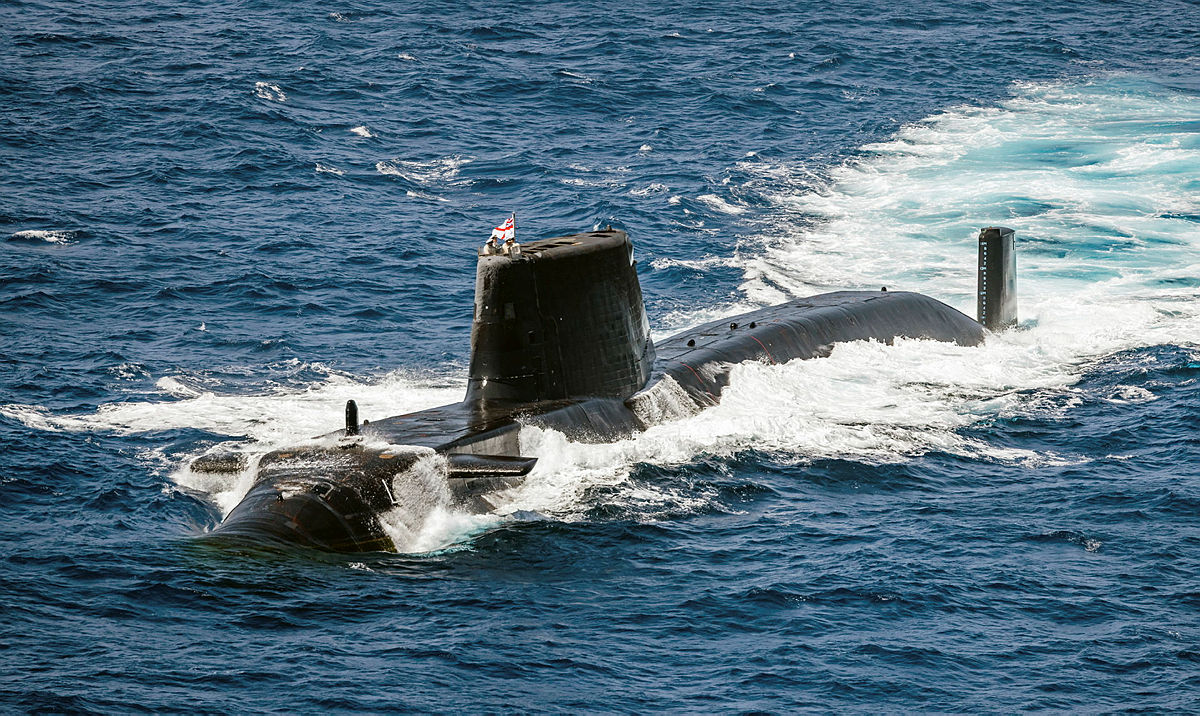
The continuing difficulty in keeping Britain’s hunter-killer submarines available for operations has once more left the Royal Navy without a single attack boat at sea, according to open-source tracking of the fleet.
Readers who have followed the fortunes of the Royal Navy will be aware that for some time now its fleet of attack submarines has struggled to put boats to sea, and that difficulty has once again reached the point where none of the service’s available hunter-killers is currently on patrol, leaving Britain without the silent and arguably most potent of its conventional naval capabilities at a moment of heightened tension beneath the waves.
The situation is not without precedent, having been observed before within relatively recent memory, and although individual boats have moved in and out of availability in the period since, the broader pattern has stubbornly endured, with the greater part of the force spending considerably longer tied up alongside than it has ever spent operating at sea.
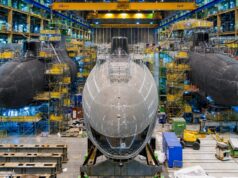
Across the in-service Astute-class boats the picture is a troubling one, with two of the submarines realistically inactive at Faslane on the Clyde after prolonged periods out of the water, and two others undergoing extended deep maintenance at Devonport, which remains the only naval base in the country capable of carrying out such work on nuclear-powered vessels. Only one boat of the entire force has returned from sea in the more recent weeks, and she now sits alongside at Devonport in the routine that follows a deployment rather than in any state of readiness, so that her return has done little to relieve the pressure on a service which has, in practical terms, run out of submarines to send out. A further boat of the class has been commissioned but continues to work through its trials and is not yet ready for front-line service, while the last of the planned submarines remains under construction.
None of this can be traced to any failing on the part of the boats themselves while at sea, for the difficulty lies instead, as it has done for many years, in the considerable challenge of keeping a fleet of nuclear-powered submarines maintained, certified and ready for operations. Because the deep maintenance and refitting that these boats require can be undertaken at only a single location, and because a substantial share of that capacity is taken up by the unceasing demands of sustaining the continuous at-sea nuclear deterrent, there remains too little room within the system to return the attack boats to service at anything like the pace required. Those constraints have been further aggravated by enduring shortages of dry-dock space and spare parts, and by a scarcity of the specialist engineers and submariners upon whom the entire programme rests, with at least one boat understood to have been stripped of components in order to keep others in some semblance of working order.
The strategic implications of all this are far from trivial, since attack submarines number among the Navy’s most valuable instruments for discreetly monitoring Russian vessels in the North Atlantic at a time when Russian activity beneath the surface around the British Isles is understood to have grown markedly, and since they play a significant role in shielding the ballistic missile submarines that carry the country’s nuclear deterrent. They are, moreover, the only platform in British service able to launch Tomahawk land-attack cruise missiles, and they constitute a central element of the protection and the reach that a carrier strike group is expected to carry with it to sea, so that their simultaneous unavailability erodes the Navy’s effectiveness across a number of distinct areas at the same time.
There exists a further concern of a longer-term character, one bound up less with equipment than with people, for submariners are unable to develop and preserve their professional skills while the boats on which they would serve remain confined to harbour.
As the crews of the deterrent submarines are required to undertake patrols of increasingly demanding length, those assigned to the attack boats find themselves drawn ever more towards simulators and shore-side duties, and there is a mounting unease within the service that the hard-won expertise which once ranked the force among the most accomplished in the world will gradually wither, to such a degree that the Navy has already been obliged to lean upon the submarines of allied nations to help sustain the courses through which its own commanding officers are qualified.
The Navy, for its part, has made no attempt to conceal the seriousness of the predicament, and its most senior officer has openly conceded that the rate at which submarines are passed through maintenance must be improved very substantially. A dedicated recovery plan has accordingly been established with the intention of hastening that work, and a number of early and outwardly modest measures have already been put in place, among them the swift erection of additional workshop space designed to bring urgent tasks forward while the more substantial infrastructure schemes are developed.
Those longer-term undertakings, which encompass the rebuilding of dock facilities at Devonport and the provision of fresh docking capacity on the Clyde, will however require years to come to fruition and will furnish little in the way of immediate respite.
For the time being, then, the Royal Navy finds itself in a position that it has occupied previously, and one that, given the condition of the infrastructure upon which the fleet so heavily depends, it may very well find itself occupying again before long. The funds have been committed and the submarines themselves constructed at very considerable expense, and yet the nation still wants for the dockyard capacity and the trained manpower that would be needed to translate that investment into a force capable of being reliably despatched to sea.
In a statement, the Ministry of Defence indicated that it did not, as a matter of routine, comment upon the condition of the United Kingdom’s submarine service, while maintaining that the nation’s waters were at all times protected by a range of assets.




It doesn’t sound as if much can be done in the short term to fix the problems, the damage has been done.
But I’ve long thought there was a good case for building a T31 style submarine class to compliment the premium Astute’s. A new yard would need to built (there is room at Barrow to do this) but if we could build relatively cheap conventional boats with exports in mind then they can patrol closer to home and wouldn’t be as restrained regarding maintenance locations. There is always issues with enough workers or sailors but it’s a bit of chicken or egg scenario – if the jobs don’t get created then industry won’t invest in apprenticeships & skills and then we use that as a reason not to create the jobs.
Some of us here have been advocating for a SSKs fleet, of maybe 4 co-shared 212CD type with Germany and Norway and especially if Canada adopts this too. Take some of the slack off the SSNs, and will surely be good enough for North Sea/North Atlantic/High North. Might be able to work with sub drones and agile enough to do coastal patrols.
Base them separately, Edinburgh/Leth so North Sea facing. We’re sharing P8s ops so relationships are already there.
Perhaps even reduce the AUKUS numbers from 12 (probably would never have happened anyway) to 9 and use the money saved to build 9 SSK’s? Rule of 3 would (in theory) allow us to have 6 subs operational at any given time with the SSK’s used for missions closer to home, as you said.
You need nuclear infrastructure to sustain the nuclear deterrent.
To sustain nuclear infrastructure, you need consistent and continued investment.
To sustain investment, you need a large order backlog.
That means at minimum 12 boats, which, assuming they begin building in 2029 sustains the shipyard at Barrow until the mid-2050s, when work on the first Dreadnought-successor can begin.
Reducing SSN-A builds and replacing them with less capable SSKs undermines this vital infrastructure.
SSKs offer a capability that could be replicated rapidly through UUV development.
Indeed. There seems to be a complete lack of understanding on the part of people constantly advocating for SSKs, that there is basically no commonality between the defence nuclear enterprise and the requirements of conventional boats. So any reallocation of resources away from the nuclear boats would jeopardise an SSN/SSN industrial base that is already precariously low on mass.
Personally I’d say go for the South Korean Dosan Ahn Chango. It has a longer range by 2000nmi more, an increase in weapons, and the VLS. Additionally it’s a cheaper design than the Type 212CD. The increased range means if needed it’s fairly blue water capable unlike the more restricted Type 212.
Though I’d say wait until SSN-AUKUS starts so as not to risk the Treasury ditching SSN. Move from 12 SSN planes to 9 and use the remaining money on SSK. If SSN-AUKUS costs the same as Astute you can buy 7.5 Chango for 3 Astutes, 7 gives us 6 for frontline use meaning 2 in the water and 1 can be used for a training submarine.
You need nuclear infrastructure to sustain the nuclear deterrent.
To sustain nuclear infrastructure, you need consistent and continued investment.
To sustain investment, you need a large order backlog.
That means at minimum 12 boats, which, assuming they begin building in 2029 sustains the shipyard at Barrow until the mid-2050s, when work on the first Dreadnought-successor can begin.
Reducing SSN-A builds and replacing them with less capable SSKs undermines this vital infrastructure.
Therefore, reducing SSN-A builds undermines the deterrent itself.
I wish people would stop deluding themselves with the idea that defence programmes are isolated systems that can be chopped and changed without consequence in pursuit of savings.
SSN design is perhaps the only British broad military capability that could still be considered ‘world-beating’.
It is, alongside, our nuclear deterrent, one of two broad capabilities that are unique within Europe (excluding France).
The SSN is our principal method of holding Russian assets at risk. It is our only viable contribution to a Pacific conflict.
It has been repeatedly run down, cut, and is now operating on borrowed time. The government has realised that it can no longer coast on seven hulls, and that the orders need to increase.
Yet, some people will continue to advocate that the logical next step is to undermine that capability by purchasing knock-off versions of a German submarine with significantly poorer performance. A shiny VLS does not make it the equal of a modern SSN, and the Koreans know this too – because they’re building SSNs of their own.
So if a lack of resources,funding,spares and Specialist Docks are impeding the Availabilty of the Astutes,i very much doubt a New class of SSK’s needing more resources,funding,spares and Specialist Docks would be the answer – or am i missing something ?.
SSK’s wouldn’t need the nuclear rated docks that the SSN/SSBNs need.
Obviously – but you will still need Docks,unless you can suggest a Design that would be Maintenance free ?.
The specialist docks wouldn’t be required for conventionally powered subs, so can bypass the current maintenance backlog. And I would imagine spare parts for a conventional engine will be easier to come by and a larger pool of engineers can maintain them.
Enough, it’s a utter disgrace labour are unfit to protect NHS and the national interests
Long term planning is the fault not labour. They’re just struggling to find the money to fill the problem
Conservatives have caused this as much as labour
Probably best to simply fix the problems with the current Astute subs as quickly as possible and then there is no longer an issue. I’m sure it is not beyond the wit of man to find a solution.
It seems the French navy will have to come to fill the gap 😉… I hope issues will be fixed soon for you.
What the hell is taking so long with Astute boat 6, Agamemnon?
She’s been sitting in the Barrow dock for 18mths now….absurd.
according to a recent Navy Lookout article, there may have been some damage in that recent fire. unconfirmed, but could explain the delay
Jush joshing but with all the time taken to build the last 2 subs there might have been enough time to build an 8th sub!?
the slow time build is just to keep the shipyards staffed over long periods, it’s not a bad approach. once you lose capability and skilled labour, very hard to jump start again.
the problem here seems more about lack of maintenance and personnel rather than shipbuilding
No, Agamemnon was rolled out of the production hall and floated in the basin after the fire, no signs of any damage.
It’s Achilles that’s still in the building when the fire happened and may have been damaged.
She is undergoing Pre Trials Testing which will lead to Sea Trials then Acceptance,this is not a quick process.
Waiting for high tide.
CDS we are on a war footing, umm ok
What do you want him to do about it?
Stop talking tough when we are such an unprepared mess, its as if he no clue how bad things are when I am sure he know only too well we are an embarrassment on the world stage, and a year long delay to the DIP is making us look worse.
We have NATO allies telling us to get a grip and we still have a government that can not or will not find the money. A year of total in action.
So, you want the CDS to tell everyone that the UK can no longer fulfil our military objectives. That always goes incredibly well…
Wel the truth might be better than lying, though of course not as blunt as that, lead by example or you fail as a leader.
Accepting “brass” lies as much as any politician is a start. For the past few decades “brass” have been self centered political animals protecting their own interests. Goes back to buying a commission days see, ie the idiots not the most able get promoted. Since Blair days? Nothing but a bunch of creeping yes men.
If the UK cannot keep a fleet of 5 boats operational, what is the point of AUKUS? The DNE is already taking up @ 50% of the entire defence equipment budget( according to the IFC), squeezing other programmes. AUKUS will only exacerbate that problem.
A key role of SSNs is anti submarine warfare. That function now relies entirely on MPA Poseidons and 3/4 available T23s. Given that the Russian submarine fleet is the biggest naval threat UK faces, this situation is disastrous, the result of gross incompetence on the part of senior navy planners.
There appears to be no quick fix, but long term a rethink is needed about our whole deterrent programme.
Is there really no viable alternative to Trident,the most expensive element of the US nuclear triad?
Might a larger number of easier to maintain non nuclear submarines be more useful than a handful of largely non operational SSNs?
Be interesting to see if a mixed SSN/SSK fleet is even in their thinking considering their drones are basically shrunk down unmanned SSKs! Might be a missing link and useful for command and control of drones.
By the time AUKUS boats enter the water, 2040s, the constructionof new maintenance docks and floating dry docks capacity will be coming online to cope with an expanded SSN fleet.
The deterrent works fine.
This absurd attitude that a deficiency in one area of the nuclear force requires the entire system to be rethought is absurd.
Fix this issue, don’t change the system to accommodate the issue. That just results in a worse system.
We are still not taking Defence SERIOUSLY and I include most Brits
So in 1985 we had 28 nuclear submarines (24 SSN) compared to 5 +1 above as mentioned by Mac
We managed to maintain 5 times our presnt SSN fleet then so could somebody tell me what happened to the facilities / infrastructure because that is the problem and some action is being taken at Devonport with the drydocks but project Euston is moving at a glacial pace
The Treasury delay on DIP will prove more expensive in the long run
Sorry but your figures are wrong, the uk had no where near 28 nuclear submarines in 1985. Even today the uk has only ever built 29 nuclear submarines since 1950.
Overall around that number of submarines, including the Oberons, I suspect.
The 3 older Churchills, the 6 Swiftsures, and the T Class coming into service.
Then 12? ( by memory ) Oberons?
Hi DM- Valiant and Warspite were also still operational in the 1980’s. I think the SSN total was 17 by 1990, with some in major refit .Pretty sire the RN was winding down the Oberon class numbers is in the late 1980.s
Morning mate.
Well remembered! I knew there were 5k2 others beyond the Churchills, 6 S and 7 T, couldn’t remember their names, only the number 5 in my mind.This all stems from my hardback “RN in the 1980s” book I endlessly studied at the time.
The collapse of the RN should have more national recognition.
Yes Jim – You are correct
I typed in to Google ” How many active RN nuclear subs in 1989?
A lesson for me – do not trust the the AI overview but in retrospect I knew
When I clicked on the Wikipedia cross reference it included all subs including diesel probably the Oberon Class – 4 Upholders briefly from early 90’s
Oh dear I am annoyed I should have checked a massive thick tome in my study from that era (not Jane’s Fighting Ships)
Who has released this information or misinformation? If true, is it time a cross-party one-off act be implemented to release extraordinary emergency funds for the MOD? WMF and other monetary monitoring establishments could be persuaded to view the action as global assistance and to reinforce the UK’s commitment to NATO. If successful, these measures could avoid additional interest charges normally measured against a country’s GDP.
How the money is raised under this agreement would need to be determined, but national defence should not be subject to GDP if international security is under stress, as it most certainly is at the moment. I might be incorrect in my assumptions, but I do believe all government borrowing (defence included) weighs on our ability to borrow at favourable rates. An extraordinary defence fund could be one way to accelerate the DIP+ and address the immediate shortfalls without immediate fiscal ramifications.
No one released the information because there is no information, just self proclaimed experts making guesses. Fact is you could quadruple the budget tomorrow and it won’t make a difference. 5 SSN’s even with no crew or maintenance issues will only put around 1.6 boats at sea. Seven will get you two on a goad day.
Except that the French can somehow manage to keep 2-3 Suffren SSNs (out of 4) operational.
The 1:3 ratio seems to be regularly quoted as an excuse – the reality is that the RN isn’t even meeting that despite it being an objectively terrible availability (and should include one boat working-up and being ready to deployed at short-notice if required as well as the one operational boat). This all reeks of hubris/complacency, £12B for essentially zero capability is an utter scandal.
Your confusing operational with at sea. Only one possibly two of the Astute’s are not operational at present. But yeah your right the UK is shit at everything because everyone looks else where and assumes there stuff is ten time better than ours because they lol at their best compared to our worst.
Like all trains in France are high speed trains that travel at 186mph because I went to France once and travelled from Paris to Lille but all trains in the UK are shit because the last train I got on from Manchester to Liverpool was ten minutes late and smelled like pee.
No, the French really do usually have about half of their fleet at sea, be it SSNs or frigates. If there wasn’t a problem, would the Navy be pretending there was?
Can you show me where you got that from please, keeping half a fleet at sea sounds impossible to me even with dual crews. Even the height of the cod war the US didn’t manage to keep half its SSBN’s at sea.
Naval News, “French Navy Boosts ‘First Rank’ Surface Ship Availability and Sea Days” claims 80% availability for the surface fleet. Even accounting for some high-readiness time alongside that’s staggeringly better than the RN is managing at present.
Defence Industry Europe, “Naval Group delivers fourth Barracuda-class nuclear attack submarine De Grasse to French Navy after four-month sea trials” says that the new Suffren/Barracuda SSNs are designed for 270 sea days in a typical year. They have to do refuelling due to the different reactor and fuel design but there are 3 dry docks dedicated to their 6 SSNs and 2 at Ile Longue for their SSBNs so it isn’t a great burden on the infrastructure.
PS I didn’t know the USN took such notice of UK-Iceland fishing disputes!
From memory at the start of the current Russian invasion the French had two of their SSBNs out at the same time in response.
Actually 3 SNLE were at sea at the begining of the invasion… Though it was a surge.
Below from Gemini and again it’s confusing at sea with operational availability. No one is saying that there are not current three operationally available Astutes.
“With 270+ days of operational availability per year, a fully worked-up Suffren-class submarine is theoretically ready to spend up to 75% of its year away from its homeport in Toulon, heavily outperforming the “half the time” baseline.”
Which 3 Astutes are available? Per Navy Lookout:
Audacious has just left dry dock and is regenerating
Anson has finished deployment and returned to Devonport, which implies she is joining the queue for the dry dock
Astute is in the queue for the dry dock for a mid-life upgrade which will take years
Ambush is alongside at Faslane but has been robbed of parts and is at very low readiness
Artful is alongside at Faslane, could potentially be put to sea but little is known
Agamemnon is supposed to be handed to the RN at the end of the year
Achilles is delayed due to fire damage, could even be overtaken by Dreadnought
I try to be optimistic about what could easily be done in the future but pretending we don’t have an availability problem is just silly.
On that list probably Audacious, Anson and Artful are classed as operationally available on the same metric being used to describe French boats being available 270 days of the year.
Certainly Anson and Artful, with a small fleet of 5 having three available is the most you would expect.
Certainly Artful?
We have no idea about her readiness.
That seems reasonable, though I still suspect the French place more significance on sea days over the theoretical availability of the vessel which I think is the better system for the reasons I said above.
As Gunbuster used to say repeatedly, it all comes down to the days’ notice that each ‘operational’ boat is officially held at. I wouldn’t bet on Audacious going to sea inside a month and Anson has just come back from a huge deployment, its going to Devonport rather than Faslane indicates that dry docking is necessary. Artful is probably the highest availability at present and is the only one I would call ‘operational’ though it really should be at sea.
Not quite right, Anson despite coming back from a long deployment and now into a displaced maintenance period has the highest availability as you would call it. If a emergency arose she would go within 24-72 hrs depending on where she is in the maintenance plan.
Not certain whether she needs dry docking, always a possibility, but the main reason she is in Devonport and not Faslane is, she is top of the pile for getting her work package done, with a far larger workforce available to do the work compared with Faslane.
If she were in Faslane she would be a lower priority (SSBNs get that in Faslane) with a far smaller skilled workforce able to undertake the work.
Artful and Audacious are the next most available assets, as both have the same issue its anyone’s guess which gets to sea first.
Astute is in refit, so out of service for several years. Ambush for various reasons ihas probably the lowest availability of the force despite being alongside for the longest time.
Agamemnon is about to conduct PRTs in Barrow, and should be on sea trials as we speak but isn’t. Her package to get operational is probably some 6-8 months away from leaving Barrow. Lots of stars need to align for her to be ready by early next year.
You can forget about Achillies for several years yet. The MOD may even prioritise Dreadnought ahead of Achillies depending on the situation with the V boats. Time will tell.
I think that’s a little made up.
The French forces are bigger in all different branches than our forces, comparable at least in quality and spend a good deal less. We are by any real standards pretty shit these days. Sorry but its true.
Ah, no. Ambush has been robbed for spares, so she’s long term out. Astute herself has started her midlife upgrade work, Agamemnon hasn’t even left Barrow yet so won’t be operational for months at best. So that’s at least half not available straight off.
As I thought, Jim.
Guesses? Experts? If all submarines are in port you only need your eyes and a brain…
More “news” about something that happened two weeks ago. Fact is from a fleet of just 5 SSN’s you would only expect 1 to be at sea on average and while open source “intelligence” sources along with the talking heads like to craft themselves as experts they have no idea as to the material state of these boats or why they remain in port. Anyone who does know including the government is forbidden from taking about it.
For all the OSINT know one of them is on a rapid readiness and will sail tomorrow or sooner if required.
Not at all, as I said above the French usually have 40-50% availability having invested continuously in infrastructure, and the USN seem to manage around 30-40%. The RN is in a hole at the moment due to infrastructure having been neglected since the Cold War.
Low sea time will cause problems in future as we can’t train sub captains or crew to a high standard while alongside and the more experienced captains won’t have the long sea careers allowing effective Perisher courses to be run etc, it isn’t just about stretching to manage reactive commitments and we should be able to be proactive rather than just managing whatever the Russians get up to in our own waters.
No you said at sea, suggest you go back and read your comment
“No, the French really do usually have about half of their fleet at sea, be it SSNs or frigates.”
Sorry, I meant at sea as I don’t consider a high readiness ship being held alongside as useful for operations or training.
Noted on the at sea vs available debate.
You might not see ships held in port as being useful but having ships on the other side of the world on deployment is probably much less useful than having a ship sitting in port in the UK when you have a Russian nuclear submarine threat. Likely the reason why Anson is now sitting alongside port in the UK and not on deployment in the Indian Ocean.
I don’t believe it’s a coincidence that we monitored a major Russian submarine operation north of the UK and Anson suddenly arrived home unexpectedly.
You mean the time Anson arrived back in the UK and immediately went alongside? Not much time to support observation ops.
The Soviet Union used to use the Alfas as ‘interceptor boats’ due to their high speed, they’d sit alongside with a dockside facility to keep the molten salt reactors active. That’s fine if you’re preparing for a huge global war to break out but we are unlikely to need to surge into the Barents sea and hunt down the Russian Navy on a day’s notice. Instead the best use of a submarine is for covertly following and monitoring their activity, which they cannot do at home.
The good people in the Navy will very much disagree with that comment
But thats not good enough is it? One boat is one boat, its a truly pathetic cabability for the money invested.
Jim, you seem to dismiss the availability problem, yet the RN and MoD have acknowledged there are major infrastructure and maintenance issues. They wouldn’t be investing in the Submarine Maintenance Recovery Plan, SWIF and Project EUSTON if everything was working as it should. These programmes exist specifically to improve submarine availability by increasing maintenance capacity and reducing bottlenecks in dockyard infrastructure. The exact readiness of individual boats is rightly classified, but the wider maintenance backlog and capacity constraints are not in dispute. That’s a structural issue, not an OSINT guess.
Great Britain, between one thing and another, is finished and is becoming defenseless. That’s what people voted for.
What a monumental failure in long term planning re personnel and infrastructure and a national disgrace. How could this not have been seen by successive naval leadership 5-10 plus years ago?
We were once able ( correct me if I am
wrong) to field 10 plus SSNs at sea or high readiness to deal with the Warsaw pact threat. So how has it come to this?
Sadly this plays too easily into the Treasury’s hands when they review value for money – the bean counters will see 6 wasting assets – none of which are currently available and contributing directly to our national defence. As has been said – this doesn’t send positive messages regarding AUKUS. That’s a great shame
Yes. We operated 13 Swiftsure and Trafalgar class boats at the same time.
Your point about the Treasury is well made. Anyone looking at this debacle could justifiably argue that no more money should be wasted. Yet HMG is committed to AUKUS and the large and costly expansion it will need.
Astute suffered from the same unrealistic ambition as the QEs. We could have built improved T boats, themselves improved Swiftsures, but instead opted for a brand new larger design we could only build with help from the Electric Boat Company.
The QEs went from 30/40000t in initial studies to carriers twice that which cost double the original budget. Now we can’t even provide an SSN escort for a carrier. We never seem to learn from our mistakes.p
Wasn’t the need for US help down to the gap between building SSN’s and the skills/labour force loss because of that rather than anything directly related to the Astutes? Unless the decision post Cold War to delay the new build was changed it wouldn’t matter what design was picked.
Large nuclear submarines are exponentially better than small ones due to the basic physics. What’s a better force 100 Typhoons or 400 BAE Hawks.
No BAE needed technical assistance on detailed design aspects including CAD systems and paid EBC $140m for their services. They also shared expertise on best construction practice.
The UK is a real basket case and a laughing stock. It’s time to face reality. It’s no longer a medium ranking power. It should be expelled from the P5 and put in its place. Trump is correct in everything he says about the country.
Trump has indeed been right in everything he’s said about ours and ENATO forces.
100 days.
It was 100 days to form a plan, mate, not 100 days to solve the problem.
A 100 day plan for a 100 season solution.
For those advocating SSKs, our allies have more than enough (or will have). To be of an adequate size they will cost an inordinate amount.
SSNs are/should be our niche. SSKs are of no use to the UK.
I agree, European NATO easily has the world’s largest and most capable SSK fleet. It’s SSN’s It needs and SSK are of little use to blue water navies which is why we the French and the USA got rid of them.
SSK are useful in short ranges and shallow waters, like that of the GIUK area. We won’t always be operating the other side of the world and many of our allies with subs operate in the Baltic or Mediterranean, not the high north.
To go from 12 SSN-AUKUS to 9 with 7 SSK allows us to go from 4 subs in the water to 5, 1 SSN and 2 SSK in the high north covering more area than just 2 SSN. Or alternatively freeing up an SSN if we wanted three subs there to allow 2 instead of 1 SSN to make use of their range on long distance deployments.
If you say so, I disagree.
My guess is that …
* There are ~8 attack submarines, more or less.
* Zero are at sea.
* Three could be at sea in a jiffy.
* The remaining submarines could be at sea but would take longer to get ready.
Also some would say that submarines simply don’t do the majority of the heavy lifting vs ships these days.
Your Guess (es) are Wrong !.
You don’t need to guess! You could get accurate numbers from a 5 second Google search! 🤡
No you can’t because submarine availability in the UK is a closely guarded secret and anyone sharing it can go to jail.
So it’s not available on Google and navy outlook along with UKDJ are plucking figures out of the air based on speculations and calling that OSINT.
So the people seeing and posting about the same subs being alongside for x number of days are all lying? Are they fake inflatable subs? Are the photo’s of them in docks AI?
Sure, the exact reason for why they are alongside isn’t going to be said, nor their potential ability to sail, but the fact that they are dock queens is something anyone can see with their own eyes.
Hard to believe after all the billions we have paid for these excellent boats no one actually planned ahead for their maintenence to actually get them to sea!
The floating dry docks story must be a few years old now and still no progress I’ve heard of🙄
We are in a mess that’s 5 to 10 years from being sorted even if by some miracle they stump up the cash needed!
We’re done, its as simple as that. Thirty years of complete bullshit and here we are.
You’re telling me you can not get one working boat from five! Rob Peter to pay Paul and get one at sea. If it’s too difficult / complicated / expensive for the UK to keep nuclear submarines operational then pull out of AUKUS and put the resources into other parts of the military. We are no longer a tier 1 military nation so stop trying to behave like one.
Fact is we pulled one back early from Australia as there was a war in Iran, for all we know she is ready to sail in a day and there was one other boat scheduled to go out about now but for unknown reason she has not yet sailed. the UK probably knows every single Russian boat in the North Atlantic and for all we or the OSINT “experts” know we have two boats waiting to surge because we have intel the Russians are about to do the same.
No one on here or navy outlook knows, that’s the real facts.
As the Australians are fond of saying, “opinions are like arseholes, everyone has one”
They have already done the “robbing from Peter” option, Ambush has been used as a parts bin for the others, so based off the issues getting Daring back in operation, who knows when she might ever sail again. But the others need dock time, and the docks just aren’t available.
Based on what you read on Navy Outlook who plucked it out of their arse.
Nuclear submarines have very large peaces of equipment and very small hatches. You don’t just take things out of one and stick them in another. Most bits won’t fit. Nuclear submarines are at all time live nuclear reactors. Again you don’t rob bits off one nuclear reactor to plug another.
She hasn’t been at sea for nearly 4 years, but I’m sure she’s in perfect working order, ready to go, the RN has just decided they prefer her alongside.
Is the maintenance being done on the boats using the most modern protocols, for instance does the RN use Reliability Centred Maintenance (RCM) and make full use of Health & Usage Monitoring Systems (HUMS)?
RCM – Reliability-centered maintenance (RCM) is a maintenance planning approach that ensures systems perform as required by users in their operating context, focusing on cost-effectiveness, reliability, and risk management. It emphasizes understanding asset requirements from a user perspective and managing maintenance based on the condition of the assets.
HUMS – Health and usage monitoring systems is a generic term given to activities that utilise data collection and analysis techniques to help ensure availability, reliability and safety of equipmment. Activities similar to, or sometimes used interchangeably with, HUMS include condition-based maintenance and operational data recording. This term HUMS is often used in reference to vehicles, airborne craft and in particular rotor-craft – the term is cited as being introduced by the offshore oil industry after a commercial Chinook crashed in the North Sea, killing all but one passenger and one crew member in 1986.
Problem is when your dealing with one of the rarest, most dangerous and expensive assets built by mankind and there is only three places that can handle them and a rope breaks on one of them and you find out the people who made that rope went out of business twenty years ago.
Planning around that is really hard especially when you were already pushing maintenance hard and the solution is extra facilities to handle the boats but those cost £1-£4 billion each and take ten years to build. A lot of things had to go wrong over many years to get the maintenance to the state it’s in now.
None of this is easy, everyone including the USA, France, India, China and Russia struggle with it.
What the article fails to highlight is that few more years of invaluable service could have probably have been squeezed out the T’s. In particular Triumph apparently was good for another 18-24 months, i.e. until late this year. But she was decommissioned in December 2024 to save money, both in regard to the cost of operating a boat that was the last of her class, but also from the ending of submarine operations at Devonport.
Ending Devonport was the key driver.
The move to Faslamabad wasn’t popular and had a big impact on retention.
The final demise of Devonport’s SM2 (okay, it was technically disbanded in the early 2000s but lived on in spirit) was much lamented. A real shame that the Astute’s were not based there.
And It proper decimated Union Street …. 😘
probably best, at some point it’s more dangerous to have an offensive capability than not, gives people an exaggerated idea of what we can do
The glacial build rates means each boat is in essential a sub class of its own with limited commonality.
The real price and cost of the Peace Dividend and Austerity! The longer replacements and maintenance take the greater the cost. The longer without continual practice the greater the cost of getting back up to speed. International crises develop orders of magnitude quicker than trying to rebuild effective defences. Those who gained from austerity are the ones who should shoulder the cost, they are the ones hoarding the money.
Protected by a range of assets?
Who cares?
No doubt this comment alone will have the boys foaming at the mouth but here goes.
1. Nuclear deterrence does not exist or work.It didn’t stop Iran attacking Israel for example. The military boys might think otherwise but in practice it is a waste of money and scares no-one. It won’t stop the US nuking NK if it decides to either. Why on earth is the idea still around?
2. Attack submarines…give me a break. To attack who and what and where? We don’t need them for local defence and should not be even contemplating having them for things in the Pacific. We are no longer an Empire btw. And the illusion that we need them to be sneaky and attack locally – have they not yet figured out that China, the US and Russia know where our subs are all the time (no I don’t mean shipyards being repaired..
3. Talking about sneaky, how many microseconds do you think it takes for a launch to be detected and thwarted from a sub??
4. Subs are effectively useless in modern warfare, as are carriers and, while we are at it, tanks.. They are as daft as Zelensky asking for them for Ukraine
I fail to understand the military ‘mind’ – the military is for defence first and foremost and the UK is woefully lacking here.
The things we do need are always there – as plans. I see we just produced 10000 drones – so about enough for a week. We have no missile capability for defence except in the dark recesses of the military mind.
And to cap it all, one of the things we could do with – people, motivation, spirit etc are ruined by our politicians who prefer to posture than talk. The most recent example of course being moron Johnson starting the Ukraine war.
get real
“Moron Johnson” started the Ukraine war ? 🤔🫡
I think I must have missed that episode 🤦♂️
That was the episode where Russia and Ukraine agreed and signed a document in Istanbul just after the withdrawal of Russian troops surrounding Kyiv and BoJo went and persuaded Ukraine that the UK and all its friends would help them fight Russia and they should withdraw their signature.
Yes indeed, the same BoJo sacked from three jobs for lying and who lied through his teeth during the Brexit debacle ( a tremendous success of course..)
With people like this around we need no enemies since we can grow our own
Oh, so you actually meant Boris didn’t actually start the war, he just promised to help after Putin’s Russia Invaded, tried to capture Kyiv, had their arse’s kicked, continued the “Special operation for 4 years now and lost @ Half a million dead and It’s all Boris’s fault.
I get It now, silly me. 🤦♂️
You get real. If you mean Johnson started the war because he helped Ukraine defeat Russia’s doomed attempt at a walk over you are right.
And who is going to attack us even locally?
Please don’t say Russia – they like others have no reason to motive to attack us. For what gain? Of course I am sure MI6 is working overtime to create pretexts but seriously?
Hang on, I got this….. Is It Trump ?
He’s attacking everyone else 🤔😁
Go Jim !
That a boy Jim, don’t let these pesky experts and NL/UKDJ fans tell you a load of old rubbish.
“Now then now then, as it appens”
Any problems the UK might have, rest assured, “Jim’ll Fix It”.
(do I get a medal ?) 🫡😊