


The Royal Navy’s Medical Navy Persistent Operational Deployment System has completed sea trials and reached Technology Readiness Level 8, though the government has confirmed delivery timelines remain subject to ongoing assessment, the UK Defence Journal understands.
Minister of State for Defence Luke Pollard provided the update in response to a written question from Andrew Snowden, the Conservative MP for Fylde, tabled on 27 May. Snowden asked when NavyPODS would be available for use by the Royal Navy. Pollard said the system “is currently in development as part of the Royal Navy’s wider efforts to enhance deployed medical capability and increase operational flexibility,” adding that “delivery timelines remain subject to ongoing assessment.”
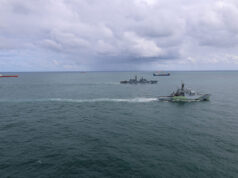
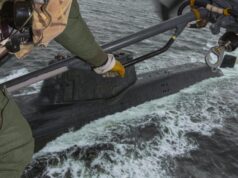
The response came after UK engineering SME Force Development Services successfully tested its containerised medical mission module at sea for the first time during a two-week trial carried out by the Royal Naval Medical Service aboard the ice patrol ship HMS Protector off the east coast of England in late April. Reaching Technology Readiness Level 8 places the system at near-operational maturity, one step below full system qualification.
NavyPODS is based on a containerised pod concept in which modules can be quickly added to or removed from a vessel, allowing rapid reconfiguration without permanent modification to the host platform. The medical variant demonstrated aboard HMS Protector is one application of a broader concept that could accommodate a range of systems including uncrewed aerial vehicles, autonomous underwater vehicles and specialist equipment.
The modular approach is designed to give the Royal Navy greater operational flexibility, allowing platforms to be rapidly adapted to emerging requirements or threats without the time and cost associated with structural vessel modifications.


“Reaching Level 8”
What are the other 7 levels ?
Conceptual, Conceptual Again, Cancelled, Renewed focus, Concept Phase, Design Phase, Concurrent redesign and manufacture.
😁😁😁
I’ve gained $17,240 only within four weeks by comfortably working part-time from home. Immediately when I had lost my last business, I was very troubled and thankfully I’ve located this project now in this way I’m in a position to receive thousand USD directly from home. Each individual certainly can do this easy work & make more greenbacks online by visiting
following website—.,.,.,.,.—>>> JobatHome1.Com
Followed by the deferment, subject to protect validation and accountability doom loop…
Joking aside, first ive hear of this interesting capability, I assume they could be linked up on a large deck, or a QE Class hanger, or individually mounted in a T26/31 bay??
I would ask Gerry Anderson but sadly he isn’t responding to my calls for some reason.
He and his wife were waaaaay ahead of their time.
Level 8 eh? Wow, gosh amazeballs…..soon to be level 9 around 2045…
I wouldn’t get too excited there are 15 levels prior to production and then level 17 is roll-out, level 18 IOC and level 19 is full operating capacity.
As much as I like the concept of PODS I am not sure about it. Several nations have tried to make it work but failed. One of the issues is that the ships services e.g. power, water, air con, data networks and possibly fire suppression would need to be ready and waiting and standardised for all PODS. Another issue that I know as I suffered from it, is the temperature build up inside a container and that was with air con. The air con just gave up.
So is PODS a good idea, yes, can it work, yes; however, it needs to be implemented in such a way that ships and the PODS work to a standardised pick up point, standardised pick up fittings etc.
In addition, I’m uneasy at containerising medical facilities in this way. Whilst logistically it makes sense, it’s going to be a dangerous game to play with regards to LOAC, especially the requirement to maintain protected status of medical facilities etc.
If you are placing these on ships doing something else as well I think it loses the protected status and could open you up for accusations of trying to conceal military operations… which is a war crime.
That is of course, if we all think that the LOAC will still be abided by.
Pretty much every USN amphibious ship has an onboard hospital for the treatment of wounded marines. It is accepted that these are not ‘hospital ships’ per se. As long as you are not claiming the ship as a ‘hospital ship’, then there is no problem with existing agreements regarding the safety of hospitals.
Treating civilian casualties in peace-time within a ‘hospital pod’ does not count as ‘concealing military operations’.
People overthink the ‘laws of war’ thing.
Thanks, nobody has ever accused me of that before.
My point on being accused of concealing military operations is driven more by the online narrative war, as part of major combat operations; not treating civilian casualties in peacetime – which would not be covered by LOAC.
But my understanding of these pods is that it’s a containerised R3 facility – and if that was a field hospital on land, it would be protected. And we wouldn’t, for example, co-locate it with a formation HQ because of LOAC.
I’m interested in why that IS different in the maritime domain.
It’s not ‘different’ in the maritime domain. Your field hospital is identified with red-crosses and other such markings. A simple jeep or APC that just happened to gather up wounded and is NOT marked with a red-cross is not an ambulance. It is fair game. The fact that wounded are present is irrelevant as the APC or jeep are not declared assets.
The USNS Comfort is listed as a civilian auxiliary with a primarily civilian operating crew for the ship’s systems. It sails around painted white with giant red crosses all over the hull and decks. The USS Wasp, though it has a hospital, is listed as a military vessel (USS designation). It is sailed by armed personnel. The hospital is not marked with a red-cross or identifying emblems indicating it is not a target.
In your scenario, a frigate with a hospital pod aboard is not violating any law because it is not wearing a red cross and toting Tomahawks at the same time. It is a declared military asset being used potentially in a civilian humanitarian scenario. That is accepted practice.
Ok, so I think you have confused the levels of military medical provision here.
The point is, this is a proposed solution for a Role 3 medical facility, but one we can put on any platform. That’s the distinction.
I’m not suggesting you can’t treat casualties on a frigate concurrently to it being engaged in combat operations.
I’m pointing out that there is a disconnect between the ability to put this anywhere and the potential second and third order consequences of not having a permanent hospital ship.
This is the equivalent of putting a military hospital on an artillery gun line.
And just before you think I’m dealing in theory, I have served in two active war zones on the front lines. It was my job to think through this stuff every day.
To start: Thank-you for your service.
Secondly, I have to think about this too, from the other end of the spectrum, because the rules of liability have changed, so people I work for can be sued if we enable scenarios such as the one you described.
With that out of the way, I’m not confused at all. It’s a question of assumptions about use-case, which wasn’t clear from your earlier post.
The question is whether or not you plan to use this as a ‘Role 3’ facility in a time of war in lieu of an actual hospital ship. I assumed that they were planning to use this as a hospital in the endless ugly ‘grey’ scenarios we’ve been dealing with over the course of the early 21st century.
Running this on a frigate operating off the coast of one of the ‘Stans, while treating people wounded by terrorists is in a ‘grey’ area. You’re not in a declared war and not using the ship as a combat asset per-se. Running this as your primary facility in a declared war in lieu of the USNS Comfort on a ship staffed by armed service personnel is a no-no.
I just don’t see a scenario where this would get used in that fashion in time of war. I see this as being used more like the hospital on the Wasp, where it would provide a capability to treat casualties until they can be evac’d to a real facility.
I think that’s fair. Just looking in the context that we no longer have a hospital ship…
So it’s most likely use case in combat operations is getting bolted into a major surface ship, be that RFA or RN – and threrein lies the issue.
Perhaps they plan for it to go onto a commercial ship taken up from trade 🤷♂️
Yeah, the lack of an actual hospital ship is a handicap in a real war. This capability, however good it is or isn’t, becomes something of a liability in a lot of ways. The hospital on Wasp is purely to get guys stabilized, so they can be taken elsewhere, which is why it works/is allowed. But it isn’t set up to be the place where you are taken for final treatment, convalescence, and discharge.
As you suggest, using a warship in lieu of a hospital ship is bad practice. Your only real hope is STUFT if you want to use this in a real, declared war, but the British merchant marine isn’t in great shape, either.
You can stick your PODS on an RFA as well. Argus versus a Tide? Is it any more dangerous?
I think that’s the point though – is that RFA a MCM Mothership, a R 3 hospital or conducting an amphibious strike?
What’s in the container? A hospital facility or a drone?
Interesting discussion, Bob.
We haven’t had a hospital ship since…? Don’t remember, as RFA Argus was classed as a PCRS, so without the protections a hospital ship has.
I wanted to know what was Inside but now I’m “thinking outside the box”
😎
“Ron”…. Is that you Ron 5 ?
No it’s Joe90 I think. Easy mistake.
Thanks for that, have not heard Joe 90 in a long time. Mmmm plug into a computer and become anything. Elon here I come.
They can join Stingray on the back burner then, all subject to the Delapitated Invalidation Project or DIP as it’s rumoured to be called.
We are spending too much time and money on the box and what’s in it. Not enough time on how it connects to the ship and to other PODs. It needs more than a few clips to bolt it down; there needs to be a standard for power and for data at the minimum (ideally water too in specific slots). If you don’t want to have to reintegrate every effector or sensor inside a POD separately on every ship and have power cables trailing all over the deck, you need to modify the ship to have a standard digital backbone into which a POD docks, and a bi-directional power standard (as some PODS will contain power generators).
PODS and containerisation could be a real blessing for the Navy, but not if it only sees them as isolated boxes with a hole to pass a power cable through.
Smart LEGO then !
I was thinking motherboard and plug in cards, but I like yours better. I may steal it. 😊
So we proved it works, but we’re not buying any anytime soon. We seem to spend an awful lot of money testing stuff without an end result.
Equipped for, never fitted.
Many interesting comments here.
Lets rewind to 1982 and the ‘red and green life machine’ in the Falklands so expertly commanded by Rick Jolly god rest his soul.
This facility housed munitions and therefore could not display the red cross. This despite the fact that men from both sides were being operated on in the building.
To display the red cross, a ship, building (etc) must be used solely for medical purposes.
An interesting footnote is that because Argentines were treated there, Rick was decorated by both sides for his service. HM Elizabeth II gave him permission to wear his Argentine medal.