

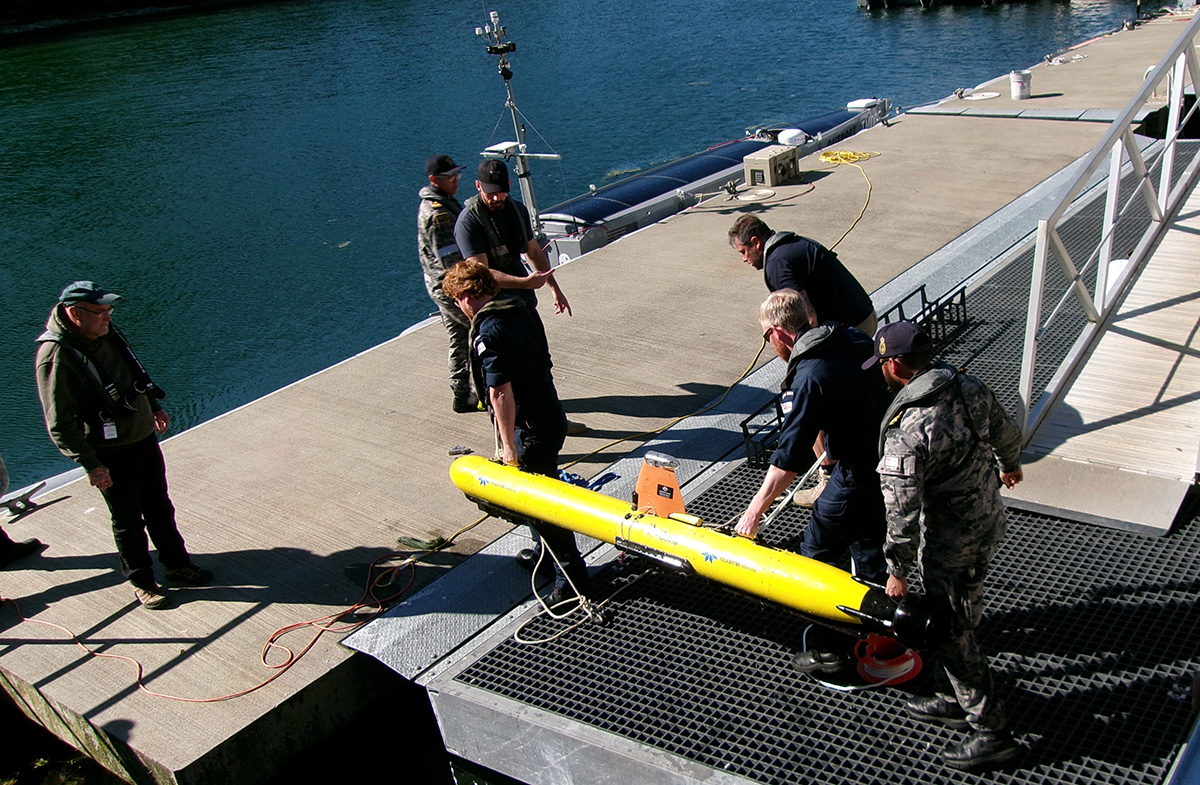
The Royal Navy has tested uncrewed and autonomous technology alongside its US and Australian counterparts to demonstrate how the three AUKUS allies could protect critical undersea infrastructure, the Royal Navy stated.
Exercise Lanternfish ran for six weeks, split between Virginia and Washington in the United States and waters off the south-western coast of Australia. Royal Navy divers and hydrographic experts ran remotely operated systems alongside American and Australian personnel. The exercise was conducted under the AUKUS Pillar 2 agreement, which focuses on the accelerated deployment of advanced military capabilities by the three nations.
The team from the Diving and Threat Exploitation Group demonstrated the VideoRay Defender, a small remotely operated submersible used to locate mines and underwater explosive devices. Experts from the Hydrographic Exploitation Group, based at Devonport, launched their Teledyne Gavia autonomous underwater system, whose modular design allows it to carry out varied missions depending on its sensor fit.
According to the Royal Navy, the systems were used to survey critical undersea infrastructure and rehearse responses to potential hostile activity in a realistic setting, operating as part of a wider ecosystem of sensors and underwater vehicles. The aim was to improve how the nations detect, monitor and respond to threats below the surface, sharing expertise and developing common operating procedures.
Lieutenant Commander Mark Wilton, from the Hydrographic Exploitation Group, was quoted in the press release as saying: “Our Seabed Warfare team worked extremely closely with our AUKUS partners, demonstrating true integration through the seamless use of Royal Australian Navy equipment when required. We completed a number of Gavia missions on the exercise, acoustic calibration, night-time and independent, unaided. The team really delivered and their qualified and experienced personnel have grown exponentially.”
Commodore Marcus Rose, Deputy Director Defence Underwater, was quoted in the press release as saying: “These events provide a fantastic opportunity to test our interoperability in a real world setting and allow us to iterate our capabilities at pace.”
The Royal Navy linked the exercise to rising threats to undersea infrastructure from foreign state actors, citing the covert operations of a Russian submarine in and around UK waters earlier this year. It said the trial reflected the service’s transition towards a Hybrid Navy, in which crewed and uncrewed capabilities work alongside one another. Planning for the next AUKUS Pillar 2 operational exercise, intended to demonstrate integration across maritime, air, cyber and space domains, is already under way.
AUKUS, the trilateral partnership between Australia, the United Kingdom and the United States announced in 2021, is structured around two pillars. The first covers the provision of nuclear-powered submarines to Australia, while the second, under which Lanternfish was run, concerns cooperation on advanced capabilities including undersea systems, artificial intelligence, quantum technologies and hypersonics.


I hope the royal navy is turning down anything the show the USA by 10%. “Can’t be too careful with allies as you never know if they will be allies in future” 😀
In other news Pete Hegseth is now calling on the UK to host a conference next week on the straits of Hormuz. I vividly remember the Fox News host saying America does not need allies but seems things have changed. 😂
Maybe wind-up Hegseth by having the IMO host the conference – like most in that administration he hates international organisations 😏
That would be absolute genius, Spock. Handing the conference over to the IMO right on the Albert Embankment would cause a total meltdown in Washington. It would be the ultimate diplomatic power play—using a UN agency based right in London to force a unilateralist administration to play by international maritime law rules.
Either way, between Jim’s point about Hegseth changing his tune on needing allies, and the Royal Navy actively leading autonomous trials in Exercise Lanternfish, it completely dismantles the idea that the UK lacks strategic clout. Whether we host it at Lancaster House or pass it to the IMO, the world is still coming to London to solve the crisis. The doom-mongers who claim our allies look down on us simply aren’t reading the room.
Strange, i thought you were the unilateralist by failing to comply with international agreements of the defence pact you choose to belong to.
Fair shout on the budget being a mess, Alex, but you are confusing capability with intent. Unilateralism means choosing to act alone without regard for your allies. Failing to meet a spending target due to Treasury squabbling is a failure of funding, not a strategic decision to go solo.
You can absolutely criticise the government for hollowing out the armed forces—and I’ll gladly stand next to you and do it—but calling the UK ‘unilateralist’ completely misreads our actual foreign policy. If we were trying to pull up the drawbridge, we wouldn’t be deeply integrated into projects like Exercise Lanternfish and patching up global shipping routes.
Worth noting we are the only US ally with forces deployed in the gulf that’s not pulling back.
The fact that we refused to take part in your illegal actions is the reason we have enough credibility to host an international conference. It’s generally the UK’s role to provide the US with what it needs to secure the global maratime order and the US desperately needs legitimacy and diplomacy at this point to get itself out of this mess. Much the same as we needed in Suez and Canada provided us with. There is no military solution to Hormuz and that means the current US administration is unable to resolve it.
😁
Brushwood gently rolling along In the breeze ……….
It’s a big old Sea.
Solitaire, it’s a great game to play when banned from further comments on a favourite place.
Would be nice to know why ?