

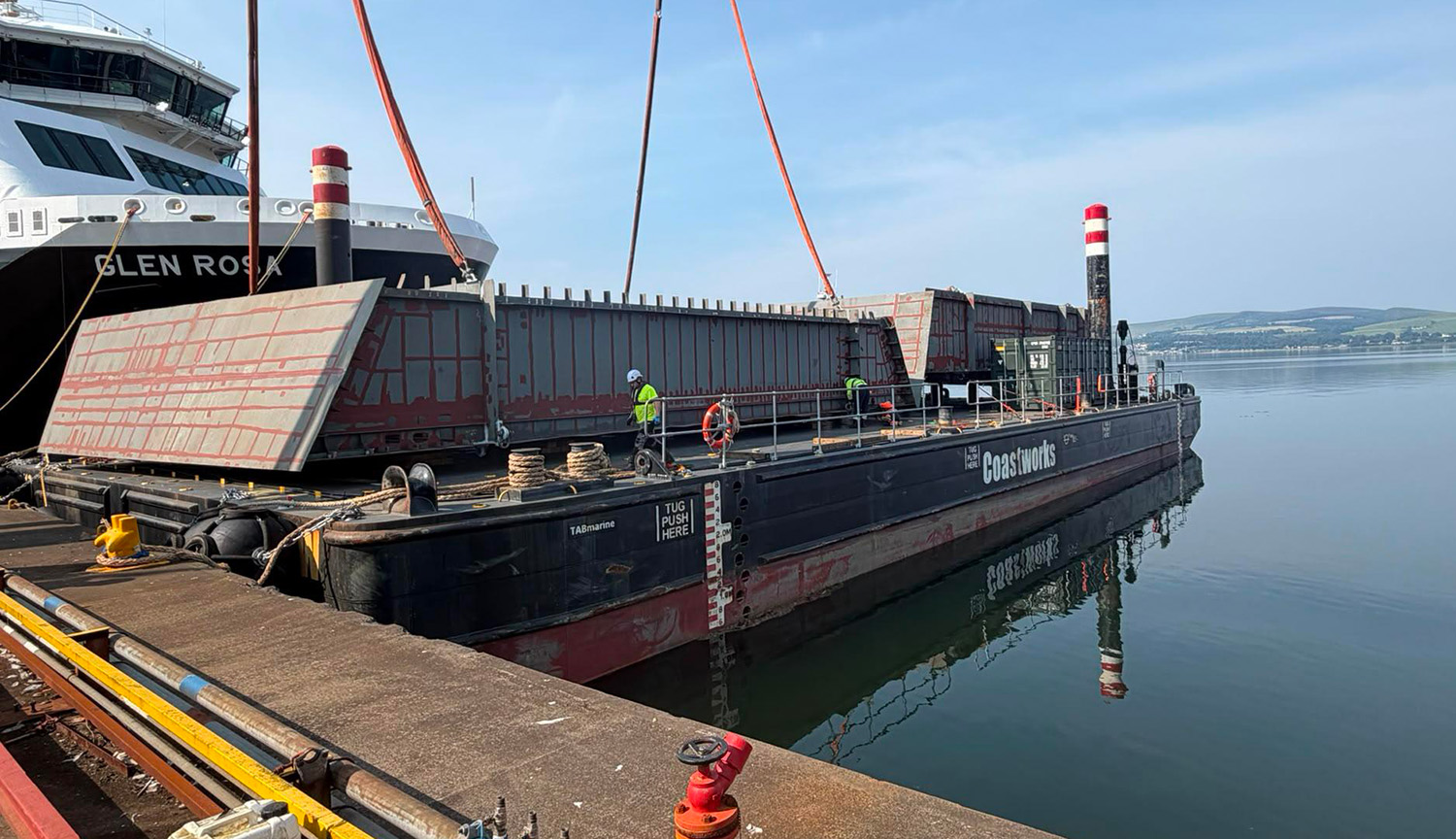
Three Clyde-based maritime firms have delivered structural units for a Royal Navy Type 26 frigate to BAE Systems, Ferguson Marine stated.
Ferguson Marine, Malin Abram and Coastworks completed three units for HMS Birmingham, the fourth Type 26 ship, as part of the programme being delivered by BAE Systems. The steel units were fabricated by the workforce at Port Glasgow before being transported to BAE Systems’ Govan shipyard in a coordinated marine operation overseen by heavy lift specialists Malin Abram, using vessels provided by Coastworks.
The delivery represents a milestone for the three businesses and highlights the region’s integrated supply chain and its role in supporting UK defence projects.
Graeme Thomson, CEO of Ferguson Marine, said: “This is a proud moment for everyone at Ferguson Marine. Our team has worked diligently to meet the exacting, world-class standards required for the UK’s next-generation anti-submarine warfare capability. This project has showcased the robust capabilities of our skilled workforce and provided invaluable, high-level engineering experience for apprentices. We look forward to strengthening our relationship with BAE Systems and continuing conversations about the support we can provide in the future as a supplier of key components.”
James Bowie, Managing Director of Malin Abram, said: “This project has provided an opportunity not only to further strengthen our relationships with BAE Systems, Ferguson Marine, and Coastworks, but also to showcase the expertise of our heavy lift team and, more broadly, the capabilities that exist across the Clyde. From undertaking site surveys and supplying the required craneage, tugs and barges, to developing the seafastening design and overseeing the operation, our team has drawn upon many years of experience to ensure the project was delivered safely, on time and to specification.”
Brian Young, Managing Director of Coastworks, said: “We have recently invested in a suite of new barges, suited for our clients’ needs, and the wider requirements of the Clyde. Scopes such as this demonstrate the value of our vessels, but also the importance of collaboration, with a growing relationship with BAE, Malin Abram and Fergusons, and an indication of the strength of the supply chain in Scotland.”
The company said Ferguson Marine is now preparing to deliver the ferry MV Glen Rosa while deploying a £14.2 million capital investment from the Scottish Government for infrastructure and equipment upgrades. According to Ferguson Marine, the funding is readying the shipyard in view of the Scottish Government’s stated intent to award it contracts to build four new vessels.
HMS Birmingham is the fourth of eight Type 26 frigates being built for the Royal Navy by BAE Systems at its Govan and Scotstoun yards on the Clyde. The class, also known as the City class, is optimised for anti-submarine warfare and will replace the anti-submarine variant of the Type 23 frigate, with variants of the design also selected by Australia, Canada and Norway.









Birmingham is almost certainly going to the Norwegians.
Seems almost certain but atleast it means we will get three in first and T26 (4) will be going straight to the bear gap where we need her just with a Norwegian crew.
How far behind is Birmingham than ship 3? Doesn’t seem like prouction is that far behind now? Maybe 12 months?
I would be very happy if it was number 4 going to Norway and the first 3 are kept as RN frigates… we really really need them.. the T23 issue has gone from a laughingstock to a profound crisis.
TBH a lot of us knew that it would be a crisis 10 years ago when the known hull life was up.
It was part of the reason for the accelerated T31 build – which was a total fantasy – to bridge the end of the graph. It is very hard to understand why T31’s build is soooooo slooooooow other than a total lack of fit out trades and key supervisors. It is one thing automating hull fabrication but it is quite another thing fitting hulls out.
All the confident statement by RN brass did take the edge off things a bit and I did wonder if they had found some means of extending the hulls. But IRL the tin worm, once properly embedded in a hull, cannot be stopped by any reasonable means.
I’m not sure if the T31 is due to be in service in 2029-2030 or if the RN is just leaving it vague. If Babcock really is taking that long to deliver then it’s unlikely it’s getting many export orders. Seems a ridiculous amount of time from now.
This is, I suspect, the root of the export problem.
BAES can claim history in launching ships.
Babcock cannot plus they have their excruciating delay on delivery to RN.
I wouldn’t order anything more, either for RN or export, until one of the ships was at least in trials with some proper feedback.
Unfortunately I think your right.
I really wish, even hope, that I’n not right.
But the slippage is unmistakable and blaming COVID for it, on both T26 & T31, can’t still wash.
It’s particularly disappointing given how fast the hulls seems to be emerging.
I totally agree. I think its time to be honest and say we are no longer a ship building nation. The Americans are sounding out destroyers being built in South korea maybe even Japan. With how quickly they turn out ships of good quality on time on budget its incredible that the position we are in this isnt an option till the current crisis is sort of over. Meanwhile get the needed infrastructure in place ready for the next batch of ships and submarines.
I think we can build high end ships.
We are just at a painful part of the learning curve!
I know we say it is slow but considering how long after the Type-26s they started building the Type-31s both projects have two hulls in the water. The first Type-26 was laid down in 2017, the first Type-31 was laid down in 2022. So in 9 years BAE have floated off two and in 4 years Babcock have done the same. So yes, I wish they were quicker but comparing BAe to Babcock you do have to give a nod of the head to them considering they started effectively from scratch and BAe carried on from the River-2s
Yes, but… the contract was for first ship in service in 2025.
I get the impression that they were too hasty to get Venturer in the water, for the optics of ‘progress’ without paying enough attention to subsequent fit out. Later hulls allegedly have more internal work completed before float off.
I agree completely with your concern over the ridiculous pace at which these ships are being completed. The Frigate gap is with us now, the replacements are due sometime after hell freezes over. I suspect that part of the problem with the fit out is that the Treasury are only releasing the necessary stage payments at their pace rather than at the rate needed to get the ships out in short order. Neither Bae nor Babcock are going to employ more people than they know they can pay, so the completion rate is out of their hands. As usual the dead hand of Whitehall dictates whether we can go to war!
Incidentally for those who still read the dead tree press, last Sunday’s Sunday Times magazine had a very good article about the ships being built in Scotland. It’s probably still available on line. It’s a good read, but the sub headline is “is it too little, too late?” I think we can all agree on that.
I don’t think this delay is down to Treasury.
It is down to lack of progress.
T31 contract was small and urgent to bridge the frigate gap….
That would make it the Bergen or the Trondheim then and certainly not Birmingham 🙂
Easier it seems than building ferries.
Doesn’t seem to be as quick as building a Model T Ford but hopefully they can speed up.
4 or 5 frigates a year of the production line is I’m sure achievable but people are obsessed be a steady drumbeat.
As everyone who knew anything about shipbuilding or construction said the problem was going to be the fitout.
The fitout supervisory skills have been allowed to wither and that is really the top and bottom of the issue.
So yes, hulls can be further accelerated but that does not help get ships into service……
SB,
Perhaps a lesson learned, albeit slowly and painfully, by MoD/RN re fleet construction and replacement intervals? 🤔🤞 Virtually equivalent pathway for USN. Only weapon system w/ virtually unlimited lifespan is the BUFF, and even that requires constant care and feeding. 😁
Hi SB I think it was you and I that first scratched our heads after seeing the initial photos inside the Babcock Buiid hall, I’m still not convinced !
However I do just wonder what would have happened if Cameron hadn’t cut the T26 numbers from 13 to 8, to speed up T23 Frigate replacement using cheaper and faster built T31’s ?
That cut ensured BAe bailed on the New Frigate Factory at Scotstoun as the reduced workload / funding couldn’t justify the cost, but made production harder by splitting the functions over 2 sites.
Meanwhile I’d love someone (like a journalist or MP) to ask a question of MOD so we get some Transparency of just how much the “cheap T31 option” actually saves compared to a T26.
I’d also like to know what are the long term add on costs for MOD having to refit and maintain 2 classes of Frigates when they are equipped from completely different supply chains ?
And Yes I will laugh my head off if HMS Glasgow is commissioned before HMS Venturer.😂
I certainly did scratch my head when I saw the initial photos as the lack of block pre outfitting….coupled with the ongoing ambitious statements about build times.
Having had a teeny tiny bit of experience in this area was was quite surprised that Babcock thought that they could build a MILSPEC ship from a cold start in a yard but not putting even the big bits into the blocks first.
Babcock must have a plan: various people said.
Sadly I don’t think there will be much in it between BAE and Babcock for first into trials.
I earnestly hope that I am wrong and that these essential ships enter into service rapidly.
Not a lot of news on T45 regenerations, thinking Daring, which doesn’t have a great smell to it given the acute hull shortages and T45’s essential role for missile/drone protection.
Was told by someone in the know that Daring is nearing sea trials……however, was also told that because of the bad press about her being out of service for so many years, much of the skilled labour working on Defender was shifted to Daring. Lack of skilled trades rears its ugly head again. Worth remembering that Daring had been robbed of so many parts to keep other 45s going, she was not much more than a bare hull. A lot of what is said about the unreliability of the type 45s is down to a terrible spares availability due to cost cutting at contract stage.parts often have to be bespoke manufactured which takes a long time and costs!
I agree Daring was pretty much stripped.
The skilled labour pulled towards the T45 project has undoubtedly affected T26/31 ISD.
Yup things are that tight.
I’ve been through a few of these alternate realities with AI just for fun. What if we went for the 13 T26s? Depending on assumptions and what you believe about the “late design” in the mid 2020s, looking at the costs of T26, T31, T23 extensions (still some unknowns there), B2 Rivers, Scotstoun expansion vs Govan, on the premise that we could have ordered 8+5 T26 in 2014 instead, and building annually starting from 2014-16. The numbers come out somewhere between break even and £2.5bn saved (in 2026 money). The actual scenario is never cheaper.
Another one I’ve worked through involved building 5 T23 starting in 2008 at Govan, pushing more of the Govan build down to Portsmouth when the Scotstoun frigate factory is built. This doesn’t keep Vospers open that much longer, but it totally avoids the frigate dip of the first scenario and the frigate chasm of the real thing. Costs are about £2.4bn more (in 2026 money) depending on new T23 midlife upgrades (Artisan, Sea Ceptor, etc). It assumes the Navy stays at 2000s manning. Otherwise you would have just ended up with lots of uncrewed frigates. T26s built annually from 2016. It gives you 13 ASW frigates up until 2033, when the T26 GPs start come on line to replace the T23s. However, you lose the B2 Rivers.
It’s fun to play “what if” sometimes.
* I meant late design of mid 2010s.
This is a brilliant bit of alternative procurement modelling, Jon. It’s a refreshing change to see someone look at the cold, hard numbers of the frigate timeline.
Your first scenario saving up to £2.5bn by going for all 13 Type 26s in 2014 is entirely sound. You’ve essentially modelled the economic reality of a protected shipyard drumbeat. In naval construction, maintaining a steady, annual build cycle keeps the supply chain cheap and the workforce optimised. When the Treasury stepped in to stretch out the Batch 1 timeline, they broke that drumbeat, causing BAE’s overheads to skyrocket. Your data proves that kicking spending down the road always costs the taxpayer more in the long run.
Your 2008 Type 23 bridging scenario is also fascinating, but as you rightly noted, manning is the ultimate bottleneck. A Type 23 needs roughly 185 personnel. Given the current structural recruitment crisis, we likely would have ended up with a fleet of brand-new hulls tied up at Devonport with nobody to sail them. Plus, the sheer cost of the life-extension (LIFEX) overhauls to fit Sea Ceptor and Artisan on ageing steel proved that trying to keep old hulls alive is a financial black hole compared to cutting fresh steel.
Fascinating run through of the numbers—the ‘frigate chasm’ we are currently sitting in was entirely avoidable if that annual building pace had just been protected.
“ Plus, the sheer cost of the life-extension (LIFEX) overhauls to fit Sea Ceptor and Artisan on ageing steel proved that trying to keep old hulls alive is a financial black hole compared to cutting fresh steel.”
AI has rediscovered the whole reason for the 18yr design life of T23!
You’ve hit on a massive point there. It’s funny how a multi-million-pound AI model takes hours to figure out what naval architects and shipwrights knew back in the 1980s. The moment we started treating a class designed for an 18-year hull life like it was built to last forever, the long-term cost models were always going to collapse.
Maybe you can ask AI what is the real cost of T26 being build already for 9 years.
Unless they have only dozen people building it each year it must be the triple cost of a normal world shipyard that takes 4 years to build a frigate. Certainly more than 2 Billion pounds.
Not even accounting for the opportunity cost of a shipyard slot occupied by an hull for more than double the usual time.
According to the 2017 Parker Review, halving the production rate increases the cost per ship by 40%. Slowing the drumbeat by 50% costs about an extra 20%.
Jon has hit the nail on the head with the Parker Review data. Alex, the inflation isn’t coming from labour hours tripling; it comes from fixed yard overheads being stretched out over a longer timeline.
The madness of UK defence procurement is that the Treasury knows a slower drumbeat adds 20% to 40% to the final cost per hull. But they still force the MoD to stretch the timelines out because it lowers the annual cash-flow requirement. It’s a classic case of saving pennies this financial year at the expense of wasting hundreds of millions of pounds of taxpayer money over the decade.
We need a steady drumbeat. Because if we go back to feast and famine we then lose all the skills again on the famine side.
Yes I would be very happy if it was ship 4 and not 3 off to Norway too!
I’ve lost track with type 31 now is the delay because they have changed their minds and adding the mk 41 launchers now instead of at a later date? On the first 2 ships for several more years delay or another misjudment on time scale.
MK41 launchers were purchased solely for the first 3 T26s so no chance of T31s getting any early. NSM would be a better addition on the fit out for the first 2 T31s.
Yes definitely NSM has to be fitted to type 31 a no brained! Think the DIP confirmed that.
After launch, about May/June last year, Babcock were talking about first handover happening the middle of this year. Apparently it was only when they were fitting out they found out how badly they screwed up the build on the first two ships. They were trying to rush it and ended up welding together modules where the internal cavities didn’t quite fit together like it said in the plans. Some of it is blamed on prep-work for Mk41, but it was bad enough that they had to stop work and conduct a review. From what I can tell, they didn’t screw up in actually adding the Mk41s, just creating the ship FFBNW Mk41s, ie in making the holes. They also talked about having built sections out of sequence, which sounds far more serious to me.
Ha really you can’t make it up! Thanks for that good news🤣
We are not alone though look at the Germans and Yanks with their frigates seems only the Italians and French have their act together.
Thanks for the post George it must be a bit of a thankless task putting up some posts 🤷🏻So I’ll be polite and the odd one out that actually comments on this very well written post about Fergusons building sections for HMS Birmingham.
Oh the irony of it all !
Fergusons was saved at vast expense by the Scottish Government to build 2 state of the art Environmentally friendly ferries using tech that had never been used in the UK before and run by a multi millionaire with zero history in ship building. The basic idea was endure the future of the yard, modernise it to secure a home grown SB for Cal Mac. Unfortunately the entire project was a fiasco as it haemorrhaged money, hit numerous issues and delays and they still can’t figure out where £100 million went to (maybe they should use different auditors as this is a bit of a habit where a certain Party is concerned).
Now the Scottish Government is resolutely not ordering anything from Fergusons and just buying abroad instead, so all that money spent on investment but they provided no further orders.
However fact is Fergusons have a skilled Shipbuilding workforce, modern Steel Fabrication facilities and are conveniently situated on the lower Clyde, so after a bit of training assistance from BAe they are now kept going by building parts for BAe. In other words it’s indirectly been saved by the U.K MOD who are the only organisation that is consistently investing in Scotlands Industrial capability and capacity and have actually resulted in major exports.
For Fergusons themselves this is their 2nd batch and BAe aren’t mugs so the quality of the steelwork for HMS Belfast must have passed BAe QC.
Well done to Fergusons and I hope they have a long term future helping to build Warships for the UK’s and Norways Defence.
The flip side of this article is it’s a little look under the bonnet of the level of diversification in their supply chain that BAe is using to get their T26 production Drumbeat up and running. Fergusons aren’t alone in this as CL and AP in England are doing the same.
As I said Ironic isn’t it.
Pretty sure Scottish Government have announced the purchase of four more vessels from Fergusons this year.
The Scottish Government direct award is now under a Due Diligence process so who know when and if they will build these four ships, and the award was announced two months before the Scottish Parliament election so the whole thing has a level of political theatre around it unfortunately instead of being straight forward and the work starting
If these ‘bits of boat’ are not for HMS Birmingham, why are they ‘labelled’ as such?
The 1st previous batch were for HMS Belfast and those must have passed QC for this batch for Birmingham were ordered and now built.
Thank you for that however, some are suggesting that these will end up as a Norwegian ship. So surely the shipyard would have a duty to report that correctly?
Recent events have finally focused MOD and government thinking on the RN’s totally avoidable escort crisis. The transfer of Belfast to Norway now seems off the table as the RN desperately needs three T26’s in service ASAP to meet critical UK national security needs. T26-04 (Birmingham) seems set to the first Norwegian vessel (delivered 2030?), and the only ship formally transferred from UK to Norwegian ownership – thus requiring a replacement (T26-13) to be ordered. After that the build slots are likely (but not officially confirmed) to alternate between the RN (T25-05, -07, -09, -11, -13) and RNoN (T26-06, -08, -10, -12). With BAE aiming to deliver one ship a year from 2030, it will realistically be about 2040 before the RN gets its eighth and final unit. A big Ouch. If BAE won another T26 export order it would get even more interesting, although realistically no such order seems likely at the moment.
This is a spot-on breakdown of the alternating slot logistics, RB. If the Norway deal crosses the finish line, pushing the Royal Navy’s eighth Type 26 out to 2040 is definitely a massive ‘ouch’ for our domestic escort numbers.
However, there is a silver lining to the strategic math here. A Norwegian Type 26 operating in the High North and the GIUK gap is fundamentally doing the exact same heavy-lifting ASW job that a Royal Navy hull would be tasked with. Because our underwater sensor data and command networks are completely integrated, a hull in Oslo’s inventory still directly covers the UK’s northern flank against Russian deployment routes.
Plus, by the time we hit the mid-2030s, the traditional hull-count metric is going to look very different. The Royal Navy’s massive push into autonomous tech—like the seabed warfare systems we just tested with AUKUS in Exercise Lanternfish—signals that a lot of routine infrastructure patrolling and sensor monitoring will be shifted to uncrewed platforms. That should theoretically free up the crewed Type 26 fleet to focus purely on high-end Carrier Strike Group protection. It’s going to be a tight squeeze on hulls, but the allied integration makes it a net win for the North Atlantic.
The UK needs to always have available an operational ASW frigate for non-negotiable sovereign nuclear deterrent related tasking. With the unexpectedly rapid collapse in the number of T23’s, having three fully operational T26’s in RN service by the end of 2030 has moved from being very important to critical. Staff at BAE’s Clyde yards are being offered double pay to work overtime hours. In the wider context – North Atlantic, High North, Bastion Atlantic, CSG … – the assumption is that Norwegian T26’s will make a major contribution. The December 2025 Lunna House Agreement security pact between the UK and Norway put this in writing.