

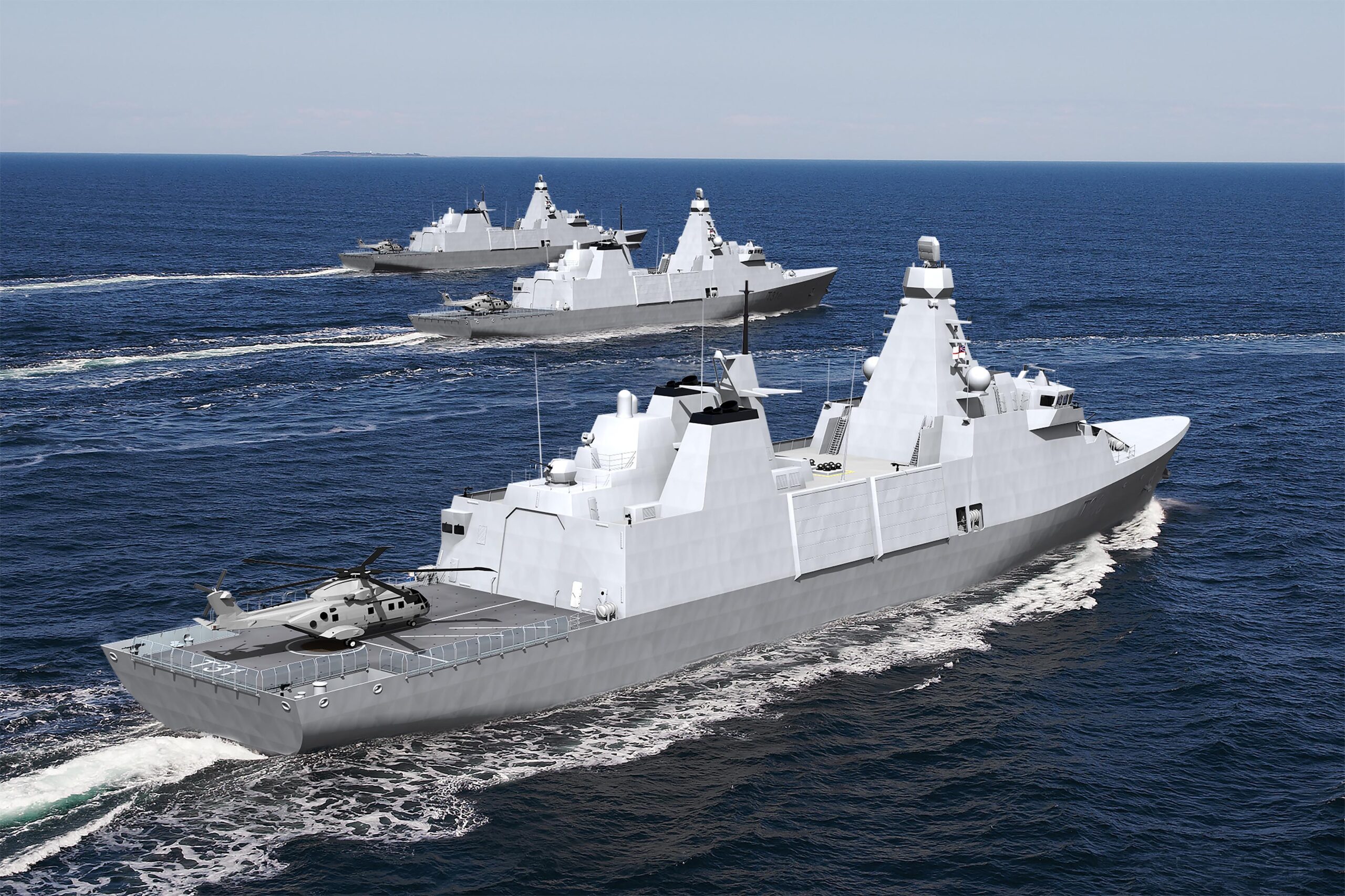
At Babcock’s yard in Rosyth, work is now under way on several Type 31 frigates at the same time. The lead ship, HMS Venturer, was launched in June 2025 and is being fitted out, the second, HMS Active, was floated off in March, and the remaining three of the five are taking shape behind them.
The Type 31, formally the Inspiration class, has drawn relatively little public attention, and the ship was always intended as a steady, practical addition to a fleet that is short of hulls.
The design itself is a deliberately cautious choice, because the ship is based on Babcock’s Arrowhead 140, which grew out of the Danish Iver Huitfeldt class and has been in service at sea for well over a decade, so the Navy is buying a hull that is already understood and proven, which lowers the risk that has dogged some recent British programmes. At close to 140 metres and around 5,700 tonnes the Type 31 is a large frigate, and it has been designed to run with a core crew of only about a hundred, with space for around 190 once specialists and aircrew are embarked.
A large hull worked by a small crew leaves a good deal of room and weight to spare, and on a warship meant to serve for thirty years that spare capacity matters, because it has to be able to take on equipment and whole roles that no one has foreseen. The Type 31 has a sizeable mission bay that holds payloads in standard shipping containers, a flight deck and hangar for a Merlin or Wildcat, and boat bays built for uncrewed craft as well as ordinary sea boats, so a single ship can be fitted out for anti-submarine work, mine clearance, maritime security or disaster relief and then changed over again when the job changes.
On commissioning the ships will carry a fairly light armament for their size, with a 57mm Bofors gun, two 40mm guns and the Sea Ceptor air defence system, and that has drawn criticism from some observers. The Navy’s answer rests on the same spare capacity, because the design was always meant to be filled out later, and a planned capability insertion will add a 32-cell Mark 41 launcher able to fire Tomahawk cruise missiles, if ordered, taking a general purpose frigate to something considerably more potent over the life of the ship.
That same flexibility is why the Type 31 fits the direction the Navy is now taking. The First Sea Lord, General Sir Gwyn Jenkins, has put a so-called Hybrid Navy at the centre of his plans, a dispersed and digitally linked force in which crewed warships work with drones and uncrewed vessels, allowing the fleet to cover more sea without manning more ships.
The force such a navy needs is already being assembled, because through an initiative it calls ARMOR Force, Babcock has teamed with the American shipbuilder HII to bring its ROMULUS family of AI-enabled uncrewed surface vessels into British service, and the firm has put ROMULUS forward as the basis for the Royal Navy’s first autonomous escort, with the aim of having one in testing around 2027. The vessels run on a mature autonomy system that HII already uses across American and allied programmes, and HII has expanded a site at Portchester in Hampshire to support them. A crewed frigate with the room, the deck space and the boat bays to act as a command ship for vessels like these is the kind of ship the plan needs, and the Type 31 was built with that in mind.
The thinking behind all this was set out in the 2025 Strategic Defence Review and owes a great deal to what Ukraine has done to the Russian fleet in the Black Sea, where cheap uncrewed boats have inflicted serious damage on a much larger navy. The role in mind runs from hunting submarines to standing watch in the North Atlantic and the High North.
Other navies have been buying the design, which is some measure of its quality. Sold for export as the Arrowhead 140, it has been picked by Poland for its Miecznik programme and by Indonesia, where the first locally built ship took to the water in December 2025. Babcock’s marine chief, Sir Nick Hine, talks of getting to “31 by 31”, roughly 31 of the ships built or ordered around the world by 2031, and each sale spreads the development cost, sustains several thousand skilled jobs at Rosyth, and leaves friendly navies operating a common hull that is easier to work alongside at sea.
The cost of the programme is widely misread, it should be noted that the figure of about £250m a ship, or £1.25bn for the five, pays for the bare platform, because the radar, combat system and weapons are funded separately by the Ministry of Defence as government furnished equipment, so the real cost of each ship is higher once that kit and the supporting shore facilities are counted, which is simply how the Ministry chooses to split the budget for a warship and not a sign of a hidden overspend.
Costs have risen during the build as well, with ministers acknowledging an extra £40m from the pandemic and supply problems, Babcock taking a £90m loss on the contract in 2024, and the company booking a further £140m charge this May for higher than expected rework and for work done out of sequence on the first ships. Much of that rework came from changing the design to build in the later upgrades, the ships further down the line have been far less affected, and figures of this kind are normal for the first vessels of a new class, so the red delivery confidence rating the programme carries reflects a demanding early stage of build and not a project that has gone wrong.
The lead ship is expected in service towards the end of the decade, and the rest of the class should follow in the early 2030s.
The Royal Navy is getting a large and adaptable frigate built on a proven hull, with the space and power to grow into a much more heavily armed warship and to serve as the crewed hub of the uncrewed force the fleet is now assembling. It arrives at a time when the Type 23s are ageing and there are too few escorts to go round, so hulls that can be delivered in numbers and turned to many different tasks are worth a great deal.
With allied navies choosing the same design and the wider hybrid fleet taking shape around it, the Type 31 stands as a sensible and well-judged answer to the demands the Navy actually faces in the years ahead.






The MoD seems to be going quiet on the MRSS concept now, I wonder if that could see the T32 concept reborn. Babcock seems to have the best T32 design by basically putting a boat handling stern dock ramp on it and increasing the flexible mission bay while putting 16 mk41 on the bow.
Definitely seems the kind of ship we need in the modern age, bake to deploy a range of drones for MCM and ASW work while providing protection for them from air attack.
I think you must be referring to the Babcock MNP AH140 variant by the sound of it? Looks very useful and could be design ready to go if a decision was given. Like to see a non deck piercing CAMM farm added atop the mission bay though along with the NSM.
As an aside, wondering if all the CAMM tubes off the decommissioned T23s could be recycled and refurbished for use? 5 T23 ships x 32 = 160 tubes.That’s a lot, and probably save a fair few quid. Could potentially reuse on T45, T26 and T31s.
I thought the CAMM farms on the T23’s can’t be reused due to their angled arrangement? It would be cheaper to buy in the 6x cell formation like on T26 and have a mushroom-farm of 24-48 above the A140 MNP mission bay. keeping the B mount position for 16 Mk41 and still having space for NSM.
The 6 cell modules don’t seem to be the choice for the Type 26 anymore.
The Royal Navy website says that they’ll have 12 cells that hold 4 CAMM each. Which is interesting given that everything we’ve seen is 8 modules of 6 cells, there’s been no announcement of a change either, just the RN website saying differently.
As it is, the 6 cell modules are incredibly undense, 24 of them takes up the same space as 20 mk.41 which could hold 80 CAMM
The RN’s website also says that the mk41 is there to fire the Standard Series, it isn’t very accurate.
I’ve gained $17,240 only within four weeks by comfortably working part-time from home. Immediately when I had lost my last business, I was very troubled and thankfully I’ve located this project now in this way I’m in a position to receive thousand USD directly from home. Each individual certainly can do this easy work & make more greenbacks online by visiting
following website—.,.,.,.,.—>>> JobatHome1.Com
I’ve gained $17,240 only within four weeks by comfortably working part-time from home. Immediately when I had lost my last business, I was very troubled and thankfully I’ve located this project now in this way I’m in a position to receive thousand USD directly from home. Each individual certainly can do this easy work & make more greenbacks online by visiting
following website—.,.,.,.,.,.,.,.,.,.,.,.,.,.—>>> PayAtHome1.Com
Sound like the RN doesn’t knows what it’s getting 😂, 12 cells would make sense if ExLS was being fitted but i understood we left this at a dead end? Who knows?! Should just standardise on Mk41 in all honesty.
I suppose another use for the soon retiring Mushroom Farm kit and tubes, is installing them into land battery positions near air bases and army camps, both for their air defence but also ground security.
What do you think Sky Sabre is for ? 🤔.
I’m presuming he is making the point that there aren’t exactly loads of Sky Sabre to go around. Whether his idea is actually feasible or cost effective I have no idea mind.
Some people on here seem to be under the misconception that the growing Fleet of Type 23’s sitting in Fareham Creek awaiting scrapping still have their Missiles in situ.The CAAM Missile is effectively a Round of Ammunition,it comes in it’s own Box/Cannister which doubles up as it’s Launch Tube.All retired 23’s have been de-milled,the Missiles have been removed to be used/deployed elsewhere.There is absolutely no vital Equipment left (STILL) on the 23’s ,including the VLS that can be recycled or reused anywhere else of any note save for Scrap Metal.Despite repeating this ad nauseum some people just don’t get it at all !.
Terribly sorry Paul, I wasn’t aware that we’d already recycled everything and were still woefully exposed defence wise.
That I don’t live and breathe it and instead make a first time observation that we could continue to utilise these expensive pieces of kit, instead of bunging them into a damp warehouse where they have no use until new ships are fitted out and even then, the RN isn’t communicating what’s going on.
So I won’t even bother with you, but if you don’t want to repeat it, perhaps scroll on and don’t waste your time explaining it to the brick walls like myself, because I’m obviously not clued in like your retired self.
TJ -Apologies my reply wasn’t specifically aimed at you,you had asked a reasonable question ,and you have to my knowledge only asked it once.My reply was aimed at the person who keeps asking the same question over and over and over and over and over and over and over and over agian,who gets reasonable repies but still asks the same question over and over and over and over and over again.
If you’re referring to my earlier post I am talking about the angled launch tube that hold the CAMM cannister box. A recent photo I saw showed all 32 tubes still in tact. Sorry I can’t remember the ship or site. If they’ve gone or can’t/won’t be used that’s fine.
Interesting on the quad Camm. The photo we have on the T45 CAMM upgrades seems to show the usual CAMM farm flush with the deck. If they go quad that’ll be quite an uptake then. We’ll hopefully see soon.
The whole thing is moot when you only order five of them
The final juggling for the defence investment plan seems to be taking place.. there are some signs f35A is out and the money for net zero will be fed into defence to plug the gap.
As Jim says we have not heard much around MRSS or T32.. this will be the very interesting bit.. the rest of the RN is essentially now locked in stone but these are the two concept level only programmes that can be fully adapted to the new autonomous navy concepts that are developing..
If the F35A is out do you think the 12 will go back to being F35Bs? Or, just no more of either for now?
Aren’t they going to need some more actual manned ships to control the significant increased masse of drones?
I’d suggest that they think around 60 F35 is enough, so they won’t buy extra, just 12B.
So another sneaky cut.
HMG are masters at announcing something to fanfare then quietly modifying it.
If they do buy the full 27, good.
The A purchase was to make a saving from the very beginning, the nuclear role a convenient figleaf.
To be honest I would much rather they spend that money for 12 F35As on something that could up the numbers of typhoons or support more AEW or provide a long range ( 500km) strategic strike weapon for the carrier based f35Bs we have..
As an example, Im not sure how much it would be to keep the 30 odd FGR4 tranche1s in the air as air defence aircraft, but I bet it’s no where near the cost of 12 f35As
I’d take that as well, to be fair.
I’d also take it if the money went on more Atlas and Merlin, E7s, P8s, a few k extra troops for the Army to form additional CS CSS, all sorts.
I thought the Tranche 1s had already gone.
The RAF still have them listed, they probably need a lot of rebuilding though.
Most have been broken down for spare parts now. Only the 4 in the Falklands remain in active service. I think it would be surprising how expensive it would be to keep those 30 T1s in service and even to give them a limited upgrade. Maintaining them became a real pain for the RAF as they were very different aircraft from the T2/3s. Very much a fleet within a fleet. Different logistics chain, different way of operating them for the pilot’s.
I would keep the 30 odd FGR4’s as well over any other aircraft types. By the time we can order and receive any other aircraft either new build typhoons or F35’s it will be the early to mid 2030’s. Any issue with Russia will be dealt with and probably China too. By the mid 2030’s we will be looking at GCAP and both Typhoon and land based F35 will be obsolete.
If Oman wants to sell its tranche 3 typhoons as well we should think about buying them plus anything Qatar doesn’t want. It’s too late now to beef up the RAF with new aircraft orders.
We can give our FGR4’s basic upgrades like Airbus is doing for Spain and keep them relevant for sovereign air policing roles. Maybe even consider an air national guard to put them in.
The irony is that the A variant is £30 million odd cheaper per aircraft, compared to the B.
And you could buy a gobstopper for 80p which also can’t operate from a carrier. Not sure I see the irony.
You’d have to go quite a long way to find a gobstopper today, I think.
You look in the wrong shops.
We could do with a few on here.
Oh dear… Talking about costs for the RAF and you failed to clock why the A would be be better for RAF procurement because you thought you’d be super tough with that Gobstopper shite.
Exactly. You were talking about the RAF and I was talking about the Navy. The F-35Bs work for both services; however the F-35As only work for the RAF, as do the Typhoons and as will GCAP. The RAF has several realistic procurement paths, the RN only one. Hence my comment that F-35A is as much use to the Navy as a spherical confection.
Perhaps someone in No 10 has switched the lights on….’why didn’t we think of this before’. As regards F-35A both 24 or zero make more sense than one squadron of 12. Maybe more Typhoons are in the offing? …keep Warton busy especially if GCAP is pushed back: the unions would be pleased. Transferring budget from net zero zealotry to defence is a no-brainer, especially if the North Sea ‘transition’ is slowed down: jobs are currently being destroyed faster than net zero jobs are being created. Redefining MRSS as a capability rather than a single hull legitimises the notion of an expeditionary capability made up of 3 frigates + 3 two spot Enforcers or Bays. Jim’s concept of T32 would be the lowest raiding rung on the escalation ladder. T32 would be more affordable and give Babcock more certainty. Also, a multi-purpose T32 might be a more attractive sales proposition to countries with small navies like NZ versus frigates like the Mogami or FDI.
Agreed. If we sre going to have the “A” version then let’s have the whole 27 on order and dedicate the “B” version for the carriers, maybe not exclusively, but with the RN having priority. I read this morning that a Japanese team are in the UK to push for the next allocation for Tempest which has also been waiting for the mysterious DIP.
Japan has been getting very pissed (Italy too even apparently) about the delays that the DIP is having on Tempest allocations. It seems we are going all German in collaborative efforts. I thought it was the EU that was plagued with red tape and bureaucracy, Labour seem to becoming Masters at it while the EU are actually forcing through policies on defence and economic matters because they can see the future if they don’t now that the US is going all hostile on all fronts and Europe a mere pawn in their games.
Like the “MRSS as a capability” comment and spread over 3+3 as Frigates/Bay types. Quantities of each could be flexible.
It’s flexible and scalable up to a point. Of course if you need to get lots of heavy vehicles / arnour ashore and you don’t control a port then you need a big LPD, preferably arned like the MRSS. The frigates and LSDs can also be tasked with other, more frequent duties / scenarios whereas the big LPD is really only for the rare ‘ San Carlos’ – its insurance. We should have it, but only 3rd party not fully comp.
F-35A… is a total waste of time..!.Tactical Nuks we Can’t Use…!.Drop them for 6/9 P-8As., 3+ E-7s…!
T31… The Vague Mention of ASW Capabilites of T31 in The Commentry Rather highlights the Worry of Many…! ( Asset or Problem Child…?? )
T32 …The Frigate that Refuses to Die…!
Suggest 5 for East of Suez, Arrowhead 160 Based Design With SIGINT/ELINT Capabilites…!
MRSS….To Expensive for the Treasury…?
What will the Marines do After The BAYS Ask the 1SL…????
I think it’s fair to assume that T32 is not going to happen id consider half a dozen freedom class LCD from the Americans to be a replacement project class ships which have had the combining gear fix are performi
Ng well within a couple of the carrier groups. Plus they are built alread..
Agreed with everything being said here , steel is cheap and air is free etc etc but before we start talking T32 let’s just keep the line rolling as is but with 32 MK41 and NSM from the offset not as ever FFNW. Three more T31 to make a class of eight in line with T26 would suit me fine but if we are going to do a Batch 2 or T32 whatever and have concerns that MRSS may never happen then maybe we should follow the Danes ( again!) and maybe take a look at a modified Absalom class design?
Steel is only cheap if you buy Chinese. UK steel or Steel from Sweden is relatively expensive because it is a better grade which is required for UK warships. You could buy cheaper steel but you would increase the dead wight of the vessel as gauging would have to increase.
Couple of thoughts. I think the RN would like to eventually get at least of the ‘proper’ 3x 20,000 ton MRSS armed LPDs. So that means 3xT32 ( or T31) would be a stop gap. Interesting to think about what would be the role(s) of 3 additional Arrowhead 140s. Option 1 is they could be just basic patrol frigates to replace the batch 2 Rivers which will come home when the batch 1 Rivers go out of service. Option 2 is they could be full fat GP frigates with lots of Mk41, CAMM-MR, better radar and a TSA. Option 3 is they could be given a slipway for launching USVs and/or UUVs. Option 4 is they could get a slipway, a vehicle deck, a side door and Mexflote i.e. an Absalon clone.
I think option 2 or possibly 3 are favourite. Enable them to launch and recover Atlantic Bastion USVs but with a big hangar you might also be able to deliver and support a a useful sized RM raiding party when deployed elsewhere. Beyond raiding I would add an Enforcer / Bay to the protecting frigate and that combo would be the expeditionary capability until we can afford MRSS.
Interesting thoughts. I think that building an updated Absalon clone would be a good idea, call it Type 32 and give it the flexibility to carry USV’s mine hunting drones or 150 Royal Marines. Absalon has hangars for two Merlins and a combination of the large vehicle deck and the sort of mission bay handling system going into the Type 26 would make a versatile ship. Keep as much as you can from the T31 design, main engines, generators sensors and other electronics to keep the cost down and you would have good design.
For MRSS why not go for something smaller, like an expanded Italian San Giorgio LPD. I appreciate they are optimised for the Mediterranean but you could make a ship perhaps 2/3 thousand tons larger, which should give greater range and good sea keeping. You have a through deck for helos and drones, a dock for raiding craft and LCVP and accommodation for most of a commando if that is your mission. Pair a ship like that with an Absalon clone Type 32 and you have got a very flexible strike group.
It’s interesting to speculate about alternative short term MRSS ‘solutions’ like San Giorgio for expeditionary capability, but I think the DIP budget is so tight it only makes sense to consider existing ships and build programs.
You are absolutely correct, my post can be put firmly in the “fantasy fleet” locker! It will be interesting to see what the DIP says having been so long in gestation, and also how long it lasts before changing threats require its revision.
Exactly we will see if it is already becoming out of date, we are in danger of this becoming like painting the 4th Bridge though perhaps a permanent ever progressing overview structure with platforms/technologies getting allocated/financed on the basis of priority and budget availability as and when they can might be a better system. As conflicts grow more imminent and requirement and thus budgets grow so more capability can then gain the go ahead. But what do I know.
The 1SL aversion to Big Platforms at A time When big Platforms are What we Need..Two.QEC and Three RFA Bays are Effectively all we have…The BAYS Are 20yrs Old ! and the QECs are hardly Reliable…! MRSS is a must For a 5000 Marine Force….?
And 1SL is a Marine. I’m finding it rather difficult to join the dots…..?
Doesn’t like “big”, what about the bloody big FFS being built then?! Build big and useful where appropriate and in sensible numbers.
Just wait until our adversaries and others start making their 1000 ship & drone type navies. What then? Large scale drone-dodgems on the high, narrow and in the deep seas! We’ll still need to have a “real” fleet around to take advantage when our adversaries are busy looking at their screens.
Would love to see the redeployed B2 Rivers replaced with a B3. B2s have been fabulous workhorses and it would leave the T31s available for more ‘serious’ jobs. Using T31 to replace the forward deployed B2s doesn’t give an increase in hull numbers. 5 B3s shouldn’t cost very much and can be built elsewhere than BAE or Babcock.
That would make sense if we can’t afford oe man more frigates and we feel those we have should be in the Atlantic.
And maybe give the B2s a bit of a gun, radar and UAV ops upgrade?
It’s interesting to contrast how the RN has taken the Danish Iver Huitfeldt and adapted it into the Type 31, against how the USN took the Italian FREMM for adaption to the Constellation…
While the spec may have been genuine and the amount of work under estimated , i would not be surprised if there was not an element of “not invented here” and “lets thow a spanner in the works” to ensure the bosses dont get too cosy about foriegn designs.
Some were valid changes, such as upgrading the survivability to USN standards which were higher. I have a vague feeling the RN had to do similar with the Iver Huitfeldt design.
But it was mainly a case of Americanising the system, sensors and weapons, together with trying to cram as much onto it as possible.
Congress wanted the USN to adopt an existing foreign design for simplicity and speed of build. But the hull is the easy part, it’s the systems, sensors, and weapons that go into the hull that make it a warship that are the complex (and expensive) part of construction these days.
I heard second hand that if they could, the USN was looking at the Type-26 Hulls, but Congress wanted an already proven and in service hull.
If they did decide to change now, the plumbing for the US Type-26s would be there. 32x VLS up front, 5 inch Gun, CIWS or RIMS, 30mm Remote Guns, via the Colonies sub classes, AEGIS combat system management and with Canada’s version, AN/SPY-7 Radar is designed into the ship already.
So they could pick up with an already designed and worked out ship to their liking. And if they require a more VLS focused option, there’s the BAE System Firepower Upgrade with adds another 64x VLS at the cost of a Multi Mission Bay fore of the Hangar.
Assuming a new administration is sworn-in in 2029, I’m sure there will be a revisiting of USN shipbuilding.
The Trump Battleships will be cancelled straight away.
Next will be an examination of FFX. If they have any sense they will reduce the order and have these replace the LCS. Hopefully they’ll realise they need a proper ASW frigate, a role neither Arleigh Burke or Legend can fulfil.
By then the first Type 26 will be operational, so 🤞🏻 But the question is whether Congress can stop the USN from further gold-plating, and simply buy the Canadian/Australian design…🤷🏻♂️
“Sweden has shown interest, and the United States has taken a licence.” Have I missed something?
Good spot. I thought Sweden went for FDI. The US taking a T31 licence would be shock move versus the Legend cutter. T31 could compete for Pacific endurance and has a lot more growth potential.
There is no US license. Not sure where the author was getting this information. As you have stated, the Swedes went for FDI. There may have been some interest. There may still be interest in Arrowhead 140. USN is doing a study of foreign designs, after all. However, there is no purchase listed anywhere.
Agreed re licence.
Given the fiasco the USN has had with Zumwalt, LCS, Constellation and now using coast-guard cutters as frigates, you would hope they would be crawling over the design of every foreign frigate they can.
Should the Legend cutter/ FF(X) frigate also fail, they might have to resort to buying frigates built in foreign yards and even using foreign systems. Two things that are currently illegal and politically unpalatable respectively.
Use of foreign systems isn’t so much an issue of being politically unpalatable as it is an issue of logistics and reverse-ITAR. Ie we don’t stock parts for SYLVER or Aster, nor would we want to be held hostage if we should want to do something with our shiny new toys. (And this has happened recently with the Swiss refusing to let ammunition they produced go to Ukraine, so it’s not just a ‘US’ thing.) We already use a lot of foreign systems, just not the kinetic ones. E.g. we use Sea Giraffe as SPS-77 on the LCSs, and there is a LOT of interest in CAPTAS 4 from Thales. We’ve more or less standardized on NSM as our Harpoon replacement. If it’s really good, the US will gladly buy it.
As far as crawling over foreign designs, what they really need to do is just hire a capable marine engineering firm to just design a frigate instead of rushing around trying to borrow one. There’s plenty of design talent here in the US to do this job, but the civilian leadership keeps trying to ‘short-circuit’ the process to ‘get it quicker’. That would be a far better use of 2 billion bucks than sending a bunch of pukes to go on ‘fact-finding’ junkets in the far east.
Frigates are what I refer to as ’10 year’ programs. You start on year 1 doing analysis and requirements work and on year 10 the boat slides into the water. If we had accepted this basic reality, the USN would have frigate 1 going into the water right now. Instead, we tried to ‘get it quicker’ with Connie by buying somebody else’s homework and… no frigate.
You need to reread what I wrote 🤦🏻♂️
Use of foreign systems is the issue for the Septic Tanks, which is why they Americanised them. Unfortunately American exceptionalism means it’s difficult for most of them to grasp that someone else might produce something as good as or possibly even better than the American equivalent. It’s very much the rate exception when they buy foreign.
The UK clearly doesn’t have such as issue as we’re using Thales Tacticos for the CMS on the Type 31. No doubt if the RN had insisted on a purely British frigate the Type 31 would still be on the drawing board with costs spiralling upwards towards that of the Type 26.
I can see the next administration, if the US ever has another presidential election, cancelling the FFX in addition to Trump’s battleships.
Ok. Ignore.
I think if Babcock had offered a T31 with the BAE CMS and Artisan it would have gone smoothly, but the government decided to accept what the winning offer ‘came with’ and Babcock were partnered with Thales.
It would certainly have made more sense to have a uniform radar across all of our frigates.
Yeah, the idea the Americans would have the license of the T31 without a big announcement in the UK media is nil.
If the Yanks were interested, I would hope we’d push hard for a Type-26 Hybrid of all the Subclasses. Because their main grip is lack of Aegis and or US Radar, but the Canadian subclass is using Aegis combat system and the AN/SPY-7 so the US Navy could pick up from there.
If they want a VLS heavy configuration, then the Aussies have them covered with that BAE Systems firepower upgrade. On top of a forward 32x VLS count, they could have another 64x VLS tubes installed and 4x Quad NSMs instead of a Mission bay.
But that’s Fictional until they start talking about it, which is probs gonna wait till this Admin is not dazzled by a Battleship.
The obvious solution for the USN is to build copies of the Canadian version of the Type 26… but that wouldn’t be politically acceptable to this administration.
oops, I’d assumed the Arrowhead 140 design had been licensed for study as part of the US frigate programme that ultimately went with FREMM
Thanks for clearing that up.
Slightly out of left field – Babcock have only one available dry dock for the T31/32 for fitting out.
Active is already sitting waiting (and others are likely to follow?).
Could Babcock use the unused dock at Scotston for fitting out if it is too small for T26?
Doubtful, Company Politics, where would you get the Labour, Money, and the fact it is probably too small for the Type 31 too.
Ridiculous that there’s only Dock 3 for Fitting out.!. I belive in Rosyth…Dock 1 is Reserved for QEC.!..Dock 2 for Nuclear Submarine Dismantling ..!..
P××× Poor Planning by Babcockup..!..At least Consider Sending the QEC to Somewhere like Inchgreen for Maintenance Releasing
Dock 1
Considering the carriers aren’t in said dock, could they not shuffle things about… One carrier, maybe two T31s?
Always thought QEC Should be Maintained Away from Rosyth..Perhaps INCHGREEN or a New Dock at PORTSMOUTH..!
The Dock 1 Should Be Used For Building And fitting Out..!
Active is actually still undergoing fitting out, outside of the drydock. They’ll be doing minor stuff now, with the aim of cutting down the amount of time actually required in drydock once Venturer goes out for trials late this year, or early next year.
Unfortunately, a drydock is still needed for the major bits, like fitting propellors and the mast.
Thanks. Frustratingly slow progress but understandable if reworking has been required on both.
What’s going to be interesting now that while we know vessel 1 has been delayed abit… ship 2 requests less work and vessel 3 full steam ahead!
Quite possibly we could get all 3 coming into service within a timespan of 12-24 months!
The Type 31 was built down to a cost – part of George Osbourne’s massive cut to UK defence. The result is that it’s inadequate for escort duties.
It’s running late.
It’s running over budget.
Its quality is yet to be proved but this will be the first warship built by Babcock’s so I wouldn’t bet on it being great.
It’s the perfect ship to purchase in large numbers (around 12-15, with the vertical launchers) and have in continuous production with incremental improvements as technology moves on. No mid-life upgrades needed with continuous production and very flexible for exports as we could offer either brand new with a relatively short delivery timescale or 2nd hand. Will we get that? Seems very unlikely!
I’m not so sure about “perfect”, but it’s certainly good enough, and that’s largely what we’re lacking. With the planned 32 VLS and the option of deploying unmanned assets like minehunters and gunboats, it’s well suited to all of the out-of-areas jobs that don’t need first rate capabilities (almost like the RN actively designed it that way…).
Realistically, we should be ordering at least another 3 (+2 more T26) to fulfil the original frigate requirement from the Noughties for 10 ASW and 8 GP frigates. Ideally, we’d be doubling the T31 order to capitalise on the investment already made in a second warship builder.
Tragically, none of it is likely with the current state of our politics. Prompt and modest investment would make a huge difference, but God forbid we have a PM willing to make the hard calls (for the politically-inclined, that’s a dig at the previous 25+ years of governments, of all affiliations, not just this one)
I work to the rule of 3, so if we’re going to upping T31 numbers it needs to be another 4 ships (which will allow 3 T31 ships to be deployed at any given time). One more T26 for 9 in total and 9 to replace the T45. That’s my ‘realistic’ hope for the RN. My fantasy fleet would have 15 ships of each class in continuous production with exports abounding!
Suppose the main benefit of good enough in massed numbers means you suddenly do have enough Type-26s for ASW as they can be focused on the Northern Arctic and Atlantic sectors, the Type-31s with their various configurations of Mine Countermeasures, Special Ops, Escort Duties, Long Range Patrols (Falklands).
It also has the benefit of keeping our lines running so that if an international buyer wants their own, it’s an in production hull or not far from it. As well as keeping the locals building them employed and the city/community around them healthy on the economic side.
The RN naver have had originally ordered 18 T23 Frigates in the 1980’s! Just 16 were ordered and built, and 3 were sold early, by Blair and Brown!
Ok…? The original plan for what became T26 wasn’t a like-for-like T23 replacement; the Future Surface Combatant programme initially covered a whole family of ships, including a Global Corvette, but eventually crystallised as a requirement for 18 frigates.
Those 18 frigates were to be 10 of the C1 type, a large ASW frigate, and 8 of the C2 type, a smaller, more general purpose design. This was similar the old Type 21 and 22 frigates (the last of which the FSC programme was set to replace).
I’ll be interested to see how these are used going forward.
T31 is as it stands a ‘patrol frigate’, rather than a true ‘general-purpose frigate’. Compared to other ships of its class, it lacks the critical sonar capability for independent wartime operations.
The sinking of the Iranian frigate Dena is a good example of the dangers faced by these patrol frigates during a wartime scenario. Dena, unlike the T31, actually did have an anti-submarine warfare capability, in the form of a hull-mounted sonar, and torpedo launching systems, though it’s unlikely those, on the off-chance they were in use, would’ve posed a significant threat to an American LA-class submarine.
A T31 frigate offers even less of a undersea surveillance capability. Russian or Chinese nuclear submarines could theoretically prosecute British T31s in much the same manner, especially given the growing Chinese space-based ISTAR capability.
The equipped Surface Ship Torpedo Defence system (Sonar 2170) provides a high level detection, classification and decoy capability against torpedoes. It’s not capable of submarine detection at stand-off distances. Furthermore, only three sets (for five frigates) have been ordered, presenting the possibility that in a surge scenario, one or two of the T31 may be deployed without equipped torpedo defences.
In an era in which littoral waters are now inhabited by small sub-surface drones capable of suicide ramming attacks, and the proliferation of midget and small conventional submarines is ongoing, the lack of any true surveillance sonar capability is a more, and more glaring weakness.
Unfortunately, conventional methods of rectifying the issue are not easy. The bow dome on the T31 is solid, with no convenient void space for the fitting of a hull-mounted sonar. Meanwhile, whilst there is space below the flight-deck for several containerised modules, a large towed array would require a hatch to be installed in the rear of the ship to accommodate the system.
A thin line, conventional towed array sonar might be able to be streamed through the currently installed openings. However, the sensing capability on a system of that calibre would be limited.
On the other hand, the RN could embrace a more innovative, but less secure, method of securing sub-surface surveillance capability: namely, through offboard, disaggregated sensor platforms. In other words, I’m talking about the large unmanned surface vessels.
These are being planned for the T26 primarily to assist in its anti-submarine mission. As it stands, these LUSVs would need four main qualities:
1) A capable towed array sonar system (for example, a CAPTAS variant – capability could be scaled depending on price point).
2) Sufficient speed margin (T31 can sprint at 28-30kn – the LUSV needs to be able to keep up with the frigate during transit)
3) Endurance (the LUSV needs to maintain a full-time sensor deployability capability)
4) Size (this needs to be a bluewater asset)
Now, forward based T31 could benefit from a fleet of four or so forward based LUSV, in order to ensure that a pair can be attacked to the T31 when it goes to sea for extended periods. A T31 forward deployment to Singapore, for hypothetical example, might deploy with four LUSV75, fitted for ASW. In a similar manner to the ratio of carriers to carrier air wings in the USN, a dual-ship T31 deployment to the Pacific could share a quartet of LUSVs.
In theory, a LUSV-based sonar network could provide superior capability to a conventional ship-based towed array sonar. It would be more responsive, easier to reposition, and safer for the manned vessel.
On the other hand, issues remain to be solved. Communications between the LUSV and the T31 would need to be very low latency. The LUSV would need a capable onboard damage control and maintenance capability, as well as a helipad for the transfer of maintenance crew from the T31 in the event of larger problems. T31 would need to operate a helicopter-based ‘shooter’ capability, though this is easy enough to achieve with current assets, given both Wildcat and Merlin can carry Sting Ray LWTs.
My final problem with the offboard sensor model is operating in non-permissive environments. Grey-zone warfare has yet to demonstrate its attitude towards LUSVs. Will nation-states or other hostile actors approach a LUSV with the same caution as a manned warship? It seems unlikely, and so there are a couple of solutions that, if performed in concert, would safeguard unmanned assets.
1) Appearance: a LUSV ought to be a named asset, and if large enough, a commissioned asset, flying the White Ensign, and painted with the typical RN colours.
2) Public presentation: an LUSV ought to be treated with the decorum of a conventional warship. It should be publicised, shown off; there needs to be a relationship established with public perception so that, in the event of a LUSV being threatened, there is sufficient pressure to intervene aggressively in its defence. However, this must be balanced with an understanding of the attritability of these LUSVs. Perhaps, this could be achieved through a media emphasis upon the actions of the LUSV in concert with the main ship.
For a specific example, the Twitter accounts nominally associated with the single warship, should be expanded to the broader manned-unmanned task force. The account of ‘HMS Active’ becomes the account of the ‘Active Group’.
3) Armament: the LUSV needs at minimum a small radar system, and a 20-40mm cannon system. This is a direct deterrent to hostile action.
You are heavily focused on what T31B1 doesn’t have — sonar — rather than what it might easily get with capability inserts, a reasonable anti-surface and anti-air capability. As you say they could carry thin-line TAS, also drones with active dipping sonar and sonobuoys. If it travels with a couple of LUSVs, I think we’ll have to wait and see what kind of formation they will take up. I doubt the captain of a controlling T31 would allow an accompanying LUSV to be boarded. Besides the designs tend to have very high sides. I imagine that’s why.
I think we’re firstly better off just calling them T31, given I doubt we’ll get a T31 B2 any time soon. I hope I’ll be proven incorrect though.
A thin-line TAS really limits your detection capability compared to a fat-line system of the full towed body variety. Really, you need a decent TAS to best use your rotary assets, because they need initial direction. You can’t simply cover the water ahead of the ship in sonar buoys.
I’ve left out their anti-surface and anti-air capabilities, but I can write a little on it if you want?
In short, it’s a mixed bag. At launch, the first two will be sailing with 12 Sea Ceptor (CAMM) missiles, a pair of 40mm cannons and a single 57mm cannon. Detection and direction is provided by the Thales NS110. The artillery armament is ideal for engaging small surface fast attack craft (manned or unmanned) and small aircraft. Missiles are also a reasonable target, but gun-based CIWS at the range provided by these systems is a difficult task.
CAMM is fine for self-defence. It can do a little escort work at very close ranges, but I wouldn’t expect much performance against small, fast, crossing targets like supersonic anti-ship missiles beyond 10-15km or so. On the whole, though, it’s a decent, middle-of-the-round interceptor who’s real advantages lie in the launch infrastructure and price point of the missile.
12, though, is pretty abysmal. Assuming two per target, that gives you on average six shots, and given a ship will generally spend those missiles against anything up from a subsonic AShM, they’ll run out sharpish.
Now, the Mk41 integration will open up quad-packed CAMM, which will offer a significant combat endurance improvement. Other missiles in the family, notably CAMM-MR, are unfunded and orders are unclear.
As for surface warfare, we’ve…not seen any information. NSM will probably be ported over, but this is yet to be confirmed. Meanwhile, Stratus LO is looking like a early-2030s entry to service.
I see the Swedish FDI’s are to be armed with 24 Aster 30’s and 24 CAMM-ER’s as standard, with Naval Group developing a new launcher for them.
Much to unpack, but I’ll say that the Sonars on LUSVs is something I reckon could be a good idea to put ASW mass in the water that doesn’t force a redesign of the Type-31 (Which will basically be a new ship at the end of it).
Instead, let it utilise the space aboard to handle the data streams coming in and manage the Unmanned components of the RN, leaving the Destroyers to conduct Area/Fleet AAW, Frigates (Not T31s) to handle ASW primarily, the Aircraft Carriers to do the Aircraft stuff.
So I reckon the T31s and LUSVs and others might be an unintentional best case match up to the Hybrid Navy, but at the same time, the other ships should also be able to link in with the LUSVs sensors and controls without a T31 or with a T31 nearby.
The other way you can manage the “grey” warfare issue that a large LUSV could have is the optionally crewed route.. essentially not a true crew but living space for a small detachment that are either and
1) acting as a security/ constabulary unit
2) acting as a maintenance unit.
3) command
This would allow LUSVs to have more independent of action when things are not kinetic… come time the shooting starts and the LUSV is sent into more harms way than is acceptable the crew essentially legs it and leaves the LUSV to it. It would also allow you to commission the LUSV and allow it to act as a commissioned warship.. because legally speaking a commissioned warship must have a commanding officer on board who carries the legal responsibilities of a commissioned warship.
Yeah, I should’ve added a section talking about optional crewing, it’s a good point. It does limit some of the benefits of being entirely uncrewed, though.
So basically a fleet of optionally manned Flower corvettes?
just the thought of being on a flower class corvette makes me feel sea sick.
Not so much.. if it’s autonomous the crew don’t need constant access to all spaces and your only talking say 10 people at most.. so no HR, medical, kitchens etc.. all you need is a bridge, mess area, 3-4 cabins, life boat and your done,
I moreso meant in terms of operations, but I take your points. 🙂
I can’t recall precisely what the legal situation is, but I remember Jonathan saying something about the separate status of a commissioned warship being entirely tied to its crew and captain with the result that a government owned and armed USV would have very few of the protections under international law accorded to a manned vessel and be vulnerable to spurious policing decisions and the like. So a major role for the core of the mini-SAG would need to be the close protection of its specialist USVs from grey-zone actions, potentially even by interceding between the USV and a boarding party. We know T31 would be good at that but it’s worth considering for T83 and MRSS.
I also don’t think that the budget will ever stretch far enough for the T31s to get whole sets of LUSVs each. T83 perhaps as that should be designed to project a huge defended umbrella but as the T31 group would be largely acting as an upgrade to the ship in high threat areas I don’t think it would ever really see more than one USV of each type at a time. Instead the frigate needs a minimum capability in each role- thinline sonar would be good- and then the single USV would have more room to operate up threat and position itself in the best way to add capability.
Yeah, I think that anything more than a pair of accompanying LUSVs is pushing it. We know the T26 will be trialled at some point with multiple unmanned escorts, but fiscal limitations limit availability in the long run.
Do the low manned escorts need to be tied to any specific class of ship?
Why not have them as an “attachable” asset to any deployment, whether you need it for the Type 31 on the Gulf for instance or with Type 83’s to increase the VLS count of a CSG.
No, I see why you might have interpreted what I said that way but the USVs should be flexible across the fleet rather than being dedicated to supporting one class. The RN’s previous known plans were for an ASW type called the T92, a strike and AAW type called T91 and an XLUUV called T93. It seems sensible to attach either a T92 or a T91 to an escort depending on what it’s doing.
Your statement that the T31 bow dome is solid without a void is incorrect. It is explicitly designed to house a hull-mounted sonar
It’s not. The bulbous bow has been there since almost the start of construction, and is delivered as a sealed block.
There’s no large void space within.
So they were £250 million bare, now £270 million has been added so they are now £300 million bare with a long way to go. Plus all the kit, so what are they actually going to cost ? How will they compare (cost wise) to the Gold plated T26’s ?
They’ll probably end up in the £400m-£550m range, depending on various factors. The final T26 will be about £800m. An FDI is about £400m.
I hope this won’t ignite a lot of anger, but how does this make sense? An FDI has a very good radar that’s roughly equal to a US SPY-1 plus 32 SYLVER VLS and Aster capability plus CAPTAS towed array and Bow Sonar. How can a Type 31 cost so much when it has a much weaker systems fit?
Apologies, I’ve just realised that I misquoted the FDI price, it’s about £600m, not £400m. So, a little more expensive than T31, which explains the capability difference.
Ok. That makes much more sense.
Ok. That makes much more sense.
T26 is more expensive than that if you use the average price of the entire program, not just the final one.
Misquoted price for the FDI, but the Type 31 also has better DC, the RN is quite a lot ahead of the rest of Europe apart from Germany, and the range of the Type 31 is incredible at 9000nmi. Both of those things will stealth increase the price.
The Type 31 is currently £317m. If we ordered the required number of Mk.41 they’d end up roughly £7m for every 8 cell modules (based on recent Danish and US purchases, includes installation and support for undisclosed number of years).
That would bring each Type 31 to £345m each and they also need a sonar of some sorts. Depending on what they’re given it’s anywhere between £6m and £60m extra.
Leh – a couple of years ago i posted an Estimate from a known Defence Commentator,that the Type 31 Delivered to the RN would be in the region of £420 million each,he has now revised it to £465 million,hopefully he is wrong.
I’m betting on the DIP being a disappointing fudge. Starmer is not interested – he just wants something/anything published before the NATO meeting to shut down the criticism – and the left-wingers who pull his chain will never agree to more defence over more welfare.
No extra money for extra ‘big’ things. Lots of droning on about drones (ha!), current overspends, etc. Proper money pushed out to the end of the decade. And don’t forget that, if if Burnham gets in, there will be another ‘review’.
I so hope I’m wrong.
Read today that the DIP is not expected to have funding for any additional frigates beyond what’s already in build.
Mmm. I think it unlikely that the DIP is not funding an order for Babcock for something, unless the Danish T31 order is in the bag.
I suppose the things that need to be asked are what does the nation ask the RN to achieve and what is the minimum capacity in a ship or boat to undertake that.. if you start at that point you understand how many of each type of ship and what they need capabilities wise… if you start at the how much money do we have and what capabilities can we buy for the money we want to allocate you start to run into trouble and you end up with a fantasy fleet ( or nightmare fleet) .
So really what does the RN need the T31 for.. how many will it need for those tasks and what are the minimum capabilities needed.. then build from there.
T31…Cheap flag Waver..???
Would We Operate one With No ASW Cover..??
Future Problem Child of the RN…???
Excellent and well written article, which explains a great deal. BZ
I have some thoughts !!!
So a Country with no Navy has Obliterated Russia’s Navy In the Black Sea with mostly Drones whilst the ships are mostly In Port.
So where do all our (few) ships spend most of their time and what GBAD do we have to protect them ?
What Is to stop a Weaponised Gosport Ferry from deviating slightly off coarse and accidently sinking POW ?
What Is to stop the Pont-Aven from ramming Daring ?
What Is to stop little Ivan painting a Willy on the side of Victory ?
Interesting side note:
The Baden-Württemberg (F-125’s) of the German Navy are to recieve IRIS-T launchers, with 32 tubes. Which means, with 8 NSM, 2 RAM II Launchers and 32 Iris-T’s they might make a decent second line surface escort now.
Oversized patrol boat, not a frigate. It’s not suitable to do any duty that River-class batch 2 couldn’t already do.
I know corvettes under 1000 tonnes that are more armed than this.
Delivered with no VLS, no anti-ship weapons, no torpedoes and no sonars. So how exactly is it supposed to help the Navy solve its ASW frigates shortage? T26 deliveries are too slow to replace the T23 like-for-like, so there’ll be a capability gap at some point. And T31 won’t be of any help even if there were all 5 of them before 2030. Unless you outfitted them with a towed sonar but with what budget? The Mk 41 VLS isn’t even funded yet. Are there even enough operational Merlins?
Well, A River can’t sink an enemy or merchant vessel with gunfire, a T31 can.
A River can’t take out another warship with AShMs, a T31 can.
A River can’t take out any aircraft with SAMs, a T31 can.
A River can’t take out any aircraft with AA, a T31 can.
A River can’t embark & operate a helicopter, a T31 can.
More things besides, though some aren’t as good as they could be due to poor choices & numbers embarked, but compared with a River the T31 is a half decent warship, whereas the River is a weakly armed OPV.
We should equip these T31s better. That’s why I said “half decent”. It is insanity to give the RN these half baked frigates when escort numbers are so tiny. ASW capabilities especially lacking. Acceptable if you already have 25-30 full fat escorts, but you’re gifting an enemy easier kills, especially in todays conflicts. You need as many SAMs & strike missiles as you can cram in, as well as far cheaper drone killers, or you don’t survive.
And we should be tapping those who’ve made billions very nicely out of decades of austerity, not taking what little those on benefits, the poorest, have left.