

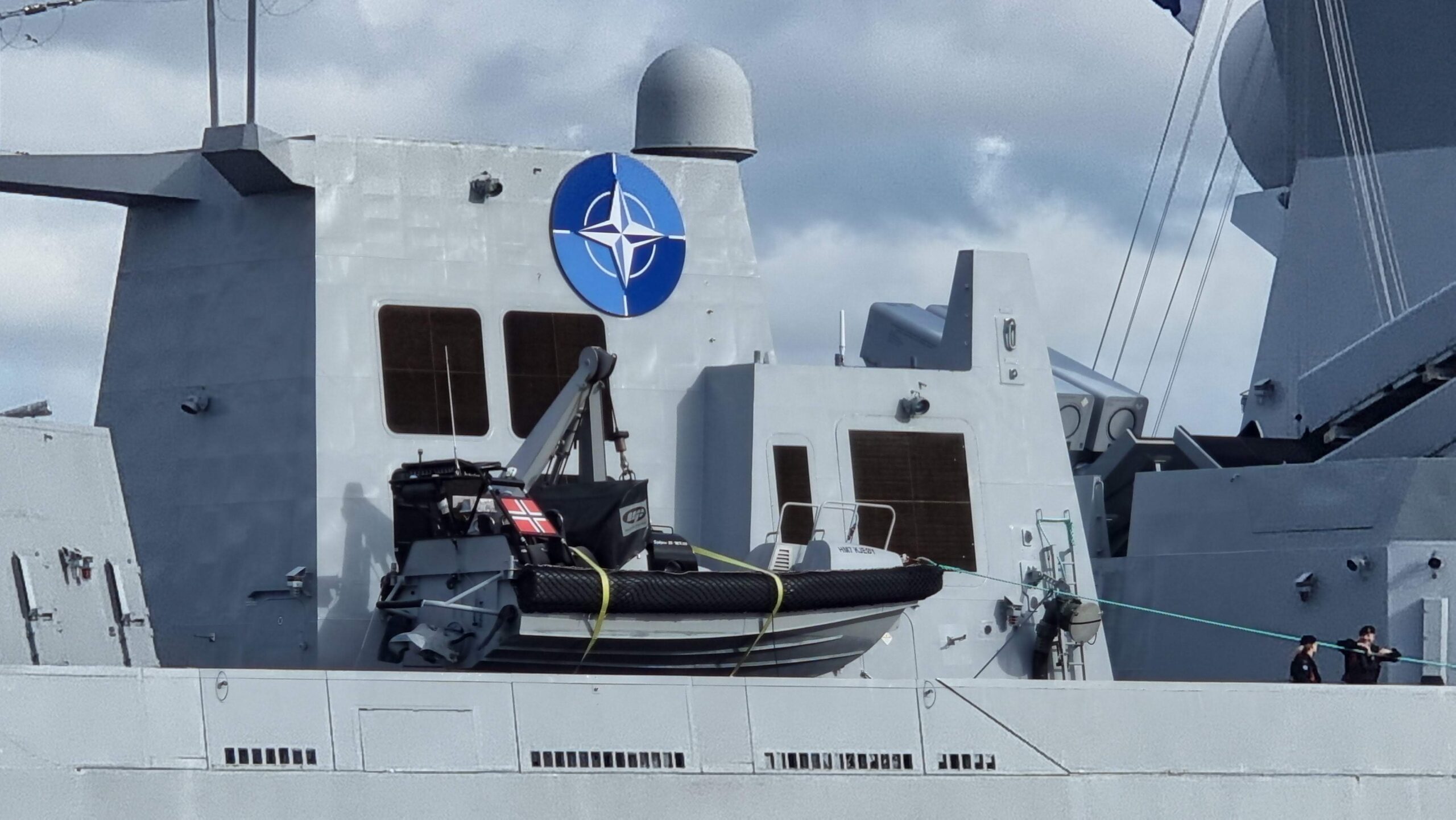
The Canadian frigate HMCS Ville de Québec, now flagship of Standing NATO Maritime Group One, has berthed at King George V Dock alongside Norway’s HNoMS Fridtjof Nansen, with the German tanker FGS Rhöne arriving a day earlier.
Warships from NATO’s Standing Maritime Group One have arrived on the Clyde, the UK Defence Journal understands.
The Norwegian frigate HNoMS Fridtjof Nansen came up river on Friday morning, assisted by the tug CMS Thunderer, and berthed at King George V Dock in Glasgow. The Canadian frigate HMCS Ville de Québec followed her in, passing Erskine later in the morning with a CH-148 Cyclone helicopter secured on the flight deck and ship’s company closed up on the upper deck.
The German fleet tanker FGS Rhöne had arrived the previous evening, berthing at the Repair Quay at Inchgreen.
Ville de Québec is currently the flagship of the group. Flagship duties transferred to the Halifax-class frigate from the German frigate FGS Sachsen during a port visit to Halifax, Nova Scotia earlier this month, with the UK-led battle staff under Royal Navy Commodore Maryla Ingham embarking on the Canadian ship.
The frigate sailed from Halifax on 15 July on Operation Reassurance, Canada’s contribution to NATO deterrence in Europe, and is due to operate in the North Atlantic, North Sea and Baltic until December. Alongside its role in the group, the ship supports the maritime component of the NATO Allied Reaction Force.
Standing NATO Maritime Group One is one of the alliance’s four standing naval forces, held at readiness to provide persistent maritime presence and to respond quickly to emerging threats. Its current composition also takes in the Dutch frigate HNLMS Van Amstel and combat support ship HNLMS Den Helder, the Turkish frigate TCG Oruçreis, and FGS Sachsen.
The group operates under Commander Task Force Atlantic, a NATO command coordinating allied maritime forces across the Atlantic. Spanish Vice Admiral Juan Bautista Pérez Puig took over that command in July and will hold it until the end of June 2027.
Fridtjof Nansen is the lead ship of Norway’s five-strong frigate class, built around the Aegis combat system and the SPY-1F radar, and configured heavily for anti-submarine work in the waters off the Norwegian coast and further north.
Ville de Québec is a Halifax-class frigate, modernised over the past decade and built for anti-submarine and anti-surface warfare in the open ocean. The class is due to be replaced by the River-class destroyer, itself a development of the Type 26 design being built for the Royal Navy at BAE Systems’ yards further up the Clyde at Govan and Scotstoun.
Rhöne is a Walchensee-class fleet tanker, one of a pair that entered German service in the 1970s and which continue to provide fuel replenishment to NATO task groups at sea.
Visits by allied warships to the Clyde are routine, with ships calling at King George V Dock in Glasgow and at HM Naval Base Clyde at Faslane further down the firth.
If you’re a local outlet keen to report this based on our work here, please do provide credit where appropriate.







OT, Commando Logistic Regiment renamed 48 Commando.
Yet another pointless rebranding that does nothing to improve the operational effectiveness of the unit.