

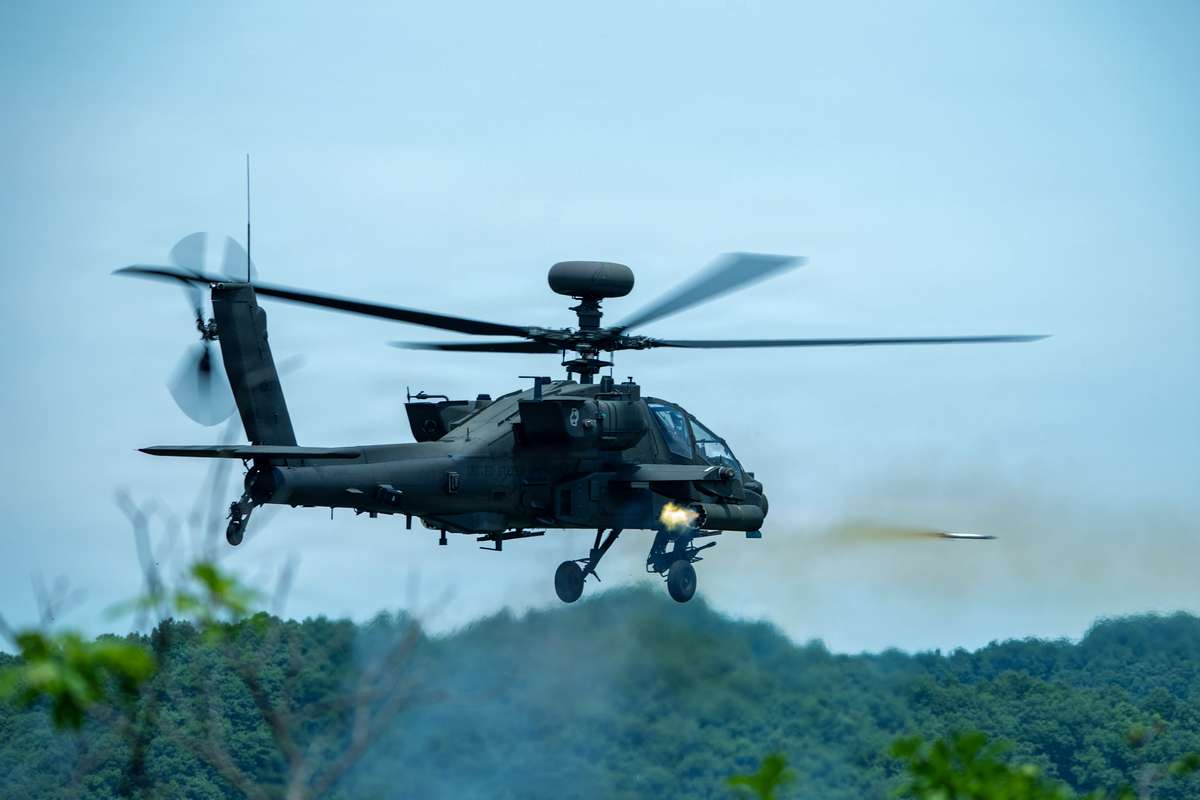
Imagery released by the US Army shows an AH-64 Apache attack helicopter firing during an aerial gunnery exercise at the Rodriguez Live Fire Complex in South Korea, a training range that sits just south of the Demilitarised Zone, the US Army has said.
The aircraft belongs to the 4th Battalion, 2nd Aviation Regiment, part of the 2nd Combat Aviation Brigade and the 2nd Infantry Division and ROK-US Combined Division, and was firing during a gunnery serial held at the range in early June.
According to the US Army, aerial gunnery certifies Apache aircrews on weapons employment and crew coordination across both day and night conditions, the process by which a unit confirms its crews are ready to fight rather than merely qualified to fly.
The Apache is the US Army’s primary attack helicopter, a heavily armed gunship built around a 30-millimetre chain gun, Hydra rocket pods and Hellfire missiles, and designed to hunt armour and provide close support to ground forces. The battalion’s crews running through gunnery at Rodriguez are the live end of an attack aviation force whose stated mandate on the peninsula is to “Fight Tonight”, the readiness ethos that defines American and South Korean forces stationed within range of the border.
The Rodriguez Live Fire Complex, at Pocheon in the north of South Korea, is the premier live-fire training ground for the combined US and South Korean force, managed jointly by the two militaries and heavily used for combined-arms manoeuvre, armour and artillery drills and large-scale unit certifications. The site regularly sees M1A2 Abrams and South Korean K2 Black Panther tanks alongside Apache aviation, and includes urban combat training facilities for clearing buildings and built-up areas, as well as hosting large joint exercises such as the annual Freedom Shield.
The 2nd Combat Aviation Brigade describes its commitment to the defence of the Republic of Korea as ironclad, and its Apache battalions maintain a continuous state of readiness, frequently conducting complex night operations and gunnery certifications of the kind shown in the released imagery. During recent exercises including Freedom Shield and Talon Reach, the brigade’s Apaches have demonstrated rapid deployment and combat power across the peninsula.
The proximity of the range to the Demilitarized Zone, the heavily fortified strip that has divided the Korean Peninsula since the 1953 armistice, gives gunnery of this kind an edge that routine training elsewhere lacks, with the US and South Korean forces stationed in the area holding readiness against one of the most heavily armed borders in the world.


I’ve gained $17,240 only within four weeks by comfortably working part-time from home. Immediately when I had lost my last business, I was very troubled and thankfully I’ve located this project now in this way I’m in a position to receive thousand USD directly from home. Each individual certainly can do this easy work & make more greenbacks online by visiting
following website—.,.,.,.,.—>>> JobatHome1.Com
In other news, a B-52H bomber crashed shortly after take-off Monday morning from Edwards AFB on a routine test mission. All eight crew members aboard are reported to be deceased. The price of freedom is never free, and is periodically painfully high. RIP. 🇺🇲