

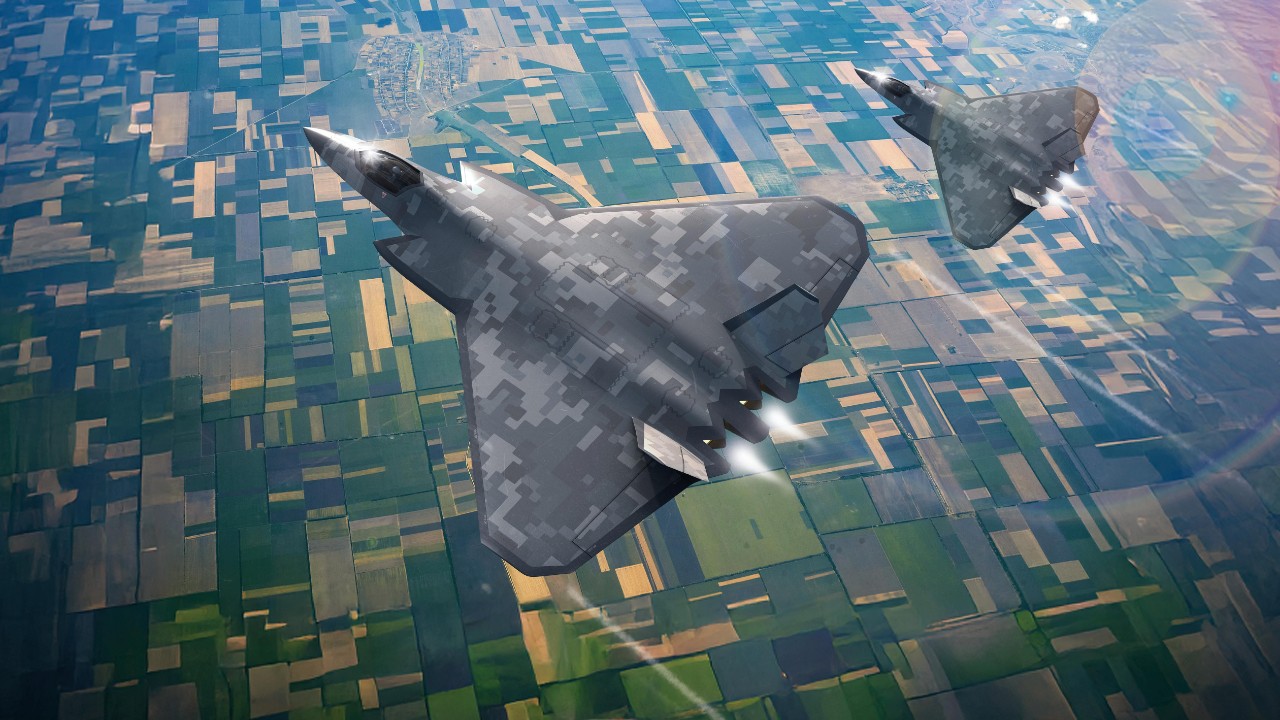
Four weapons and electronics firms have signed a collaboration agreement to support the Global Combat Air Programme, MBDA stated.
The agreement, announced at the Farnborough International Airshow, was signed by MBDA UK, MBDA Italia, Mitsubishi Electric and Mitsubishi Heavy Industries, operating together as the Sovereign Effects Partners. According to MBDA, it sets out a new operating model under which the partners will jointly advance work to support Edgewing’s delivery of the core GCAP platform, including expert advice and engineering services on effects optimisation and the digital integration of effector systems.
The company said the agreement does not include the joint development of effectors, the weapons the aircraft will carry, but instead aligns the partners’ sovereign approaches to those weapons and supports their digital integration for GCAP. The arrangement marks a shift from national contracting toward a sustained international construct intended to ready the partners for future phases of the programme.
According to MBDA, each company draws on national expertise and experience of major international collaborations. MBDA, which it describes as a world leader in complex weapon systems, has worked on GCAP’s precursor efforts since joining the UK’s Team Tempest in 2018, with Italy joining the following year. Mitsubishi Electric played a key role in Japan’s F-2 programme and its F-X next-generation fighter work, and is also working with Leonardo and ELT Group on GCAP’s integrated sensing and communications. Mitsubishi Heavy Industries, the only fighter aircraft manufacturer in Japan, is prime contractor for the F-2 and produces guided weapons for Japan’s ground, maritime and air forces.
GCAP is the trilateral programme under which the United Kingdom, Italy and Japan are developing a sixth-generation crewed fighter to replace the Typhoon in British and Italian service and the F-2 in Japanese service, with an in-service target around 2035. Edgewing, referenced in the agreement, is the joint venture formed by BAE Systems, Leonardo and Japan Aircraft Industrial Enhancement Co to deliver the aircraft itself.
The weapons arrangement mirrors the structure adopted elsewhere on the programme, under which each nation contributes established industrial players and the partners align sovereign work rather than merging it. That approach preserves each country’s control over sensitive technology while seeking the integration needed for the aircraft and its weapons to function as a single system, and follows separate agreements covering the airframe, engine and sensing and communications work across the three nations.





Cool.
Excellent to see this formalized at Farnborough. Setting up the ‘Sovereign Effects Partners’ framework early makes a ton of sense if they want to avoid the massive integration headaches that slowed down previous joint projects. The really interesting bit here is that they aren’t co-developing a brand new shared missile from scratch. Focusing purely on a unified digital architecture is clever. It means the UK can plug in Meteor and Spear 3, while Japan hooks up their own sovereign kit, all without the nations having to hand over their sensitive national source codes to each other. It protects sovereign tech while giving Edgewing a plug-and-play weapons bay. Solid step forward.
From an export perspective probably good as well. A system designed from the offset to be capable of multiple missiles should be easier to integrate new missiles into, allowing other countries to use their own without issue.
Agreed. The software interface is half the battle, but the big physical question next is how much flexibility is built into the weapon bay itself. Handling everything from long ramjet Meteors to different domestic Japanese missile shapes means the internal geometry and universal launchers have to be just as modular as the digital code.
Speaking of MHI, the international news wires are reporting that final coordination is underway to make their Komaki South plant in Aichi the core national assembly hub for the GCAP airframe. Apparently, the centre will be set up by the end of this year, and British engineers are already on-site working alongside them. Makes a lot of sense given they already do the F-35A final assembly and checkout there, so the specialized low-observable tooling and infrastructure are already in place. It’s great seeing the industrial footprint finally taking physical shape alongside Warton and Turin.
so many ize’s.
Blame my browser’s spellcheck, it’s determined to Americanise me against my will. 🙂
Riiiight, and that cannot be changed 🙄
You’re a tough crowd, Grinch! I’ll send a strongly worded letter to Microsoft tech support just for you.
Now that we’ve spent two days sorting out my keyboard settings, do you actually have an opinion on the MHI Komaki South infrastructure sharing the F-35A tooling for GCAP? Or are we just sticking to IT troubleshooting today?
Looking good, nations should be able to put their own kit on it, unlike f35.
30 year old weapons.. ?
B52 ?
so much better than waiting a decade for the US to decide to integrate their only Level 1 partner’s weapons on the F35. Much better to have control, and with Italy onboard we can ensure all European weapons are integrated, with an option to sell these to Japan. Anyone know if Japan has any decent weapons we might look to acquire as a result of this?