

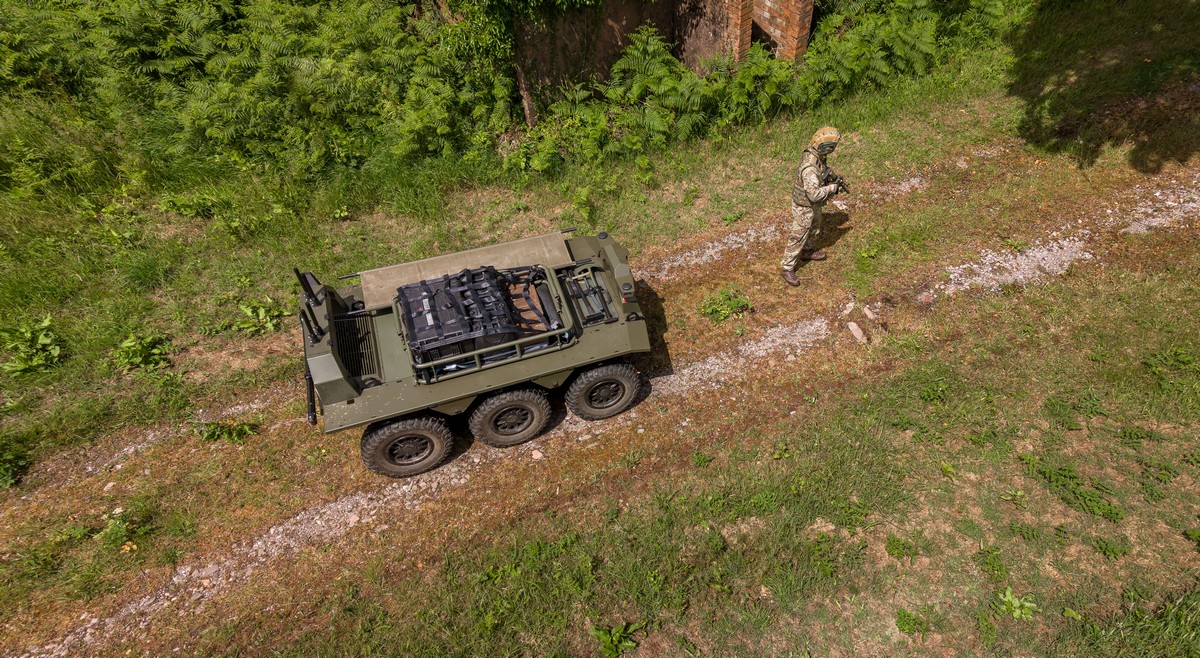
Defence vehicles have a long-standing habit of arriving in service already out of date, and IDV says it has built its uncrewed vehicles around precisely that problem, because the sensors and computing inside them roughly double in capability every eighteen months.
Dr Geoff Davis, the managing director of IDV UK, told the UK Defence Journal that the pace of improvement in lidar, cameras and processing now sets the rhythm for the whole sector, and he made the point in the plainest terms. “These sensors and the compute capability effectively doubles in its capability” on that cycle, he said. “The latest lidar I’ve got has twice as many lasers as the lidar of 18 months ago, and the price comes down as well.”
What Dr Davis is describing is, in effect, Moore’s Law reaching the battlefield, the principle set out by the Intel co-founder Gordon Moore in 1965, which held that the number of transistors packed onto a microchip would double roughly every two years even as the cost of making them fell, and which has driven half a century of computing growing steadily smaller, faster and cheaper. The commonly quoted shorthand of a doubling every eighteen months or so is close to the cadence Davis sets out for the sensors and processors aboard the Viking, and the company’s argument is that a vehicle deliberately built to ride that curve, rather than frozen at the moment it was designed, need never be left behind by it.
His verdict on the traditional way of buying defence equipment was a pointed one, drawn directly from his own industry’s habits. “It’s a really good analogy for the old defence industry, where you spend five years designing something, five years testing it, and eventually put it into service ten years out of date. Our approach is the platform itself will be able to be re-rolled and re-lifed numerous times, because all you need to do is change the compute capability and the sensors as they develop,” he said. “If you buy this vehicle today and come back in three years’ time, we could fit next-generation lidar, next-generation cameras, a completely new compute capability, and you’ve got a UGV that has moved from being maybe out of date to being absolute cutting edge.”
The latest Viking is meant to be the proof of that approach, looking broadly familiar to anyone who has seen earlier versions yet heavily reworked over a decade of user trials, with repositioned and upgraded sensors, the latest computing, and a switch from parallel to series hybrid drive.
The same thinking runs through battlefield repair, a question the war in Ukraine has made impossible to ignore as cheap attack drones knock out vehicles worth millions, and when asked whether a damaged Viking could be patched up by frontline mechanics or whether it has to go back to the factory, Andrew Maloney, the head of technology and chief engineer at IDV Robotics, pointed to its car-like roots. “It’s designed to be easy to maintain. Changing a wheel is just the same as changing a wheel on a car,” he said, explaining that the vehicle is built around line-replaceable units that come apart with the minimum of fuss. “You can unplug some cooling pipes and electrical connectors, slide the battery out, fresh one in. Like the engine, it’s very modular.”
Even the payloads follow the same logic, since standard power and data connectors mean a new mission system can be bolted on and plugged in, after which the software “will discover those, and then give you all the menus and functions for that payload,” while the artificial intelligence models behind detection can be retrained and reloaded as they improve, including by Five Eyes partners.
The promise, reduced to its essentials, is a vehicle that ages like a fleet of phones rather than a piece of armour, with the chassis enduring while everything that actually determines its capability is refreshed, and the open question is whether defence procurement, built around programmes that run for a decade or more, can ever learn to buy at that speed, something the Defence Investment Plan will now have to answer.










I’ve gained $17,240 only within four weeks by comfortably working part-time from home. Immediately when I had lost my last business, I was very troubled and thankfully I’ve located this project now in this way I’m in a position to receive thousand USD directly from home. Each individual certainly can do this easy work & make more greenbacks online by visiting
following website—.,.,.,.,.—>>> JobatHome1.Com
Some say that a week in drone technology development is too slow. However, if remote vehicles are designed to accept regular updates, then subject to costs, that should be achievable. One comforting factor, it’s the same for everyone. This year’s Eurostatory 2026 is brimming with remote vehicles and systems, including IVF’s and medium tanks; a remote CH2 hull with a suite of weapon options would make good use of redundant CH2s.
They are not going to do remote CH2 hulls. Maybe they can upgrade the turret on some of these C2s but not very much chance in automating or remote operating them probably. They are too big/heavy/fuel hungry.
But it’s an interesting article nether-the-less.
I will grant that.
I’ve gained $17,240 only within four weeks by comfortably working part-time from home. Immediately when I had lost my last business, I was very troubled and thankfully I’ve located this project now in this way I’m in a position to receive thousand USD directly from home. Each individual certainly can do this easy work & make more greenbacks online by visiting
following website—.,..,.,.,.,.,.—>> LIVEJOB1.COM
I’ve gained $17,240 only within four weeks by comfortably working part-time from home. Immediately when I had lost my last business, I was very troubled and thankfully I’ve located this project now in this way I’m in a position to receive thousand USD directly from home. Each individual certainly can do this easy work & make more greenbacks online by visiting
following website—.,.,.,.,.,.,..,—>> PayAtHome1.Com
It’s how I would run my desktop computer.. it would change over the years as I replaced and changed bits.. I did not buy a new whole desktop in years, but in the end there was nothing of the original desktop left.. I had even swapped out the case.