

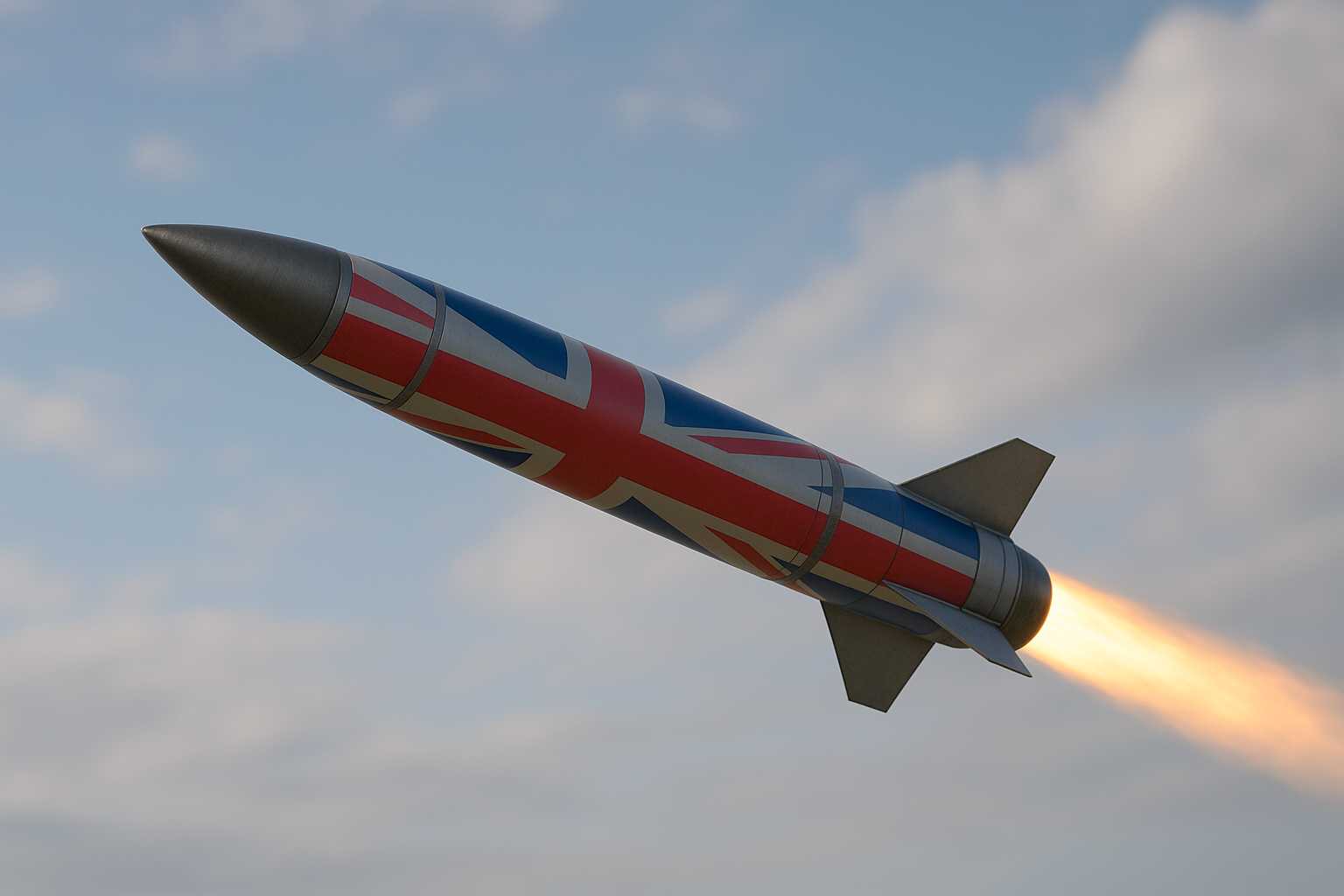
The low-cost strike weapon developed for Ukraine under Project Brakestop could enter service with the British armed forces, the UK Defence Journal understands.
Asked whether the project would feed into UK capability as well as supplying Ukraine, a defence official said the question went to the heart of the Defence Investment Plan’s approach to munitions. “The answer on Brakestop is yes, it very well could be in our inventory very soon,” the official said, while noting that decisions on specifics have not yet been made.
Brakestop is one of the rapid programmes under which the UK has developed low-cost, long-range strike weapons for Ukraine. Weapons in this category, often described as one-way effectors or low-cost cruise missiles, trade the exquisite performance of systems such as Storm Shadow for affordability and volume. They typically use simple airframes, commercial or automotive-grade components and satellite navigation rather than expensive military-specification seekers, allowing them to be produced quickly, at scale and at a fraction of the cost of a conventional cruise missile. Ukraine’s own long-range drone campaign against Russian refineries, airfields and logistics has demonstrated the effect such weapons can achieve in numbers, and both sides in the war now expend them by the thousand.
The official said the project is exactly the kind of pivot the Defence Investment Plan is trying to make across all three domains. “It’s just not good enough for us to be sitting on small stockpiles of exquisite weapons,” the official said, adding that while high-end capabilities such as bunker-busting remain important, “there’s a lot more to operations than that.”
Many of the companies the department has been talking to since the Strategic Defence Review were largely unknown a year ago and are now, in the official’s words, bursting onto the market, though the department has to be discerning about which to back given the volume of choice on display at events such as DSEI. The official pointed to the potential for Brakestop-type projects to be produced in the UK and scaled up for export into Europe.
The defence official said too great a proportion of the munitions budget had been going on high-end complex weapons that are very capable but held in low numbers, and that the plan redresses the balance towards munitions that can be produced quickly in the UK.
The department is restarting and sustaining production lines for weapons including CAMM, ASRAAM and the Stingray torpedo, and beginning sovereign production of critical energetics and explosives, with the always-on production lines due to be up and running this parliament.











Will it, won’t it.
First we heard it was for the UK, with flag on the side.
Then it was suggested it was being procured for Ukraine only.
Now it’s re announced it might become part of our inventory.
Again, I ask who operates it. With the loss of AS90, there are Batteries in 1 RHA and 19 RA either twiddling their thumbs, using the 14 Archer, switched temporarily to Light Gun, or maybe even acting as TAC Group Batteries. So maybe them?
Yet those Regiments are due to recieve the RCH155, so in the long term, unlikely.
Who? How?
MoD make lots of grand announcements without the nitty gritty actual realities.
Danielle, one thing we constantly hear is the word “swarm”. There is a reason for that. Modern warfare is increasingly becoming a battle of economics as much as technology. Whether the “Money Obliteration Department”, in Whitehall understands that, it remains to be seen.
A swarm gives the attacker a numerical advantage. More importantly, it forces the defender into an impossible cost exchange. Fire a £20,000 to £50,000 drone or a simple cruise missile at a target, then make the defender decide whether to shoot it down with a missile costing several million pounds. We have watched exactly that happen over Ukraine, across the Red Sea, and during the recent conflicts involving Israel, Iran, the Houthis, Hezbollah and Hamas. Defence analysts have repeatedly pointed out that the side winning the cost exchange often gains the strategic advantage, regardless of who possesses the more sophisticated equipment. Reports from Ukraine and the Middle East have highlighted the unsustainable economics of using Patriot, THAAD, SM-2, SM-3 and SM-6 interceptors against waves of inexpensive Shahed drones and other low-cost weapons. Governments in the Gulf have since openly explored buying low-cost interceptor drones because their stocks of expensive missiles have been heavily depleted. Senior US naval officers have also warned that air defence missiles have been expended at an alarming rate during operations in the Red Sea and the defence of Israel.
This is exactly why the UK needs quantity as well as quality. We do not always need an exquisite £2 million to £5 million cruise missile to achieve an effect. Sometimes we need hundreds of simple, reliable, attritable weapons that can be produced quickly, launched in large numbers and accepted as expendable. We need to be capable of producing these missiles and their components in cheap and simple units spread across the country. As we see in Ukraine where people who live in flats will get together with neighbours on the same floor and produce drone components, assemble drones and other material that then filters up the chain before entering military logistics.
Cheap cruise missiles and one-way attack drones are not simply weapons in their own right. They are weapons designed to exhaust an enemy’s air defences. Every interceptor fired is one less available to protect an airfield, headquarters, naval base or critical infrastructure. Once those expensive missile magazines have been run down, the battlefield changes completely. Then the high-end weapons, Storm Shadow’s successor, hypersonic weapons or advanced stand-off missiles, have a far greater chance of penetrating to their targets because the sophisticated air defence network has been degraded and, in some areas, reduced to guns and short-range systems.
Ukraine has demonstrated this lesson daily. Russia launches massed Shahed attacks not because every drone will hit its target, but because they force Ukraine to consume interceptors, stretch radar coverage and saturate command and control. At the same time, Ukraine has responded by developing low-cost interceptor drones and electronic warfare rather than relying solely on multi-million-pound missiles, because the economics simply do not work otherwise. Military planners across Europe are now openly discussing “attritable” systems, weapons that are deliberately cheap enough to lose, but numerous enough to overwhelm an opponent.
If we genuinely believe a future adversary will politely send a handful of expensive missiles against us, we have learned nothing from Ukraine or the Middle East. They will send hundreds of drones, decoys and low-cost cruise missiles first, specifically to empty our magazines. The real question is not what we fire on Day One. It is what we are still capable of firing on Day Five. By Day Ten, unless we have built sufficient depth into our inventories and industrial capacity, we risk fighting with bombs, bullets and whatever remains on the shelf.
The British Army, Royal Navy and Royal Air Force therefore need a balanced arsenal. We absolutely require the very best precision weapons for strategic targets, but we also need large stocks of simpler, cheaper missiles and drones that can be manufactured rapidly and in volume. Recent wars have shown that mass has returned to warfare. Precision still matters, but precision without quantity is no longer enough. Hitler called the V1 and V2 his “Terror weapons”. Providing we are not doing what Russia has been doing by unleashing hundreds of drones and cheap glide bombs at civilians, I see no reason why we do not build up huge stockpiles of these things.
As a side note, I also believe our military is missing a trick by not investing in some old-fashioned prop fighter aircraft as part of a layered defence network. Why fire a multi-million-pound missile at a Shahed when reverting to 1940’s Battle of Britain technology can do the same job for pennies? How many videos are there of a Spitfire, Hurricane or Mosquito shooting down a V1 doodlebug?
Thanks mate.
A job for the Wildcats thrown away! Sorry….”retired.”
In relation to my obsevation about who will use it, so far, it seems like the opposite of what you describe.
A single Battery here and there does not make mass.
Each Division should have a Regiment of these OWE and cheap BM.
Cannot see them?
Spraying 20mm shells around the South-east of England may not be as realistic a response as it once was. And you’ll struggle to find a video of a Hurricane hunting V1s…
But a low-cost air defence role for the Hawk replacement should absolutely be considered, using APKWS.
In comparison to it hitting a target and costing several lives as we see every day in Ukraine? There would be an ROE attached. But, as Daniele points out, the perfect job for Wildcats!
doodlebugs were usually shot down by Tempest Mk V, I don’t think the RAF will be using the modern version of Tempest in that role though
Just wondering, is the UK’s integrated air defence system able to spot small drones that could possibly be launched from off shore vessels and the fact that the UK hasn’t any prop driven aircraft, what would be the best way to intercept said small drones??
Don’t forget the Tempest the real ace in that particular effort. We could do with some Tempests now…. Oh right. In reality I see first person drones doing most of that job eventually. The Ukrainians even stick prods on the front to mess up propellers so they don’t lose the interceptor drone, indeed shotguns too.
Absolutely right ex RM! Really spot on article!
APKWS a cheap laser guided missile -a BAE Inc product (which has US iforeign sales controls) has proved excellent in action and production has been vastly increased – so economies of scale make it even cheaper
Pity BAE/ MBDA or others cannot do it in UK
It would be an unprecedented outbreak of common sense to have something affordable in numbers brought into service. For that reason I’m sceptical!
Well as we are 100% cobelligerents because we not only build them we launch them and target them
About time we shared some of the pain beyond the guys who died on the ground without recognition before we pulled them back.
We hide behind propaganda and claiming Ukraine is doing everything while we destroy our own capabilities with a 14% availability across all services.
What the weather like today in St Peterburg
As a Russian general said in WW2 regarding T34’s – Quantity has a quality all of it’s own!