

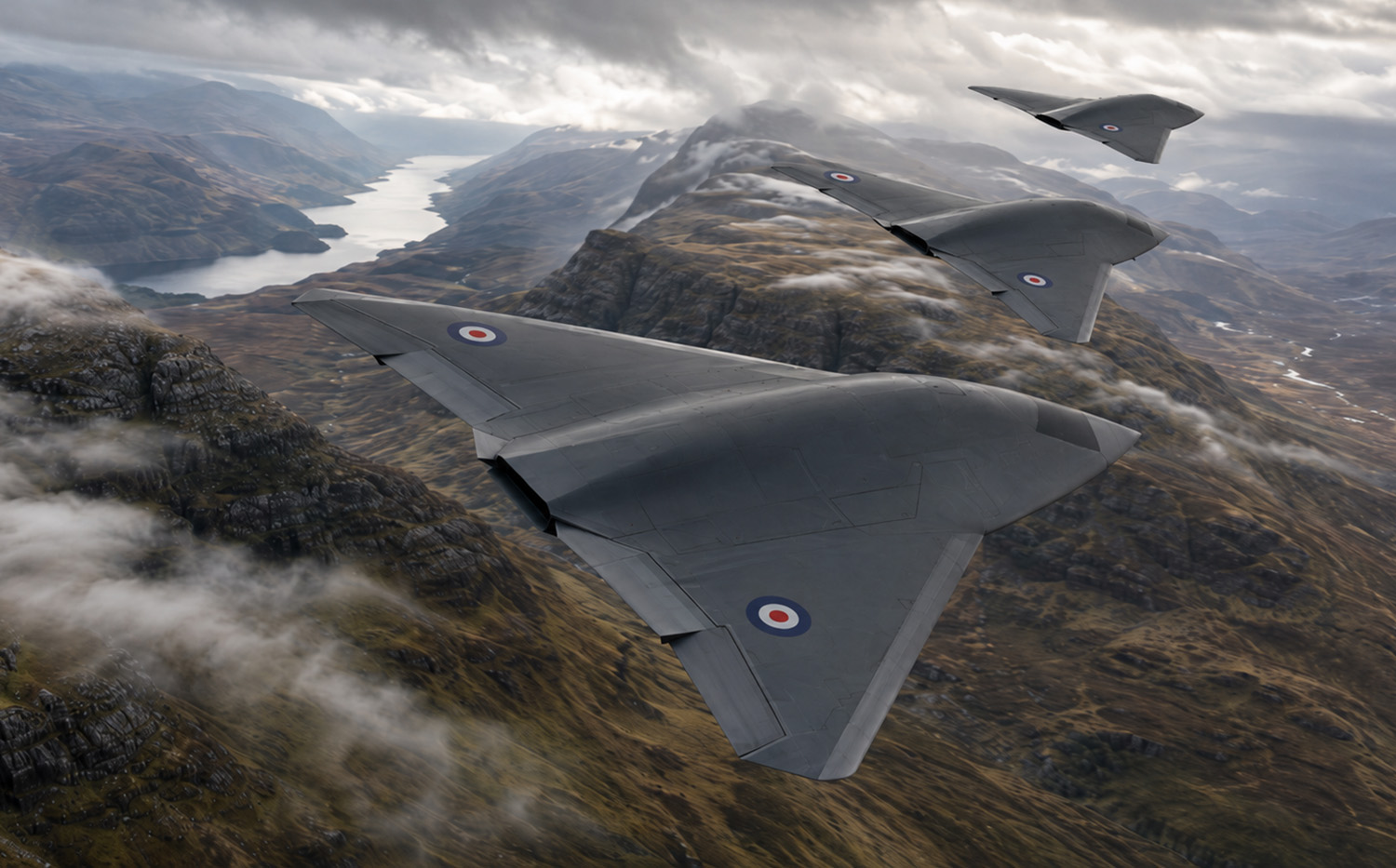
The UK’s sovereign Collaborative Combat Aircraft programme, StormFighter, will see a demonstrator fly next year and reach operational service by the end of the decade, Defence Secretary Wes Streeting said.
Streeting set out the timeline in a keynote speech at the AGF Defence Summit at the Farnborough International Airshow. He described StormFighter, announced the previous week, as pairing uncrewed autonomous fighters with crewed platforms such as the Typhoon, an approach he said would make the RAF Europe’s first sixth-generation air force.
Describing the intended role of the aircraft, the Defence Secretary said: “These uncrewed autonomous fighter jets will provide us with eyes and ears, carry missiles and confuse the enemy. Five at a time and 500 miles ahead of the Typhoon pilots controlling them, crucially, at a fifth of the price of that aircraft.”
He went on to confirm the programme’s near-term milestones, telling the audience that “our ambition is to get a demonstrator CCA flying in the air next year and have StormFighter operational by the end of the decade.” According to Streeting, the project will support 2,000 jobs once the full production line is running, and he put the value of the global CCA sector at more than £125 billion to 2050, a market in which he said he expected the UK to excel.
The announcement followed BAE Systems’ unveiling of its own sovereign CCA prototype, Brontanax, at Farnborough earlier the same morning. Streeting pointed to that launch as evidence of the opportunity on offer in capability, jobs and exports. Designed and built at BAE’s site in Warton, Lancashire, Brontanax is intended to provide electronic warfare and precision strike, operating alongside the Typhoon, with a first flight also planned for next year.
Streeting linked the programme to a wider push for speed in defence procurement, citing a recently upgraded Typhoon precision weapon capable of defeating drones that he said had been delivered in 42 days. He said he would direct his department, working with the Defence Industrial Joint Council, to take a new approach to risk, arguing that not every decision would succeed but that delay posed the greater threat in modern warfare.


Yeah like they’ll buy 5 times as many of these drones as Typhoons.
And chances of them being 20% of the price of a Typhoon = zero.
I was wondering how they got to a 5th of the price of a typhoon?
Surely the cost of the engine and radar and weapons fit will come to more than a 5th of the price of a typhoon?
Maybe if mass produced then we could bring the price down through economy of scale but id be pessimistic about reaching that price tag.
Just for context an MQ9 is about 30 million and some sites suggest upto 45 million with complete systems.
I suppose it depends if you are looking at capital cost or lifetime costs.. if you can run it five times cheap than a typhoon over a 20 year life then the capital bump will ease out.
The five hundred miles is an interesting figure.. and controlling 5. Essential your looking at 1 crewed aircraft for the equivalent of 6 sorties..
Also when you consider stratus lo had a reported range of about 600 miles.. essentially the new wingmen are likely to essentially help the stratus lo to the target.. maybe doing the SEAD/DEAD mission with spear 3.