

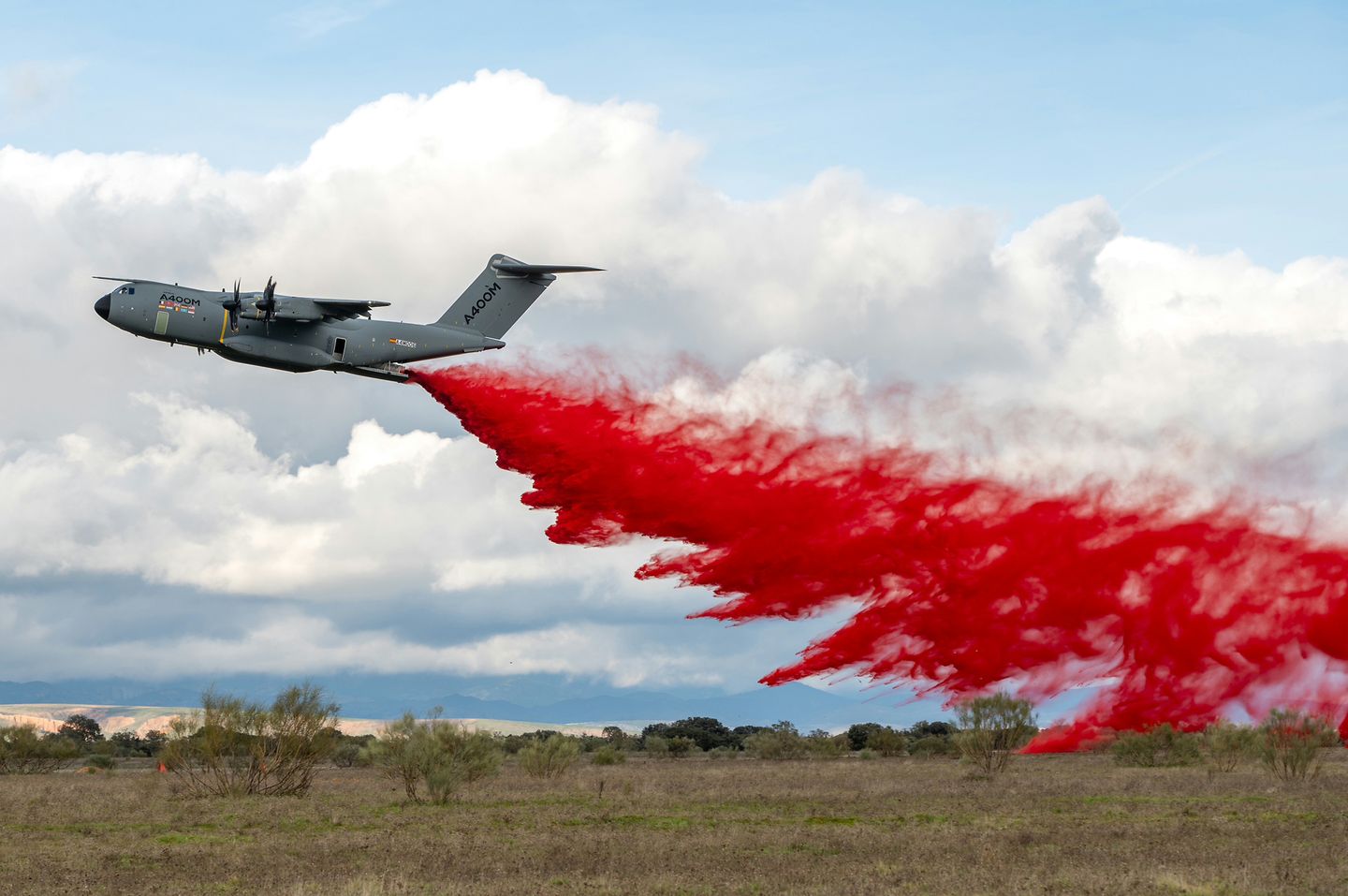
The Royal Air Force will equip its Chinook helicopters and A400M Atlas transport aircraft to fight fires, giving Britain an aerial firefighting capability permanently based in the United Kingdom for the first time, according to the government.
Wes Streeting, the Defence Secretary, said: “As the threat of wildfires in the UK grows, defence will step up to provide greater support to our emergency services and protect military training areas across the country.
“This will see the RAF’s Chinook helicopters and A400M aircraft equipped with new specialist firefighting equipment to enable them to tackle wildfires from the skies for the first time.”
Ministers had ruled out precisely this six weeks ago, when Louise Sandher-Jones, a defence minister, answered a question from Neil Duncan-Jordan, the Labour member for Poole, who had asked whether the A400M fleet could be adapted to carry water. Her answer, published on 9 September, said that “responsibility for responding to wildfires in the UK rests with the relevant civil authorities and emergency services” and that “the Department is aware of the Airbus A400M aerial firefighting system currently under development and testing.” It concluded: “Consequently, the Department has no plans to adapt the RAF A400M Atlas fleet for aerial firefighting purposes.” That position was reported here in September.
Pressure on the question had built through the summer, when a wildfire that broke out near Glenmore in the Cairngorms on 15 July burned across roughly thirty square kilometres of heather, woodland and conservation land, and the UK government offered military helicopters for heavy lifting alongside support from stand-by battalions. The Scottish government declined. Neil Gray, the Justice Secretary, said the requirement on the ground was for waterbombing helicopters, that every commercial waterbombing aircraft in the country was already committed, and that the military did not hold that capability. Royal Air Force Chinooks of 1310 Flight had dropped around four hundred and fifty tonnes of water on a Cypriot wildfire in July 2025, flying from Akrotiri with Bambi buckets, which this publication set out at the time.
The Prime Minister said: “I stood in Stourbridge and watched families lose everything. I will never forget it. Our firefighters were heroes that day, but heroes shouldn’t have to fight with one hand tied behind their backs.
“Crews will now have the kit they need to stay safe and military aircraft will stand ready to help tackle wildfires from the sky. We cannot put people through another summer like this one.”
Firefighters in England will be given additional specialist wildfire teams and lightweight personal protective equipment designed for wildfires, backed by up to £45 million. The kit crews currently wear is built primarily for fires in buildings and is not meant to be worn for long stretches, and the replacement is intended to be lighter and more breathable so it can be used for longer periods.
Angela Rayner, the Communities Secretary, said: “The wildfires we’ve faced this year have been unrelenting, leaving a devastating impact on communities, homes and our precious countryside.
“We’ve heard loud and clear from communities, experts and emergency services that more needs to be done. That’s why we’re taking immediate action now, while working across government and the sector to build a stronger, more resilient national response to wildfires for the future.”
On prevention, the government will put £25 million into restoring dried-out peatlands in England so that they hold more water and act as natural firebreaks, and will give farmers financial support to fireproof their land by digging ponds and clearing burnable material in high-risk areas. The new Peatland Restoration Grant Scheme will be run by Natural England and is expected to operate from April 2027 to April 2029. Tougher local restrictions and bans on particular products are also being examined as a way of stopping fires being started when the risk is high.
Dame Angela Eagle, the Environment Secretary, said: “The wildfires that tore through our countryside this summer showed the urgent need to adapt to our changing climate.
“Nature is our greatest ally in preventing wildfires starting in the first place, with healthy landscapes keeping more moisture in the ground to stop fires spreading.
“That’s why we are stepping in and investing £25 million to restore peatlands as well as backing farmers to deliver natural fire safety measures on their land.”
A Wildfires AI Unit will be created inside the National Situation Centre in COBR, drawing together universities, technology firms and government departments to spot and fight fires faster. The government will work with the Met Office on better wildfire forecasts and risk assessment, develop England’s first Wildfire Action Plan covering prevention, preparedness, response and recovery, and work more closely with the devolved governments on shared expertise. An interministerial meeting between the UK and devolved governments will be convened to coordinate the response across all four nations.
Louise Haigh, the First Secretary of State, said: “The UK has world-leading expertise in the application of new technologies to track and tackle wildfires. By bringing together the work of the National Situation Centre, leading academic institutions and our international partners, we are building a centre of excellence at the heart of government that will share best practice and strengthen our national preparedness.”
Katie White, the Minister for Climate Transition, said: “Anyone who thinks climate change is a problem for our children and grandchildren, rather than here and now, should spend a shift with a firefighter. This summer, crews battled devastating wildfires in extreme heat, risking their lives to protect the places we love. The threat is already here, staring us in the face.
“We can’t stop every wildfire, flood or storm, but we can make sure Britain is ready. This summit is about better equipping our brave emergency services, protecting our people, and building a stronger country, whatever the weather.”
Civil fire and rescue services across all four nations will continue to request firefighting support through the Military Aid to the Civil Authorities process. The Ministry of Defence is the second largest landowner in the United Kingdom, and the government said the department requires an aerial firefighting capability of its own to adapt to the increased risk of wildfires facing the country.
The package was announced ahead of a summit at which the Prime Minister met fire chiefs, local leaders and experts. Airbus, Google and VodafoneThree attended, setting out how satellite monitoring, early warning, connectivity and aerial capability can help communities prepare for and respond to fires. Kata Escott, managing director of Airbus Defence and Space UK and head of UK public affairs, said: “Today’s Wildfire Summit is an important step toward strengthening wildfire preparedness and prevention in the UK. With our life saving capabilities, we are supporting the UK effort in the air, in the digital domain, and with our early warning assets in space.”
This summer was the United Kingdom’s hottest on record, and the Met Office has found that climate change made the extreme heat around one hundred and thirty times more likely. The government held the first meeting of its Climate and Nature Security Taskforce last month, which will establish the most significant climate and nature security risks facing the country and shape the government’s approach to them.




Good stuff. And will Central Government help pay for this or does the military lose another piece of its diminishing force structure if the MoD budget pays for it?
Obviously note mate, it’s a good idea using the RAF for this, The A400M is a perfect plane for it but it should be paid for by civilian budgets just like DEFRA pay for fisheries protection.
You championed for this a few weeks ago. The money should come from DEFRA if they are needed for firefighter operations. But it will be another training package for A400 crews, as firefighting tactics and the low level flying is dangerous and is another skill set to remain current in.
Exactly.
But it’s not the MoDs responsibility to pay.
Too often MoD get lumbered with the bills of others so I voiced concern that the costs would fall again.
So often HMG turn to a military they find it expedient to cut as the need arises then turn to bail them out.
Great news. Might come from the Bellwin funds?
” Bellwin scheme may be activated where an emergency or disaster involving destruction of or danger to life or property occurs and, as a result, one or more local authorities incur expenditure on, or in connection with, the taking of immediate action to safeguard life or property, or to prevent suffering or severe inconvenience, in their area or among its inhabitants. There is no automatic entitlement to financial assistance.”
Additional wear and tear – after all this won’t be cruising at 30,000ft – and the time spent doing this means less availability for core tasks (altho good low level flying practice for crews!).
This is fine for a season, esp next year with a very strong El Nino forming, but given extreme climate events are going to be more frequent going forward, Govt should be thinking more longterm and putting a putting aerial firefighting on a firmer footing.
So, if the RAF are the operators of choice for this, then how about a few more Chinooks and A400Ms? 😀
Although I feel that if we are going to be fihhting wildfires every summer going forward, we should look at establishing a civilian aerial fire service with a dedicated fleet, possibly through a contract with someone like Bristow.
When it’s a civilian matter, the MOD charges to the appropriate department. That’s always been the case. I don’t see it being any different for fire fighting if it’s needed. This is a welcome development, And we will have a credible capability with A400 and Chinook of its needed next summer. Hopefully not.
Funny that Burnham and Rayner are all over the statements on MoD purchases now.
It’s a sensible idea as the kit can be bought and mostly just left in a hangar until needed.
Worry more about destroying the natural fuel than fighting the fires.
TJ. I’d hope they’d put the equipment into the aircraft before fire seasin starts, and they’d need to train with it too. It can be a tricky, dangerous job flying low in hot, windy conditions with smoke and sometimes other aircraft around.
Got to be honest, if the Irish AC have been bambi bucketing for over a decade at this stage in all sorts of conditions without incident, I’m struggling to see how the RAF are going to be challenged by the role. Now granted the job has ripped the arse out of the 139’s as they were never intended for the role but they were always a basic airframe.
Over the last few years there have been several crashes of large aircraft performing this role. C130 and 737 in Australia, CL-415 Sicily and Greece, Beriev 200 Turkey. It’s dangerous work. Low level, hard manoeuvring with an unstable load often over steep terrain made more difficult by strong air currents caused by the fires. It’s not something that should be taken lightly and I’d image will put huge stress on the airframes.
I hope this isn’t coming from the MoD budget, although at least the crew training and maintenance side probably will. I also hope is doesn’t get allocated as defence spending, although it probably will. I’d imagine the RAF are very unimpressed with this announcement.
Welcome the change, will be a massive help to fire services next year.
The usual load of old nonsense trotted out by politicians who are too lazy to do any homework themselves or, rather, too busy electioneering i.e. making things up as they go along.
In fact nobody knows how many wildfires there have been in Britain this year or previously. How could they?
‘Wildfire incidents are not consistently recorded across the UK. In the Home Office Fire and Rescue Incident Statistics which report information submitted via the Incident Recording System, wildfires are not recorded as a specific incident type. Instead, wildfires could be captured by either the ‘other outdoors’ or ‘secondary fires’ categories. This makes tracking trends difficult, a problem that is exacerbated by different definitions of wildfires being used in the devolved administrations, in the media, and by FRS (Fire Rescue Services).’ National Fire Chiefs Council (NFCC).
The NFCC also said ‘Most wildfires in the UK are caused because of human activity, including leisure activities or deliberate acts.’
This is, as usual, exacerbated not by climate change but by intrusive bureaucratic and unnecessary government regulation.
‘Winter burns create firebreaks in upland areas by forming strips where there is less flammable foliage, thereby limiting the speed at which wildfires can spread. But in 2021, the burns were banned from areas of “deep peat” – where it extends for 40cm or deeper – in conservation areas, totalling 222,000 hectares of land. The Department for Environment, Food and Rural Affairs (Defra) is now consulting on plans to extend the burning restrictions to 368,000 hectares of peat by lowering the threshold for “deep peat” to 30cm.’
Consequently the hard pressed British taxpayer has to put their hand in their pocket once again in order to fund these fire fighting enhancements. And the resources of their already over committed armed forces are given yet more taskings: willing the mission but not the means.
The usual self serving mendacity. The usual shambles. All to do with the question of whether to hold an early election.
Another copy and paste rant. Pretty sure you’d be straight on these pages moaning that we don’t have this firefighting capability come next summer.
I give references to support my remarks with evidence.
Good that the Fire Service is getting necessary support.
Unfortunate that it comes at the cost of more commitments for our overstretched and underfunded armed forces.
Why doesn’t the government look at the underlying causes of wildfires?
You.know the rest…
EFFIS – European Forrest Fire Information Service.
Their records will advise on current UK wild fire data.
This is electioneering at the taxpayers expense, pure and simple.
Data from the collaborative project between NASA and the European Space Agency, Copernicus demonstrate that over the past two decades there has been no trend towards worsening wildfires in the UK or worldwide
‘Global burned area was 18% below average this past season and has been falling for two decades.’
NASA MODIS burned area product, MCD64A1
But what you have not mentioned is that reserach from Manchester and studies from Ordinance Survey show that there is a trend now for wildfires to be closer to the forest/urban interface which greatly increases the risk to life and loss of property. We have seen this in the West Midlands as well as in France and Spain this year, and also London a few years ago. So while there may be less “burned area” the risks to property and life is increasing, which is something that should be factored and costed for.
And, though the worldwide burned area has gone down, it is the countries fighting climate change and making sure that everybody knows about it that seem to be those most on fire.
Most of the fires are caused by human activity. The best solution? Fire breaks. This is not complicated. Nothing to do with climate change, everything to do with incompetent government regulation and irresponsible or illegal human activity.
they are not incompetent, it is ideological vanity of city/university people.
The British government, like most other governments wants an ideological green country but green country means more fires because there is more fuel and the more continuous extension of green areas the bigger the fire.
Greece has 30% forests area relative to total area, UK has 14% and increasing.
Portugal had 9% forests at the end of XIX Century, now has 33% since around late eighties. Fires got much more severe.
Well another common sense action/decision that will help safeguard life and our land by using assets already paid for by the TAXPAYER. Somethin I have advocated for many years. So allocations will need to be ensured such as 2 A400’s and 4 – 6 Chinnocks throughout the summer months (yes reducing the fleet available for other tasking but UK life should be paramount). But longer term a dedicated service should be established along the line for the SAR service we use around the UK with backup from the RAF/RN using additional assets if needed. This would also allow the UK to help our neighbours if needed too so a WIN WIN all round. Funding? it all comes from the taxpayer in the end so long as life is saved thats the important matter.
A common sense decision would be to lift restrictions on landowners regarding winter burning to produce fire breaks.
Instead this is yet more government spending of other people’s money.
‘This will see the RAF’s Chinook helicopters and A400M aircraft equipped with new specialist firefighting equipment’
And that means even higher taxes.
Due to the environmental lobby the lifting of the burning ban will not happen, whilst I agree with you it would help, it would only be part of the means to control such events. The use of the appropriate response would be welcome and if had been available this summer many homes and large area’s of land would have been saved. The RAF already have the Chinnock force equipped with the kit as its used in Cyprus and adding the role in kit for the A400’s which has already been developed would be a wise use of public money rather than supporting the thousands of illegal foreign spongers it currently gets wasted on. The MOD wastes so much already and really needs someone in charge that would sort that waste thus delivering more that is needed.
The overstretch within the Armed Forces causes problems with retention of experienced personnel, morale. That creates further problems for recruitment. An early election might be a very good thing. Interesting to watch the decision making process now in progress.
I guess they’re more concerned about having to answer questions in the media and Parliament next summer as to why no plan was put in place to deal with the now raging fires than they are about the cost.
2 x loadies on the tailgate, 2 buckets, one with sand, job done, cost to the MOD just 1.6 Billion (after an extended period of testing, trials, ensuring the buckets have local modifications to ensure they are “world beating UK manufactured, ensuring one job in the local bucket factory)……
Don’t forget that the bucket must pass elf and safety at the MAA, so that’ll delay it all in paperwork for a few years.
“There’s a hole in my bucket, Dear ‘Liza, Dear ‘Liza….”
Let’s hope the RAF are not busy next summer or on leave. Idiotic idea when we have no “civil defence” force or infra-structure in this country, this could be the catalyst for doing what the rest of the free world does and stop relying on charities at times of trouble.
If only the UK had a load of spare medium cargo planes like C-130’s that could have been passed to a civilian agency for this sort of stuff. 🤔
I couldn’t agree more.
I can’t see why they can’t buy in some of ST Engineerings civil fire fighting version of the Bronco (ExtremV), looks ideal for challenging terrain, just have some water tankers on stand by for topping up as near as safe.