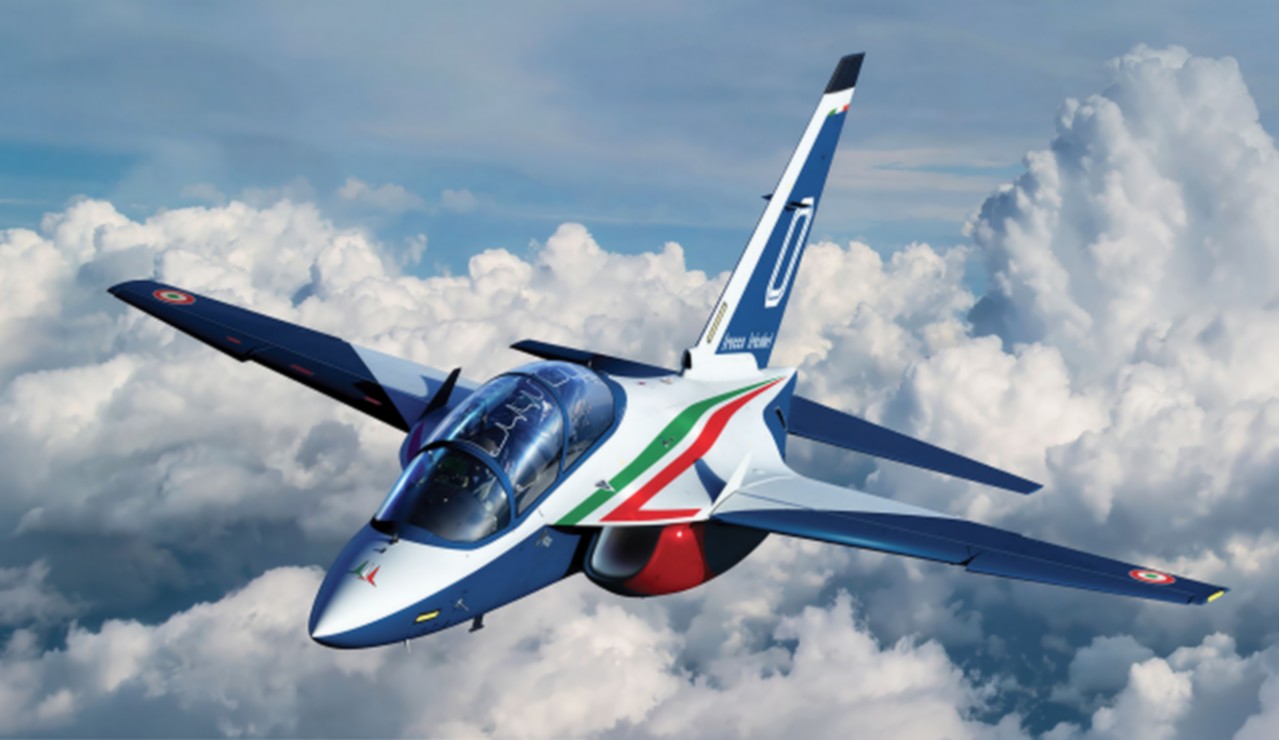
Leonardo has rolled out the first of 15 M-346 aircraft for the Italian Air Force’s Frecce Tricolori aerobatic team and begun flight testing, pilot training and work on a new display programme, according to the company.
The aircraft, designated M-346 PAN after the Pattuglia Acrobatica Nazionale, will replace the team’s MB-339s after more than 40 years. They will be built at Leonardo’s Venegono Superiore plant near Varese and delivered between 2027 and 2028, and the programme also covers technical and logistics support, training and simulation systems, and upgrades at Rivolto Air Base, home of the 313th Aerobatic Training Squadron.
“This programme represents a major success for Leonardo and for Italy,” said Lorenzo Mariani, CEO and General Manager of Leonardo, adding: “Our close collaboration with the Italian Air Force and the Italian Ministry of Defence has enabled us to achieve this important milestone, laying the foundations for further achievements.
This renewed confidence in a Leonardo aircraft, set once again to earn worldwide recognition for its aerobatic capabilities, building on its proven success in training and operational roles with several air forces fills us with pride.
Behind every aircraft are designers, engineers, technicians, skilled workers and entire industrial supply chains. Behind it are investments in research and development, expertise and a culture of industrial excellence and dedication that is passed down through generations and continually renewed.
The new Frecce Tricolori aircraft is not just about the future of the National Aerobatic Team. It is about the future of Italy continuing to turn excellence, expertise and industrial vision into a symbol recognised and admired around the world.”
“It is a truly moving experience to see this remarkable achievement of Italian technology take to the skies. The transition from the illustrious MB-339 to the M-346 marks another step forward, embracing the challenges of the future while remaining true to the values that have always defined the Frecce Tricolori,” said Lieutenant General Antonio Conserva, Chief of Staff of the Italian Air Force.
Stefano Bortoli, Managing Director of Leonardo’s Aircraft Division, said: “Through its choices over the years, the Italian Air Force has supported the company’s growth, helping us achieve the high level of competitiveness and capabilities that continues to distinguish us today. This latest achievement also reflects the continued evolution of the M-346 system at a significant stage in the programme’s life cycle. The M-346 is now well positioned to pursue major new commercial and industrial cooperation opportunities worldwide, both as a trainer and multirole aircraft and as a platform for aerobatic teams.”
The display version keeps the trainer’s twin engines, quadruple-redundant fly-by-wire controls and avionics, and adds a ventral smoke system holding white, red and green smoke fluids, eight fuselage cameras for live video streaming, an “Acro Mode” that moves the airbrake fully in or out to ease formation keeping, and a retractable boarding ladder for ferry flights. Pininfarina styled the livery. Leonardo says the M-346 family has flown more than 170,000 hours. More than 170 aircraft have been ordered, and 23 operators have either bought the aircraft or trained pilots on it.
Designated T-346 by the Italian Air Force, the aircraft is the centrepiece of the International Flight Training School at Decimomannu in Sardinia, run by the Italian Air Force and Leonardo with support from CAE, which trains pilots from Italy and numerous European, NATO and non-EU countries.
RAF pilots have trained at the school since July 2023, flying the T-346 for lead-in fighter training. Six completed the course in 2024-25, and the Ministry of Defence forecast two more in 2025-26 and three in 2026-27, as we reported in April 2025. Announcing the first solos by RAF students there, Air Commodore Sharrocks said the arrangement would “deliver greater resilience to the RAF frontline”, according to the RAF.
The M-346 is expected to be among the contenders for the Ministry of Defence’s Jet Training System, which will replace both the Hawk T1 flown by the Red Arrows and the Hawk T2 used for advanced fast jet training. The department opened market engagement in August, seeking a single aircraft that would bring significant UK workshare, and noted that the Hawk T1 is due to leave service in 2030, when the project to replace the Red Arrows’ jets kicked off. The Defence Investment Plan set aside £360 million to recapitalise jet training and confirmed new jets for the Red Arrows.
The Boeing and Saab T-7A Red Hawk, offered with BAE Systems and UK assembly, and the KAI T-50 family are also seen as likely entrants. Luke Pollard, Minister for Defence Readiness and Industry, told Parliament in October that “The Jet Training System programme is ongoing and no final procurement decisions have been made,” in reply to a question on the T-7A’s ejection seat.
The Strategic Defence Review called for priority for British industry, and former Red Arrows pilots have petitioned against a foreign aircraft. BAE’s Hawk production line has closed, and the British firm Aeralis, which had developed a modular trainer for the requirement, has folded. The Red Arrows cut their display from nine jets to seven this year to ease strain on the ageing fleet.