

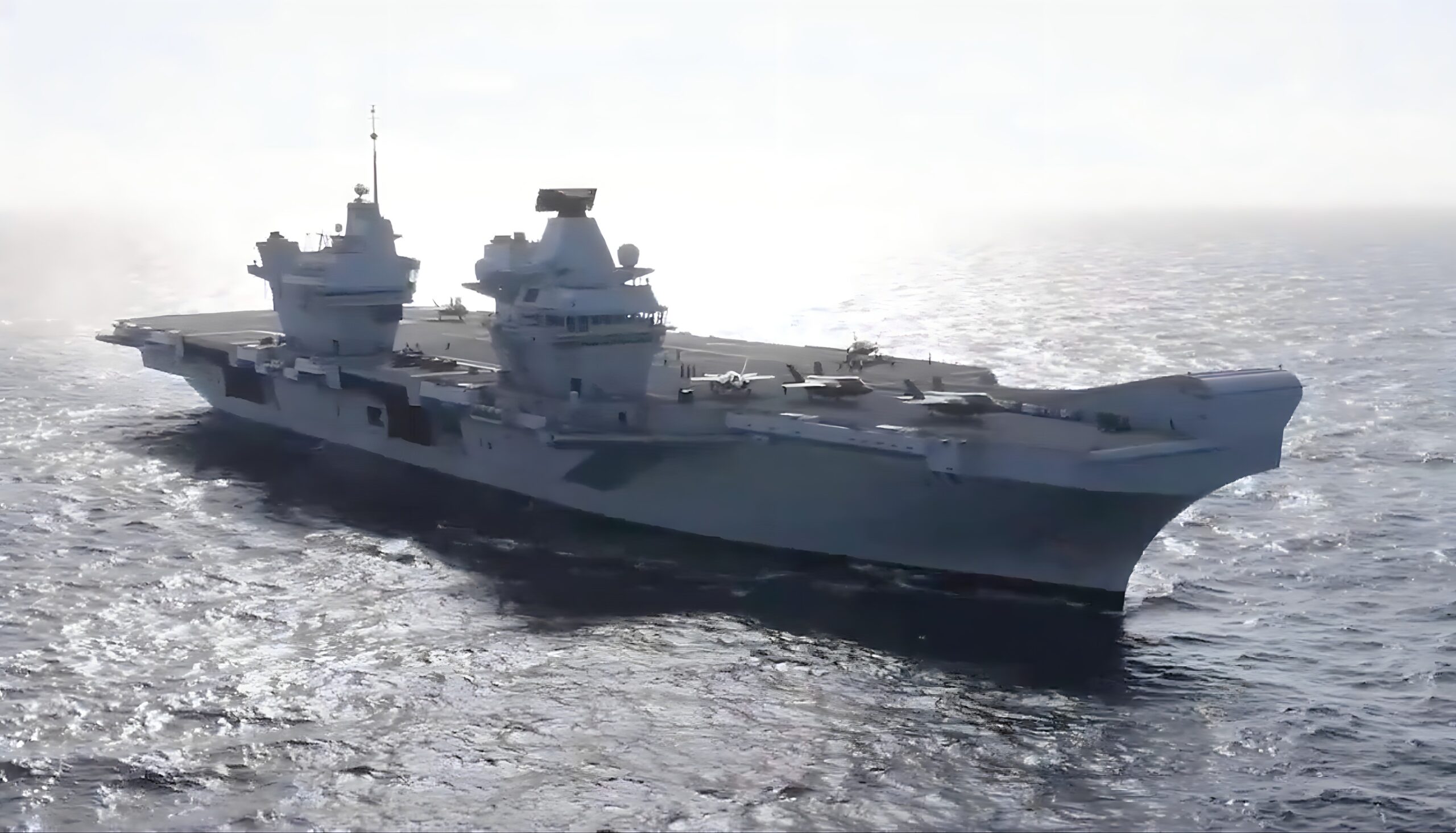
HMS Prince of Wales is back in Portsmouth after three months on NATO’s Northern Flank, having flown the alliance’s Iceland air policing mission from her deck in a European first, with F-35Bs reaching as far as Poland.
The UK Carrier Strike Group has completed the first phase of its 2026 deployment to the Arctic and North Atlantic, the Royal Navy stated.
Led by HMS Prince of Wales with the destroyer HMS Duncan, the tanker RFA Tidespring and an air wing of F-35B jets, helicopters and uncrewed systems, the group has spent three months on Operation Firecrest working along NATO’s Northern Flank. Prince of Wales and Duncan returned to Portsmouth today for leave and maintenance before the deployment resumes in the autumn in northern European waters.
According to the Royal Navy, the group delivered NATO’s Air Policing mission to safeguard the skies of Iceland and the Arctic from incursions by Russian aircraft, the first time that mission has been flown by aircraft launched from the deck of a European aircraft carrier. The group also delivered NATO’s Arctic Sentry enhanced vigilance activity.
Minister for the Armed Forces Louise Sandher-Jones was quoted in the press release as saying: “I had the pleasure of seeing first-hand the professionalism, skill and dedication of our Armed Forces personnel serving in our Carrier Strike Group as they worked alongside NATO allies to keep the North Atlantic secure.” She added: “Over the past three months, the Carrier Strike Group has been at the forefront of NATO’s defence of the Northern Flank, deterring Russian activity, protecting NATO airspace, and training with allies to make sure we are ready to respond, whenever and wherever we are needed. This is NATO-first in action, with our Armed Forces working around the clock to keep the UK and our allies safe.”
The first half of the deployment closed with Exercise Neptune Strike, which brought ten NATO allies together across air, sea and land in the Atlantic. The exercise focused on the strike group delivering long-range air strikes with the F-35Bs of 809 Naval Air Squadron, which used an RAF Voyager and an Italian 767 tanker to extend their reach and fly sorties not only over the North Atlantic but as far as Poland. The ships concentrated on surface and underwater work, supported by Merlin and Wildcat helicopters and reinforced by the frigate HMS Somerset and a French destroyer.
Commodore Richard Hewitt, Commander of the UK Carrier Strike Group, was quoted in the press release as saying: “Over the past three months, we have proven the UK Carrier Strike Group capabilities over and over again, committing this capability to NATO and demonstrating our determination to defend NATO’s Northern flank.” He continued: “We have shown how we can generate, sustain and when called upon, defend our NATO and JEF allies against unwanted threats in the High North and North Atlantic. Neptune Strike has been a successful finish, demonstrating our capability and supporting NATO deterrence across the Euro-Atlantic.”
Commodore Donald Mackinnon, Assistant Chief of Staff of Operations at NATO Joint Force Command Norfolk, was quoted as saying: “Neptune Strike 26-3 demonstrates NATO’s ability to integrate maritime, air, land and multinational forces across one of the Alliance’s most strategically significant regions.” He added: “Operating in the High North and North Atlantic strengthens our readiness, reinforces interoperability among Allies, and ensures we can command and synchronise multi-domain operations as required.”
Since sailing in April the group has worked with 19 allies from NATO and the Joint Expeditionary Force. The deployment took in combined aviation operations with 18 NATO allies during Exercise Ramstein Flag, submarine hunting on the NATO exercise Dynamic Mongoose, and an Anglo-Norwegian test of helicopter, missile and fast attack boat tactics in the confined waters of the fjords during the JEF’s Exercise Tamber Shield.
The ships most recently called at Iceland, where the group hosted the Defence Secretary alongside Iceland’s Foreign Minister and Defence Director ahead of NATO’s summit in Ankara. Prince of Wales also visited Stavanger in Norway, while Duncan called at Bergen, Aarhus in Denmark and her affiliated city of Dundee.




All we need is a decent lump of F35B so this can be sustained as well as other missions and spares packs.
The issue with F35B is that the fleet isn’t big enough to fully utilise all the specialist trades so the £££££ per hr are high with this shape of pyramid.
That is why I’m not at all sure of the F35A ££££/hr argument for 12 planes
The biggest problem that’s affecting availability is they are about 170 Technicians short of what they need. The aircraft isn’t any more unreliable than any other fast jet the RAF has operated. Its a shortage of manning that’s the bottleneck.
And spare parts because the UK was too stingy to order enough.
Exciting headline but how mant 35’s guarded the skies? Two, three, not four surely 🤔
2 on alert, another 2 ready to go. Only 2 Typhoons hold QRA at Coningsby and another 2 at Lossiemouth. But other aircraft can be made available at very short notice to surge the QRA mission if needed. They have many plans in place. They know what they are doing.
Apparently 8-12 at peak.
What a great capability
And so much lovely space to move about In. 😊
750 deck landings during a relatively short exercise and 9000 since POW entered service. Those are the stats that matter and sorties generated. Not just the obsession with “how many jets are onboard”.
Just remember, a chunk of those were helicopter landings as well for this deployment.
Roughly, though, starting from the arrival of the F-35Bs, it’s about 19 sorties a day.
And that’s more than you will see from many frontline stations around Europe on any given day.
Those stats are impressive against a backdrop of the first jet landing on QE in 2018 and the last jet flying from Ark Royal in 2010. The RN has regenerated a CEPP capability from scratch to this.
Yep. Its a massive achievement that many don’t seem to appreciate or understand. They just want see 40 aircraft onboard everytime it leaves pompy.
👍 China commissioned Liaoning in 2012 and Shandong in 2017 and they’d struggle to be at this level of proficiency at this time.
USNI (7/16/24): China’s Aircraft Carrier Shandong Launches 240 Sorties in Philippine Sea
“China’s People’s Liberation Army Navy Shandong Carrier Strike Group conducted 240 fighter aircraft launches and recoveries and 140 helicopter take-offs and landings over the course of a week operating in the Philippine Sea, according to a Tuesday news release from Japan’s Joint Staff Office (JSO).”
It would appear their struggle is over.
Given the relative resources the 750 figure for RN is impressive by comparison – puts it into context – thanks for that
Just to put things in context. Given it was a 3-month deployment, that 750 sortie figure, a decent number given the limited number of aircraft on board, averages out to a level of proficiency of about 65 sorties a week. And, I believe those numbers helicopter operations too.
Well done to the RN some good news for a change.
So who or what is looking after the high north now? The Russian menace has not gone away.
And so if I take a drive down prozzy lane, it means im guarding the working girls and their turf does it?
After all the whinging about CARBAR carriers I think it may just turn out that the Elizabeth’s turn into the almost perfect keystone of maintaining sea dominance in the high north..