

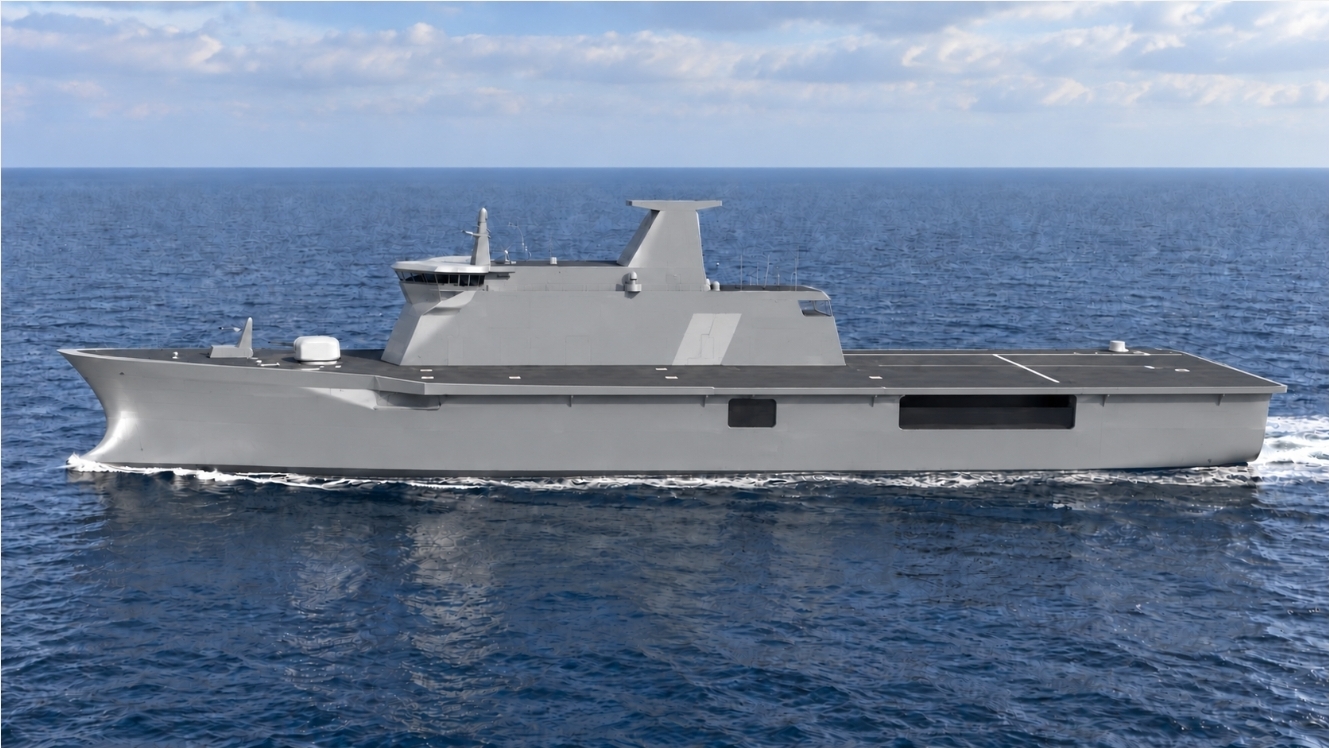
Damen has said its next project at its Galati shipyard in Romania will be amphibious transport ships for the Royal Netherlands Navy, despite a UK minister saying Britain would build all eight Anglo-Dutch ships, according to remarks reported by News.ro.
Speaking to the Romanian news agency at the Euronaval exhibition in Paris, Richard Keulen, Damen’s director of corporate strategy and innovation, said the next project the company will produce in Galati is amphibious transport ships for the Dutch Navy, which would support Dutch marine operations and act as a command platform and logistics centre.
He said the design remains largely under wraps ahead of a defence exhibition in the Netherlands on 19 November. According to News.ro, Keulen also said the United Kingdom is interested in joining the programme and would also buy four ships, but that the final decision rests with governments, which must work out how Britain can join.
The government has repeatedly said the ships will be built in Britain. Announcing the £2.4 billion UK-Netherlands partnership at the NATO summit in Ankara in July, under which each navy will operate four ships of about 160 metres and 15,000 tonnes, the government said “the vessels will be built in the UK to a Dutch design”. Sir Keir Starmer, then Prime Minister, said: “I am incredibly proud that British shipyards will help deliver these ships”, adding: “This partnership is not just about building ships, it is also about delivering long term security”.
Luke Pollard, Minister for Defence Readiness and Industry, went further when he told a joint session of the Treasury and Defence Committees on 8 July that Britain would build all eight ships, including the four for the Netherlands, saying the UK would be “building them for the Netherlands as well”. He said: “To a certain extent I can’t say which yards yet because that hasn’t been procured”, and that “our ambition is for the first ship to enter service in the 2030s.” In a written answer to Parliament, Pollard said the ships will form “the backbone of a strengthened UK-Netherlands amphibious force”.
Neither government has named a designer or a builder though, and no contract has been placed yet of course. Dutch maritime outlet SWZ|Maritime reported in September that it remained uncertain where the ships would be built, and that a British yard could become involved if Damen chose one as an alternative to Galati, whose position near the Black Sea leaves it exposed to Russian drone and missile attacks.
Readers will be aware that the stated dimensions of the ships closely match Damen’s Enforcer design. Keulen’s remarks do not say where the Royal Navy’s four ships would be built, and the Dutch and British programmes could yet be split between yards in different countries.
Galati has built more than 30 military vessels for NATO and allied navies, including the Dutch combat support ship HNLMS Den Helder, and News.ro reported that it will also begin work next year on at least six anti-submarine frigates for the Netherlands and Belgium, as well as completing a drone carrier for Portugal. Several British yards are competing for the amphibious work, with Navantia UK pitching its Belfast site and Balaena offering its yards.
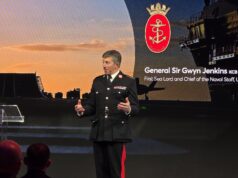
General Sir Gwyn Jenkins, the First Sea Lord, told the International Sea Power Conference in Oslo this week that the four new amphibious ships will give the Royal Marines greater reach.







HMG misleading us all on defence? Quelle surprise.
To be honest, I was shocked at the time that the Dutch had put such faith in UK defence industry given our recent track record of delays and cost over runs. But my conclusion was that these were unavoidable and probably replicated across the western world.
Either that or HMG didn’t know what they’d signed up to. I doubt Damen will be the ones making a mistake here.
Under UK rules these cannot be made anywhere other than in the UK so it’s going to be an interesting dilemma
If true, this is quite extraordinary. We had been engaged with Netherlands for a long time in trying to agree a common design for new amphibious vessels. We then agreed to differ but later re engaged. How can any minister misunderstand what had been finally agreed?