

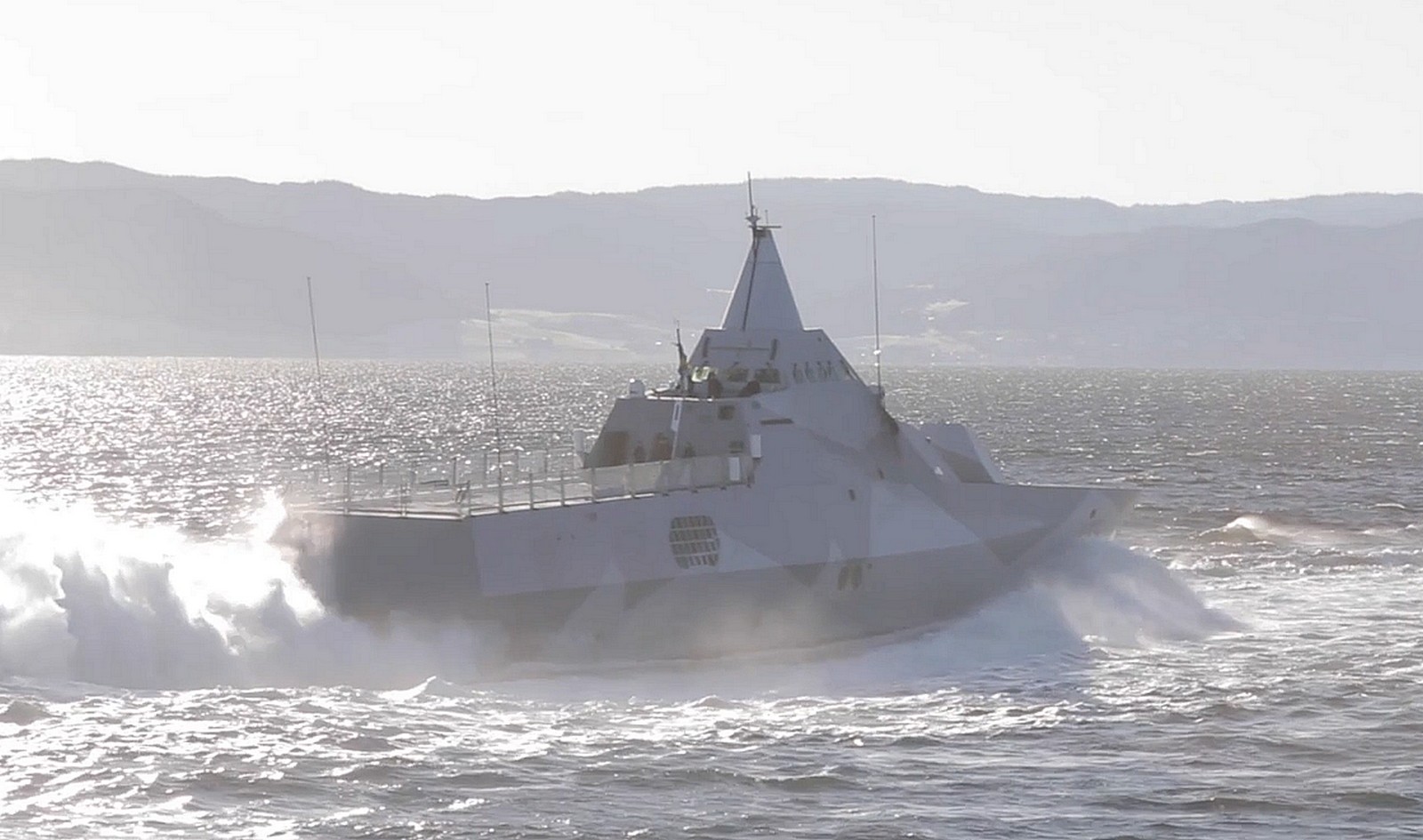
It started not long after we reached the undisclosed exercise area.
The crew got louder. Busier. Two men took the guns behind the bridge. Orders were given. Targets were highlighted. They had spotted something. Then it came into view: a German submarine, on the surface. And above it, maritime patrol aircraft were descending.
By the standards of the warships around her in Exercise Dynamic Merlin, HSwMS Helsingborg is tiny. The Swedish corvette is a fraction of the size of the frigates and support ships in NATO’s task group, and carries a fraction of their crew. She is also one of the most advanced warships in the Baltic, and these are her home waters.
Helsingborg is one of Sweden’s five Visby-class corvettes, built by Kockums at Karlskrona and commissioned in 2009. She is 72.7 metres long, displaces about 640 tonnes and draws just 2.4 metres of water, which lets her work among the islands and shallows of the Baltic where bigger ships can’t follow.
Her hull is a sandwich of carbon fibre laminate over a PVC core, shaped in flat, angled panels to scatter radar. Gas turbines and diesels drive waterjets rather than propellers, pushing her to more than 35 knots.
What stands out on deck is what you can’t see. There are no exposed weapons, boats or clutter. The Bofors 57mm gun sits folded inside its angular housing until it’s needed. The RBS15 anti-ship missiles and 400mm anti-submarine torpedoes are hidden behind hatches in the hull. She also carries depth charges. For finding submarines, she has a hull-mounted sonar and a towed sonar that can be lowered to different depths, the tools of the submarine hunt.
We were allowed to see her torpedoes, her towed array sonar and her depth charges up close. But there are strict limits on what we can report about them, and on what we can show.
“The Visby class corvette brings more fighting capability, foremost in the Baltic Sea, in the dimensions of anti-air warfare, subsurface warfare, and surface warfare,” her commanding officer, Theresia, told the UK Defence Journal on board.
There’s a line in Star Trek: First Contact that fits. Watching the USS Defiant in battle, Commander Riker remarks: “Tough little ship.” Worf, her captain, shoots back: “Little?” It’s easy to imagine Helsingborg’s crew giving the same answer.
The one thing the class has lacked is a surface-to-air missile. Its air defence has rested on the 57mm gun and decoys. That is about to change, and on board there is real excitement about it.
Sweden has ordered MBDA’s CAMM, the British-designed missile known in Royal Navy service as Sea Ceptor. Saab won a SEK 1.6 billion contract in May 2025 to fit it to all five corvettes, with work due to begin in 2026. Each ship is expected to carry up to 36 missiles in vertical launchers. Saab’s Mats Wicksell said at the time that it would let the corvettes cover “a considerably larger area and engage air targets at longer ranges”.
For the ship, it means being able to shoot down aircraft, missiles and drones at ranges of more than 25 kilometres, well beyond the reach of her gun. For the Swedish Navy, it means more than self-defence. A Visby with Sea Ceptor can protect the ships around her as well as herself, which is exactly the kind of layered defence the exercise was designed to test. It also puts the same missile in Swedish and British ships.
The surprise is inside. Indeed, a warship this small, packed with this much, ought to feel cramped. In places it does. And yet it somehow feels spacious too.
Part of the reason is people, or the lack of them. The Canadian frigate HMCS Ville de Québec, also taking part in the exercise, carries around 250. A Visby-class corvette is run by about 45, most of them officers and petty officers, with heavy automation doing the rest. On the bridge there are just three seats, and the autopilot does much of the steering so that the watch can stay small.
Everything has more than one job, of course, on ships of the class, the mess where officers and petty officers eat is also where they relax, and doubles as the medical bay. The galley turns out four meals a day, timed around watch changes at three and nine o’clock. The ship is fought from a compact operations room where the air, surface, underwater and electronic warfare teams sit within arm’s reach of each other and of the captain.
Walking through Helsingborg, she didn’t strike me as either tight or roomy, perhaps because so few people are needed to run her. What stood out instead was how many spaces doubled up, and that everything had a clear purpose. She isn’t old, and she still feels very modern: compact, with everything stowed away efficiently.
Some passageways are much narrower than others. In places you have to squeeze past the missile launchers, which on a Visby sit inside the hull, behind hatches, rather than out on deck as they would on most warships. Her crew typically spend weeks at a time on board. I was there for only a day, but it felt comfortable rather than cramped.
For the first day of Dynamic Merlin, NATO’s anti-submarine warfare exercise, Helsingborg sailed from Berga Naval Base, south of Stockholm, into the exercise area.
The route out runs through the Stockholm archipelago, and Helsingborg set off through it at speed. There is little I can say about what we saw or exactly where we were. The Swedes were, rightly, very protective of that transit. These are some of the most sensitive waters in the country, and they are central to its defence. The navy’s bases at Berga and Muskö sit among these islands, and it was here, in the 1980s, that Sweden spent years hunting suspected foreign submarines in its own waters.
For most of the navies taking part, the Baltic is unfamiliar. For Helsingborg’s crew, it’s the back garden.
“It’s really [an] opportunity to practise subsurface warfare with our allies within NATO, in somewhat our own backyard in the Baltic Sea,” Theresia said. “So it’s a great opportunity to exercise together.” Sweden joined NATO in March 2024. Asked how that had changed the way her navy operates here, she drew a clear line. “It really hasn’t changed the way that we operate in the Baltic Sea. It has changed in the way that we are operating together with our allied [partners] within the framework of NATO.”
Helsingborg herself is a case in point. In October 2026 she became the first Swedish warship to operate under Finnish command, joining a patrol of the Gulf of Finland after repeated drone incidents and airspace violations there.
Sweden’s Chief of Navy, Rear Admiral Johan Norlén, made the same point from the top. Speaking in Stockholm before the exercise, he called the Baltic “a very unique and in some ways extreme area” and “a hotspot for some time now”, and said Dynamic Merlin was a chance for NATO’s newest member to prove its worth.
“This is one way for the Royal Swedish Navy and the Swedish Armed Forces to actually show what we can actually contribute with inside NATO, and in this regard, in the underwater domain,” he said. He added that Sweden was “hoping for CTF Baltic here in a couple of years”, calling it “Sweden’s way of also showing very strong commitment to the alliance”.
The Baltic is one of the hardest places in the world to hunt a submarine, and Norlén explained why. “We have different temperatures, because we have a lot of rivers that are giving a lot of cold water into the Baltic Sea,” he said. “So the confined area here is actually the tricky part. The bottom is always in play.”
Crews from outside the region described the same challenge. The helicopter crew of Ville de Québec counted “upwards of 50 to 60 ships in an hour” on one flight. Her captain, Commander Jason Knowles, said the Swedes “understand the battle space in and around the Baltic better than people that are coming from the outside, because they really highly specialise in it”.
Norlén was clear that the exercise is about more than submarines. “This is so much more than just an anti-submarine warfare exercise,” he said. “We always talk about drones or anti-submarine warfare or missiles. The bottom layer here is that we are here to test and train together in all three dimensions at the same time. That is what makes it really complex.”
It’s also where a ship like Helsingborg fits in. Norlén said one aim was to see how small ships and large ones can protect each other.
“One ship may not be able to control everything or to defend themselves in every sense,” he said. “That is also part of the evaluation here during the exercise, [to] see that we can actually use a small ship together with a large one, because they have […] different layers of defence that can actually work much better together.”
That first sighting, the guns manned and the German submarine on the surface, was only the beginning. The weather was remarkably kind. It was bitterly cold, but the sea and the wind played ball, and under a cloudy sky the maritime patrol aircraft came thundering through the clouds towards their target.
Then a helicopter arrived: the Canadian CH-148 Cyclone from HMCS Ville de Québec. It made a series of low passes, scouting the area and lowering its dipping sonar into the water to listen for the submarine below. And everywhere I looked, on every part of the horizon, there was a NATO warship. It is an impressive sight, Allied military power arrayed across the Baltic. The plan was for the submarine to dive and for the hunt to go on. But for us, that was where it ended. After an action-packed few hours, Helsingborg turned for home. The exercise continued without us, as it should: these ships are there to train their crews, not to ferry journalists about.
The Swedish Navy is a professional force. It isn’t finding its feet in NATO. It has found them.








I can’t help but feel that a highly automated lean manned vessel is a better way to offor the RN to add mass than looking for fully autonomous T91 etc platforms.
yes it helps up to a point. but in wartime and combat situations you need people doing many jobs 24/7 and it puts a lot of strain on crews the longer the mission lasts. for example after deppoying in the Red Sea vs Houthi drones the french navy dexided to increase the crew size on its FREMM frigates (which have a lot of automation to reduce crew size) because of workload over time, with drones being a constant threat crews need to be sharp at all times, there is no letting down.
Allow not offor!