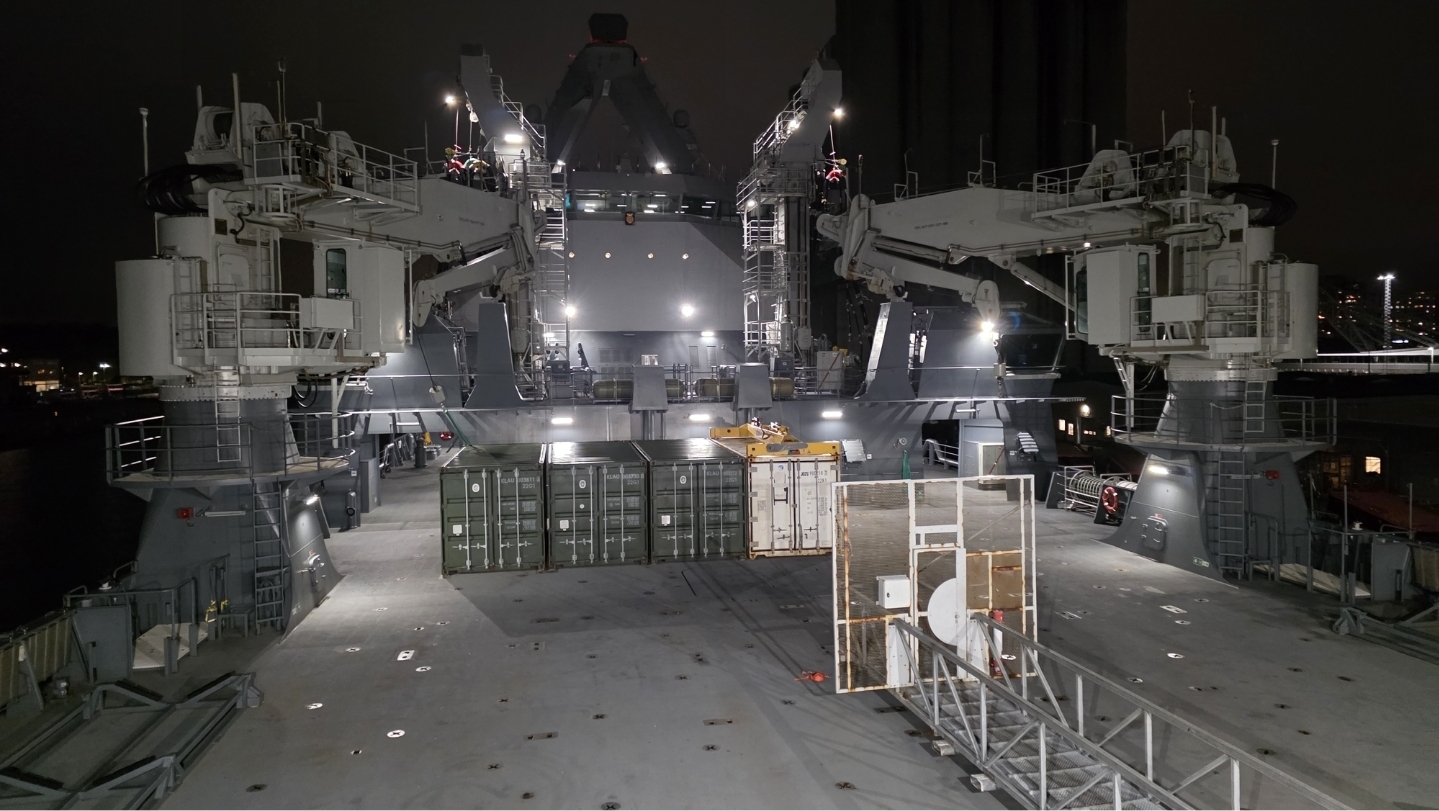
The flagship of the NATO task group hunting submarines in the Baltic is not a destroyer or a frigate. It’s a tanker.
HNLMS Den Helder is a combat support ship, built to keep other warships supplied with fuel, food and ammunition at sea.
But for Exercise Dynamic Merlin, and for two months in all, she is also the command ship of Standing NATO Maritime Group One (SNMG1), carrying its French commander, Rear Admiral Nicolas Molitor, and his multinational staff.
Welcome to the Enterprise
The first thing that strikes you is the bridge. It is wide, bright and uncluttered, all screens and sweeping windows, and it looks nothing like the cramped, grey spaces of an older warship. More than once during our visit I heard people, from naval personnel to fellow journalists, call it the Starship Enterprise. As a die-hard Star Trek fan, I couldn’t help but agree. There is one difference. Den Helder moves her cargo and supplies with replenishment rigs, hoses and cranes rather than transporters.
It is also the first time she has done this job. “It’s brand new,” her commanding officer, Commander Cleo Ten Hoopen, told the UK Defence Journal on that bridge. “It’s the first time having a staff on board, so it’s good to have staff on board just for the ship to get a good focus on the operational side of things, and just to see what the ship is capable of, just to see what we can do, what we can’t do, and just evaluate that in time.”
Learning to be a flagship
Asked how that learning process was going, Ten Hoopen was upbeat. “I think we’re doing quite well, to be honest. Still, there’s a lot to learn,” she said.
“Beforehand, we had a good look at the ship and [saw] what we can do and can’t, and we asked the staff as well: what do you need, and how can we provide it? And I think for a ship like this, we can provide quite a bit.”
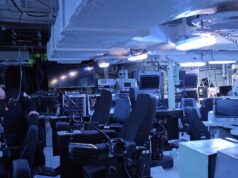
The key, she said, is giving the admiral’s staff the same view of the battle as the ship’s own team. “We have a combat management system that the staff can see as well, so we can share that picture so they can see what’s going on outside.”
The rest comes down to people. “The [integration] is going quite well, I must say, because we eat in the same room and we talk. Well, we have to talk a lot with each other,” she said. “And I think, we’re Dutch. We’re used to having other countries on board and working together closely.”
Is a support ship an unusual choice of flagship? “It depends a bit on which ship is available, what kind of exercise you’re doing, or what kind of mission you’re doing,” she said. “It can be useful as long as you can provide [the] whole picture to the staff so they can do their job.”
The staff she hosts is drawn from eight nations. Its Royal Navy plans officer, Lieutenant Commander Jonny Miller, said the team was planning up to 72 hours ahead while also looking “past the exercise, for the rest of the year and next year”, adding: “Just get my crystal ball out.”
Rear Admiral John Craddock, NATO’s submarine commander, was impressed after a walk round. “It’s an amazing ship,” he said. “Incredible capability.”
The day job
Being flagship doesn’t excuse Den Helder from her main role. “We will be the [flagship], obviously, but we will be replenishing other ships as well,” Ten Hoopen said. “So providing fuel to the other ships as well. And probably some helicopters, just providing them with fuel.”
The ship’s press officer, who doubles as her flight deck officer, set out what that means in practice: “We can replenish ships. That’s our main core business.”
Den Helder carries about eight million litres of fuel: F-76 diesel for ships and F-44 for helicopters, along with fresh drinking water. She can pass it to ships on both her port and starboard sides, and can do both at once. The week before the exercise she refuelled the Danish frigate HDMS Esbern Snare at sea.
She had also been busy with the group’s aircraft. “Last week we did the familiarisation with all the helicopters in the group. We have the Germans, the Canadians, and the French,” the press officer said. That included practising vertical replenishment with a Canadian helicopter, which lifts loads from the deck without landing: “It will not land. We will just hook on a load.”
Built around logistics
Our tour began the way everything on board seems to run: quickly. The safety briefing was over in a couple of minutes. “It’s a brief brief,” the press officer said.
From there we went aft to the hangar and out onto the flight deck, where the light was fading over Stockholm and the cold was biting. The Dutch crew seemed not to notice.
A walk through the ship shows how much of her design serves the job of supply. A passageway runs the length of the ship, built wide enough for forklifts to carry stores from the crane to the hangar and lift. On the flight deck, a hatch opens straight down to the refrigeration and freezer units, so provisions can be struck down as they come aboard.
Below, the ship is diesel-electric, with four diesel generators driving two electric motors and two shafts. She makes her own fresh water from seawater by reverse osmosis, and can supply certified drinking water to other ships. The engineers are proud of her environmental features: waste heat from the engines warms the ship’s water and heating, and urea is injected into the exhaust to cut emissions. Photography is not allowed in the ship’s control room, but down in the engine room a corporal from the technical department talked us through his machinery over the noise with obvious pride.
She is lightly armed for her size, with a remotely operated Lionfish gun among her close-in defences.
A hospital at sea
Den Helder also gives the task group its best medical facilities. The Dutch Navy describes it as a Role 2 hospital, where a specialist team can carry out surgery. Casualties are brought first to a triage room, then to one of two trauma beds, and on to a sick bay to recover, in the press officer’s words, “until they’re ready to go back to the fight again”. A doctor is carried on board.
That matters to the ships around her. Commander Jason Knowles, captain of the Canadian frigate HMCS Ville de Québec, said his biggest worry was “somebody getting hurt beyond our capabilities of making them better here”. Den Helder and the German support ship Berlin, he said, “have more medical staff, a higher degree of specialised equipment”.
The newest ship in the fleet
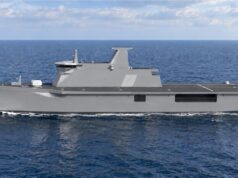
Den Helder was built by Damen at a cost of about €374 million, with her hull constructed at Galați in Romania and fitting out completed in the Netherlands. She was commissioned on 1 October 2025.
At 179.5 metres long and about 20,000 tonnes, she has a core crew of 76 and room for around 80 more, which is what makes it possible to embark a NATO staff. She can carry two NH90 helicopters and around 20 containers of stores.
She fills a gap the Dutch Navy has lived with since its last dedicated tanker, HNLMS Amsterdam, was sold in 2014, leaving the larger HNLMS Karel Doorman, on whose design Den Helder is based, as its only replenishment ship. Her first year was spent on trials, in the heat of the Caribbean in late 2025 and in the ice of the Baltic in early 2026, so these are waters she already knows. She left her namesake port on 31 October 2026 to take up her role with SNMG1, and is expected home in about two months.
We ended the visit over dinner in her central mess, with the ship’s company and the admiral’s staff eating side by side. It was a small illustration of Ten Hoopen’s point: on a flagship, you have to talk to each other a lot. For a ship barely a year old, she already seems very comfortable being in charge.