

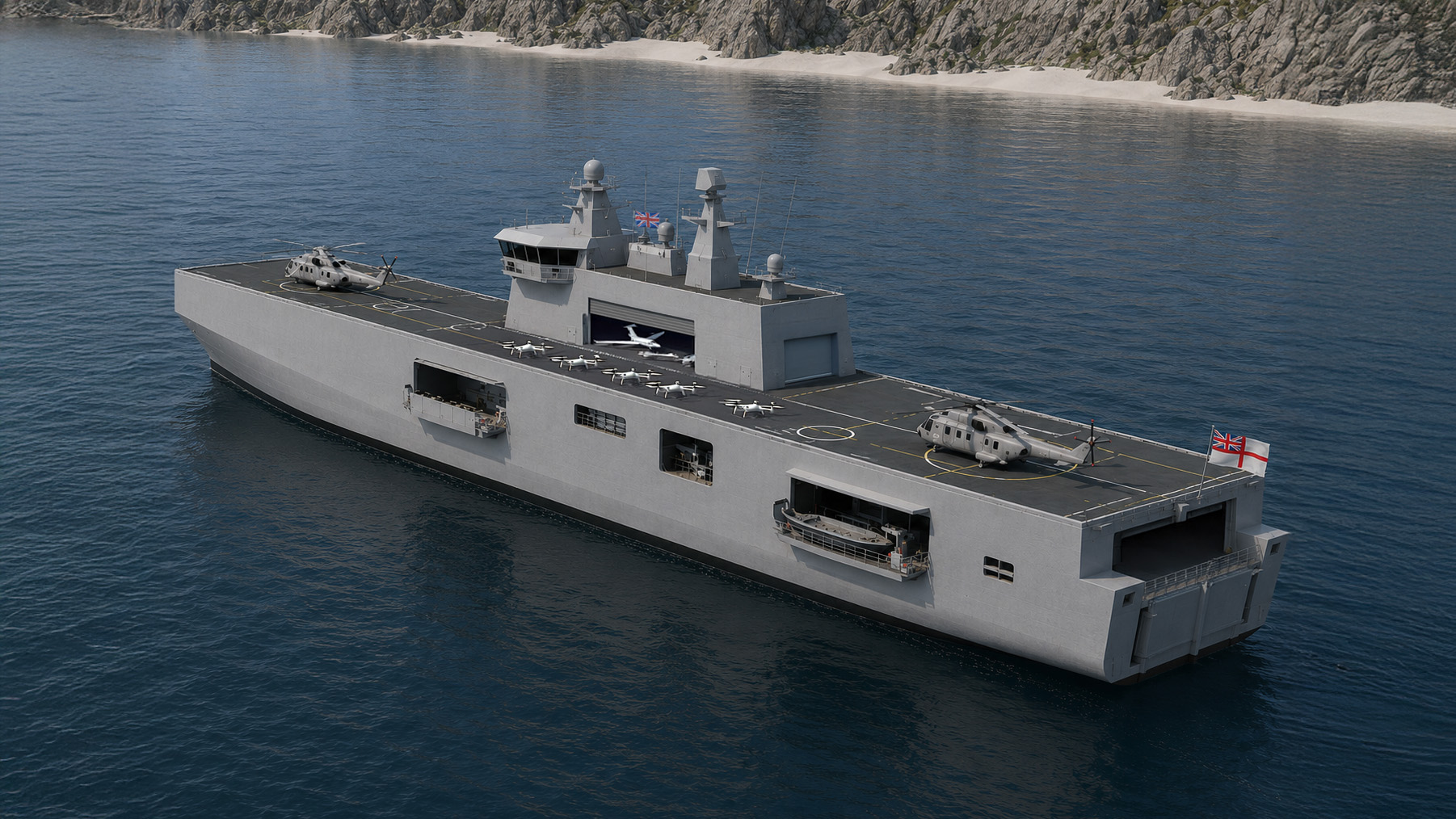
Britain is expected to build all eight ships in the planned Anglo-Dutch amphibious fleet, including the four vessels destined for the Royal Netherlands Navy, Defence Minister Luke Pollard has confirmed.
Speaking to a joint session of the Treasury and Defence Committees on 8 July about the government’s plans to maintain a continuous shipbuilding workload, the day after Prime Ministers Keir Starmer and Rob Jetten signed the £2.4 billion agreement at the NATO summit in Ankara, Pollard described the arrangement with the Netherlands as an export success for British industry. He cited “the agreement that we have made with the Netherlands to build the new Amphibious Transport Ships, both for the United Kingdom and, importantly, us building them for the Netherlands as well,” adding: “that is effectively an export campaign win.”
The joint programme covers eight Amphibious Transport Ships, with four intended for the Royal Navy and four for the Royal Netherlands Navy, and Pollard’s comments therefore indicate that all eight vessels are intended to be constructed in Britain, although the final allocation of work between UK shipyards has yet to be decided. He said he could not identify the yards involved because the programme has not completed procurement, adding that work could be distributed across several sites through block construction. “To a certain extent I can’t say which yards yet because that hasn’t been procured, but that could be across a number of our new shipbuilding projects, that could be block builds,” he said.
Block building, in which sections of a ship are constructed at different yards before final assembly at one site, would spread the amphibious work beyond a single facility, and the evidence leaves the field open days after Navantia UK publicly positioned its Harland and Wolff yard in Belfast for the programme, telling the UK Defence Journal the £98.5 million recapitalised site gives the UK a proven, sovereign capability to build the vessels. The overall number and the intention to build the Dutch vessels in Britain are now clear, while the precise industrial strategy, contracting structure and geographical distribution of the work remain unresolved, with the final build locations depending on the procurement process and the government’s wider effort to sustain shipbuilding activity across the Clyde, Rosyth and other British yards.
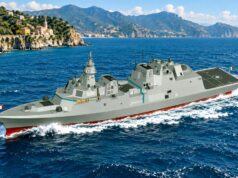
Previous government information described the £2.4 billion programme as involving ships built in UK yards alongside Dutch industry, based on a Dutch design, with each vessel approximately 160 metres long and displacing around 15,000 tonnes, carrying troops, vehicles and equipment including drones, and fitted with flight decks able to operate current and future long-range uncrewed systems. The work is expected to support hundreds of skilled UK jobs, and the first ship is intended to enter service during the 2030s, with Pollard telling the House of Commons earlier this week that the programme restores a dedicated amphibious capability following the withdrawal of HMS Albion and HMS Bulwark. “We are working with the Netherlands to develop a joint capability, and our ambition is for the first ship to enter service in the 2030s,” he said.
The Amphibious Transport Ship programme replaced the Royal Navy’s earlier Multi-Role Strike Ship proposal, which envisaged up to six substantially larger vessels of between 25,000 and 40,000 tonnes, after the government concluded the previous concept was too complex and no longer aligned with its planned model for the Commando Force. A joint design was first pursued under Project Catherina, signed in 2023 on the fiftieth anniversary of the UK-Netherlands Amphibious Force, before being set aside in 2024 when the two nations judged their requirements too divergent, a position the Defence Investment Plan has now reversed in favour of the Dutch-led concept.
The Royal Navy has had no dedicated amphibious assault ship since Albion and Bulwark were retired in late 2024 and subsequently sold to Brazil, and building all eight hulls in Britain gives UK yards a second export programme alongside the five Type 26 frigates being built for Norway, which Pollard told the same session has extended Clyde production by fifteen years.


I wonder what the ‘planned model for the Commando Force’ actually is. Attempting a contested landing in the modern world would probably not be a good idea, but normally ships are designed around a fairly specific operating concept that dictates how big they are and what they are designed to carry. ‘Amphibious assault’ is a concept that seems to have been heavily debated in recent years without any obvious conclusion.
It appears helicopter and fast boat insertion of a largely infantry based force seems to be what they are angling for.
Absolutely, the days of “Commando ships” that would actually embark a full Commando of 800 men are long gone. The ATS design seems right sized for an embarked RM Vanguard Strike Company of 150-200 men, although of course an overload of double that could be embarked for a few days. They are a bit too large, expensive and conspicuous for routine use by the SBS, who will probably remain stuck using converted trawlers or what ever other semi-suitable platforms they can beg, borrow or steel!
These mini LHDs also look ideal for actively policing grey-zone activity. Unlike a very large platform (e.g. an Albion or QE) these ATS are small enough to be economically sustainable for persistent presence, as we see with the use of the Bays. But also large enough to carry a decent boarding party of RM, plus proper support facilities for a few helis, fast sea boats, drones for over-watch etc. So the kind of interdiction operation we recently saw to seize a Russian shadow fleet tanker, can be launched *entirely* from just one of these ATS, anywhere in the world. They can therefore provide deterrent against grey zone antics (anchor dragging, launching drones etc.) to protect UK offshore infrastructure, a domain where funnily enough, we have many overlapping interests with the Dutch.
Contested landings have been long abandoned as borderline suicide missions.
Have a feeling no one really knows what can and can’t be achieved by any such concept (if even concept can be applied) the US is equally running around trying to determine possibilities if on a bigger scale. Fact is this is something that only a conflict will probably truly determine, as so much has been in Ukraine where even crossing rivers and holding bridgeheads has proved problematical with drones so prevalent.
I wonder if this sort of capability is now seen more as militarised ferries where they can perhaps transfer light forces into an under threat environment before real direct conflict has actually broken out. That seems to be the prime focus for British forces within NATO now, ie in quickly supporting Norway against a prospective Russian incursion to bolster defences there as larger forces are prepared and fill defensive gaps perhaps. Smaller flexible vessels of this nature arguably at least may be best suited for that role in that environment, especially if 8 are there to carry it out, certainly probably the safest bet. But I think it’s all a best guess now trying to retain a capability that no one wants to lose but are unsure how best to keep it relevant and within a manageable budget.
One positive is that this style of vessel very likely has great export potential, that larger more specialist designs probably wouldn’t.
Opposed landings are dead, for democracies anyway. No way could a western government survive the kind of losses that would be sustained in such an operation, let alone if video footage emerged of swaths of casualties emerged.
Raiding missions, as envisioned by the Royal Marines new doctrine is as close as we’ll see. Even with these, the aim will be to land on enemy territory without being spotted, let alone engaged, while doing so.
When supporting NATO allies such as Norway, the aim will be landing forces on territory still controlled by the ally. So reacting before the ally falls, or landing in a neighbouring nation and then travelling overload.
So the future is using ports/docks etc, such as with the Point class – though with ideally more defence-measures aboard.
And let’s be honest, if there was an opposed landing, they’d be bombing the crap out of them in advance to reduce issues with troop helos coming in.
Assuming you had air superiority to do the bombing.
And even with air superiority that’s not going to stop troops on the ground operating the type of small FPV kill-drones used to take-out individual soldiers in the Ukraine-Russia frontline.
Good comment. Can’t see uk doing risky opposed landings like d day and did we in suez? Using nearby friendly ports ok. At least we are in partnership with another country so MoD maybe taking a right decision. What if stipulated all future build Scottish ferries to have a flight deck?
Short of massive investment in Rosyth there’s no way it can be anyone other than H&W to build 8 largish ships in that timeframe.
Excellent news, though!
I hate to be negative but H&W hasn’t built anything for decades.
Rosyth hasn’t finished a T31 yet.
BAE hasn’t finished a T26 yet…
This is a great export success if it has commercial backbone. However, I scent that it enabled T32 or T31BII to be quietly ditched in favour of unproven drones that will struggle in high sea states.
It’s all ultimately about cost and what we can afford…Drones currently seen as a relatively cheap option against specified military Requirements..!
Dare say if costs exceed expectations of these Drones …
(Maintenance, lifetime Running costs, operational performance, etc )
we may yet see them take another look at this..
And therein lies a huge problem. UK shipyards are simply far to slow when it comes to ship building! God knows when we’ll get a decent number of new Frigates in service thanks to the snails pace progress at BAE & Babcock. If we want these new amphibs in service at a reasonable pace we might need to look at foreign shipyards.
No, we need to make UK shipyards faster!. If this means expanding capacity so that more can be in production at the same time, great, but suspect major reason is simply because the yards are working at a slow pace because that’s what the funding and political ‘push’ allow.
Lack of skills too I think. Thanks to previous decisions the yards are now full of new trainees and older near retirement staff as those who would now have been mature experienced staff left in large numbers when the future for shipbuilding look bleak and in decline a decade and more ago. We might have to tempt foreign workers into the system if we want to speed up matters at least till newer intakes mature their skills sufficiently. The real cost of short term-ism that has so plagued the Country.
Agreed. I find it hard to reconcile cries of not being able to get jobs on the one hand or workers on the other! Areas with the highest unemployment rates are often the areas crying out the most. We need an ongoing fully funded programme to train apprentices in shortage areas and guarantee jobs at the end of it. Recruiting foreign workers? Good short term option, but mostly there needs to be the will to train people by companies and the will to be trained by workers.
That just kills our defence capabilities Even more… if you want a meaningful navy you must build your own ships.. if you keep starving your ship building industry you cannot build ships.
It’s no point smacking your dr in the face breaking his nose and then complaining he’s to slow.
Finally it’s all about tax… you spend 3 billion in a foreign country and you are giving that country probably 1 to 1.5 billion in tax revenue all at the expense of the British tax payer.. build it yourself you get 1 to 1.5 billion in tax revenue back as well as the fact you don’t have a load more unemployed wasters and have an export industry…
You make it good by feeding it.. the more it builds the better it is… let’s not feed some other random nation.
I don’t disagree with you, but UK ship building needs a major overhaul/when up call to get it in a competitive position to turn out vessels at a rapid pace..it’s all very well having lots of orders, but pointless if they take forever and a day to get built. A classic example is Babcock promising a pretty good build rate for Type 31. Hull 2 is in the water, but tied up alongside for months because they only have one drydock still occupied by hull 1.
Yes I agree the orders need to come with investment.. but it’s essentially two sides of the same coin.. the government must give good assurance of orders and for that must get guarantees of investment in infrastructure and productivity from the ship builders..
Personally I would like to potentially see government investment in the shipbuilding companies.. with actual shares.. so they are private companies with a level of government ownership via share structures..
Yes. Very much this. Until recently that was anathema to the Treasury. Nationalisation by the back door. (Pace Ben Wallace and Forgemasters.)
Reeves has opened that door a crack with her wealth fund, which is a way to circumvent her fiscal investment rule. If the government owns real assets they don’t net off against financial liabilities (her chosen measure). But shares in a company that owns real assets are classed as financial assets not real assets, so owning those does net off, letting her meet her chosen target. While I think it’s mad that a Chancellor has rules that she plans on openly circumventing from day one, it may allow government to own real assets once more. Something I’m all in favour of.
We don’t need to do that we just need to get the sequence right. Theres now no point having everything being built at the same time, because there will be nothing coming after and the yards will close.
BAE has T26 for 15 years.
Babcock will have CCV after T31- 2030’s sorted
Navantia will most likely have ATS after FSSS- 2030’s sorted.
Speed is significantly impacted by MOD stipulated milestone payment schedules…what cash in what fiscal years.
“unproven drones that will struggle in high sea states.”
😂
Trouble is I don’t see it as very funny.
One of the reasons for biiiiiig carriers and destroyers is the ability use the platforms in a wide range of sea states.
The SSN advantage is that they can carry on doing what they are doing calmly down below albeit there is a lot of noise coming from the wave action above.
There’s plenty of automated vessels, in service, that operate in high sea states.
Carriers are big to provide capacity for larger air-wings and long flight decks.
Destroyers are big to maintain stability when mounting their AAW radars on high masts.
There’s plenty of vessels that travel the world’s oceans that are smaller than both.
“Destroyers are big to maintain stability when mounting their AAW radars on high masts.”
So how is the AAW going to work in high sea states on smaller vessels?
Yes, smaller vessels can bob about but can they fully function?
Given the radar picture will be a fusion of all those from the smaller vessels combined, possibly including airborne drones, with that of the CCV, then it has the potential to be superior than a single, lone radar on a bobbing destroyer.
There is the tiny issue of coherence which is mostly down to phase which requires super precise timing and geometry.
Now I can understand that quantum coherence might be used for this but not quite yet…
I’m not a radar guy, but I think it should be possible to combine tracks from a bunch of different sources, and let AI join the dots where they don’t quite line up? If anything, I’d say multiple sources can provide an additional layer of cross checking for error.
Oh, absolutely multiple radar heads can make fooling the system harder and detecting stealthy planes easier.
The problem is actually combining data so that you don’t simply get a mess.
AI will be of some assistance but if you feed mess to AI expect to get a *lot* of hallucinations. Very simple radar rule: the cleaner the data in the cleaner the data out.
The bit I am not getting is how these platforms are to be synchronised. Previous ideas and indeed attempts used laser clock pulses which are OK but the range is limited by atmospherics and curvature of the earth.
“The bit I am not getting is how these platforms are to be synchronised.”
Quantum optical atomic clocks presumably, as already trialed aboard XV Excalibur?
Feels like all these technology trials are all finally fitting together…
Well yes up to a point.
But there is the tiny issue of spatial synchronisation.
Pitch, yaw that kind of thing….radar arrays are very tightly engineered….so if the ship is bobbing around like a cork and using a tight LPI beam then where the radar head is spatially rather matters….as does where it is in relation to the other radar heads….
Time of rapid change and innovation. Frankly, ANY drone produced today in whatever numbers are basically interim types, obsolete by the time they go into production. Afraid that’s a phase we have to get through – and if we opt out and leave it to others we lose the race and will never make the time up.
The difficult trick, will be coming-up with a design that can be quickly and iteratively updated in a regular basis to stay current.
TBH with most of the hardware, this won’t be difficult, especially with the engineering side of things (hulls, engines).
The rapid development is in terms of the software systems, the processing power required, and sensor fit to keep the AI informed of the situation. Plus the encrypted comms.
I would say most of the development is in how the systems are used rather than specific specifications. So size, range, speed, guidance systems, ‘best’ target, cost…. There are literally thousands of options and realistically they need to break down into a small number of workable systems suitable for mass production. Any system developed has to be available in large numbers – useage by Russia and Ukraine involve insane numbers of drones – and we need to have insane numbers in storage, not on order. But again, what systems?
You’re talking about small one-use kamikaze drones.
The article is about drone ships for AAW detection, missile arsenal, etc.
Confusing the two is like confusing a Scalextric car with Lewis Hamilton’s F1 car.
No, I’m talking about the whole shebang. ‘Small one use kamikaze drones’ – sure. they’re in the mix. But so are anti drone systems – how much do they cost, what are they designed to take down, what is their expected range. And surveilance drones. Or systems designs for short/medium/long range? Fact is, the whole technology is still in it’s early years – and it’s going to be a while before we decide what the correct ‘mix’ will be. It’s a completely new ball game…
You hate to be negative? Are you sure? So many people are negative on here it just feels like the every day sort of response.
Yes, I am very sure.
I sense that the direction of travel is being dictated by budget and by top leadership with the manufacturing bobbing along behind.
I also scent the Good Ideas Club working hard here: which is what makes me most apprehensive TBH as most kit disasters start out with a Good Idea…..
It’s got to be H&W assembled from blocks. Appledore isn’t long enough for the published length. I don’t know what’s at CL, but they will be building blocks for SSSNXYZ for the conceivable future
I did see two Blokes In Hi-Vis using a tape measure down at Priddy’s Hard a while back…..🤔
Ah, but which one was holding the dummies end halfwit, or did they swap???
Babcock have just erected gantry cranes at Buckler’s Hard too
😂👍🤣 luv Priddys hard , sailed in there with my trusty thirty footer a many a time – now so sadly gone.
H&W are a relatively new set up with Spanish help…
Those fleet stores ships will take a while to build..!
when do they expect these lhds vessels to enter Service if H&W do get the contract ..?
Could they consider out sourcing part of the shell construction of the Vessels to European or Turkish yards?
they could and should be built in more then one yard Balaena Group i.e cammell laird, A&P Group, Babcock Rosyth , Ferguson marine Plus Inchgreen drydock , and whatever space navantia “UK” / Harland & wolff can find , it can be done
Rosyth has the facilities already to build huge aircraft carriers. Expect the same ‘block’ construction approach for these vessels. H&W will likely get a share of the blocks but remember the new owners also have the Methil facility on the same Forth estuary as Rosyth.
Hopefully a joint project will prevent cost cutting that happened with the Albion around the helicopter bay that heavily impacted their usefulness outside war.
Good point, I was already thinking that potentially these ships will have far greater flexibility in performing more general duties in peacetime.
Including UMCM in the mothership role as Lyme Bay is doing now.
Would be a good Caribbean storm season standby / response vessel with an enginerring load out as well as anti drug smuggling mothershiip with deployments possibly funded by foreign aid budget.
This is good news! We need orders that are beyond the capability of current industrial capacity as we want private businesses to have the confidence that capital and human investment will be worth it. Could be a double win if the Dutch choose T31!
Very welcome good news to start the day.
Lots of work for UK shipbuilding….a nice problem to have!
Yep, I’m not against this hybrid Navy malarkey ‘if’ they can get the magic source stirred to the right consistency to make it all work…
As I’ve said before, make them minimally manned and you can make things a hell of a lot more straightforward.
I’m hoping President elect, Burnham Bounce, might just add a few T26 and T31 to boost up the manned end of things though… I know, let an old man dream his dreams.
If not, it wouldn’t be too late in tbe production cycle for the next administration to order a few more of each.
It’s a relief to be able to see the general direction for the RN. Its been hard letting go of the LPDs, coming to terms with what we can afford and frankly, post empire Britain. We are still global power and a nuclear power. We are still audacious and creative. The manned fleet at a minumum will be 8 T26, 5 T31, 5 OPVs, 3 MCM motherships, 6 T45 – CCV, 2 QE carriers, 4 lite LHDs and I expect the batch1 Rivers to be replaced by 3 manned patrol ships; either a batch 3 River or maybe the original T31 patrol frigate; and I wouldn’t be surprised to see some enhancement of the B2 Rivers. All plus Tides, FSS SSBNs, Aukus SSNs, drones etc. By anybody’s reckoning that’s a substantial force.
Amazing!! Just need some Type 31’s built for export now….
No – we need three more T31 built for ourselves . Call them drone control USV motherships if you must to get them built !
So 4 hulls replacing 6 for the UK, which means at best 2 available for tasking, Where are the sailors coming from? Lets betting they will get cut before we know it……..
They could not operate albion and Bulwark at the same time how are they now thinking to operate 4 ships
They are replacing the Bays aswell.
So the long and short of it is, despite what the government say, this is in reality just more cuts to the RN expenditure
I guess the real question in regard to that will be around the viability of this sort of capability in modern navies and the priorities involved. I can’t answer that but someone has to and perhaps has in regard to this decision. Cut or simply common sense based on honest reassessment based on what’s possible in modern warfare, is a big question, not sure if the answer as yet truly is clear tbh.
I think that when people talk about amphibious ability they think Saving Private Ryan. Personally I see more of a Sierra Leone type operation. For that purpose I think these will be good enough. Maybe a smaller with less capabilities in terms of helicopters and landing craft, but 2 of these turning up and landing their kit is much better than nothing.
I think also very useful in deterring Russia from their grey-zone antics. Between us and the Dutch, we can as needed have one of these patrolling the North Sea (or wherever) with a few marines & helis aboard, ready at short notice to interdict any merchant ship that’s dragging anchor, launching drones, or similar.
Agreed in full.
Far smaller crews, The Albion Class was designed in the early 90’s when chucking personnel at a ship was thee way to make it go…
I suspect these will have a standard operating crew of about 80.
I served on the older Bulwark in 1972/73, yes, we had a crew of around 800 but then we also carried a peace time complement of around 800 co andos and nearly 30 helicopters and a hammer internally to store them, being Bulwark was a converted aircraft carrier ofthe 1950s and 60s, but could still chug along at a far greater speed than the more modern Bulwark or even the new proposed ships
Perhaps they’ll be 15,000 ton drones so they won’t need sailors. 🙃😢
Well the Albions needed 340 ish crew.. these have a crew of about 100
Yeah and the Bays 60 when no EMF or ships flight embarked
And the bays are essentially auxiliary logistic vessels that we are pretending are actually amphibious warships.
We have finally accepted that we are not doing contested amphibious landings, that 4 Bays / Enforcers are close to what we need but that a thru deck future design for a future of drones and helicopter assault. I see these ships more as Ocean lite replacements, with the Bay’s MCM role migrating to specialist ships.
Starting when?
The new owners of cammell laird are also showing interest in this project.
The historic Cammell Laird shipyard in Birkenhead has been acquired by the maritime engineering group Balaena as part of a £150 million takeover of its parent company, APCL Group. As part of the deal, the 123-year-old site is being rebranded to Balaena Birkenhead.The acquisition brings Cammell Laird together with A&P Tyne, A&P Falmouth, Gibdock in Gibraltar, and Padstow Boatyard, creating a combined network of five shipyards and 12 dry docks.Worker and Union Perspectives on the TakeoverUnion officials have expressed optimism that the takeover provides stability and growth for the local workforce.“This deal gives certainty after months of speculation and allows our members and the yards at Cammell Laird, A&P Falmouth and A&P Tyne to move forward together.”Wirral Today“We look forward to working with the new owners to ensure we continue to grow UK sovereign capability and increase local jobs and apprenticeships in Merseyside, west Cornwall, and on Tyneside.”Wirral GlobeWould you like more details on the shipbuilding and defence contracts the Birkenhead yard is currently working on under its new owners?4 sitesShipyard to lose Cammell Laird name after 123 years – BBC15 Jun 2026 — Shipyard to lose Cammell Laird name after 123 years * Marc Waddington. North West. * 15 June 2026. * One of the oldest names in sh…BBCBalaena buys Cammell Laird owner in UK shipyard shake-up12 Jun 2026 — The maritime engineering and shipbuilding group Balaena has acquired APCL Group, bringing the historic Cammell Laird yard at Birke…UK Defence JournalCammell Laird renamed Balaena Birkenhead after £150m …17 Jun 2026 — Balaena Group CEO Simon Gillett on future of historic Birkenhead shipyard on the River Mersey. Manufacturing. Elliot Jessett City …www.business-live.co.ukShow all
CL should focus on what they are good at, ship repair. Last thing we need to try and do is active a fourth surface yard.
cammell laird isn’t an inactive shipbuilder recently completing the build of the MV Royal Daffodil and currently building two car ferries for Western ferries , they also built the RRS Sir David Attenborough and do Block building cammell laird is more then ship repairer
But they are very good at ship repair and we have a lot of ships in need of repair.
If theyr very good at repair then maybe someone should get them repairing said ships.
Shipyard “very good at repairs”..
Bunch of ships STILL alongside awaiting “maintenance/repairs”..
Someone obviously not been joining dots.
Can someone tell me how this is bad news 😀
I know labour bashing is the way to go but in the past year they managed to get a swap with Norway for them buying 5 top of the line frigates from us to form the worlds most capable anti submarine fleet at the cost of us buying a couple of adapted OSV’s and now they seem to have signed the biggest export by tonnage in modern British shipbuilding history with the Dutch so we can form a joint amphibious fleet of 8 vessels.
And we haven’t even got to Denmark yet which probably now has little choice but Arrowhead 140.
I thought when the last government took the decisions to save a few quid and reactivate Rosyth and Belfast that UK ship building was doomed but I’m happy to say it now looks like it’s going to be a massive win. All three yards probably look secure for decades now. Decisions like getting Norway in on T26 and ditching MRSS for ATS have meant taking a short term reduction in some capability but the new pan European JEF navy we are building looks awesome. Factor into that Canada now with 15 X T26 derivatives and a massive SSK fleet of 12 SSK’s shared with Norway and Germany and now Denmark’s decision to go in on P8 the North Atlantic looks very well defended in the 2030’s without having to gut the NHS.
This isn’t the bad news. It’s the good news to offset the demise of MRSS. It’s good for our industry and bad for our Navy, which will now be getting 4 smaller ships to replace 6 larger ones (of 7 if we count Largs Bay).
Hi Jon, our navy only has three amphibious ships, there has not been 6 ships in the amphibious fleet since SDSR 2015 got rid of HMS Ocean and laid up one of the Albion’s and sold off one Bay class. Obviously much of those decision were taken because we have 130,000 tonnes of LPH kicking around in the form of the Queen Elizabeth’s which can and will be part of any amphibious operations.
It’s like the government just announced it’s buying two battleships and everyone says it’s a massive cut because we use to have 15.
Not really, because there was a plan to return to 6 amphibious vessels with MRSS that has now been down scoped to 4 ATS purely based on financial constraints. The requirements for both types are so nebulous that debating on the basis of individual hull capacity is a waste of time.
Only having 3 Bays is an aberration and the result of poor decisions, saying 4 ATS is a step up is like looking at our 5 current T23s and saying that the 8 T26s are clearly an upgrade so cancelling T31 is justified.
There was no plan, there was only a plan for 3 MRSS, that’s all they consulted industry on. There was an aspiration for up to 6.
HMS Albion, HMS Bulwark, RFA Argus, RFA Lyme Bay, RFA Mounts Bay and RFA Cardigan Bay. Those are the six I was referring to. All part of the fleet until last year, which was 2025, definitely not 2015.
Not really in the fleet though, one of the Albion’s was laid up in long term reserve from 2015. By that standard I could still say RFA Argus is in the fleet as she still afloat and still owned by the RFA.
Yes. You could make that argument. However, I think you might be making my point, rather than your own original one. Er, thank you. There is utility in owning older vessels like Argus and RFA Fort Victoria, because you might decide you have no choice but to restore them to use, regardless of cost. However, we know that Bulwark and Albion were not in the same state as Argus and Ft Vic. They were kept commissioned and useful until very recently and the fact that we only ran one at a time for over a decade didn’t make them potentially less useful in time of war.
They were only useful one at a time though as the other Albion class was put into long term storage and could only be reactivated with a full refit.
All I’m saying is us having four of these Amphibious ships is not a cut on what the current navy has and will have for the next decade.
Bay was 2010 mate, as was an LPD into reserve.
Someone will spuriously claim that the first four built will be for the Netherlands and that the RN will have to wait. On that while the Dutch ones are being built the RN will reduce its order.
You know many on here hate nothing more than good news. Then there’s the flat-earth brigade that see conspiracies everywhere. 🤷🏻♂️
Yes we do so easily forget how bad things looked even 5 years ago let alone 10. We now have an opportunity to have long term joint projects with various other Countries for many decades to come. To be honest this is what Britain should have strived to do more generally 15 to beyond 20 years ago but sadly back then we still retained the big player mindset even as we were well within an inevitable decline to medium sized European power. We now need to work with foreign Countries and doing so with Norway, Netherlands and Denmark is not only allowing us to regenerate capability but allows us to have the biggest say in what happens. Compromises can be very positive, especially ially when you have allowed your own capabilities to decline so badly. This is a wonderful opportunity and with a similar experience in the air, we are underestimating the turnaround we have created and we need to take this theme forward in all manner of industrial sectors rather than sadly simply seeing companies succeed grow and then sell out to usually American exploitative predators who now tend to exploit and Americanise them and often even making them US companies benefiting US interests with little to no benefit thereafter to Britain. This indeed is now it seems a US political ambition to weaken and control competition so let’s wake up to those realities.
Well said Jim but he careful however – we don’t want to see so much positivity on here – it might catch on lol 😀🇬🇧👎
😀
I think one of the reasons Balaena Group took over cammell laird and A&P Group was to get this work cammell laird has experience in full shipbuilding and A&P Group has in experience block building they demonstrated this well on the build off RRS Sir David Attenborough the new Balaena Group is more then capable taking up this work , and they have the current workforce in place with cammell laird recently completing the build of the MV Royal Daffodil and currently building two car ferries for Western ferries and both cammell laird and A&P Group been doing block building they are well placed to take the work up
So now we know the planned unit cost is £300m. Not sure why Netherlands don’t want to build their vessels in a Dutch yard. They seem to have the capacity.p
Damen are having a rough time at the moment;
• on trial for bribery
• on trial for busting sanctions against Russia
• just had the German frigate order cancelled
It was the cancellation that made me think they would have capacity to build these amphibious transports. Odd that the initial announcement didn’t spell out that all 8 would be built in UK.
The frigates I believe were to be built in German yards. One of the major technical issues was the sharing of data digitally between Daman and the yards.
I suspect this is a large part of the reason and the UK can probably build them cheaper. I’m guessing Dutch yards will be building blacks though it’s just final assembly in the UK.
One of Damen’s Romanian yards has gone under, and is getting nationalized by the Government.
In the end our navy did not really have 6 amphibious vessels
It ran 1 Albion and 3 logistics vessels ( one of which was always acting as a mine warfare vessel tender ship in the Middle East )
Argos was not an amphibious vessel she was a hospital ship that could do a bit of general purpose aviation support.
So if the RN actually runs 4 full fat 15,000 ton amphibious vessels, that’s got a hanger and a well deck … that is an improvement in capability… really.
But not only that the point class replacement is essentially going to be a logistics vessel with over the water transfer capability as well as some self defence, survival and even so ice capabilities.
Have 8 15,000 ton warships built in the UK in the 30s along with what is already ordered, the 5 new Norwegian T26s and the 6 CCVs, as well as cutting steel on The new SSN before the last one is build is huge..
The simple fact is since 2015 the recapitalisation of the Navy is working as is the rebuilding of the shipbuilding industry… we are again building warships for other countries.
Let’s just sit with that for a second..
Stop pointing out all the good news, they’ll hate you on here for doing that. 😉
Sorry have I missed something on the Point class replacement? Can’t find it mentioned in the DIP – that would be very welcome news though
It’s the Strategic Sealift – Future (SSL-F) program.. there is actually a spec out to industry about it.. they are looking at 6 vessels.. with enhanced survival, the ability to fit defensive weapons and systems, having ramps on all sides, including the ability to off Load from ramps at sea (self supported ramps etc) onto Mexeflotes, which it will have the ability to carry.. as well as its own cranes…
Well now that is remarkably positive!
That sounds remarkably expensive….
Possibly, but it’s their present planning.
You are sounding like a government minister: we already sold the Albions off to Brazil, one for spare parts,0 so they don’t count, besides we weren’t running either of them last year when we sold them so there was no loss of service. We agreed to upgrade/extend Argus rather than one of the Bays, then we cancelled that, so it doesn’t count either, because it was never all that. So this will be an increase.
I’m rather surprised that nobody has argued that the joint Dutch-UK fleet (shades of 1689) will be 8 ships, so we’ll have a far more powerful amphibious capability.
No but the reality is the RN did only actually run one true amphibious vessel since 2010. Yes we had 2 Albions.. but one was always years away from service. The low readiness reserve is essentially not being in commission.
And the bays for all their use are well designed logistics auxiliary vessels not warships and Argus was a cheap and cheerful cargo ship conversion to an auxiliary..
So yes having 4 commissioned true amphibious warships is far far better… yes it’s a cut if we had closed our eyes squinted and pretended the bays and Argus were amphibious warships and pretended we did have 2 assault ship available and well. which was bollox really.
Oh so true ! 😁👍
At £300m for a 15,000t ship, I wondered if they could really be built to warship standards. I’ve looked into it as best I can, and it seems to be a hybrid between military and commercial standards, with things like networks and the data backbone being fully military, the hull structure being mostly military, and a lot of the internal architecture being to commercial standard, as will be the engines. Of course this is making some assumptions from the Enforcers and what the Dutch have previously said. I’m no architect, but it’s not screaming out to me as a bad choice of where the money should go and where it shouldn’t.
Also the 15,000 tons was a pleasant surprise. From previous articles I thought they’d be smaller. We were told they be cross-overs between the between the Rotterdam LPDs and the Holland OPVs, and these are barely smaller than the larger LPD – a little shorter perhaps.
Okay. I’ll stop moaning, keep an open mind and watch this space.
Or having to go cap in hand to Uncle Sam 🇺🇸
The problem is boom and bust. If it means they won’t be ordering any new ship after that then we’ll be back to the situation we know today….
Blocks built across many yards is the most expensive way to build. Building and assembling all the blocks on one site is the most economic option and the way the way its done by the industry leaders. We do know how to get the best value for money from our already stretch budget.😀
Sssssshhhhh!
Don’t say things like that out loud.
I was shouted down for describing how a proper build hall would improve productivity and quality…..
Then someone told me I didn’t know what I was talking about with production pathways crossing or that linearised production flow makes a difference….
Indeed, and in reality the fact they are going to build a load of smaller autonomous vessels means these small yards like Appledore will have plenty potentially on there hands.
In the end they are still trying to manage recapitalisation backlog from the lack of orders from 2005 to 2015.
So want have the Dutch given up. Keep in mind only 20%-30% of the through life support is the building. The real cost is in the life cycle support. I’d happily let someone build me a ship if I could ensure I get a chunk of the life cycle support by ensuring its my design, my software, my equipment that needs to be replaced during the life cycle.
Pollard is delusional. The Dutch ships will be built by Damen in Romania and Holland.
Damen’s Romanian operations are in a state of chaos. One of their yards already went bust and the other one is laying off workers.
Maybe Pollard means all 8 will be put out for bid and the winning yard will get to build them all. So Damen is as likely to get the work as H&W.
The Dutch have a real problem in that Damen are under criminal investigation and if found guilty will be banned from all Dutch government and all other European government contracts for about 4 years.. not only that it could potentially be driven into bankruptcy by the fine…
Stroke of luck for the UK that Damen has lost credibility due to accounting discrepancies.
Can’t imagine that 8 will be built but sure enough if royal navy gets 4 the gvmt will be looking to sell one or all off before long because it’s a forced compromise and The rn will probably reject these ships because it wants something else.:-
Seems like there is though an opportunity here to come up with a hull that could serve as lpd (or whatever this is) and future offshore patrol vessel and as envisioned (unnecessary) drone control ship…..
Future patrol ship would likely be better selected from the upcoming Norwegian ship builds (from where our motherships for all things to do with mines are coming)
Yep Damen are in the toliet at present and it’s only likely to get worse.. if they are prosecuted ( and it’s likely ) then they will be banned from all European government contracts for a good few years.. and the fines could destroy them.
I am a bit confused with the weight to length. If it is 15,000 tons empty that puts it in the same bracket as the Dokdo class and Mistral class LHDs but these are around 40 m longer. Yet at 160m which is not much bigger than a T45 which when at deep load is about 9,000 tons it is expected to be 6,000 tons heavier. Something does not add up. The cost of a Dokdo and Mistral class in 2026 dollars is just under $500 million. If the £2.4 billion is just for the four ships for the RN then the tonnage and price is right but the length seems wrong. For the money I would prefer the Dokdo type vessel.
So let me get this right …..aside from maybe a few million euros for the design license , all the jobs and all the money goes to the UK. Tell me again….why on earth would the Netherlands agree to this deal ?….seems like a clear lose-lose scenario from their POV.