

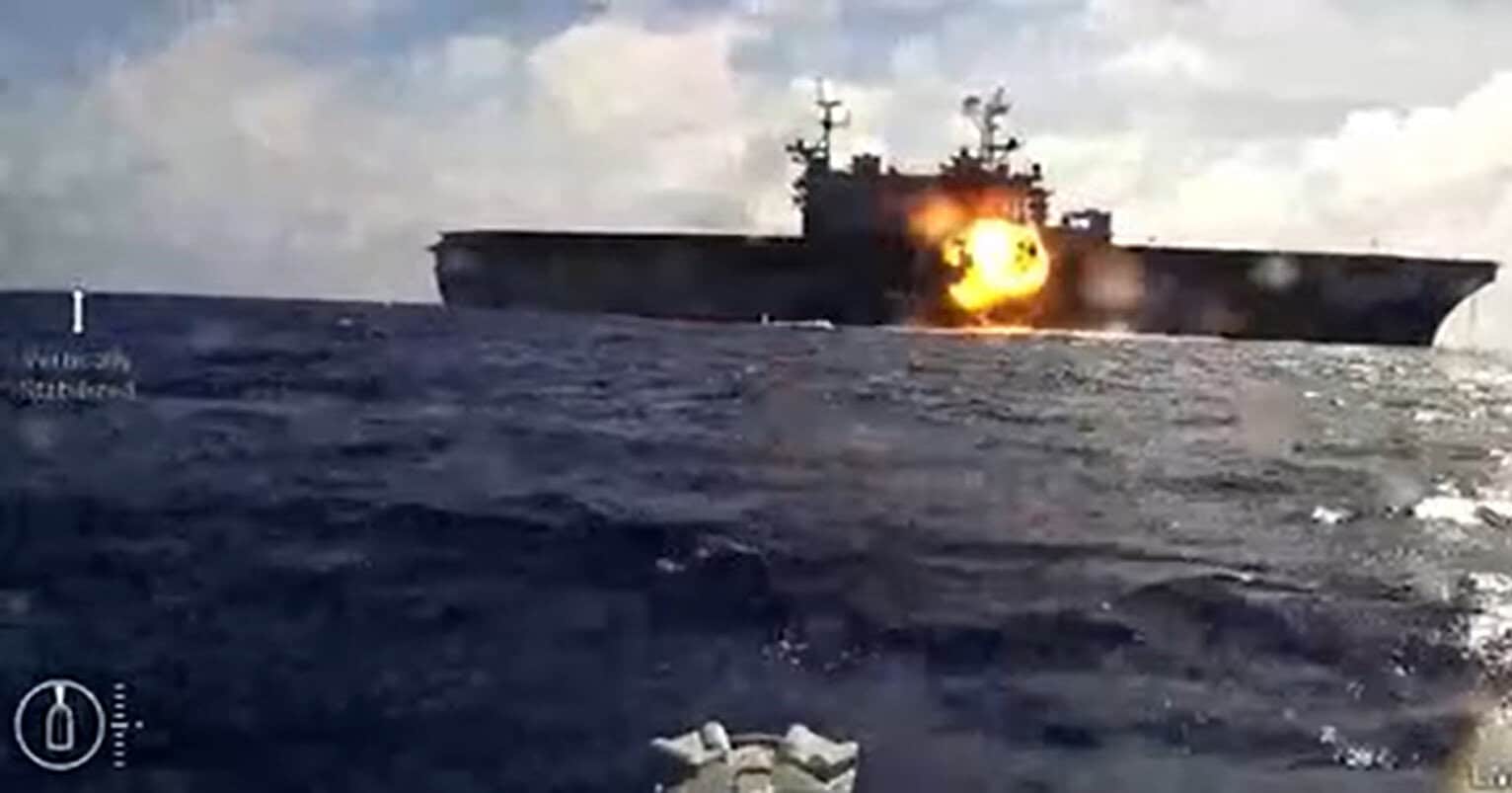
The US Navy has sunk the decommissioned amphibious assault ship USS Peleliu in a live-fire sinking exercise in the Pacific, using unmanned surface vessels and anti-ship missiles fired from a submarine, according to the US Navy.
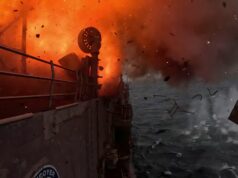
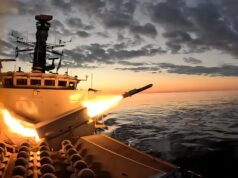
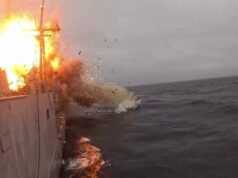
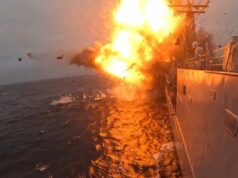
The Tarawa-class ship, hull number LHA 5, was targeted during Exercise Rim of the Pacific 2026 on 17 July. Footage released by US 3rd Fleet showed unmanned surface vessels taking part against the hulk of the vessel, which was also struck by two UGM-84 Harpoon anti-ship missiles fired from the Los Angeles-class fast-attack submarine USS Columbia.
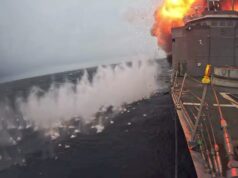
Sinking exercises, known as SINKEXs, allow navies to test weapons against a full-sized target and are a regular feature of RIMPAC, as well as providing a means of disposing of decommissioned hulls. A single target is often engaged by a range of platforms, from ships and aircraft to submarines, using missiles, torpedoes and gunfire.
Under US environmental rules, such exercises must be conducted in water at least 6,000 feet deep and at least 50 nautical miles from land, with vessels cleaned of hazardous materials before being sunk.
Peleliu served for more than 35 years. With a displacement of nearly 40,000 tons, the ship launched a variety of aircraft from its flight deck while conducting combat operations and humanitarian missions across half the globe. LHAs are the largest of all amphibious warfare ships and resemble a small aircraft carrier. The ship was decommissioned in 2015 as the last of the Tarawa class, and took its name from the 1944 Battle of Peleliu.
RIMPAC 2026 involves 30 nations, 30 ships, five submarines, 15 national land forces, more than 190 aircraft and more than 30,000 personnel in and around the Hawaiian Islands from 24 June to 31 July. The US Navy describes it as the world’s largest international maritime exercise, providing a training opportunity while fostering cooperative relationships among participants and supporting the safety of sea lanes. RIMPAC 2026 is the 30th exercise in a series that began in 1971.
The Peleliu sinking was the second of two SINKEXs at this year’s exercise. Five days earlier, on 12 July, the decommissioned Ticonderoga-class guided-missile cruiser USS Mobile Bay (CG 53) was sunk in the same waters. Both ships now rest on the Pacific seafloor, roughly 15,000 feet down and more than 50 nautical miles off the northern coast of Kauai. During the two exercises, units from Australia, Canada, Italy, Japan, New Zealand and Spain took part in targeting and live-firing alongside US Navy, Air Force and Army forces.
Mobile Bay entered service in 1987 and was decommissioned in 2023, having deployed to the Pacific on humanitarian and peacekeeping missions and supported operations in Iraq. Republic of Korea Navy Rear Admiral Inho Kim, RIMPAC 2026 Combined Force Maritime Component Commander, said in a US Navy release: “The successful execution of multiple SINKEXs highlights the unbreakable bond and growing capability of our coalition.” US Navy Vice Admiral Jeff Jablon, the exercise’s Combined Task Force commander, said “SINKEXs are a prime example of the strength and readiness our partnerships create.”





This is all good in theory, but the West effectively lost its conflict with Iran due to a fundamental clash of doctrines. Western military strategy relies on expensive, precise weapons and minimizing casualties. In contrast, Iran’s doctrine embraces asymmetric warfare, cheap mass-produced weaponry, and a willingness to accept high losses while targeting civilian infrastructure and vessels. The reality is the West has not won a war against a non-Western-thinking opponent since WWII. No matter how many shiny new weapons we build, an adversary with different strategic/moral boundaries boundaries will always win. I think West is uncomfortable with the fact that the currency of war is violence and blood.
Note I don’t respond to comments, life’s to short 😀
you keep posting and stating that you don’t respond to comments yet nobody really ever bothers to comment either way.
Maybe It would be better If you didn’t bother then 🤔🤔🤔.
life’s too short after all. 🙂
I’ve had conversations before with Expat, so this no response is a relatively new phenomenon.
I still found what he said of interest.
And yes, no feedback needed if he won’t reply.
Oh…
I wonder what happened to make him feel this way ?
Personally I just see this as Trumps Deflection, not the West’s war.
All of Histories experts agree that a war against Iran cannot easily be had or won.
Even a Halfwit can see that.
‘The West’……thats funny
Life’s too short? But not too short to spew your opinion in the first place?
I think you’re just a coward. Too scared of anyone who might actually make you look like a moron.
You are entirely right, Dern. He certainly loves dropping a philosophical bomb and running when his logic cannot withstand actual tactical debate.
Expat’s argument completely collapses by confusing maritime policing with total war. The West hasn’t ‘lost’ anything to Iran or its proxies; it has simply conducted highly restricted defensive operations to protect commercial shipping lanes. If a genuine peer conflict erupted, the rules of engagement would shift overnight from defensive interception to the total, kinetic destruction of their launch infrastructure and state command nodes. Advanced tech combined with precision targeting remains the most devastating application of violence on earth.
Furthermore, posting a sweeping moan about the West ignoring cheap mass on an article explicitly showing the US Navy integrating mass-produced autonomous kamikaze drones is a spectacular piece of irony. The West isn’t losing a clash of doctrines; it is actively absorbing the lessons of asymmetric warfare and industrialising automated mass faster than its adversaries.
There have been a lot of left-wing sock puppets on the internet spouting pro-IRGC, pro-Putin, pro-CCP nonsense that the US has somehow ‘lost’ the conflict and the glorious world revolution / collapse of capitalism / new world order is imminent. Complete garbage, of course. The defence industry has learned a lot from the Ukraine conflict but these things can’t be implemented instantly.
I disagree expat. Ayatollahs Iran is committing suicide.
– makes its only significant export product and the waterway for it unreliable.
– attacks all neighbors, people that will have to live with forever and making them more assertive and strongly allied to USA
– pitiful number of attacks the only thing that achieve is training the enemy forces on how better to neutralize them.
The conflict with Ayatollahs have been a fantastic training exercise against ballistic missiles and drones with minimal causalities on our side.
You’ve raised an excellent point, AlexS. The reality that this situation serves as a massive training exercise is exactly what the ‘mass always wins’ crowd consistently overlooks.
The Western alliance has gathered invaluable, real-world telemetry on Iranian ballistic and drone capabilities without having to risk a single capital ship. We’ve effectively rewritten our layered air-defence software, algorithmic tracking, and interception doctrines using live target data provided directly by the adversary. They have spent years building up finite missile stockpiles just to help us perfect our counter-measures.
It perfectly mirrors what we are seeing in this RIMPAC exercise with the mass-produced GARC drones—the West isn’t ignoring asymmetric mass; it is learning how to neutralise it while simultaneously industrialising its own automated fleet systems.
Hi mate. And i believe this is why the RN is going down the hybrid fleet route and away in some cases from very large very expensive combat vessels.
Ukraine has been doing this for the last few years with I suspect much cheaper drones. The US and by turn the UK are still way behind the curve.
Ita because stupidly our government is reactionary.
For example, if a load of ruzzian missiles start hitting British cities the UK Treasury will magically find am extra £10billion or so for air defence.
Isn’t that everyone though. Most people don’t do stuff until forced to do it. How many times have you had some DIY that needed doing but as a not imminent problem you decide to spend the money else where until your cornered. It’s human nature. There is no realistic threats against the UK on the horizon and it can be put off to another day is the thinking.
The Doctrine from 2000-2020 !!
Problem is when a threat does appear and the cupboards bare with commodities and inflation going through the Roof…you do look a pillock..!@
‘Plan’ for the worst, ‘hope’ for the best..
Counter point:
Ukraine needs to use drones to strike the Russian fleet.
The US and UK can use existing surface assets and air assets to do the same thing.
They can yes – but would they if they had unmanned assets available
You know an Anti-ship missile or a torpedo is also unmanned?
Absolutely. Both can be launched from either a manned or unmanned craft. No risk to life (on our side) if delivered from an unmanned craft plus less cost if lost.
Not really, the reason Ukraine has been so successful is drones are tiny and ride very low making them insanely hard to track. Yeah we could use subs for the role but we only have 7 and they are limited to how shallow waters they can operate.
No really. A torpedo is smaller and rides lower, a anti-ship missile is faster and even harder to track. Neither require a Submarine to launch.
Storm Shadow, LRASM, NSM, JSSM, JASM, these all have ranges of 300-500km, all of which are harder to track and hit than a surface drone, which is slower, and, generally, larger. They also can be launched in any sea state, unlike surface warfare drones. All of them are weapons that NATO has easy access to and Ukraine does not.
Ukraine uses drones for a lot of things because it’s what they have access to and what they can afford to use, not always because it’s the best tool for the job.
Sadly, I believe we have a number of ex-frigates that could be used for a sinkex!
I think Expat did not want to reply to comments because he did not want to be taken to task over his claims. We can surely debate them? The West as a whole was not in conflict with Iran. By most accounts Netanyahu jabbed Trump and so the only superpower in the world attacked Iran with physical support from its smaller but deadly minion. The USA has a particular way of warfighting which majors on the strengths of its armed forces, which may not necesssarily win results that could be judged a strategic success. That Trump claims total successs is no surprise to me in that he merely tallies and trumpets the losses of his enemy’s assets. Arguably the US does not know any other way to wage war. Other Western countries do. British forces have a range of modus operandis’ that can be adapted to tackle any type of opponent. We don’t rely (can’t rely!) on firing huge quantities of exquisite ordnance from very distant smart and hyper-expensive platforms.
The claim that ‘the West has not won a war against a non-Western-thinking opponent since WWII’ is quite ludicrous if you consider all types of kinetic operations and not just peer-peer or peer to near-peer conflict. I was going to give examples, but the list would have been too long.
Agree. It would appear to me that Expat is simply spouting some anti-western nonsense that won’t stand up to the mildest scrutiny.
“British forces have a range of modus operandis’ (sic) that can be adapted to tackle any type of opponent.” My but you Brits live in fantasy land.
Too much of a coward to reply to Graham directly?
I understood that the US had sunk everything Iran had.
Now they appear to be sinking much of what they had.
I can understand why you would want to do some live firing if you haven’t done it for a while but ….