

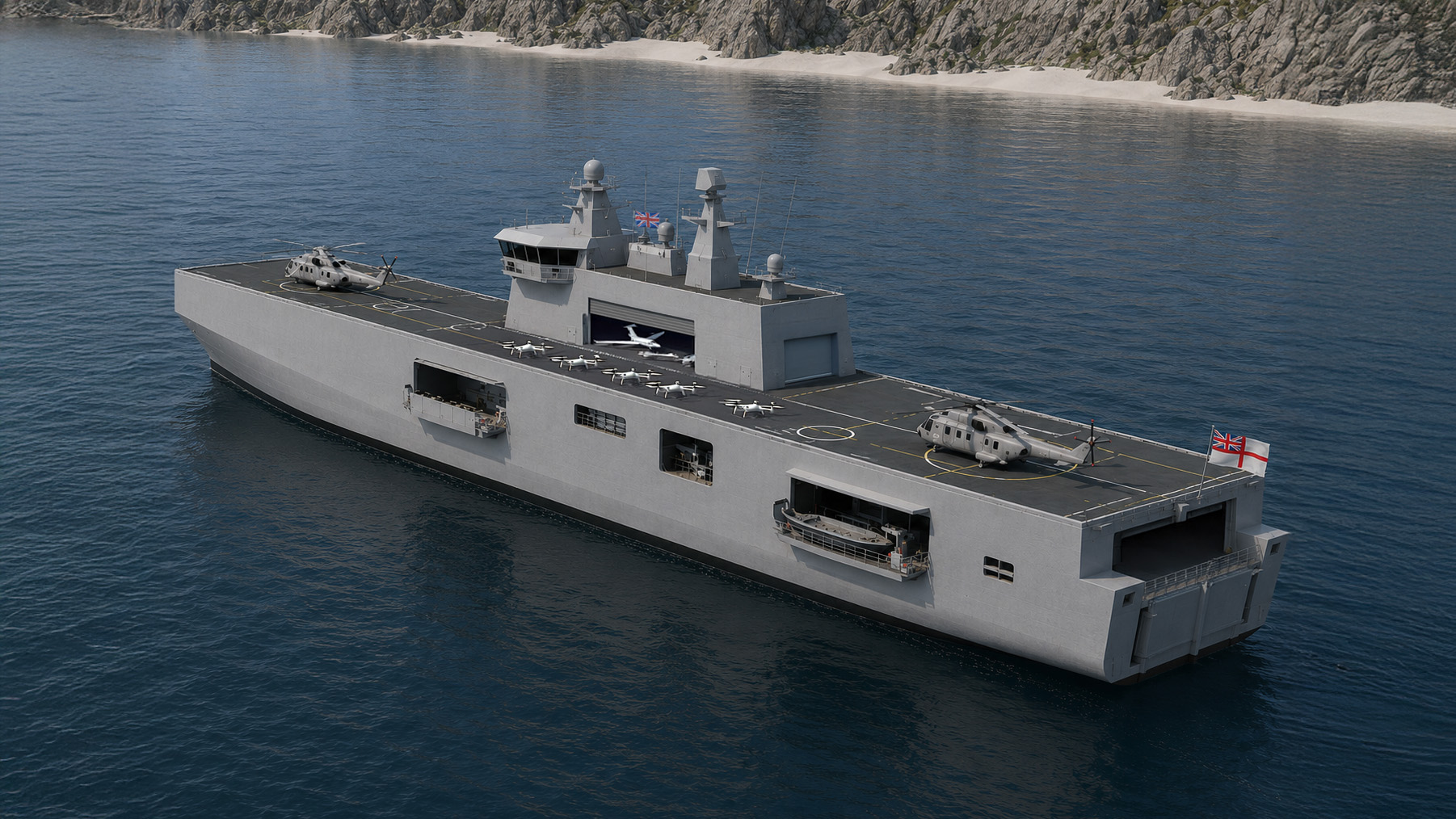
Eight new amphibious transport ships will form the combined UK-Netherlands amphibious fleet, with four vessels operated by each nation and all of them built in British shipyards under a £2.4 billion deal, the Ministry of Defence has confirmed.
The detail, confirming earlier remarks, came in a written answer from Defence Minister Luke Pollard to Conservative MP Stuart Anderson, who asked what the new combined fleet with the Netherlands will include. “British and Dutch forces are set to be equipped with new amphibious transport ships under a new maritime partnership. Based on a Dutch design, the ships will be built in UK shipyards alongside Dutch industry as part of a £2.4 billion deal, which is expected to support hundreds of high-skilled UK jobs,” Pollard said, as quoted in the answer. “The new ships will form the backbone of a strengthened UK-Netherlands amphibious force, with each nation operating four vessels.”
The answer consolidates the shape of the partnership signed by Prime Minister Keir Starmer and Dutch Prime Minister Rob Jetten on the sidelines of the NATO summit in Ankara earlier this month. At around 160 metres long and 15,000 tonnes, the ships will carry troops, vehicles and equipment including drones, with flight decks designed to operate current and future long-range uncrewed systems in support of the Royal Navy’s transition to a hybrid fleet, and they are expected to enter service from the early 2030s. Neither government has formally named the design, though.
For the Royal Navy, the ships answer the question left open by the retirement of the landing platform docks HMS Albion and HMS Bulwark and the evolution of the earlier Multi-Role Strike Ship concept, restoring a dedicated amphibious flotilla around which the Royal Marines’ littoral strike posture can be built. Operating an identical class to the Royal Netherlands Navy is central to the plan, allowing the two fleets, whose amphibious forces have exercised and deployed together for more than five decades through the UK-Netherlands amphibious relationship, to train, deploy and sustain their ships in common, along with the drone and uncrewed technology the two nations intend to develop together.
The industrial arrangement mirrors the model struck with Norway on the Type 26, in which foreign partners buy into British-built hulls, and the Government has presented the run of deals as evidence of a shipbuilding sector winning export-scale work, with the amphibious programme expected to support hundreds of high-skilled jobs alongside the thousands sustained by the Norwegian frigate order. Which yards will build the ships has not been announced, a decision that will be watched closely across a sector with Type 26 and Type 31 production concentrated on the Clyde and at Rosyth and capacity questions live elsewhere.


As long as they don’t sell one like the bay class very quickly after completion then great .
And hopefully they come with a bit of armament. Maybe 57 & 40mm?
Seems likely as the Dutch are planning on using them as patrol boats as well.
4 small drone carriers then. I’m not sure were a compliment of marines and thier kit is supposed to go.
I thought they were 15,000 Tonnes, Mark.
With room for RM, vehicles, heli deck ( don’t know if there’s a hanger.) And yes, Drones.
Almost certainly a hanger for drones, when military platforms are built, they are designed for enough space for future integration. HMS Ocean was 23000 tons and still shall we say a busy ship. Yes she was an LHD.
LHA…?
The requirements does say 15,000 tons displacement.
Actually, looking at the SACEUR tasking for the UK, this is more likely to be an Army force that is transported to the North than a RM raiding force. I don’t know, but increasingly looks like these are designed for rapid reinforcement before hostilities. And then the logistical flow if hostilities are commenced.
This littoral strike posture wording is a red herring. The only way they might do that is to land small forces to DENY key terrain for A2AD – but that would very much be SHAPING ops.
Not as replacements for the Points, surely??
In which case it’s a blisteringly typical piece of MoD spin.
Definitely not a Point replacement, the future strategic sealift future (SSL-F) requirement is a completely separate programme that will supposedly deliver 4-6 ships by 2032. But safe to say that the limited budget (not even mentioned in the PID) and aggressive timeline (order now delayed until 2029/30?) will make it certain that the ships will be foreign built. No final life support bung to H&W this time!
Well that seems to be what UKCF have ended up as, if they can decide between that and being dedicated again to the gigh north as 1SL indicated some time back.
Or grab Murmansk while the Russias are bogged down in the Baltics.
Finland being in NATO opens up many opportunities now.
Murmansk is a terrible target for Amphibious ops. It’s on the wrong side of the Fjord, with very few bridges back to Finland and Norway for resupply; extremely limited cover on approach routes. Any amphib operation would have to happen about 50miles to the North East, with very limited options for resupply unless Murmansk port can be captured on the march intact. It’s also in the backyard of the Russian submarine fleet and has several airbases nearby.
By comparison, cutting the only road to Murmansk is a 80 mile advance from the Finnish border through dense woods with a good road and a secure supply route through Finland back to Rovaniemi and Oulu.
Hi DM -my understanding is they are 15k tonnes – a little on the small side, a pity they didn’t scale up bigger like an HMS Ocean design. I imagine the original option to use one of the QE2 carriers as a “commando carrier: remains open?
Hi Chris.
Assume so! Not the best use of a huge Carrier but with the ER Chinooks might be useful.
HMS ocean sta at 23000 tons and she was a tight fit when fully loaded.
HMS ocean sta at 23000 tons and she was a tight fit when fully loaded….
Assume that was for a Commando Group, so best part of a RM Commando plus supports.
She also had an Air Group to accommodate.
The RM don’t operate at that level now, sadly.
I don’t agree with it.
Yes look decent cheap Drone Carriers in an emergency. Look genuinely useful vessels if the Falklands or one of our protectorates come under threat
And what happens when Space x switches off starshield?
There seems to be very strong hints that the ships will be through-deck, but has it been expressly confirmed does anyone know? I bloody hope so
Through deck for drones maybe or even cabs.
Far too small to take F35B and the costs would be eye watering.
Probably has to be through deck as the flat top is too small to operate and store. The USMC carriers a lot bigger and they are super busy spaces.
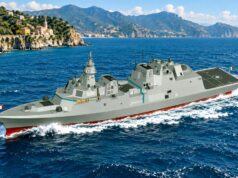
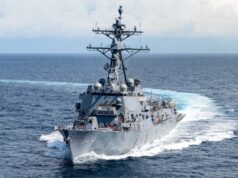
I think the Dutch want the Damen ‘ATS’ concept, which is a thru deck design of 160m like the image above. It is capable of landing a Chinook, maybe two?
3 slightly larger vessels would be my choice…
A fourth would probably find its way Eventually to Australia or Brasil after a few years as a Dockside Paperweight..
If we do Get these vessels how long before been on the market up for sale. HMS Bulwark and Albion should still be in service with the RN .
So the requirement has gone from 6 amphib vessels, three of them larger ones to replace Albion, Bulwark and Argus, three smaller ones to replace the Bays and carry the Commando littoral response groups, to 4 smaller ships. The assumption must be two operational for the LRGs, North and south, one on the wall and one in maintenance/training/trials.
In light of the rundown of 3 Cdo Bde to two smaller raiding bns, this looks logical enough for normal peacetime duties. Should it be necessary to move a larger land force, say to deploy troops to Norway or some other hot spot, we will have one or maybe two of these available, plus the Point replacements. More would be better, but there are a lot of other competing claims on the budget, particularly UAVs, Project Bastion and the frigate programme.
SPEAKING OF ALBION AND BULLWARK. MIGHT IT BE WORTH A EXPLORATORY EFFORT TO USE THEM BOTH IN A PART EX FOR ONE OF THE TWO MISTRALS OPERATED BY EGYPT?
Navy on the cheap…..
Thats a good point. I read that uk had paid into Spacex starlink defence bandwidth for our armed forces . I was hoping uk would invest in sonething similar and sounds like they are investing in other networks though starlink is pretty hard to beat at the moment i would imagine . It would not suprise me if in a Falklands rematch starlink gets turned off as USA is very ckose to Argentina at the moment . The new oilfields in Falklands are seemingly being pumped out by an Israeli Usa company which i think strategically is bad news for Falklands UK as Israel and USA now have a commercial interest and now will be keen to decide who falklands belong to for their own interests .
Manned by whom?