

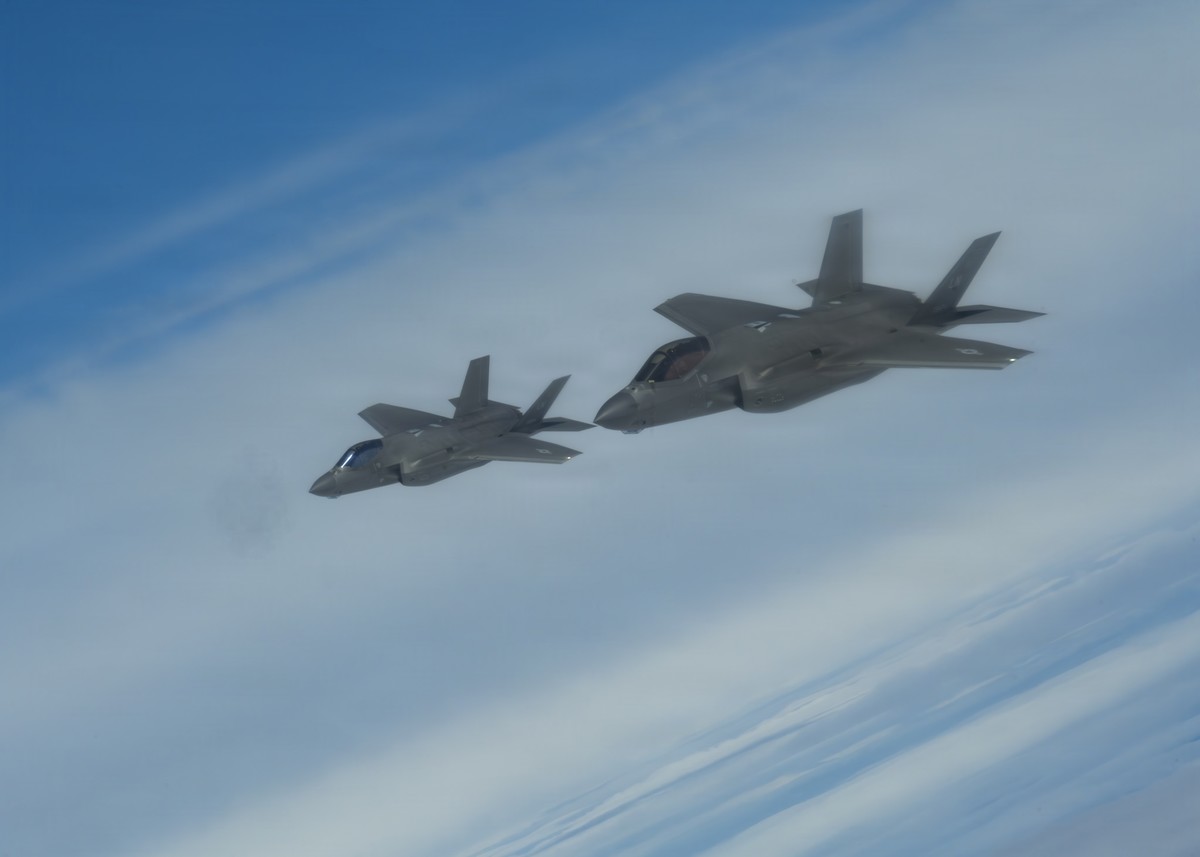
US Air Forces in Europe has described a substantial concentration of Allied air activity over Europe on 18 August as routine training conducted alongside Allies and partners, declining to provide further detail on operational security grounds, the UK Defence Journal understands.
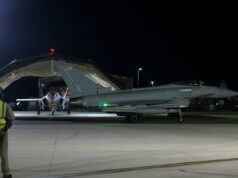
Open-source flight tracking through the morning showed at least five tankers airborne alongside two NATO E-3A Sentry AWACS aircraft and a G550 Conformal Airborne Early Warning aircraft, with activity extending from the North Sea across Germany and into Poland. Six USAF F-35A Lightning II aircraft operating out of RAF Lakenheath were tracked over the same period. A Turkish Air Force E-7 was also tracked in the wider area at 30,000 feet.
Asked whether the activity was pre-planned, a response to ongoing events, or a deterrence effort, a US Air Force spokesperson said:
“U.S. Air Forces in Europe routinely conducts training activities alongside Allies and partners, and yesterday’s air integration exemplifies interoperability, readiness, and deterrence. By practicing coordination and communication in realistic training scenarios, we strengthen our collective defense and ability to maintain security and stability in the region. Due to operational security considerations, no additional details will be provided at this time.”
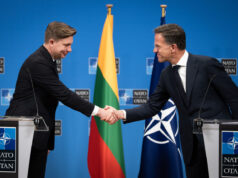
US Colonel Martin O’Donnell, spokesperson for Supreme Headquarters Allied Powers Europe, said:
“NATO is a defensive Alliance and Allies are constantly honing their defensive abilities. The Allied activity today on 18 Aug 26 in the Baltic region involving U.S. and Norwegian fighter aircraft, Polish ground forces, a NATO E-3A Airborne Warning & Control System (AWACS) and more, which is being overseen by the U.S., is one example of this approach.”
Allied Air Command said it would not disclose further detail for operational security reasons and deferred subsequent questions to US Air Forces in Europe on the basis that the activity was US-led. Neither command said whether the activity fell under Eastern Sentry, the enhanced air posture NATO launched over its eastern flank following repeated airspace violations.
The Norwegian fighter contribution and the Polish ground force element referenced in the NATO statement were not visible on open-source flight tracking.
Activity was not confined to the Baltic as a separate concentration of Allied intelligence, surveillance and reconnaissance aircraft was operating around northern Norway and the approaches to the Barents Sea through the same morning. An RAF RC-135W Rivet Joint, was tracked in the region alongside an RAF P-8A and a Norwegian P-8A. A NATO A330 MRTT was operating in the area too.






Brexit has reduced the size of the British economy by an estimated 6% to 8% compared to remaining in the European Union. This consensus, backed by studies from the National Bureau of Economic Research (NBER) and Bank of England data, represents an annual loss of over £200 billion in economic output since 2019. Clearly, had this reduction in UK GDP not happened, we would be spending more on defence
While the UK economy continues to grow slowly and maintain low unemployment, it has severely underperformed compared to G7 economies since the 2016 referendum.
Total corporate investment has collapsed by 12% to 18% against comparable advanced nations. Labour productivity has contracted by 3% to 4%. More than 110,000 UK companies have registered for official insolvency since the post-Brexit transition period ended on December 31, 2020. Corporate bankruptcies reached a 30-year high in 2023 with over 25,000 failures, followed closely by 23,938 liquidations in 2024 and 23,459 in 2025, before stabilizing slightly in mid-2026
The implementation of the UK-EU Trade and Cooperation Agreement ended the frictionless movement of goods. UK exports to the EU fell roughly 14% to 16% below pre-2016 trends, as businesses faced steep non-tariff barriers, customs checks, and strict Rules of Origin paperwork
Post-Brexit regulatory divergence and new independent Free Trade Agreements could still yield long-term competitive advantages, if domestic taxes and regulations are aggressively optimized. The Institute of Economic Affairs (IEA) points out that raw, unadjusted trade figures show UK-EU trade volumes have risen modestly in absolute cash terms since 2019.
Cumulatively, economists generally agree that the total projected output from all the independent post-Brexit global trade deals combined will recover about 0.3% of the 6% to 8% GDP loss incurred from exiting the EU single market
We must be objective when discussing this controversial subject. It is difficult to cleanly isolate Brexit from the massive global distortions caused by the Covid-19 pandemic and the 2022 fossil fuel energy cost crisis. But the reduction in GDP is real and Brexit has definitely cost us more than we have gained.
Rock on Nigel, the architect of this economic disaster
Grandad found the AI again. 😂
Bit negative there David. Certain things have happened over the last decade. Absolutely no point in raking all this stuff up right, wrong or indifferent.
We are where we are. That will never change. Well done for highlighting the negatives and some might note you have ignored the positives.
Currently I would note, as we are on a defence site, that a war is raging in Europe. Our reaction to that as an independent country might well have saved Ukraine (in my humble opinion). During the last 20 years crisis upon crisis has beset the world. Financial, Health and War. Perhaps more problems than the last 50 years of the twentieth century.
Let’s just accept the decision of the people and crack on in a positive way.
Somehow grandad Lloyd gave a major rant on Brexit to an article discussing NATO AirPower in the Baltic. I think he has the wrong forum again or he is missing his meds 😂
Stop it, your as bad as each other 🙄
Enjoy Brexit little one – I am 😉🙂
I love a good remoaner shedding it’s tears 😂
👍
Defo. It wasn’t done for financial reasons, somethings are more important, to some of us at least.
Agreed, sovereignty.
Brexit doesn’t account for uncontrolled illegal immigration or general government incompetence.
It sort of does account for migration to be honest..
And yet we have reclaimed our position as the 5th largest economy in the world.
It is what the UK chooses to make of it.
Thanks ChatGPT.
Worse still the so called regaining of mythical freedom has instead placed us at best between a rock and a hard place, exploited by both, while under Trump and those of his ilk who may follow we are becoming a relative colony of the US. Under Farage you can forget the ‘relative’. So much for ‘no taxation without representation’ but then even Congress is becoming emasculated under the Supreme Leader and the midterms may only prove that fact so US voters are losing that too.
Deranged. It is in UK that people are being intimidated and being put in jail by their opinions. It is UK(and Europe) that social networks are being censored.
Finally how many your recent prime ministers have been actually elected?
Give it a rest the votes done and we’re sick of hearing it. This is a defence site
Well if you Brexit and you don’t take advantages of Brexiting like having a free market economy instead of a political market economy then your country is just a smaller replica of EU bureaucratic monster.
Is it just me or does the US / NATO Command structure seem a little coy about the two ‘exercises’. These were apparently not declared before hand, but that may simply indicate that they were below the threshold at which they would have needed to be declared which is 9,000 people being involved under Organization for Security and Co-operation in Europe (OSCE) procedures. Nevertheless, it all seems a tap unusual.
Cheers CR
This may be a bit hot or cold but they may have been concerned about being effectively caught in a splitter tap on two fronts.
It’s AirPower the UK should be focusing on in any fight against Russia. We will never be able to go toe to toe with Russia on the ground on a continental battlefield but we have all the capabilities to decimate and Russia Airforce and ground force through the employment of air power.
We operate capabilities like F35, Meteor and Storm shadow than are far beyond Russias technical or financial capability to operate. The first priority of SDR25 should have been to double the fast jet force.
Whilst I’m not against fast jets. Unmanned is the future. It’s obvious.
Just as in the 1930s tanks were the future.
I suspect not in the near term for AirPower, I think missiles and one way attack drones will be vital in overcoming A2AD bubbles and conducting SEAD operations however I suspect once you scale up a platform, put a very large an expensive engine in it and give it an expensive sensor suite the cost is going to be very similar to a manned aircraft. They will be too expensive to be attributable and manned aircraft have proven to be far more survivable than drones especially in peace time. The accident rate on something like Global Hawk is insane compared to a modern aircraft like F35. If I don’t give it a large engine and capable sensor suite then it’s not going to be very fast, long ranged or capable of anything other than being a target.
If high end drones like BAE and LM are proposing cost 25% or 50% the cost of a manned fighter while operating significantly smaller payloads then the defence economics rapidly works against them.
If I want something expendable to deal with GBAD then I can use MALD or Spear EW on mass for a fraction of the cost of drones.
“put a very large an expensive engine in it and give it an expensive sensor suite the cost is going to be very similar to a manned aircraft.”
Not even close, aircraft need pilot training, airbases(fixed assets very vulnerable to saturation attacks), airborne missiles need also guidance systems.
Then there is the issue of replacing aircraft, its manufacturing time, sovereign tech – simpler the device easier to achieve –
Aircraft only make sense if cant be achieved necessary range with missiles only or the missile bigger propulsion is so expensive that it trumps all aircraft related expenses, plus the aircraft missile weapons.
Agreed.
I also agree, add into that defence of bases / radar assets and funding the logistics with a lot more tankers, AEW and dispersal options.
The reality is no one knows for certain what a future war might look like and as such a resilient air force is one that’s protected on the ground, wide range of munitions, supported by lots of tankers and I’d go one further and argue for low maintenance easily dispersed / rough strip capability which we lack presently.
As we stand today, the vast majority of RAF capability could be knocked out on day 1 of a surprise attack by sub cruise missiles and ballistic missiles.
I agree Will, drones will do little to replace ground infrastructure and personnel. There are around 35,000 in the RAF and only 400 or so fast jet pilots. You’re not saving much by getting rid of pilots.
For most of the dull dirty dangerous tasks we can assign to drones for multi millions we can assign much the same task to one way effectors and missiles for tens or hundreds of thousands instead.
I think drones will have the biggest effect on land but that effect is largely about creating small aircraft that can affect the battlefield, the air war already has aircraft and the basic physics of an air battle (speed, range, height, energy) tend to favour large expensive platforms. If they are large and expensive then they probably should have a man inside working with the computers.
Any platform that you can’t afford to loose will be infinitely more survivable with a human inside, not least because humans will be less likely to task it on stupid unnecessary missions with a high risk of failure.
I’m generally sceptical about the rush to unmanned platforms. But the loyal wingman idea holds real promise, if it can be made to work. One of the constraints on the RAF is pilot training and retention with as you note only around 400 qualified. Fast jet operations generally involve at least a pair of aircraft. If you couple a manned jet with a loyal wingman, you double combat mass.
BAE claim Brontanax will deliver 70/80% of a manned aircraft’s capability at 20/25% of the cost. Clearly not an attritable platform . It would be useful to know what the UCAV won’t be able to do- the 20/30%- but with first flight planned for 2027, we will find out soon.
Compared with the RN ambition for unmanned platforms, this strikes me as inherently more straightforward and affordable.
I have a hard time wrapping my head around the loyal wingman concept to be honest. If I want a man in the loop to control drones why not use a satellite data link instead? Even the radar should soon be coming from the satellite. We already have un jamable laser communications from satellites to aircraft in trials.
If I have very expensive drones following my even more expensive manned platform, then can I really accept 70% of the performance? We spend billion to gain a few % on aircraft effectiveness because that few % might make a massive difference in combat kill ratios.
In my mind drones should be working on their own but as part of a larger air warfare picture, like they have done since the 1980’s. They should either be cheap and expendable one way effectors (basically missiles and target drones like MALD and SPEAR EW) for EW and spoofing or persistent ISTAR platforms along the lines of Protector but perhaps more survivable.
I just don’t see a role for drones flying a round with manned aircraft to give manned aircraft more missiles in a fight. As America just found out we will run out of missiles long before we run out of manned aircraft.
Sticking radar sensors on unmanned aircraft probably also doesn’t make sense. Modern Radars are ridiculously expensive and if they are to be useful they are extremely power hungry. Large and power hungry means a large and expensive jet engine and once I have that I’m back to something that is so expensive I might as well put a man in it to keep it safe.
It’s difficult to say if BAE Brontanax has a radar but it doesn’t look likely. So it’s probably a bomb or missile truck. I can’t see a use for missile truck armed with SPEAR missiles to suppress air defences or dropping bombs on a strike mission. However those are all basic roles that Reaper has been doing for two decades with Hellfire and Pave-way IV and it does those missions on its own with satellite control. But in an air to air role I see no need for such platforms and if they are operating in a passive environment after the air defence has been neutralised then something like Repaper probably makes more sense with massively longer range, persistence and altitude.
If we only need these things for the start of a war or to conduct a large deep strike mission then cruise missiles are probably much cheaper.
Drones make little sir sense which is western forces have used them actively since 1982 in SEAD operations and for ISTAR. Drones controlled by manned aircraft I am yet to be convinced on.
Its interesting this has apparently been essentially flagged as part of a direct response to what NATO thinks is a a potential risk that Putin would act against a Baltic state in some way..
But the talk now is that he may try something against the UK sidestepping and going for something that will keep below a U.S. threshold for supporting an article five….
Realistically Putin has already been doing sub article 5 threshold attacks against the UK for 15 years. The reality is that Putin’s prewar grey zone attacks on the UK were worse before the Ukraine war where he used both nuclear and chemical weapons. At the time I think the Russians lacked respect for the UK. That was their massive miscalculation because I think it’s very safe to say that without the UK it’s highly likely that the Ukraine invasion would have gone Putin’s way. Its the UK that’s largely responsible for western support in Ukraine and it was the attacks on the UK with Polonium and Novichok that caused the UK to support Ukraine so strongly.
Paying a Ukrainian refugee £3,000 in crypto to set fire to a car outside Kier Starmer’s sister house or mapping some cables in international waters pales in comparison with assassinating someone with a radiological weapon or causing innocent civilian deaths in the UK with the world’s most deadly nerve agent.
The Russians have convinced themselves rightly or wrongly that the UK is their greatest enemy especially now they have in their eyes defeated America with Trump.
The only way the UK will ever be safe is the removal of the Putin regime.
My wife was a touched stressed with me today when she found me measuring the thickness of our walls.. and she asked me what I was doing and just told her I was figuring out the best place to build a fallout shelter…
I watched the film ‘Threads’ last night. You know, that light hearted summery film from 1984. This could be one of the news reports playing on the TV in the background in numerous early scenes. Consequently, I did not sleep well…