

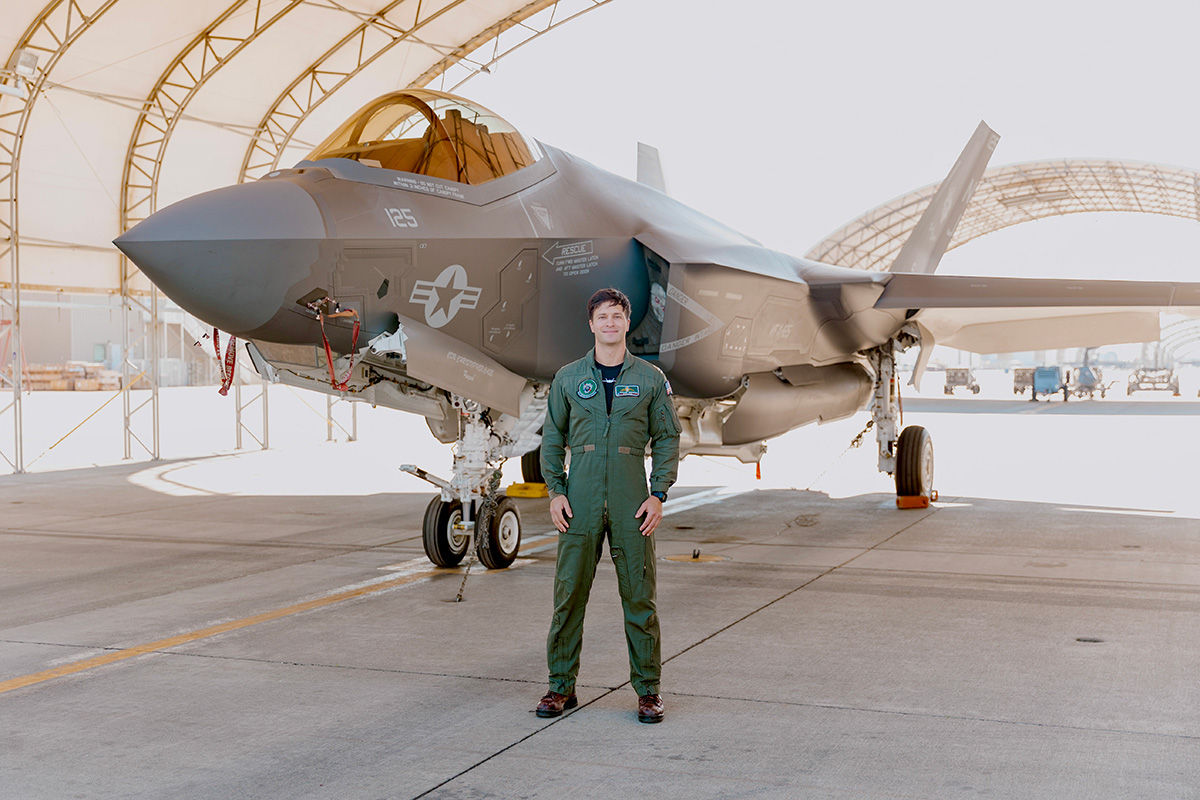
A Royal Navy officer has become the first British pilot to serve as an F-35C instructor and the first to be embedded within a United States Navy squadron flying the type, the Royal Navy has said.
Lieutenant Richard Woods, who grew up in Ashtead in Surrey, volunteered for a non-reciprocal exchange to Naval Air Station Lemoore in California, where he has been stationed since late 2023. At VFA-125 he instructs both ab initio US Navy and Marine Corps pilots and experienced aircrew training to become squadron instructors.
He said: “This level of joint training and integration between the F-35 partner nations at the tactical and operational level is essential. It’s needed to drive the ultimate objective of multi-national compatibility and integration in theatre.”
Britain operates the F-35B, the short take-off and vertical landing variant flown from the Queen Elizabeth-class carriers, rather than the C model. The Royal Navy has no carriers with catapults and arrestor wires, which makes the exchange one of the few routes by which a British pilot acquires conventional carrier expertise.
The C differs from the A and B principally in its much larger wing, which allows slower approach speeds for catapult launches and arrested landings and carries more fuel than either of its cousins. It also has a tail hook, strengthened landing gear and folding wings to fit the deck space available aboard an American carrier.
The route there
Lieutenant Woods completed officer training at Britannia Royal Naval College in 2014 and flew the Tucano on basic fast jet training with 72 Squadron at RAF Linton-on-Ouse before being selected for his first exchange, moving to Meridian in Mississippi in 2018.
Flying the T-45, he carrier qualified aboard USS Dwight D. Eisenhower and earned American gold wings, becoming what the US Navy calls a Tailhooker. Eighteen months later he moved to NAS Oceana in Virginia to convert onto the F/A-18 with VFA-106, the Rhino fleet replacement squadron, joining his front-line squadron VFA-211 on the F/A-18E in September 2020.
After working up with the squadron, including events at NAS Fallon under the eye of Topgun, he deployed aboard USS Harry S. Truman to the Mediterranean, a deployment that coincided with the Russian invasion of Ukraine. He was frequently entrusted with the ship’s defensive counter air alert lead, ready to launch and defend the carrier strike group at short notice, armed with AIM-120 and AIM-9X missiles and the Super Hornet’s 20mm cannon. He also flew enhanced air policing over Romania.
During the same deployment he flew dissimilar air combat training against RAF Typhoons operating from Cyprus, and spent several weeks with Spanish Typhoons on a detachment to Seville, instructing front-line Spanish pilots in one versus one and two versus one fighter manoeuvring. He said: “One of my most memorable exercises during deployment was leading a training sortie with Greek F-16s. We executed Defensive Counter Air from the USS Harry S. Truman, while Greek F-16s acted as the aggressors. All of it was to the incredible backdrop of the snow-covered mountain peaks of Crete.”
He finished his front-line tour with almost 300 carrier deck landings.
At Lemoore
Alongside instructing, Lieutenant Woods is assistant operations officer at VFA-125, responsible for planning and managing training across the squadron, liaising between its maintenance and training departments and managing its range space.
His advice to aspiring pilots was direct, he said: “Work hard and never give up. Stay focused working towards each objective along the way, but don’t lose sight of what you’re trying to achieve. It doesn’t happen overnight, but you’ll get there if you persevere.”
He said he hopes more Royal Navy pilots will follow, adding: “By training together, we ensure that we’re ready to stand together, if the time arises.”
Exchange postings of this kind have long underpinned British carrier aviation. When the Royal Navy retired the Harrier in 2010 and lost fixed-wing carrier flying altogether, a cadre of pilots was kept current by flying with the US Navy and Marine Corps, and that arrangement preserved the skills needed to regenerate the capability when the Queen Elizabeth class entered service.



It’s nice to think by training together we stand together, but I’m afraid that’s an illusion made of paper.. who stands with who is an entirely political decision and political alliances are all made of paper.
Whilst an excellent point it is important to remember that people (not all people) have an impulse to do the right thing.
Politicians are supposed to be there in a democracy to ensure that everyone does the right thing.
The judiciary and the military are there to protect the democracy.
Fly Navy!!!! Well done Lt Woods 👍👍👍
207 Sqd currently has a massive 69% shortfall in qualified F-35B flying instructors (just 5 of the required 16) but apparently we can spare an instructor to teach trainee USN pilots to fly a variant of the F-35 not even operated by the UK. Mmm. It might be a great tour for Lt Woods but the prioritisation has to be questioned as we continue to fail to get 617 and 809 squadrons anywhere near their authorised strength of at least 18 pilots each. We badly need some USMC and RAAF pilots to be seconded to and embedded in Lightening Force.
Basically he is in the US Navy then so why all the fuss. He should be in the UK as I’m sure the Yanks can manage without him. Time to call a halt to the holiday.
Fly Navy.BZ 🕳️🙃🇬🇧👍.