

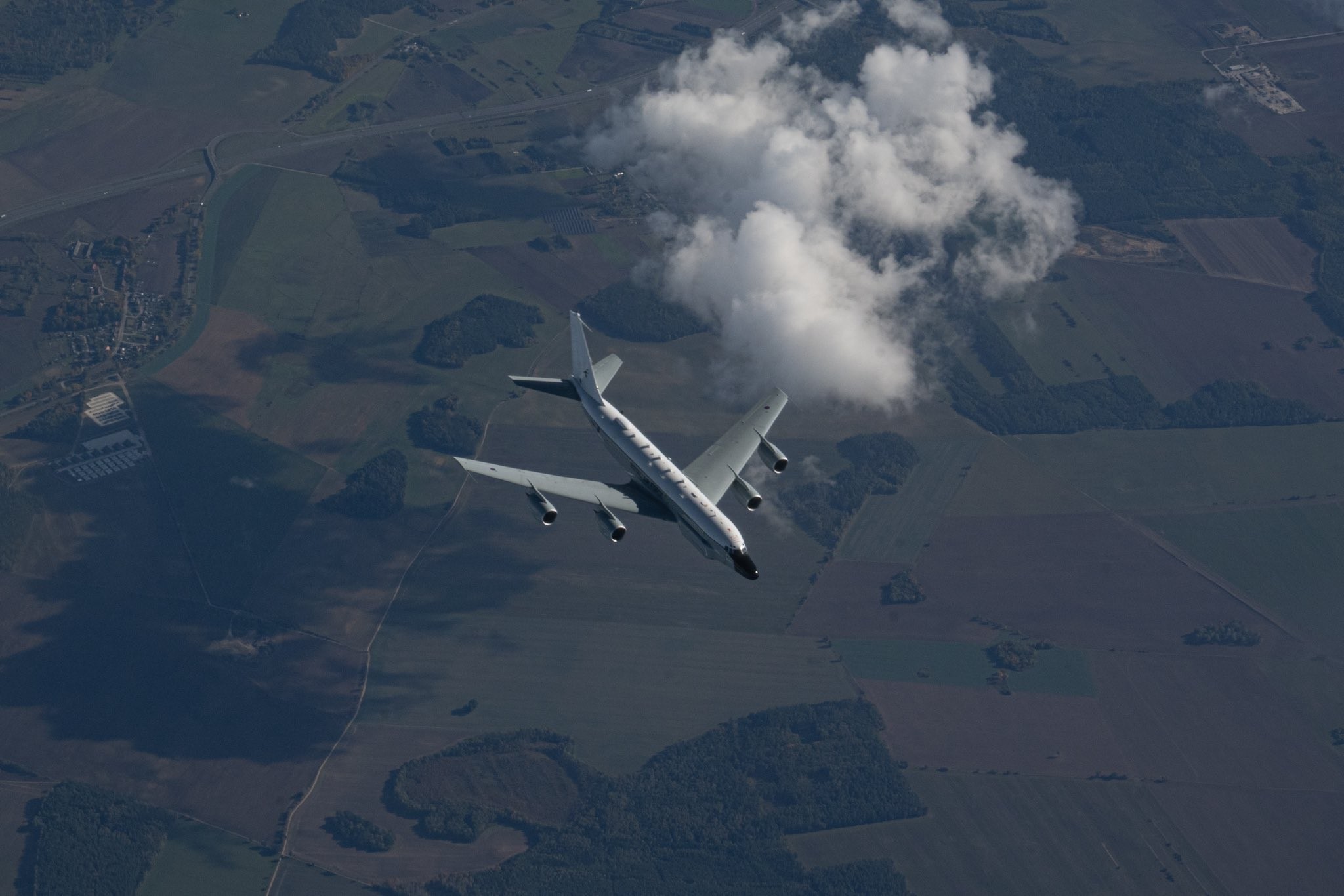
Britain deployed its entire operational RC-135W Rivet Joint intelligence fleet on missions around Russia on 25 September, with both aircraft currently available to the RAF flying separate sorties over the Baltic and Black Sea while the third British Rivet Joint remains in the United States for refit and maintenance work.
Open-source flight tracking identified the aircraft as ZZ664 and ZZ666, both operating from RAF Waddington. ZZ664 flew around the Baltic region and close to the Russian exclave of Kaliningrad, while ZZ666 operated over the Black Sea before both aircraft began their return towards the UK. Neither aircraft was shown entering Russian airspace.
The UK operates three RC-135W Rivet Joint aircraft, meaning the two sorties represented the RAF committing its entire immediately available Rivet Joint force to intelligence-gathering activity around Russia on the same day. The third aircraft is currently in the United States undergoing refit and maintenance work, leaving the two aircraft seen over eastern Europe as the complete operational British fleet at that point.
The visibility of the sorties is also part of the point before someone asks if this should be secret, civilian services such as Flightradar24 build their tracking picture from sources including ADS-B, where an aircraft broadcasts information such as identity, altitude and position, and multilateration, or MLAT, where a position is calculated from the timing of transponder signals received by several ground stations. Both British aircraft were readily visible on civilian tracking networks for substantial parts of their missions, meaning these were not flights whose broad presence was being concealed from public view. Military aircraft can reduce the information available to civilian trackers, although MLAT can still plot an aircraft transmitting suitable transponder signals, so public visibility does not necessarily reveal every element of the mission. Had there been a requirement to minimise that visibility, however, the tracking picture could have been considerably less complete.
The Baltic aircraft followed a route around eastern NATO territory and Kaliningrad, an area containing a concentration of Russian military facilities, while the second aircraft operated over international waters in the Black Sea.
The RC-135W Rivet Joint is the RAF’s principal signals intelligence aircraft and is designed to intercept, locate and analyse electromagnetic emissions generated by military activity. Rather than relying primarily on cameras, the aircraft carries an extensive suite of receivers and processing equipment used to collect communications and electronic signals, including radar emissions, allowing crews to build a picture of activity at considerable distance.
Mission specialists aboard the aircraft can detect and classify signals while the sortie is under way, helping identify radar systems, communications networks and other emitters. This allows Rivet Joint to collect intelligence while remaining in international or allied airspace rather than entering the territory being monitored.
The three British aircraft are operated by No. 51 Squadron from RAF Waddington and are closely related to the RC-135 fleet operated by the US Air Force. British Rivet Joints are regularly used for intelligence missions around NATO’s eastern flank, but the simultaneous appearance of both operationally available aircraft around Russia placed the whole immediately usable UK fleet on missions covering Russia’s western and southern approaches.










The headline makes it sound real impressive. When you read “all” and “entire” you think my word, wow, what’s up? But then you realize it’s 2 and it’s a bit deflating.
We do only have 3, they are a unique capability only available to use and the USAF.
We only had 3 Nimrod R1s at the height of the Cold War as well.
The number is I think appropriate to the task this particular sensor has when plugged into UKUSA 5 Eyes.
The most impressive ( and for me, the most interesting ) is the support system the Rivets data plugs into, so the ground side of things, several units and organisations staffed by the RAF and purple tri service. Some are unique, tri UK, tri US.
That is the bit that counts.
Putting two up was done to send a message.
Clearly something g was going on and a ‘We are watching you carefully” message needed to be sent.
Did not realise refits and maintenance work is done in US. Not ideal imo, leaves us with little potential to speed up refits and servicing as required for operational needs.
Three airframes is enough for a country and military of our size. These will be expensive aircraft to maintain and refit especially if we are using US contractors.
It makes perfect sense as the aircraft are the same capability and equipment standard as USAF RC135s. Only us and the US have this kind of capability and as Danielle explains above, the data is shared across multiple agencies.
When you rely on foreign agencies to support your equipment you loose control over it in terms of servicing upgrades etc. Just look at the F35B aircraft we have purchased, are they at full capability do they have the required software for our missiles? You only have full control when build, design, service and maintenance are in house.
Bump.
We need to develop sovereign capability and show the high port to the US MIC.
Orange Man will get pisssshed quite quickly when his MIC stop paying him and his family.