

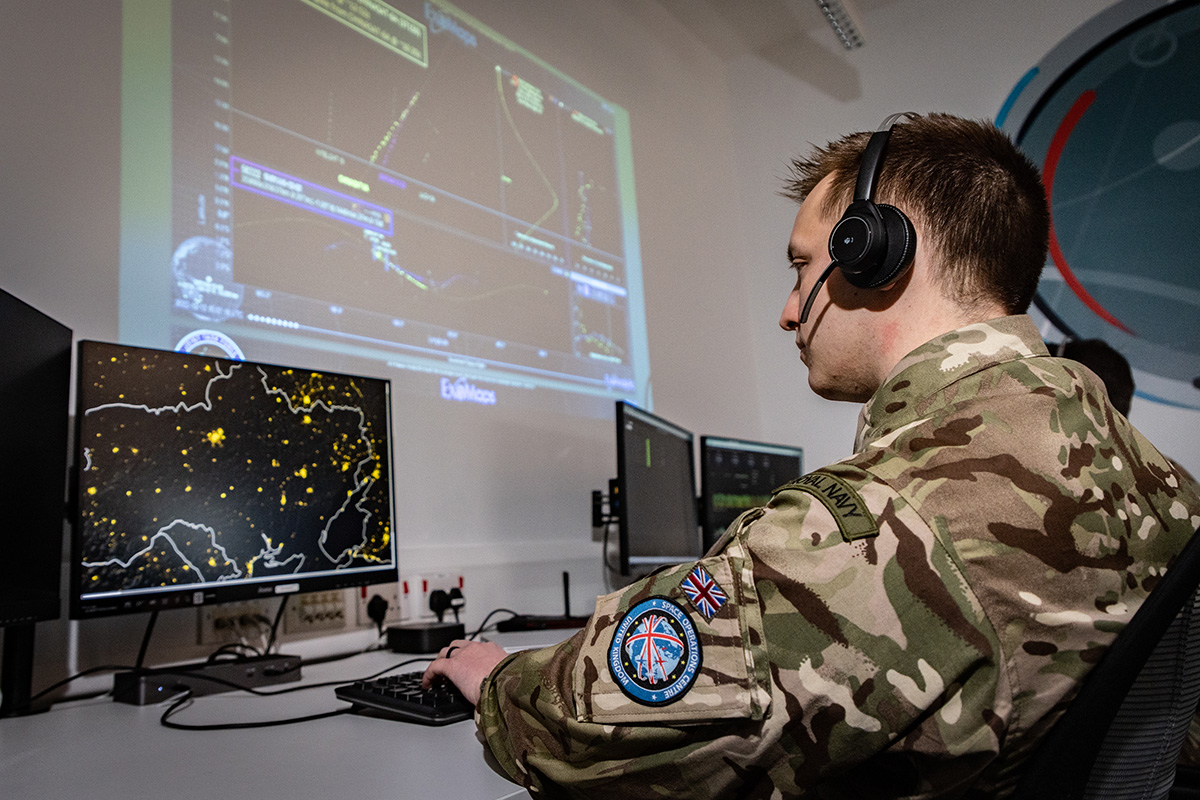
The Royal Air Force is today forming No. III Space Effects Squadron, the first British unit dedicated to disrupting, degrading and denying hostile activity in space, the Ministry of Defence stated.
The squadron is being announced by the Chief of the Air Staff, Air Chief Marshal Sir Harv Smyth, at the first UK Space Power Conference today, and will bring together specialist personnel from across the armed forces to counter hostile activity in orbit and defend the satellites the country depends on.
Sir Harv will say: “Space no longer supports operations from the sidelines. It’s a domain of direct competition, where our military advantage can be won or lost. No. III Space Effects Squadron will safeguard the vital benefits that space gives to our integrated armed forces, and will be capable of denying those benefits to our adversaries.”
The new unit completes a trio of squadrons, since No. I Space Operations Squadron gives the Royal Air Force the ability to watch what is happening in orbit and No. II Space Warning Squadron provides warning of threats, while according to the department No. III will act against those threats using advanced technology including electronic warfare. It will support both offensive and defensive space operations and is expected to expand as new capabilities enter service.
The department describes the formation as contributing to developing British capabilities for space warfare, including electronic warfare and countermeasures against anti-satellite weapons, and delivering the Control of Space Requirement set out in the UK Space Strategy published earlier this month. That requirement covers maintaining freedom to operate in space while denying adversaries the same freedom.
Britain has formally ruled out destructive anti-satellite missile testing, the kind that generates long-lived debris fields, and the department says it continues to work through the United Nations Committee on the Peaceful Uses of Outer Space to promote norms and principles of responsible behaviour in orbit. The government describes itself as committed to the peaceful and sustainable use of space while protecting critical infrastructure.
Alongside the announcement, the department restated an £880 million investment between 2026/27 and 2029/30 in space-based intelligence, surveillance and reconnaissance and in space control activities.
The Strategic Defence Review stated that the ability to operate in, from and through space underpins British security, prosperity and daily life, and the Defence Investment Plan committed to the Deep Space Advanced Radar Capability, a trilateral programme with the United States and Australia whose British site is due to begin construction in April 2027 and which will provide continuous radar coverage of geostationary orbit.




I guess they will be using our new super secret space effectors.
So a “new” squadron tasked with protecting space, denying hostile activity and deterrence and has zero equipment to do any of that.
Absolute hot air.
Maybe they can launch a Trident into space, but only with nukes warheads it would be illegal…
Just asked Google AI
“If configured to fly straight up in an anti-satellite (ASAT) trajectory rather than its standard standard surface-to-surface arc, a Trident II D5 missile could theoretically reach a maximum altitude of 2,000 to 3,000 kilometers (1,200 to 1,850 miles) into space.Under normal operational conditions, a Trident II D5 carrying a standard payload reaches an apogee (peak altitude) of roughly 1,000 to 1,200 kilometers during its parabolic flight path to cover its maximum horizontal range of about 12,000 kilometers. If that massive amount of horizontal energy were converted into purely vertical thrust, it would allow the missile to comfortably reach deep into Medium Earth Orbit (MEO).”
I think it’s far more likely that striking refers to the ‘hack it’ or ‘fry it’ approach. Kinetic attacks in Space have the possibility of producing large amounts of debris which could take out our or our allies assets.
There is also the possibility that a kinetic attack could be launched against a ground link.
Obviously speculation on my part.
Trident is very, very, very… expensive, no one will ever use it for things like that, but you can try to “blind” satellites using lasers, the Chinese have this, if you want to blow things up you need an exo-atmosphere interceptor
Hi mate.
To a large degree, as is the norm. However… it was announced a while back that the UK has access to classified tech in the cyber and EW domains to affect satellites, or something like that, all over my head.
So, just maybe there’s something up our sleeves, however minimal and however much they inflate.
It’s a positive step forming a third Squadron anyway.
Yeah, I just have a feeling that I was better equipped to deter space based hostile contacts in 1978 with my Jedi light sabre , a Raleigh Chopper and a belief that the force was with me than the FFBNW space squadron.
I think I mentioned a while ago, that whenever Dragonfire is tested, a NOTAMS (Notice to Airmen) is issued to avoid the area. But also within the NOTAMS is a warning to satellite operators that a temporary disruption may occur. Bearing in mind Qinetiq/MBDA have said Dragonfire is a classed as a 50kW weapon. It does suggest it can blind satellites that use optical sensors. Additionally, Dragonfire is a scalable fibre based laser, meaning its power can be scaled up, with some suggesting nearer to 100kW. Which would not only blind satellites, but could also damage them, especially for ones in low earth orbit. So although not talked about formally, there is definitely a Dragonfire option.
Thanks, Davey.
Yes, I think it’s obvious that we have access to or own something up our sleeves.
The 3 wise monkeys?
I’m sure someone will tell me to grow up.
Strike but not allowed to use weapons that actually strike? You couldn’t make this shit up!!
Grammatically, of course, that should be ‘No III Space Affects Squadron’, not ‘Effects’.
The squadron will do things that ‘affect’ the badies. The consequent change in those badies (eg getting confused) is the ‘effect’ on them.
Just saying.
No, it will achieve “effects” – all NATO planning is based off desired effects with agreed definitions; DESTROY, DEFEAT, BLOCK, BLIND etc etc.
I think effects is correct. It’s a noun taking the part of an adjective and it means the consequential changes, just as you say. So it’s the Space Changes Squadron, the squadron delivering space changes or space effects. Affect as a noun means something totally different: an external manifestation of an emotional state, itself very different from affect as a verb: the usage you explained.
I understanding your point, but the ‘Affects’ is capitalised; part of a name, not an adjective describing a noun. Like ‘Aggressor Squadron’ isn’t meant to reflect the damage it causes, otherwise it would be ‘Destroyed Squadron’.
Anyone can join the new squadron, just bring your own effector
😂👍
Great to see this being pushed and developed! Alas same same regarding Government policy:
“Britain has formally ruled out destructive anti-satellite missile testing, the kind that generates long-lived debris fields, and the department says it continues to work through the United Nations Committee on the Peaceful Uses of Outer Space to promote norms and principles of responsible behaviour in orbit”
Fuck me, so we have a new space effector Sqn, with firstly no effectors, secondly with rules to say no effector shit in orbit and thirdly……nah the first two pretty well sums it up! Same rules I suppose for the RN “no destructive navy shit in the sea, hence why we have fuck all warships I suppose (delete RN insert Army/RAF etc) 👍
Not really. They’ve been very careful with the language. Ruled out testing an anti-sat missile, not having one, and tied the naughty bit to creating ‘long lasting debris fields’. Using jamming or anything to disrupt a satellite and make it a single piece of debris is apparently fair game.
Obviously the UK will try to get international agreement on the peaceful use of space. How hard they try may be variable.
They don’t need missile to stop satellites doing their jobs.
Ah yes “international agreements on a peaceful space” as usual that will mean we would be the only nation that respected that agreement!
Haha haha haha. Oh, that’s a funny article. The United States’ ‘Space Force’ launches rockets, has its own command, and can do what it wants. Meanwhile, someone in the RAF thought they’d like their own ‘Space Force’, but with some handheld laser pointers and an app that shows you where the known satellites are.
Why did they bother?
Grandstanding.
Oh, and copying US Orgs. Happens all the time, British military orgs get rebranded to mimic US examples.
Space is in vogue so we need a Space Command.