

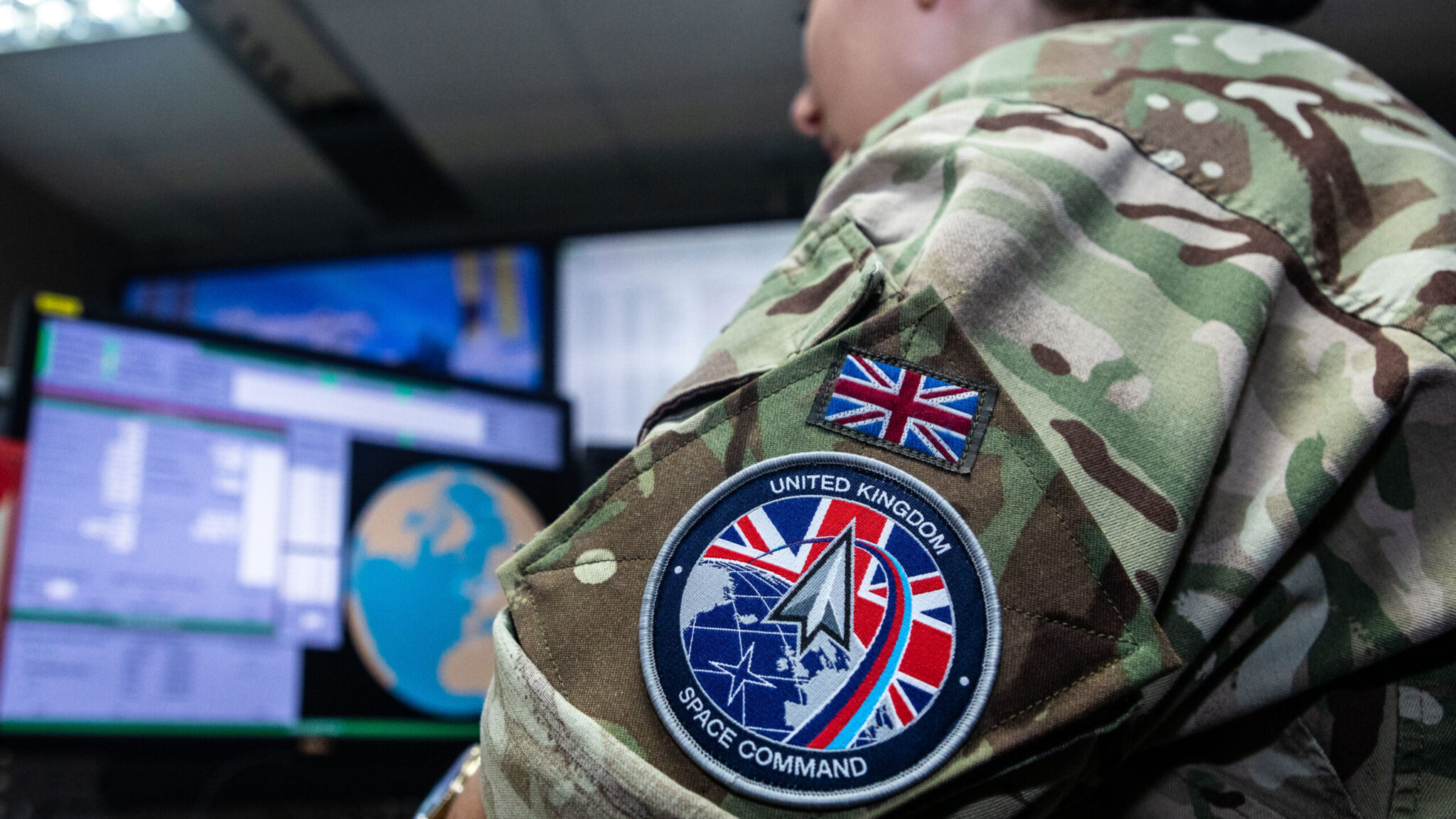
Britain is developing capabilities for what it explicitly describes as “orbital warfare”, including systems able to disrupt, degrade and deny hostile activity in space as the Armed Forces prepare for conflict extending beyond the Earth’s atmosphere.
Air Chief Marshal Sir Harv Smyth, Chief of the Air Staff and professional head of the Royal Air Force, set out the direction of travel at the UK Space Power Conference in London, warning that adversaries are not waiting for Britain to complete its preparations.
The conference is delivered by UK Space Command and led in partnership with the Freeman Air & Space Institute. Its programme brings together senior figures from Defence, government, the UK Space Agency and allied military organisations.
Smyth said: “Space has never been more important for our nation’s defence and security, for our prosperity and our daily lives, and our adversaries are not waiting until we’re ready for them.”
He added: “We must now get on with delivery of space capability and operational effect at pace.”
The most direct indication of how far that effort is moving came when Smyth described the development of capabilities specifically intended for operations against hostile activity in orbit.
He said: “To help our nation fulfil the control of space requirement, UK Defence is now developing capabilities for orbital warfare.”
Smyth defined this as “actions and effects conducted within space to achieve military objectives”, alongside electronic warfare, systems intended to counter anti-satellite weapons and other supporting operations.
He said: “These capabilities will help us to deter threats, defend our critical space infrastructure, and reduce an adversary’s freedom to operate against the UK and against our allies.”
The language marks a shift from treating space primarily as a supporting domain for communications, navigation and surveillance towards preparing to contest it directly if necessary.
Smyth said the objective was to secure freedom of action for Britain and NATO while denying an adversary the same advantage.
He said: “Through a whole-of-government approach, the UK will safeguard allied space interests. We will gain and maintain our freedom to operate in space, and we will deny our adversaries that same freedom.”
That effort is being backed by several large investment lines. Smyth said £2.3 billion is being committed to satellite communications between now and 2030, alongside £880 million for space-based intelligence, surveillance and reconnaissance and space control, and £440 million for novel space technology.
Skynet remains central to the military communications architecture. Smyth described the satellite system as the backbone of Britain’s sovereign global communications capability and said an additional £50 million had been allocated to extend the life of the existing Skynet 5 satellites.
Skynet 6A is due to join them next year, while allied and commercial satellite communications are also expected to provide additional capacity and resilience.
Britain is also expanding its ability to detect and understand activity in orbit. Smyth pointed to RAF Fylingdales, the planned Deep Space Advanced Radar Capability being developed with Australia and the United States, and a growing network of optical and commercial sensors feeding the National Space Operations Centre.
He said the Borealis command, control and data-processing system had reached initial operating capability six months ahead of schedule under a five-year, £65 million programme, giving commanders a better picture of activity in space.
The UK is also examining newer sensor technologies, including neuromorphic systems intended to search large areas of space for unexpected activity around satellites while using considerably less power and communications bandwidth.
Those surveillance systems are intended to support the wider military effort rather than operate in isolation. Smyth described space as the “connective tissue” of the integrated force, linking communications, surveillance and targeting systems across land, sea and air.
Space-based intelligence is also expected to feed the Digital Targeting Web, a £1.8 billion programme intended to connect sensors, commanders and weapons and reduce the time between detecting a target and acting against it.
Alongside the new technology, Defence is expanding the military organisation responsible for operating it. No. 1 Space Operations Squadron already supports activity through the National Space Operations Centre, while No. 2 Space Warning Squadron carries out operations associated with RAF Fylingdales.
A new No. 3 Space Effects Squadron will provide personnel specifically for offensive and defensive space operations, with Smyth saying it will “disrupt, degrade, and deny hostile activity to defend UK space interests and gain operational advantage for the integrated force.”
Plans are also being developed for further numbered squadrons covering areas including tactics and training, the deep-space radar programme and space defence as part of a wider integrated air, space and missile defence structure.
Smyth was careful to frame the build-up as deterrence rather than an intention to initiate conflict.
He said: “No one wants a war in space. We are positioning to deter this. The UK will always operate responsibly in ways that promote stability and avoid escalation.”
But he also made clear that Defence is preparing for the possibility that deterrence fails.
He concluded that Britain must be able to “monitor space, make effective decisions, deter our adversaries, and, if necessary, prevail in this vital yet increasingly contested domain.”








When I was young (long, long ago) I always wanted to be a spaceman. So I don’t expect there’ll be any difficulty about recruitment.
While I respect HMG position on keeping things secret I think it’s a mistake to keep any on orbit effectors we may have secret. No one doubts Britains ability to monitor space. We have radar systems and telescopes coming out of our ears and we are linked with our five eyes partners into the largest surveillance system in the world.
However there is massive doubt by our enemies on Britains ability to do anything in space especially without our former greatest ally. Yiu can have detterenst if your enemy doubts you.
We don’t need a demonstration but we do need an announcement of what capability is available and what we are procuring.
We don’t need Anti sat missiles but we do need ground based EW platforms and we need on orbit inspector satellites able to forcibly move other satellites.
For goodness sake Jim why do you keep coming on here and posting crap like this? What on earth do you know about space warefare? Nothing. Go away, theres a good boy
Grandad back off his meds 😂
Earth to Jim. Still in la-la land hallucinating, I see. To engage in orbital warfare one needs a launch capability which the UK doesn’t have and doesn’t have the funds, infrastructure, or manufacturing base to achieve.
Russian trolls back, as you may not be aware comrade the UK has access to a number of space launch systems including Ariane 6 and Falcon 9 as well as ULA all currently used to launch classified payloads for the UK.
PK your a clown and a troll, and seems to have an issue with anything UK, but as stated previously I suppose finding a 3 PARA Mortars T shirt in Mrs PKs dirty washing does have that anger effect!
Engaging adversarial satellites doesn’t require a single asset in space.
“Radars and telescopes coming out of our ears”?
Seriously?
I doubt there is much for the MOD to announce. Tyche was a civil launch and before that it have to go back to the last Skynet5 in 2012.
The only orbital effectors this Government will buy is a few dozen contact lenses for the blokes sewing on the new giant space badges!
If it’s anything like the prep on land, sea or air here then I won’t hold my breath.
Army exercises – cut. Rotary assets – cut/ decimated. Frigate force – decimated. Typhoon Force – minimal.
The boss of UK Space Command has other things on his mind at the moment.
Methinks that was the problem!!!!
Ha, read about that earlier!
Bit more spin using previously announced budgets for said areas! Don’t hold your breath, this is an area where we could do very well, but having a new “3rd space effects Sqn” won’t keep dozens of Labour backbenchers in their current post without using that cash to buy those required votes!!!!