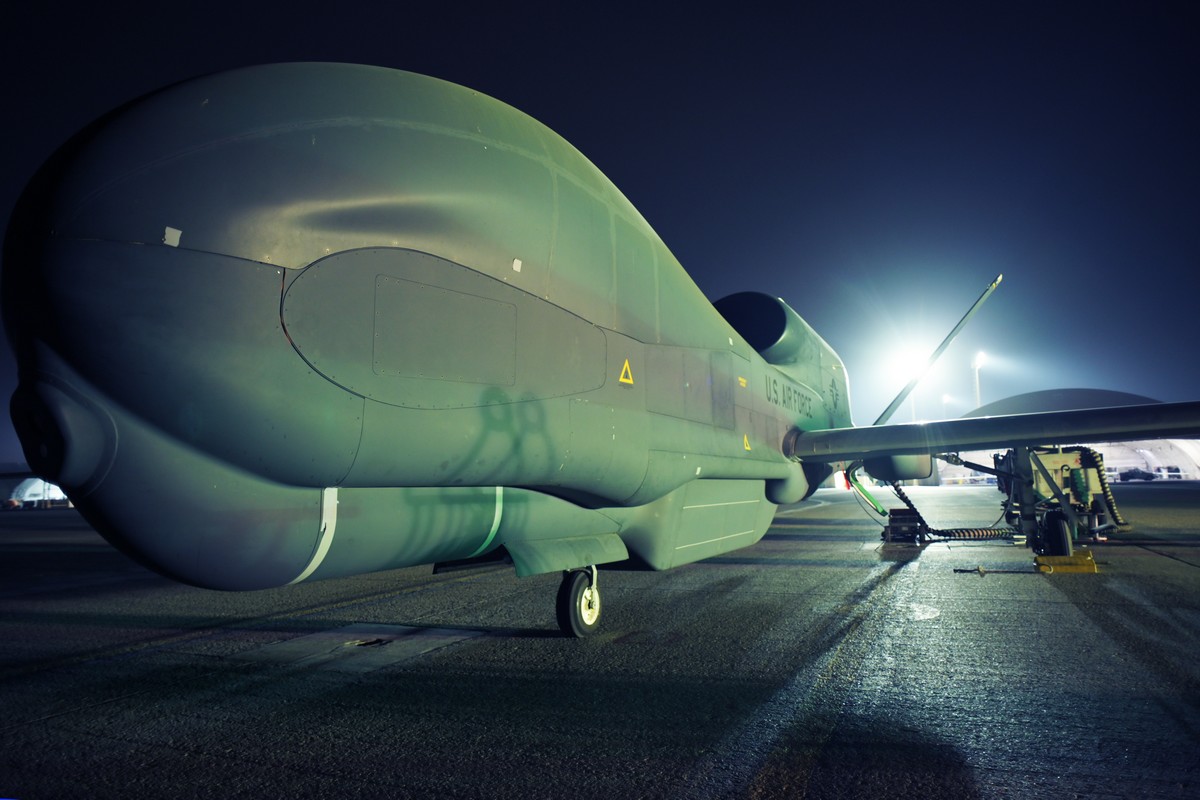
A NATO RQ-4D Phoenix has returned to Sigonella in Sicily after a sortie lasting around 25 hours, most of it flown without appearing on public flight tracking.
The aircraft, using the callsign MAGMA10 and carrying the registration MM-AV-SA-0017, departed Sigonella late on the evening of 24 August and landed on the night of 25 August.
It reappeared on tracking at 58,000 feet over Greece as it headed back towards Sicily.
NATO
Operated by Italy Air Force 🇮🇹
RQ-4D Phoenix #33FD5E/MM-AV-SA0017/MAGMA10
Tracking NE out of Sigonella.@Borrowed7Time @blackswanadria @Intel_Sky pic.twitter.com/Jd3W5tb6SD— 1776Girl (@sipjack1776) August 24, 2026
Sorties of that length are within the design endurance of the type but sit at the upper end of what is routinely observed. The RQ-4D is NATO’s variant of the Global Hawk Block 40, capable of remaining airborne for more than 30 hours at altitudes above 50,000 feet, and the airframe is built around persistence rather than speed.
The Phoenix fleet forms the Alliance Ground Surveillance force, one of the few capabilities NATO owns and operates directly rather than relying on contributions from individual members, alongside the airborne early warning fleet at Geilenkirchen. The aircraft are based at Sigonella and flown by a multinational unit, having reached initial operating capability in 2021.
Their sensor is the Multi-Platform Radar Technology Insertion Program radar, which combines synthetic aperture imaging with a ground moving target indicator mode. In practice that allows the aircraft to build a radar picture of terrain and structures and to detect vehicles and formations moving across it, from a standoff distance and without entering the airspace it is watching.
Since 2022 the fleet has flown extensively along NATO’s eastern flank, with regular missions over the Black Sea, Romania, Poland and the Baltic states, and over the eastern Mediterranean. Flights are frequently visible on public tracking, which is a deliberate feature of the way NATO conducts much of its surveillance, though aircraft do periodically operate without broadcasting.
As we reported on Tuesday, a United States Air Force C-17A Globemaster III, serial 07-7191 and using the callsign REACH 4555, flew from Riga to Moscow Vnukovo, arriving mid-morning. The aircraft had routed from Joint Base Andrews to Latvia two days earlier. CIA Director John Ratcliffe was aboard for meetings in the Russian capital, according to CBS News senior White House reporter Jennifer Jacobs, in what appears to be his first known trip to Russia since taking the post.
Neither Washington nor the Kremlin explained the flight while it was in the air, and military aircraft generally require approval before entering another country’s airspace, which is what made the Riga to Moscow leg notable.
NATO does not comment on individual intelligence, surveillance and reconnaissance sorties, and no link between the two movements has been established. Alliance Ground Surveillance aircraft fly routinely over the Black Sea, the eastern flank and the eastern Mediterranean, and a long mission on any given day is not in itself unusual for the type.
Alliance Ground Surveillance sits under Allied Air Command and delivers its product into NATO’s intelligence structures rather than to any single nation. The programme was funded by fifteen member states, with Britain not among the original contributors, though the United Kingdom operates its own strategic ISR fleet including the RC-135W Rivet Joint from RAF Waddington, which flies missions along the same frontier.
One of those aircraft flew a patrol around Kaliningrad on 7 August, and a substantial allied air package including a NATO E-3A Sentry operated over the Baltic region on 18 August, with further flights on the two days following.