

There is a common turn of phrase, used with a degree of gallows humour, that records where someone happened to be when a famous celebrity or public figure died, usually Elvis: “I remember where I was when X died…”
The more mundane the location, the funnier the punchline. You can easily add the cancellation of a naval procurement program to that concept.
In the case of the Type-83, I was sitting at my dining table eating breakfast before work, doing what I usually do in that moment: looking through my news feeds on my laptop. The article “UK to buy drone command warships instead of new destroyers” caught my eye immediately. My first reaction, over a bowl of cereal, was confusion. I checked the date to see whether it was April, and then started to mull over what I was reading. Now, don’t get me wrong; I was certainly quite excited about the Type-83. As you may have noted in my earlier article on Tempest/GCAP, it even gets a small mention as part of a future vision of integrated combat and data sharing.
So you would think I would be upset about its cancellation. Looking through the enthusiast forums and the comment sections of articles about the decision, you can see the outrage bus being revved up, with commentary about “Putin laughing” or “penny pinching,” and many saying, “This is a cut to our air defence capabilities.” Well, my view is simple: this is an excellent decision, and the government should have taken it years ago, if not for the political awkwardness of cancelling a project as prestigious as an air defence destroyer.
I know you are all itching to blame the current Labour administration, but I need to break it to you in bold type: “Type-83 was an unfunded fantasy program that was never going to be built!” As for the announcement of drone command ships, that is smoke and mirrors, but I will come back to it.
Does anyone remember the Type-43?
Along a wall of my spare room there are three tall Ikea Billy bookcases; they contain what I like to call my “reference collection,” an eclectic set of books and reference manuals I have acquired over several decades. Tucked onto one shelf between a history of the AK47 and an encyclopedia by Ian Hogg is a fairly compact book titled “Rebuilding the Royal Navy: Warship Design since 1945,” written by David K. Brown and George Moore. Moore, who died in 2005, had a long career as a naval researcher, while Brown, who died in 2008, was a naval architect who retired as Deputy Chief Naval Architect of the Royal Corps of Naval Constructors. Arguably the peak of his career was designing the excellent Castle class offshore patrol vessel, a design so robust that one of them, Dumbarton Castle, sold to the Bangladesh Navy and renamed BNS Bijoy, withstood a calculated 0.5 to 1.1 kiloton explosion only a few hundred meters away, shielded only by a grain silo, without sinking in the notorious Beirut port explosion of 2020. It was towed away to Turkey, repaired and put back into service, which is a testament to the design and to David Brown.
The book, with its focus on design and naval architecture, covers the period between 1945 and the main gate decision for the Type-45, taking in nearly every class of vessel the Royal Navy built or considered building during that period. For such a compact volume it is packed with useful information, and it remains my go-to guide for understanding Royal Navy construction decisions to this day. If you ever manage to pick up a copy, page 12 has a useful snakes and ladders diagram that really cuts to the reality of ship procurement for the Royal Navy, and tucked deep into the pages are forgotten paper designs that never were. One of them was the Type-43, an intended large Sea Dart equipped follow-on to the Type-42; there was also a smaller Type-44 design, the low-cost option, so to speak.
Various ideas for these vessels were pushed around, including the use of the Type-22 and other hull forms. None of them came to be. The Type-42 was stretched in service, and eventually things moved on to the Horizon NATO frigate project, which is a story for another day. My point is that none of these concepts got serious traction; they were all minimally funded. I am aware of other paper concepts over the years that are not mentioned in this book. At one point, for example, there was the idea of adapting the Type-82 hull to the AEGIS combat system, an idea so minor that even finding a mention of it is hard. The truth is that, without serious backing and funding, a supposed future warship program can meander for years with barely any funding until it is eventually cancelled.
The pivot that wasn’t to be, and the hubris of Boris
Before I wander any further down this digression, let’s get back to the Type-83. Do you know how much was spent on it? Roughly £1 million, which in terms of UK defence spending is a rounding error. That should tell you something important about this whole situation: in the world of multi-billion-pound warship procurement, £1 million over three years is the financial equivalent of keeping the lights on in an empty room. It is loose change, enough to fund basic CAD renders and PowerPoint slides. It shows an MOD and a navy that are seriously uninterested in a ship.
Put simply, the Type-83 was never a serious project; it was a political placeholder awaiting a convenient time to be cancelled so the Navy could pivot to something it actually wants. Talk of drones and drone command ships is smoke and mirrors, meant to distract the public from the reality that this was a cost and mass driven decision.
The Type-83 was officially announced in the previous Conservative government’s 2021 Defence Command Paper.
- The intention: it was inserted during an era of optimistic post-Brexit “Global Britain” rhetoric, and was meant to signal that the UK would maintain a high-end, blue-water carrier escort capability into the middle of the century.
- The reality: no major industrial contracts were ever issued to BAE Systems or any other contractor, and no serious technical specifications were locked down. As the Ministry of Defence’s equipment plan black hole ballooned to over £16.9 billion, everyone involved, from the MOD to naval planners, knew the Type-83 was financially dead on arrival.
That 2021 Defence Command Paper contained an enthusiastic pivot to the Pacific, and the Type-83 is what you would build if you were planning to engage in a peer conflict with China. A 12,000 ton plus “exquisite” cruiser packing a 128-cell vertical launch system (VLS) and hyper-expensive, long-range radars is a weapon system designed specifically for high-intensity, blue-water carrier battles in the South China Sea against the People’s Liberation Army Navy (PLAN). It was a product of the brief, post-Brexit “Global Britain” era, when the UK fancied itself a Pacific naval power. Since the beginning of Putin’s three day SMO, the UK’s immediate, existential threat has been Russia. Russia does not have a massive, functional blue-water surface fleet capable of fighting a Second World War style carrier battle in the Atlantic. The Russian threat comes from quiet nuclear submarines, hypersonic cruise missiles fired from land or from bombers, and hybrid sabotage of undersea internet cables.
There is still a need for an air defence destroyer, but the Royal Navy’s technology, and tangentially Europe’s, is already a generational overmatch for the surface fleet Russia possesses. What we and Europe do have is a presence gap. If the UK had proceeded with the Type-83, the skyrocketing costs would likely have reduced the procurement to just three or four hulls. Because of maintenance cycles and the rule of threes (one deployed, one training, one in refit), that would mean only one destroyer available at any given time: the “weight, power and manpower spiral” made flesh.
How much?!
As part of the Future Air Dominance System (FADS), early concepts for the Type-83 envisioned a massive hull carrying heavyweight radars, massive power generation for directed-energy weapons such as DragonFire, and massive missile silos. The MOD faced a massive funding gap. Buying “exquisite,” multi-billion-pound platforms meant the UK could likely only afford three or four hulls. Defence Secretary Dan Jarvis explicitly noted that CCVs are a smarter investment than a “small number of large expensive ships.” By buying the CCV, the Royal Navy gets six capable air defence destroyers, allowing mass and presence to be maintained.
The Royal Navy is not the only navy coming to this conclusion in recent weeks. Just like the Type-83, Germany’s F126 has bloated into an absolute monster. At over 10,500 tons, it was the largest German surface combatant planned since the Second World War, but it was plagued by compounding delays, contractor dysfunction and projected cost overruns that threatened to push the program beyond €18 billion. Rather than sink billions more into a massive, delayed project, German Defence Minister Boris Pistorius pulled the plug and pivoted to procuring up to eight smaller, proven MEKO A-200 DEU frigates from ThyssenKrupp Marine Systems (TKMS).
Common Combat Vessel: smoke and mirrors
When it comes to anti-air warfare (AAW), the idea of relying heavily on uncrewed drone vessels to fire or guide missiles runs into massive physical barriers, whereas the logic for anti-submarine warfare (ASW) is completely sound. To intercept a modern supersonic or sea-skimming missile, a ship needs massive radar power (AESA) to burn through electronic jamming, plus immense electrical and hydraulic power to manage, heat, cool and rapidly fire VLS cells. Uncrewed surface vessels (USVs) are typically small, light and optimized for endurance. Sticking a 24-cell Mk 41 VLS onto an uncrewed “missile barge” requires a massive hull, major power generation such as a large diesel generator or a gas turbine, complex automated damage control and a heavy cooling infrastructure. If the drone barge has no crew to manually reset tripped breakers, handle misfires or put out a localised fire, a single malfunction turns a multi-million-pound asset into a floating paperweight. ASW, on the other hand, is slow and methodical and relies on acoustic sensor coverage over vast areas, which makes it perfect for uncrewed systems.
To act as a remote AAW magazine for a carrier strike group, a drone barge cannot just drift in the ocean; it has to maintain a transit speed of 18 to 20 knots and sprint at 28 knots or more to keep pace with an aircraft carrier. To break it down:
- The weight spiral: keeping up with the fleet requires large, powerful marine diesel engines or gas turbines, and high-performance engines consume massive amounts of fuel.
- Losing the “drone” benefit: to carry thousands of tons of fuel, a heavy Mk 41 VLS matrix and the machinery to run them, the drone’s hull must balloon in size. Before long you have not built a cheap, disposable drone; you have built a 5,000 ton ship that lacks a crew.
Add to that the “highly explosive sitting duck” problem. A VLS module is not a passive cargo container. It is a highly volatile magazine packed with rocket propellant and high-explosive warheads, all carrying a multi-million-pound price tag.
- The vulnerability: without its own high-end radar and active electronic warfare jammers, an uncrewed missile barge is blind. It relies entirely on the command ship for situational awareness.
- The cascade failure: if an adversary fires a cheap, sea-skimming anti-ship missile or a loitering munition at the drone barge, the drone cannot perform complex evasive manoeuvres or deploy manual countermeasures. A single hit would detonate the VLS magazine, vaporizing millions of pounds of high-value missiles in a massive secondary explosion. To prevent that, you would have to dedicate a crewed frigate just to guard the drone, which defeats the entire purpose of an unmanned asset. So put me in the sceptical camp when it comes to a family of drone barges acting as active combat platforms for AAW.
If the drone side of AAW is impractical, why is the MOD pushing it? It acts as a convenient political smokescreen to mask a severe capacity gap. By labelling the CCV a “hybrid drone command hub,” the government can visually justify shrinking the size and raw armament of the ship compared with the cancelled Type-83. In reality, the actual air defence capability of the future fleet will likely remain concentrated in traditional, robust crewed hulls. Note that the Type-26 and Type-31 are both getting Mk 41 VLS, with some form of Cooperative Engagement Capability (CEC); that means any frigate in the fleet can act as a missile bin, combined with the missile load-out of the CCV itself. That is not to say that some form of drone command will not be exercised from the CCV. It will, and that is baked into the future of the Navy, but underneath everything else it is an AAW destroyer, if it goes the way I expect.
So what will we get?
Looking forward, we already have an idea of what the CCV will be. It will probably still be fairly big, similar to the current Type-45, which itself will now probably remain in service beyond 2040. There appears to be a lean towards using an established hull as a basis, with the Type-26 and Type-31 both on the cards; both types have the margin to stretch to a similar tonnage to the Type-45. Also, do not be surprised if Navantia, via its H&W operations, puts forward a design as well. For propulsion, an MT30 gas turbine, MTU diesels and IEP appear to be the norm now, and I would not be surprised by some form of battery bank and the ability to use “green fuels” either. System-wise, expect either BAE Systems TC2 or Thales TACTICOS and some form of CEC, Mk 41 VLS and some kind of gun, probably the Mk 45. I could see Phalanx dropped in favour of the Bofors Fast Forty, and DragonFire lasers certainly. As for AAW missiles, that is where things get interesting.
For nearly eight decades the Royal Navy was trapped in a cycle of “missile lock-in.” If a ship was built to fire a specific missile, its radars, fire-control computers and launching tracks were completely hardwired to that single weapon system. If that missile became obsolete or suffered supply chain issues, the ship became a floating liability. Standardizing on strike-length Mk 41 VLS cells, pairing them with an advanced combat management system (CMS) and using modern active homing missiles completely shatters this historic vulnerability. If the Royal Navy wants to integrate a new American, Australian, Ukrainian or European missile into the Mk 41, it no longer has to rip out the ship’s physical wiring. Engineers simply write a software “app” for the CMS, allowing the ship’s brain to speak the missile’s language. This gives the Royal Navy and the UK MOD massive flexibility.
As for radar, that is becoming very clear as well. There is an industrial vacuum in the UK when it comes to developing a brand-new, high-end replacement for the BAE Systems Sampson radar. There is frankly a distinct lack of investment, or even interest, which is not entirely surprising. The truth is that Sampson was expensive and got no export sales, and it took roughly 20 years to go from initial proof of principle to a fully operational mast. Developing a completely sovereign, next-generation fixed-face active electronically scanned array (AESA) to replace it would require billions of pounds in upfront research and development.
There is an alternative solution, and the interest in the Australian CEAFAR is real and deepening. The Ministry of Defence has not just dropped hints; formal cooperation is actively accelerating. At the Australia-UK Defence Industry Dialogue, UK and Australian defence ministers formally confirmed that they are deepening joint work to explore putting Australian AESA technology onto British warships. The CEA Technologies CEAFAR system is already bought, paid for and proven in service with the Royal Australian Navy. Because CEAFAR uses a scalable, modular “microwave tile” architecture, it can be scaled down to fit a medium frigate or scaled up to act as a heavy area-defence hub. It provides exactly the 100% continuous, multi-target tracking required to handle hypersonic or saturated swarm threats, without the UK having to invent the technology itself.
The perfect AUKUS “offset”
A common critique of the AUKUS alliance in Australia is that it looks like a one-way street, with Australia spending hundreds of billions of dollars to buy American and British nuclear submarine technology (AUKUS Pillar I) without getting something in return. Under AUKUS Pillar II, which focuses on advanced, collaborative military technologies, buying CEAFAR allows the UK to show that it is a reciprocal partnership. It acts as a massive industrial offset: Australia buys British submarine designs, and the UK buys world-class Australian radar technology.
Defence procurement often runs into fierce political opposition when major contracts go overseas, such as buying off-the-shelf American or European equipment, which critics claim “exports British jobs.” CEAFAR, however, has a unique political shield: the British public and media view Australia as a close, trusted cousin, so buying from Australia does not carry the same political baggage as relying on other foreign nations. Frankly it is win win, and do not be surprised if the CCV ends up with a CEAFAR array. I will certainly be happy about it.
Such is realpolitik
According to the dictionary, “realpolitik is a political or diplomatic approach based on practical, worldly objectives and material power rather than ideological, moral, or ethical considerations.” Coined in 19th-century Germany, it operates on the philosophy of adapting to “things as they are” in order to relentlessly pursue a state’s national interest.
In my opinion, we need some calm pragmatism over the cancellation of Type-83; it was cool, but it was also never going to happen. The Royal Navy and MOD regarded it as an awkward child lumbered on them by the Johnson government, not the only one as well, such are the former’s prolific abilities in such areas. Type-32 appears to have been a program born out of a slip of the tongue in Parliament, and rather than send a correction via Hansard, the MOD and Royal Navy were forced to spend years making up a capability and associated ship program to save his blushes. Unsurprisingly, because it never had a genuine strategic or financial foundation, the Type-32, like the Type-83, was quietly put on life support. By the time the National Audit Office looked at the equipment plan, the Type 32 was routinely flagged as an uncosted, high-risk fantasy.
I know you want to blame Starmer and the current Labour Government and I am not totally letting them off the hook on this but they made the right decision, what came with the announcement was purely managing of political optics, a version of the so called “throwing a dead cat on the table” method.
The timing and presentation of the June 2026 Type-83 cancellation are a textbook example of a government using a high-tech news distraction to mask a deeply unpopular financial reality. Instead of generating headlines that screamed “UK Cancels Strategic Air Defence Destroyer Due to Financial Black Hole,” the Ministry of Defence has attempted to shift the narrative to “Royal Navy Pivots to Cutting-Edge Drone Warfare Learned from Ukraine.”
The timing is also highly calculated; Labour has been saddled with the unfunded and unwanted Type-83 since they gained power in 2024. Shifting this massive policy change right during a prime ministerial transition allows both the outgoing and incoming administrations to win, in theory:
- The Outgoing “Unpopular” PM: They get to quietly bury the massive funding gap of the Type 83 program, ensuring that the legacy of a multi-billion-pound procurement failure isn’t pinned entirely on their final weeks in office.
- The Incoming “Industrial Midlands” PM: A new leader hailing from the UK’s manufacturing heartland gets the perfect platform to look strong, decisive, and forward-thinking from day one. They can frame the CCV program not as a desperate cost-saving measure inherited from their predecessor, but as a brand-new, intellectually rigorous “change of strategy.” It allows the new administration to immediately champion a fully tendered procurement program that will bring high-skilled manufacturing and engineering contracts directly to British industrial regions.
Because “Drone Command Ship” is a loose, poorly defined marketing term, the MOD doesn’t have to provide concrete technical specifications right away. It buys the government years of time. They can spend the next five years running cheap feasibility studies and testing small, experimental uncrewed vessels while the public thinks a revolutionary automated fleet is actively being built. This allows time for the real Air Defence Destroyer in the form of CCV to be properly conceptually designed and costed before the main gate decision. We have also avoided the massive expenditure that Germany made on the T126 class so there is that to celebrate!
Don’t be too upset about the cancellation of Type-83; no doubt in future books about Royal Navy ship design it will also, alongside Type-32, take up a page alongside Type-43 and CVA-01 of alternate Royal Navy fleets. I for one look forward to reading it!
This article is the opinion of the author and not necessarily that of the UK Defence Journal. If you would like to submit your own article on this topic or any other, please see our submission guidelines.










No! You cannot make us love it. We want Type 83 back and we want it now!
Well if they at least stick to 6 CCVs that’s something, if 8 that’ll be a bigger statement of real intention to increase lethality and resilience. And add a few more T31s and replace the B1 OPVs before you add lusvs. Get the navy out of this “19 ship box” and up to 22-24 destroyer/frigates and 8 Opvs. Which will give more crewed platforms to control potentially more unmamned platforms.
The current Labour Government are an absolute f’ing disgrace.
They have done nothing but undermine – underfund and cut the British military since taking office.
They are blatant liars – traitors and are 100% unfit to govern the U.K – the sooner they are removed from office the better.
The Labour Party their members and supporters disgust me.
Again let’s not make this a football type convo. Prior the Tories were in power for sooo long… if you follow these things like I assume you do you know what ‘options’ their decisions left the next gov with – even if it was another Tories government or god help us Reform
We have a much bigger problem with defense in general and our approach to it. Unfortunately all of this is heavily influenced by what happened post world war and how America wanted us as subservient – that’s not an opinion of mine, that’s recorded British history we don’t talk about so as to be polite to our ‘Ally’ the US
Thst being said our politicians have so much to answer for and it is easy to forget why the pitch/field we play in is where it is
So much of these things that piss us off are caused by strategic and industrial realities over how we use our budget or how big our defense budget should be
If we got the budget we wa ted tomorrow we’d have to answer all these bigger questions to be sure we get the value we think we need base on how we see and define value in a changing geo political landscape and its impacts
It’s annoying
Guessing you didn’t read the article?
I would second that. They are the party of change. Change for the worse. They will leave us with 8 escorts by 2030 or shortly thereafter. They have broken the country after just over 2 years. The next class after the Inspiration is the Illusion Class.
If so they’re just following the shambles the Tories inflicted ion the armed forces.
We expect better, we need better, we want better, being on the verge of major war.
Could AH160 be considered as a candidate for said “CCV”
Not without a ?
This was a nice write-up. Reading this, though, building the QE class might be the second silliest thing the Royal Navy has done in the last 25 years.
👍👍👍
They probably assumed they wouldn’t have funding gutted.
If we kept the funding at the same level as when it was planned we’d be running 9-12 destroyers, a full 13 Type 26 and then probably 10 Type 31, plenty enough escorts for the QECs and some amphibious ships.
There’s a lot of sensible stuff in here.
But trying to portray T83 as a ‘design’ to go alongside CVA-01 and T43 isn’t really accurate. Both of those were fully fledged technical drawings ready for the shipbuilder- CVA-01 was only cancelled a year before construction would have started- whereas T83 barely merited the term concept. All that the designation T83 represents is the suggestion that the Daring class should be replaced with vessels at least individually equivalent and with more multirole capability. It was never ‘cancelled’, just under a decade before the first ship could have started construction.
Instead what has happened is a deliberate move away from the terms ‘cruiser’, ‘destroyer’ or ‘frigate’ as they have been used in the past by the RN. Now we have a nebulous ‘common combat vessel’ which places no public expectation on governments, the Navy or the MoD as to what the vessel will be or do and frees them to cause radical changes to the RN’s strategy and force structure with practically no oversight. I don’t think anyone would seriously suggest that the RN abandon large radar platforms as the main route to an air picture, and as the author says a ship carrying a useful quantity of VLS and other weaponry quickly becomes as large as a frigate anyway. T45’s radar set is already small by the standards of modern AAW frigates, let alone the top rank of destroyers as are being produced for homeland defence in Korea and Japan. But every indication from the MoD, either through parliamentary answers or the models their industry engagement is causing to be made, has been to offload a lighter set than T45 onto unmanned vessels with no capacity for maintenance or damage control and leave CCV as a barely capable patrol frigate carrying computer racks.
It is, of course, entirely possible that what the MoD has in mind is not what they have been indicating. Something like KDDX or GMF-140, a genuine attempt to retain individual capability while exploiting the advantages of unmanned vessels, would be a good route forwards. But it feels like the RN is diving head first into the unmanned stuff without considering the risks or answering the questions.
PS No British radar development?
BAE in Cowes, NGRD etc?
I suspect the CEAFAR announcement probably means this program is dead.
We have heard anything from BAE for a long time about it.
Realistically the day BAE sold its Edinburgh site to Leonardo was the day it gave up on UK radar.
Last BAE news on radar is from the end of last year, which is pretty good as far as British private developments go. They were still using the Artisan NG version to represent T26 at Farnborough.
Besides, the surface air defence radar development has always been done at Cowes, that’s the workforce that developed SAMPSON and is now doing BAE’s wide range of future projects.
CEAFAR will do the volume search – it is far too heavy to mount very high up.
The BAE son of SAMPSON will do skimmers and periscopes and other interesting things.
It has been mounted pretty high on the Hunter I’m depending exactly what panel arrangement you get it has options for some smaller high up panels in addition to the main ones.
Besides, it doesn’t actually give you a massive increase in horizon. Going from 15m to 35m high actually only gives 4km longer horizon.
Two things
– 4km is a huge amount of area and volume sanitised; and
– the height is predicated by the linear distance required to the speed of the incoming to allow for detection; reaction; effector launch; effector interdiction and a secondary fallback.
It is a calculation not a nice to have.
Excellent rounded lens to read. I agree on some of the opportunity with the hard line that our approach should be hybrid drones but with something like the 83 not instead of
Bear in mind, the successor to the type 23 was called FSC first, then GCS and is now the type 26 frigate. I wouldnt mind betting that the CCV will end up as the type 46 destroyer.l still think it has a chance of fielding the new Bae radars, as l think a version will be needed for the type 26 upgrade.Also noticed that the new singapore multi role ships are based on an enlarged version of the same basic hull as the type 31. At 150m x 21m they are pretty much the same size as the type 45. I wonder if this enlarged hull could form the basis of the CCV hull?
There is a genuine opportunity to have a common crewed multirole cruiser based on the T26 (aligned to the RAN/RCN) combined with LSUV T91/T94 Destroyers and T92 frigates and crewed OPVs. This would give a solid foundation to a hybrid fleet, not “on the cheap” wishful thinking.
If sufficient ships in T26/T31/T45-CCV will there be any actual need for the T91 and T94s? Save a few quid and spend a bit more on increading and up-arming the T26s and T31s.
Why didn’t the T26s have a 4x mk41s? Can the CAMM farms be quad packed into a smaller space with ExLS or new farm design blocks? Will RN also go for 2×4 NSM on the roof as with Norway, Canada and Australia? Any thoughts on a double-stacked CAMM cannister, still with the one but stronger booster but to make better use of the 7m+ strike mk41 length cell? Can T31s then have CAMM farm/Exls as well as 4x mk41s and NSM? With all this fire-power you mayn’t need so many or any T91 or T94s if the T26/T31 are sufficiently powerful. The T91 has the potential to be more useful as a lean crewed “Independence” like LCS if hangar for helo/uavs and bays added and gun/vls are rearranged a bit. B2 Opvs can also upgraded. There’s a lot to play with.
The size of the AAW ship (call it a destroyer, frigate, CCV whatever) is determined by physics. The author is bang-on regarding the need for masses of integrated electrical power for propulsion, radars and the processing systems (CMS). But in addition, you have to look at the threats. Consider medium range ballistic missiles, supersonic ‘sea-skimming’ missiles and, of course, drones.
For the ballistic missiles you need a big powerful radar, looking a long way out horizontally and vertically. That’s a big, heavy radar whether you use multiple ’tiles’, or not. For the sea skimmers you need a high data rate and you need to extend the radar horizon as far out as possible. That’s a lot of top weight a long way above the waterline. For the drones, you need a number of weapons that may take a lot of power but provide multiple relatively ‘cheap’ shots in quick succession. To provide a platform for all that, you’re going to need a big, relatively broad hull. It’s going to be at least as big as a T45; probably bigger. It’s going to be networked (CEC) and ultimately, it’s going to look a lot like a Type 83 but by a different name.
Have a look at the DDG(X) to replace the Burkes (which are so short of power the Flight III can’t power HELIOS so, it won’t be fitted) and the Type 055. You just can’t do all of these tasks in a 5,000 tonne canoe.
Agreed, the elephant in the room is what type of effectors the ship/drone carries. For example if a ship is going to be capable of launching a missile that will be used to intercept exoatmospheric threats. Then the current off the shelf solution is fitting the strike length Mk41 and using SM-3 as the interceptor. The strike length Mk41 VLS is some 7.7m deep and comes in a minimum cell capacity of 8. The SM-3 is 6.55m long and for the Block 2 version just over 50cm in diameter. However, the strike length Mk41 is too short in depth for carrying hypersonic weapons or medium range ballistic missiles. Though the USN through Project Blackbeard are investigating how to scale down a hypersonic missile so it can fit a strike length Mk41, rather than the longer/deeper Virginia class payload module.
But it does raise the question of what will the air defence drone ship’s VLS be “armed” with? Or will they be looking at containerised launchers, which can lie flat when in standby, then raise vertically to launch the weapon? The standard strike length VLS will mean the ship requires a fairly deep draught, but also enough structural height above the waterline. A single pack of eight cells, will simply be too small to be effective against a large number of threats, even 16 is considered too small these days. Unless some of those cells contain a duo or quad packed set of missiles. Whilst the containerised option will be limited to the number of cells it contains. I believe the Mk70 uses a 40ft container, that only has 4 cells per container.
In essence you either need a ship with a fairly large structure of internal Mk41 fitment, or a really large flat deck for the 40ft containers. As far as I’m aware Finland’s Pohjanmaa-class corvette, will be the smallest vessel fitted with strike length Mk41. Which is currently only a single 8 cell pack, where they are going to quad packed with ESSM. There is apparently space for a second 8 cell pack behind the first on the foredeck. The ship is some 117m long, with a draught of 5m and weighs 3900 to 4300t. So not very small at all! Granted the corvette does come with a hangar and flight deck. But I’m not sure how much smaller a ship could be, if it was built solely around the VLS farm. Could for instance a hull the size of B2 River accommodate a VLS farm?
But he f126 where not aaw ships they where underarmed large frigates essentially the germans are still ordering 8xf127 which are 10000tn aaw destoyers and realistically 6 destroyers was never enough just like 19 escorts isnt even in peace time, the t45s will still need to be succeeded and an aaw frigate payed for on the cheap with no growth margins, we should of just delayed t45 replacement and focused on other things till the budget went up and industry has more depth both of which will happen by early 2030s
The author failed to mention the Type 94.
The biggest boost in the program will be sensor drones operating radars over a wide area and those radars can be fairly easily combined into giant arrays but I do agree the heart of all this will be a large manned warship.
It’s just doesn’t have to be a 12,000 tonne super BoJo class cruiser with massive radar and 100+ missiles costing £3 billion.
We should aim for a dozen or more T31’s instead.
There is a reason for that, I wrote the bulk of the article a couple of days after the Type-83 cancellation back in June and before there had been any definitive information about Type-94. The article has been in the publishing queue since then.
How do you get a powerful radar capable of properly tracking ballistic and hypersonic missiles with only a small ship?
And no, the Type 94 is even smaller so not any help in that regard.
Given those sensors (i.e., radars, target illuminators, ESM, antennas, etc.) need to be mounted high in order to maximize range. Plus, such equipment needs proper spacing to function properly.
The Type 94 might end up being a fairly big ship, something akin to a T31.
Except, radars need to be mounted high in order to maximize their detection ange, which will dictate the overall size of the ship. Those Type 94s might be much bigger than you think.
The £1m figure is complete baloney.
But apparently true, presumably based on a cost code, rather than time spent preparing presentations for conferences! But basically the MOD invested only slightly more effort in the T83 project than it did in the T32 project (£400,000) – which everyone knew by 2022 was never going to happen. I’ve learnt to only take a project as being serious when Defence Equipment and Support (DE&S) sets up a dedicated project office.
A fine read, that.
Thank you.
Yes an excellent article.
Good article, I was edging to similar conclusions. The CCV (Type 46?) will be to the T83 what the T42 was to the T82 – a smaller and more affordable AAW platform, that whilst less capable has the huge merit that it can be built in greater numbers. The assumption that the T31 design is a shoo-in as the basis for the CCV also needs challenging, for North Atlantic and CTG ops, a modified T26 design has a lot of merit. Keeping the unit price tag down to an “affordable” c.£1 billon will then be tough, but after building 13 T26’s BAE Systems really should be well down the learning curve, e.g., in real times the last few T23’s cost about 40% less to construct than the first few. The other problem will be Babcock’s workload, assuming no T31 export order appears soon it will have to swivel to specialising in designing and building unmanned or very lean manned vessels for Atlantic Bastion, e.g. the proposed Type 92 ASW sloop. It needs to team up with BMT and put together a credible concept and realistic proposal, before the MOD issues an RFT for a bleeding edge system of systems, and after two years of deliberation decides all the bids are unaffordable!
Babcock needs to build something, though. There’s no point spooling up the yard for surface combatants, and capping it at five T31s.
I think it’s a wait and see situation, the £25 million rectification fiasco with the POW shafts has left an element of doubt in MODS mind. So wait and see how T31 does on trials, a year of service and maybe then more orders. Meanwhile just bite the bullet and get it building blocks for more T26’s on the Clyde.
If the UK could afford an additional 1-2 T26s would there becany need for the T92 sloop? All these LUSVs could be come a liability if not rugged and reloading enough and not able to be carried or dock able at sea in a tender/mothership maybe on the scale of a Bay or MRSS? Should they then be re-looking at getting 3-4 MR Srike/Support Ships that might also supplement the RM/ATS fleet?
*Strike
*bloody phone…reloading….reliable
Problem is the Type 82 was a joke for its size, (it should have been fully double ended), the Type 42 wasn’t its lesser, it was the same only smaller. The Type 43, now that had some promise, again at the time (4x Sea Darts in air at once plus Sea Wolfs for close in).
Bristol ultimately became a very expensive one-off testbed of new systems and technologies. In hindsight the vast sums spent on Ikara was probably very poor value, whilst Sea Dart deserved to have been developed far more. The Batch 1 &2 T42s were too small, I spent some time on on a B3 (Gloucester) and gathered from crew members that they were vast improvement, particularly in accommodation and sea keeping.
A well written piece, shame you couldn’t keep it free from the stench of leftist politics.
??? I don’t see anything ‘leftist’ in what the author wrote. If you mean his criticism about Boris’ lunge to the Pacific, well I think most of us would agree that we simply don’t have the resources to grandstand on that scale any more.
A very good, incisive article, thanks to the author. The switch from a mega-expensive T83 to a capable T45 successor sounds right and more realistic. His doubts about the practicality of the T91 are explained well and put a question mark over the practicalities of this one. If it is simply an ‘armaments barge’ carrying replacement missiles and munitions, maybe it could have a role, but it would still be a pretty vulnerable target.
It will be interesting to see the progress of the new Dutch arsenal ships. Lightly manned and carrying containerized AAW missiles, they should be a lower risk and cost alternative to wholly autonomous platforms.
The CCV is a practical admission that the RN doesn’t have the money to be a miniature USN. It must pick an area to make a peer-level investment, stick with it, and admit that other areas will rely on less-capable mass, or foreign imports.
For the UK, the obvious choice for the former is its submarines. If losing an air defence cruiser means gaining a submarine or two, I’d take it any day of the week.
CEAFAR is a very decent radar, and whilst not my first choice as an import, is both politically palatable and scalable. BAE might have to settle for local production and the software side of this one, sadly, but it is what it is.
See SPF reply to your identical comment there, but I’ve also been looking at foreign air defence ships and the Korean KDDX design is a pretty perfect match for what I think CCV should be. 155m, 8000t, decent radar, 48 mk41 sized VLS and what looks like 16 K-VLS-II 10m deep cells for ballistic missiles.
Yeah, I reckon it’d fit nicely. I’d drop those ballistic missile cells for additional Mk41/A-70NG, just for the missile mass, but beyond that, its large enough for a decent radar, has enough mass to be credible alone, but shouldn’t be crazy expensive. I like it.
Could go for a container tub for drone weapons/container IRBMs, that would work too. I do quite like the idea of DPS being an all-platform missile, it’s time we properly invested in something like that.
Probably not quite as far as the Korean Joint Strike Ship concept with 32 SRBMs, 15 IRBMs, 4 MRBMs and an ICBM though. Badass though it is.
The USA doesn’t have the money to be a miniature USN
The Trump class battleships will bankrupt them, at this rate they will end up with less surface combatants than us.
The author contradicts himself. He says that Defence Secretary Dan Jarvis explicitly noted that CCVs are a smarter investment than a “small number of large expensive ships.” But then says that by buying the CCV, “the Royal Navy gets six capable air defence destroyers.” Wasn’t six Type 83 the plan? And isn’t six ships actually a small number?
He also says that “early concepts for the Type-83 envisioned a massive hull carrying heavyweight radars, massive power generation for directed-energy weapons such as DragonFire, and massive missile silos,” while remarking elsewhere that “To intercept a modern supersonic or sea-skimming missile, a ship needs massive radar power (AESA) to burn through electronic jamming, plus immense electrical and hydraulic power to manage, heat, cool and rapidly fire VLS cells.” So what was envisioned for the Type 83, then?
Also “CCV will probably still be fairly big, similar to the current Type-45,” which is what the early concepts for the Type 83 were.
T83 was a cruiser in all but name. The functional versions of BAE’s FAWCS were 150-160m long, displacing some 9000-11,000t, and carting around 96-128 ‘strike-length’ VLS cells. Their mast alone would’ve weighed some 250t according to BAE. Heck, some early concepts even touted space for Conventional Prompt Strike missiles; those are being installed currently on the 15,000t Zumwalt-class ships.
When the author references ‘six capable air defence destroyers’, I believe they’re referring to a ship far closer to the current T45. Those are 7000-8000t, 150m long, and will leave service carrying the equivalent of 54 ‘strike-length’ VLS cells. Their future CCV is a modernisation of this concept, rather than the ‘cruiser concept’ outlined above. We might see an AH140, or hypothetically an AH150, or a Global Combat Ship derivative, with a medium-sized radar, 32-48 cells, 8000t.
I’m a bit confused as to where you get your “54” from? 48x Aster Sylver 50 plus 4×6=24 CAMM =72 for the T45s. I think you or someone might have mentioned that the CAMM configuration may be more than the initial so happy to be corrected here and happy if the quantity is indeed greater? Liked to think that they could have recycled the retired T23s 32 CAMM silo bay including the walls, split down the middle either side of the Aster silo, non deck or minimal deck piercing and maybe they’d still room for a mk41 behind the gun!? But we’ll never know.
Methinks you’re saying it 6 quad packs of CAMM for 24 and not the original 4×6 CAMM farm blocks? Anyway still same end missile count.
Any other navy would have a CAMM like missile quadpacked into a Mk.41 style VLS.
24 CAMM = 6 MK.41.
Trying to act like 24 Mushroom farms is the same as 24 Mk.41 is rather disingenuous.
FAWCS150 had 80 VLS by my count, it wasn’t actually huge. A lot was sacrificed to get the massive radar mast on that small a hull.
Good call, I was misreading the rear bank in the render as 64, not 48.
FAWCS will forever be ‘the one that got away’ IMO.
It’s pretty much just phat KDDX, to be fair.
Would like to see a total modular design where we can literally plug and play the weapons and radars we choose. We hsve some good hulls in t26 and t31 just tweak existing designs and bash them outt 2 a year . Buikd the hulls with engine pack , there bare bones and if uk does not buy them guarantee so e one else will
Good article. A lot of common sense info
I’ve posted a number of times on this site that a T45b class of ships could replace the current 45’s. No need to re-invent the wheel, just apply the ‘lessons learnt’ from the original design, update some tech, add a few drone boats and you’ve got yourself a capable hybrid AAW destroyer.
Good point. Sea Viper Evolution will give the Darings some ballistic missile defense, something that could be applied to a Daring Block 2.
If BAE get the gig it might well be T45/T26 lookalike or if Babcock get it a stretched T31 lookalike!
T45 was designed to take the weight of the tall mast, I would have thought it would be much easier to build on that design than the others. And the T26 was optimised to be as quiet as possible, that’s a lot of extra expense that an AAW platform doesn’t need. But we’ll see, I’m still quite sceptical that the tech is mature enough to gamble our air defence on it.
I have to say that anyone who manages to mention David K Brown to start an article and his Castle Class OPV design is off to a great start. What I find interesting about your comments about the Castle Class robustness as if it was an accident. David K Brown deliberately designed it that way and it was massively over engineered for another purpose than just an OPV. That secondary requirment required Reliability, Seaworthiness, Robust construction and very well thought out hull design (though using a WW2 RN Cruiser knuckled style bow form was aesthetic genius). He even decided that as it was a comparatively small ship to be in the middle of the Atlantic the best place to put the crew accommodation and bridge was amidships as it’s the most stable place on a ship.
Back then the RN was pretty well focussed on ASW in the North Atlantic and as Russian boats were going deeper and becoming quieter we needed more Sonar “Bandwidth” than could be provided by the numbers of Frigates that could be afforded. So one solution was to design a non combat, simple(cheap), lean manned, very seaworthy vessel that could tow a TASS, have flightdeck to refuel a heavy ASW Helicopter and be easy to produce.
The reason previous RN missile armed ships were pretty well single missile vessels was just 100% down to HMT and what they were willing to fund, they needed numbers so they thought the best way to do that was to design the absolute minimum sized ship that could take the weapon and its sensors to sea, hence Leander, County Class, T42, T22 and T23. Non of these designs had sufficient build margin to allow cheap upgrades or modernisations.
The only ships we ever built between the 1940’s and 1990’s that were big enough for growth was one single T83 and the T22 b3’s, after those they got cold feet and we ended up with the T42s and T23’s and the latter only managed to get upgraded due to CAMM and electronics being smaller !
History bit over.
IMHO we do not need a T83 or an enlarged AAW version of the T26 or T31 to get up to the capacity of the T45, we should just do the following.
Unlike the earlier designs the T45 was deliberately designed with KURS for FFBNW weapons (2 x MK41, 2 x 2 ASW TT, Harpoon and a 155mm gun) and sensors (which were never fitted) plus an 11% Board Margin for future growth on top of that (ref Rand report on T45 for MOD).
In other words even with NSM, CAMM and the extra DG fitted they still have space weight and stability for even more development, so why not add the CEA panels and Dragonfire and think about another Batch to follow on. This isn’t pie in the Sky thinking, it’s pefectly practical and this is born out by the very similar HORIZON AAW ships of France and Italy which are being upgraded with extra missiles and 8 Grand Kronos S & X band radar panels and upgrading the exiting S1850m and EMPAR ones.
FYI the RN T45 were deliberately designed to be 90cm beamier than the Horizons just so we could carry out further mods and upgrades during their lifetimes.
It seems a lesson has been learnt from the past and it works, so why not take another one ? The vast bulk of the RN Destroyers in use until 1943 were the A,B,C,D,E,F,G & H classes and as the A class was an excellent design they just made little improvements for each subsequent flotilla and kept on building them.
Yours is a good post read too. Very nice summary.
I still remember reading about the Castle in a Portuguese military magazine. Some fancy versions and one with an untypical Sea Dart launchers(2).
I don’t really get the criticism of having VLS cells & radars on separate ships. As long as the ships are close, it doesn’t matter that the ship being targeted isn’t the one firing the missile. A destroyer in a carrier strike group can provide protection to the ships in the group, doesn’t matter that the other ships can’t shoot missiles too.
Good article, the CCV is a convenient placeholder and avoiding the term cruiser or the T8X cruiser type nonmenclature is certainly a political move, as it has been since the 1950s. The CCV will fulfill a modern 21C cruiser role by being a command ship for the uncrewed vessels in a taskforce/squadron, but no need to spook the Treasury by calling it such!
When CCV gets raised, I don’t hear mentioned is the risks of adapting an existing hull such as T26 or T31 for it, rather than starting afresh. Refashioning an existing design to handle the extra systems such as the data centres to run the uncrewed network, together with extra power, cooling and other energy demands will need a lot of workarounds. Surely a fresh design will be more straightforward and ensure British ship design expertise doesn’t atrophy for a generation like our sub building did in the 1990s?
Be even nicer if they go more than six!
A lot will decide on how big the VLS farm is going to be, or more likely how much are they willing to spend on it. Taking the T45’s upgraded number of 48 Sylver VLS cells and the additional 24 CAMM cell. Dramatically increases the ship’s capabilities. However, the Red Sea operations showed how easy it was to expend a huge number of your expensive surface to air missiles. Where even the 96 cell Arleigh Burkes had to put in to a safe harbour for a replen’. Both Australia and Canada struggled in getting their wish list of VLS cells, with their versions of the T26. Due to the weight of the CEAFAR mast, the Hunter can only have 32 Mk41 strike length cells, where they wanted at least 48. They have increased their air defence missile count by fitting two 21 cell RIM-116s. Whereas, the Canadian Hunter is keeping the 24 MK41 cell as used by the T26 and has the option of fitting an additional 8 cells in front of the current 24 cell far. It got rid of the 24 cell CAMM farm that sat above the mission bay and instead will be fitted with the 21 cell RIM-116. Both the Rivers and Hunters have grown slightly in size over the base T26, with the Hunter having the widest beam, due to balancing out the CEAFAR mast weight.
However, if the priority is air defence, you will need additional strike length VLS cells. Plus you will need to decide if your ship will have a purely endoatmosheric capability, or be capable of engaging exoatmospheric threats. As that will alter the missile loadout, but also ramp up the missile cost. However, If the T31 gun armament proves to be the right direction in countering lower cost threats like drones. Then the ship will need space to mount them, whilst giving them the widest engagement arc. Additionally, if energy based weapons like Dragonfire are to be included, you will need a lot more available power, to recharge the system between each shot. So space will be required for large capacitor banks.
The T26 hull could loose space from the mission bay, and fit an additional 64 cell VLS farm, as was proposed by BAES for the Hunters, to give a 96 cell count. However, the mission bay is a very useful addition, which you really want to keep. Apart from BAES other option of replacing the 5″ with another VLS farm, the only other option is a stretched hull, with a mid-section plug to add the additional space for a VLS farm. Similarly, the T31’s boat bays could give up more space for a larger VLS farm. Babcock however, have suggested a stretched Arrowhead 160 design, which also features a mid-section plug to house a larger VLS farm. But will its 4 diesel engines be enough to power significantly more powerful radar, but also energy based weapons? Therefore, it may be easier to look at a clean sheet design, rather than trying to redesign and modify a current ship.
Cheers for the detailed and considered reply, DaveyB – while normally I’m sceptical when govts say they can delay replacing kit because thrre’s plenty of life left in the current gear (eg Type 23), with T45s they do seem to have a lot left to give, with the PIP upgrade only just being finished across the fleet and the Seaceptor upgrade just beginning.
With so much political, technological and doctrinal change going on, I can see the advantage of kerping the T45s going a little longer and seeing how everything develops.
Experimenting with drone boats alongside T45 and T23/26 and working out the strengths and weaknesses of the new system could feed into what the T45 replacement will look like, whatever the project is called…
My concern is that he implied the CCV will be lightly armed and the MOD will brush off criticism,
by stating that the CCV is purposed as a drone control hub.
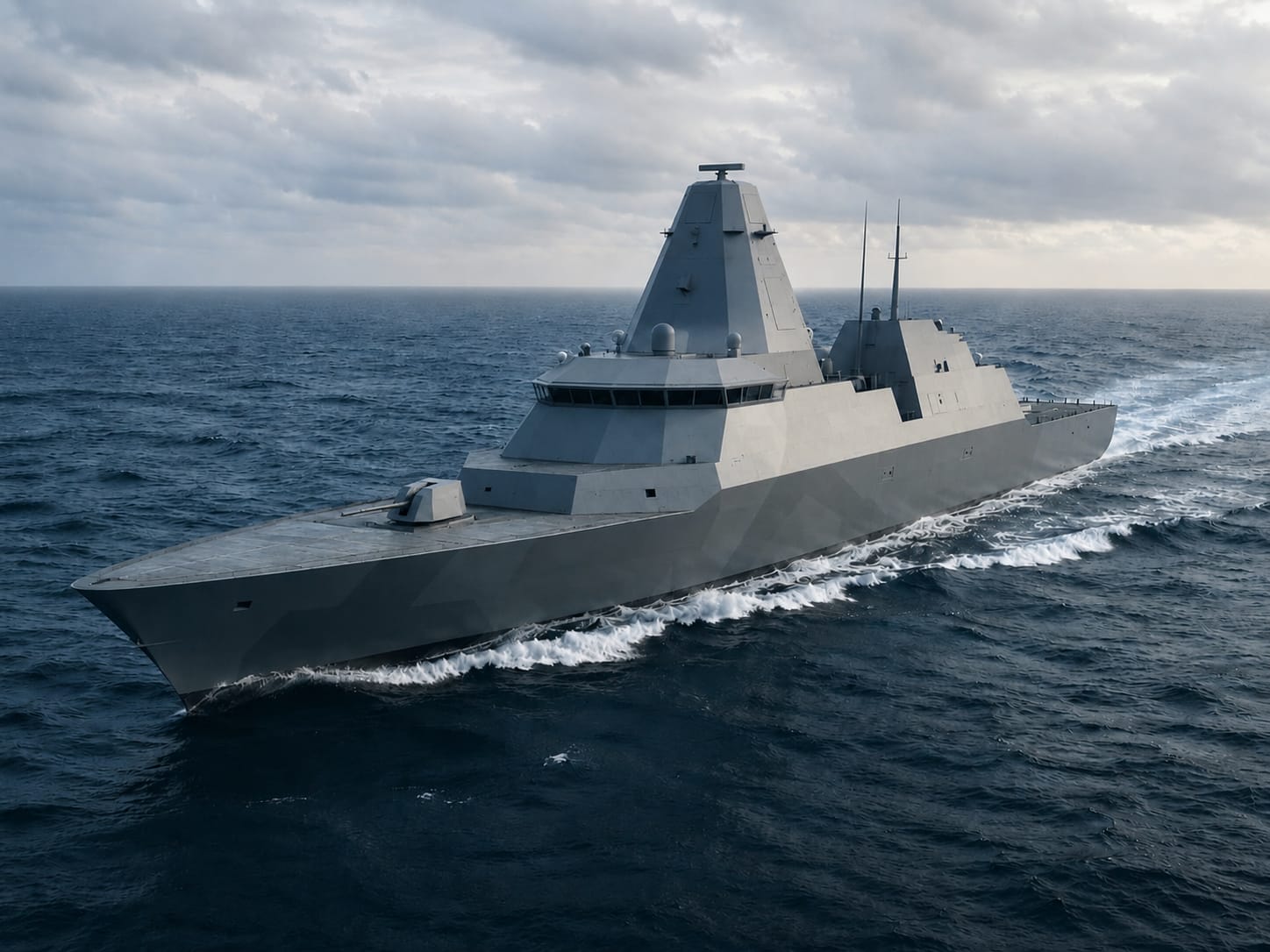
The image at the top doesn’t help as it looks pretty naked.
‘The Russian threat comes from quiet nuclear submarines, hypersonic cruise missiles fired from land or from bombers, and hybrid sabotage of undersea internet cables.’
Russia is a land power engaged in a long term program of imperialist demographic expansionism. It has evidenced intentions to subsume Ukraine (in progress), Moldova (in progress, delayed), the Baltic States and parts of Eastern Poland. It will not stop, because it views success in this endeavour as essential to the survival of Russia and the Russian people.
Missiles, sabotage of cables, may form part of a pre-emptive strike but the real threat is on land and it is on that threat that deterrence must be concentrated.
That, for Britain, requires SDR 2025 to be implemented in full. The omens regarding HMGs stated spending intentions, expensive nationalisations, net zero spending, do not look at all good for the levels of defence spending now required to deter.
How about 6/8 FDI frigates from France?. Job done. 🤔😊
No room for growth and whilst that bow is great in the Med and Baltic, imagine the amount of green water over the top of it in the middle of the North Atlantic.
I was being cheeky really but your right. Mind you, my dad was on a/s escorts in the Atlantic and Arctic during the war and he was not impressed with Corvetes or Sloops, which wre ver small compared to today
I don’t rue the passing of the Y83, thought it was massive overkill.
Also agree unmanned ASW would be easier to implement than AAW, so the next step after unmanned mine warfare ops would be T92 and T93.
Extending the T45s and having CCVs enter service alongside them boosts AAW and our knowledge of ops and tech will hopefully have matured for the next step – T91 and T94 as the T45s exit
A good artical and agree with a lot of the conclusions but the RN will not be ready for a crewless fleet for at least 50 years if ever, so in the mean time keep building T26’s and T31’s once we have got to a fleet of about 12 of each then sell off the older hulls to maintain a new and up to date fleet the addition a crewless hull is a bonus and should be used as loyal wingman to crewed vessels for at least the next 20 years which will allow us the build up the confidence and know-how in un-crewed vessels.
I thought Babcock is going to build the T31 CCV for Denmark ……and the RN?
If the CCV is a large destroyer sized vessel with a strong magazine depth and high powered radar it is the Type 83.
If it doesn’t have those things then the RN won’t want any decent air defence for a CSG making the carriers useless.
As for the Type 9X, can’t we low crew them instead of completely unscrewed. They’re still going to have to be big and have tens of millions in systems. Will still need maintenance and so on.
And in addition, why do they have to be paired to a CCV. Surely being able to tag them onto any deployment in need is a better option, it’s what Australia is going for with their Type 91 equivalent. Because otherwise we’ll end up having to stick an air defence destroyer (CCV) in the high north just so some Type 92 can do ASW. And with 6, that means only 2 available, and a CSG needs more than 1 air defence platform.
Something tangentially related to this and proof that a larger number of smaller ships with small or no crews is the way forward; Ukraine has started operating drone boats armed with interceptor drones in VLS cells. Reusing old A2A missiles on drone boats was already impressive, but this is on another level.
I bon’t understand the author’s basic premise. They start out by trashing the concept of a big heavy Air Warfare Destroyer, and then make the case for……a Big Heavy Air Warfare Destroyer.
What you are proposing is a ship with the same big expensive radar (CEFAR aint cheap), the same CMS, the same MT30 / IEP based proposulsion and the same number of mk41 silos. Only difference is that some of the 128 silos are sitting on a separate remote controlled barge. But it’s still 128 silos.
And the references to politics and Brexit are a bit silly
Germany and Italy are both developing 10000 tonne Big Heavy Destroyers as are Japan, Korea, India (and arguably Australia.).
Also – using the T45 as a base is not possible – different propulsion system, no tooling, no cad. The T45 was a hybrid of the pre-cad and post cad era. It was largely designed by contractors in slovakia.
This is what a broke economy with a broken society looks like. How far you fell uk.