


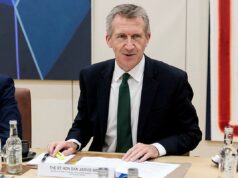
Britain is spending more servicing its national debt than it spends on the Home Office, defence and justice put together, John Healey told the Labour Party conference.
The Chancellor of the Exchequer used the comparison to attack the previous government’s record, telling delegates that Conservative decisions had left “a legacy of sky-high debt costs, for families and for government.” Turning to the opposition front bench, he said: “Your reckless actions are still causing pain for people today. You left crumbling public services. And you left Britain spending more on debt than the Home Office, Defence and Justice put together. And people won’t forget, people won’t forgive.”
He set out what that means for departmental budgets in terms defence readers will recognise. “The cost of the nation’s debt is not just a number in a Chancellor’s Budget,” he said. “It’s the money that we can’t spend on the NHS, on schools, on housing, on social care. On policing our streets, on controlling our borders, on defending our country. And I tell you these levels of debt are an assault on our common sense, they are an affront to our values.”
Healey attributed the position to three episodes, naming austerity under David Cameron, the effect of Brexit on exports under Boris Johnson, and the mini Budget of Liz Truss, which he said crashed the economy and collapsed confidence in Britain’s fiscal strength. He noted that the shadow chancellor appointed by Kemi Badenoch had helped write that mini Budget and still maintains there were good things in it.
The comparison carries weight because debt interest has grown into one of the largest single items in public spending, competing directly with the departments the Chancellor listed. Defence spending is committed to rise to 3.5 per cent of GDP on core defence by 2035 under the promise made to NATO allies, which Wes Streeting restated from the same platform as a cast iron guarantee, and the Defence Investment Plan has committed an additional £15 billion between 2026-27 and 2029-30, taking planned investment to around £298 billion across the four years.
Against that, the Chancellor made fiscal discipline the condition for everything else. “On day one as Chancellor, I said my first duty is fiscal discipline,” he said. “And I’ll tell you why. It underwrites every promise this Government makes. On growth, on jobs, on national security, and on public services. We can’t succeed without it.” He committed to balancing the books with a buffer against uncertainty, controlling borrowing to bring down inflation and reducing long-term pressures on the public finances.
His Budget is a month away, and he told delegates that fiscal discipline would run through the core of it. The tension that argument sets up for defence is a familiar one, since the department’s own investment plan runs over the same period in which the Chancellor has undertaken to bring borrowing under control, and Streeting acknowledged from the same stage that more spending on defence comes with choices and trade-offs.
Healey quoted his own predecessor as Defence Secretary on where those trade-offs lead, reaching back to Denis Healey’s warning from 1969 that cutting defence expenditure to the extent that security is imperilled leaves a country with no houses, no hospitals and no schools, only a heap of cinders.









They always miss out the massive amount of money spent/borrowed tackling the covid-19 global pandemic.
Massive amount of money pissed up the wall takling COVID 19
Hi folks hope all is well
Doesn’t Healey realise he and his political colleagues are very much responsible for the current condition of economy, and conveniently left out the cost of welfare which is one of the largest expenditure of the UK. Which tops most government departments put together.
As a side issue have many of you being watching the War Game on Sky? Quiet interesting when there’s reference to the lack of various defence components to defend the UK. There’s a clip of Nicola Sturgeon saying more should be spent on defence. The irony coming from her. Still hope the programme helps persuade the general public of the need to increase defence expenditure ASAP.
Cheers,
George