

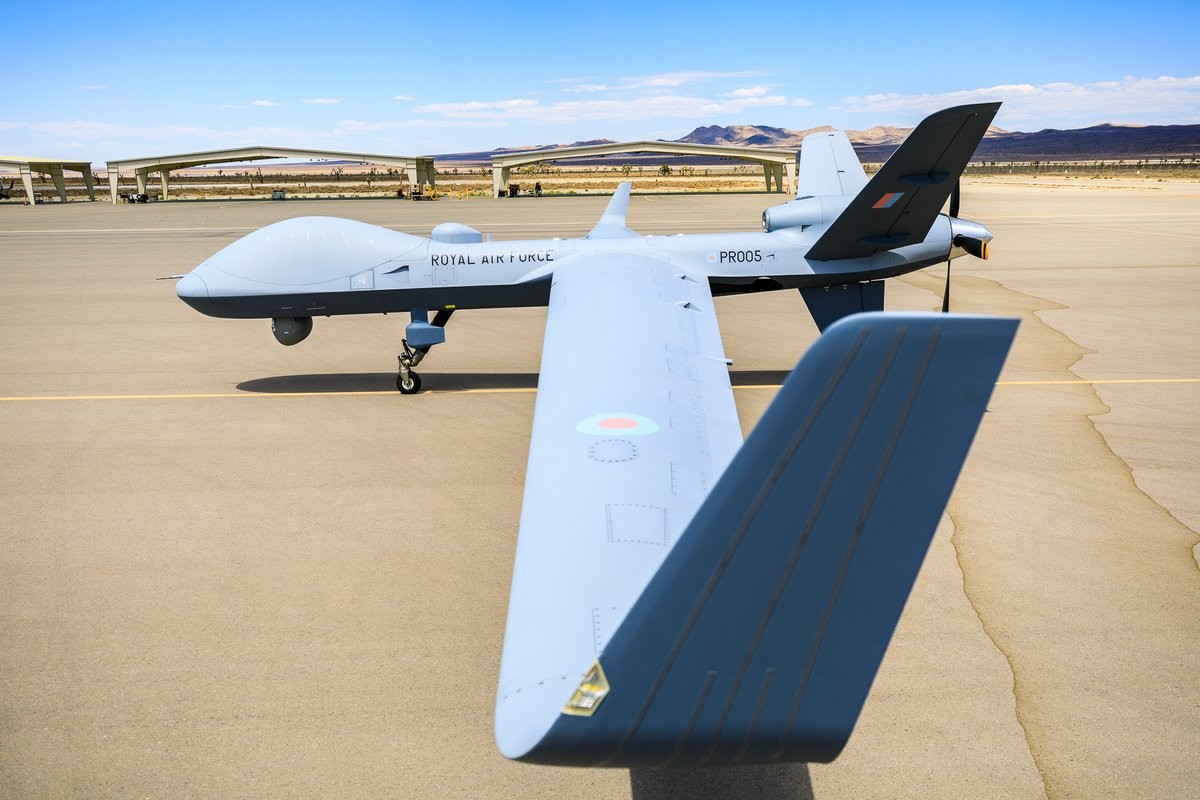
An RAF Protector RG-1 that flew over the English Channel on 14 October was operating in support of defence aims and not in support of the Home Office, according to an answer given in Parliament.
Ben Obese-Jecty, the Conservative member for Huntingdon, had asked for what reason the aircraft was tasked to support the Home Office in the Channel on that date.
Louise Sandher-Jones, the Minister for the Armed Forces, said: “The Ministry of Defence regularly and routinely monitors our waters to protect UK interests, contribute to domestic maritime security, and act as a deterrent against potentially malign activities.
“The deployment the hon. Member refers to was conducted in support of Defence aims, not in support of the Home Office.”
Protector RG-1 is the RAF’s version of the General Atomics MQ-9B SkyGuardian, and the United Kingdom has ordered sixteen of them to replace the MQ-9A Reaper fleet that was retired after two decades of operations over Afghanistan, Iraq and Syria. The aircraft has a wingspan of around twenty four metres, an endurance of more than thirty hours and a maximum altitude above forty thousand feet, and carries Brimstone 3 missiles and Paveway IV bombs alongside its electro-optical and infrared sensors and a maritime search radar.
The aircraft is built to a NATO airworthiness standard and fitted with a detect and avoid system, lightning protection and de-icing, and that certification allows it to fly in unsegregated British airspace alongside civil traffic without a reserved block of sky being set aside for it. The Reaper it replaced could not, and needed segregated airspace or a danger area for every domestic sortie. The fleet is based at RAF Waddington in Lincolnshire with 31 Squadron, and operations are flown from ground control stations on the station.
Surveillance of small boat crossings in the Channel has been contracted out by the Home Office to a commercial operator. The Portuguese company Tekever has operated its AR5 maritime surveillance aircraft over the Channel since 2020 under Home Office contracts, a framework worth up to £1 billion and renewed repeatedly since. The AR5 is a twin-engine fixed-wing aircraft that flies for more than twelve hours and carries maritime and synthetic aperture radars, day and night cameras and receivers for vessel identification and distress beacons.
Paul Webb, managing director of Tekever UK, has said of the work that “drones can identify humans in distress in a much faster way and help rescue teams.” The company has since sold the same system to the Portuguese government and has expanded into supplying uncrewed aircraft to Ukraine.






Wasted question me thinks.
i am not so sure i believe, i would not put it past them , they are concern migrants may make it to shore without the welcome pack or benefits.