

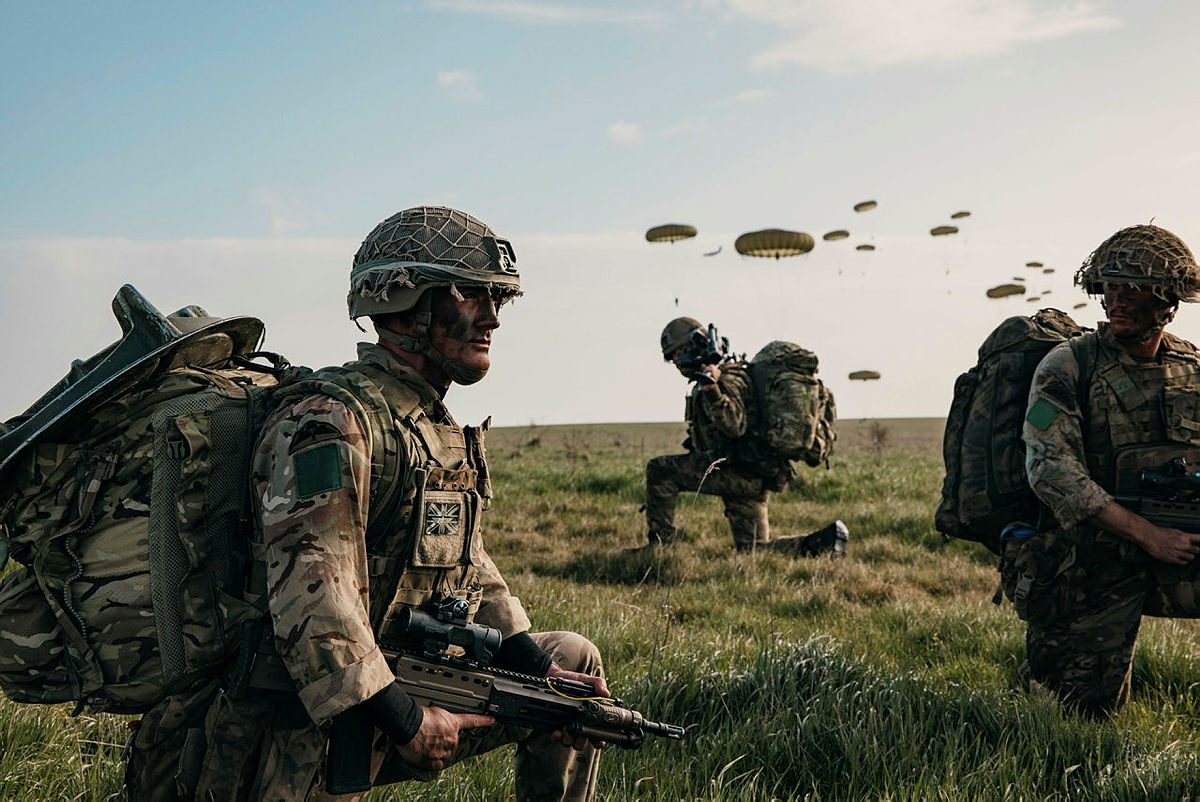
Around seven hundred paratroopers have been dropped onto a German drop zone from four Atlas C1 transports across multiple waves, bringing back battlegroup-level airborne insertion using the aircraft for the first time, according to the Royal Air Force.
Exercise Rhino Titan brought together the RAF Air Mobility Force and 16 Air Assault Brigade Combat Team as a Joint Airborne Task Force, with British, French and German troops taking part. Airborne operations have long been part of British military capability, and the difference here lies in the scale and in soldiers travelling with their stores in the same aircraft.
Squadron Leader Luke, a flight commander on 30 Squadron and the airborne mission commander, said: “Rhino Titan demonstrates the return of large-scale airborne insertion as a capability. The Atlas allows us to deploy combat forces further, faster and more efficiently than previous generations of aircraft, giving Defence the ability to project force rapidly wherever it is required.”
Stores previously needed aircraft of their own, so carrying personnel and equipment together generates more combat power from the same number of airframes, and lets troops become operational almost immediately on landing. Paratroopers board carrying parachute equipment, weapons, communications systems and bergen loads of up to fifty kilograms, with air loadmasters and parachute jump instructors supervising the process before departure.
Squadron Leader Nick, officer commanding the Parachute Training Squadron at RAF Brize Norton, said: “By the time soldiers board the aircraft, a significant amount of planning and preparation has already taken place. Parachute Jump Instructors will have delivered specialist ground training, while detailed planning between aircrew, dispatchers and ground forces coordinates every aspect of the mission.”
He added: “It takes RAF aircrew, engineers, Air Loadmasters, Parachute Jump Instructors and support personnel working alongside the Army to deliver that capability safely and effectively.”
Getting to this point took eighteen months of increased activity between Brize Norton, Weston-on-the-Green and Salisbury Plain, progressing from basic parachuting serials through formation flying and simulated mass drops to integrated delivery of personnel and stores. Aircraft, crews and instructors had to be dedicated to that training while global operational commitments continued.
Squadron Leader Luke said: “The harder we train in exercises, the easier it is to deliver the capability when it’s needed.”
Pathfinders went in ahead of the main force to validate the drop zone and provide reconnaissance and surveillance before the larger force arrived. The RAF said the exercise builds on work done with NATO allies through activities such as Exercise Falcon Leap, where Atlas operators and other tactical airlift nations develop common tactics and procedures, and that dropping troops by parachute lets forces deploy beyond established infrastructure.
The A400M Atlas entered RAF service in 2014 and operates from Brize Norton with 24, 30, 70 and 206 Squadrons. The type will also be fitted for firefighting under the package the government announced last week, which is to give Britain an aerial firefighting capability permanently based in the United Kingdom for the first time.







“24, 30, 70 and 206 Squadrons”, all ’12’ operational aircraft??
3 per squadron?🤔🤔
30 and 70 are the front line Sqns mate.
24 is now the OCU for the wider transport force and 206 is an OEU, I doubt they have their own assets.
Halved in number, effectively, as with the Herc force 24 was operational and we had 47 too, the SF outfit.
Morning mate, I was being a little tounge in cheek to be honest, but it does highlight the extremely limited assets at our disposal.
Some years back, I was a shooting team with a 47 Squadron pilot, an interesting character to say the least, although ( obviously) he would never say anything about operational matters, he often used to say things like, “you wouldn’t believe me if I told you where we landed last week”, often on a stretch of road somewhere with the transponders off….
The loss of 47 Squadron and it’s unique capability was felt keenly across the SF community and not just the UK family either….
One of the most Idiotoc of all the many cuts over the last 3 decades.
I hope some sort of SFF has been established in one of the 2 other Squadrons, the requirement hasn’t gone away and arguably expanded, with the expansion of the UKSFG and now more widely, actions in the Grey Zone.
The RAF wanted to keep those Hercs BTW.
Imbeciles.
Also amusing that now the Fire Fighting roles been added the overall number of assets available is down.
That applies to the Chinook force, about to be halved.
Imbeciles!!
Never mind, we’re on a war footing, Starmer says so, Burnham has his priorities ( EU, votes, welfare bill, migrants, aid ) so I’m sure the RAF will cope! Like they always do.
One detail on this drop I read about on SM was that the number of paratroopers in each “stick”? Is less than it was with Herc. Something to do with the aircraft I assume.
I would guess so mate, they are still being progressively role cleared.
The A400 simply can’t replace the C130 in some it’s previous SF roles, it’s size for one and it’s bloody loud!!!!!
We are now reliant on others for certain tasks and that means a real reduction in sovereign capability.
Still, as you say, as long as the ‘Pipsters’ get paid, that’s the main thing….
I assume all RAF a/c are pooled on their bases these days, squadron markings are not definitive, I guess.
I believe that applies to the bigger types, yes.
I live in Hamm and saw the Atlas transports on ADSB – they flew VFR low level from Celle. Rather unusual, quite a large exercise. We havent had that for a while.