

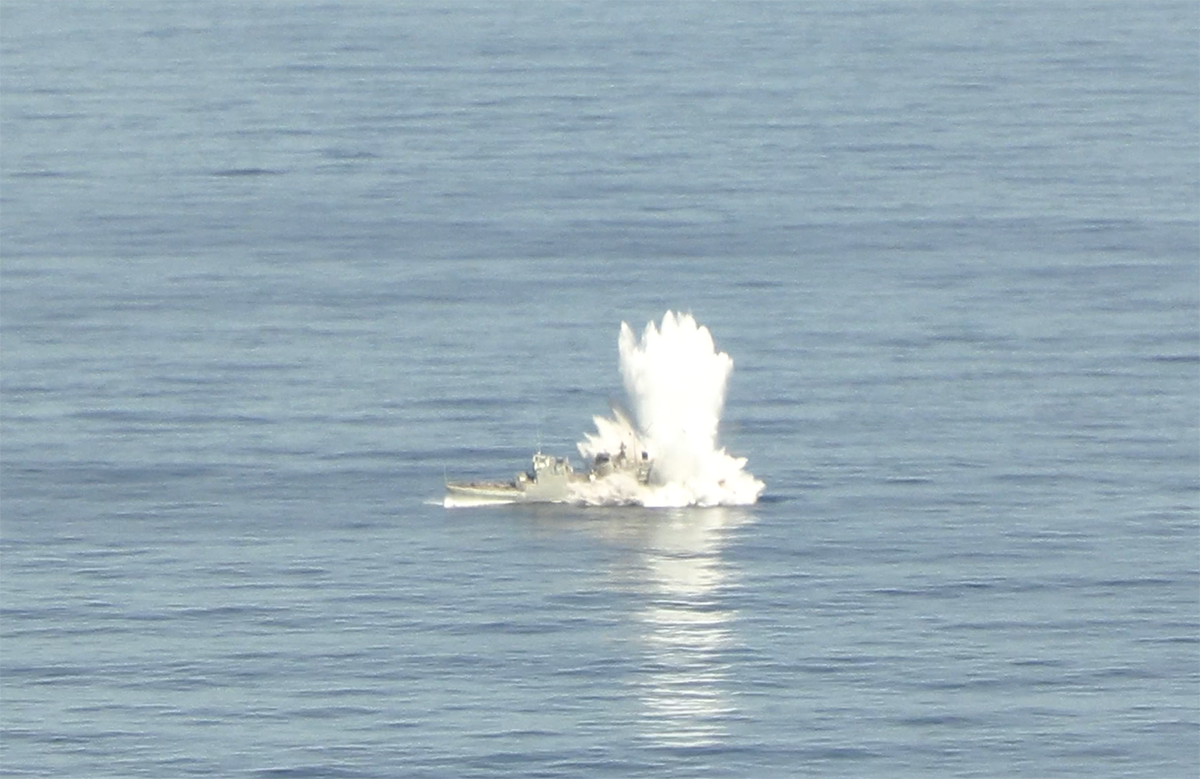
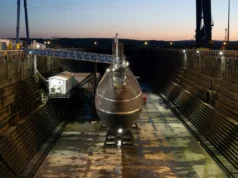
The Spanish submarine Isaac Peral has sunk the decommissioned patrol vessel Infanta Elena with a single torpedo during Exercise SINKEX 26 in the Atlantic, the first of the new S-80 class showing it is ready for operations, according to the Spanish Navy.
The submarine worked alongside the frigates Cristóbal Colón and Navarra, the multipurpose vessel Carnota, the patrol ship Relámpago, a mine countermeasures diving unit, three AV-8B Harriers, a helicopter, a Scan Eagle drone and a Spanish Air Force maritime patrol aircraft.
The Spanish navy said the old ship had all fuel, oil and other polluting components removed beforehand, and that a monitoring protocol protected cetaceans and other species during the live firing.
Captain Rafael Mira Calvo, Commander of the 41st Escort Squadron, who directed the activity at sea from Navarra, said: “the exercise could not have been conducted without the professionalism, training, and effective coordination of the crews, pilots, specialized teams, and support elements of the participating units; their performance was essential to executing the activities in accordance with established procedures and safety measures.”
Navantia is building the class at Cartagena to replace Spain’s ageing S-70 boats. A redesign followed weight and buoyancy problems found during construction of the first boat, and the second, Narciso Monturiol, completed its first static dive in July.
Britain has a stake in the programme, with Babcock supplying the weapon handling and discharge equipment and acoustic countermeasures launchers for all four boats.






16 years from lay down to commissioning and costing @€1b.
Only Japan seems to have found a way to build reliable submarines in a short time frame.
Spain had expertise in submarine building, which the government basically threw away by building submarines of a French design instead of improving. Decades later, all the knowledge was lost and bear in mind navy submarines are very complex and something only 12 countries in world can do. So when the S-80 was announced, it was good news but also a challenge. Not only designing and building a submarine, which is a challenge on its own, but also doing it without previous knowledge. Add to that politics which constantly change requirements, retire funding and several other issues and the program easily runs late and with overcosts for the first units. But it does mean one thing: the expertise and now experience is returning. What do you suggest would have happened to the Royal Navy had the decision of stopping designing submarines been taken? Specially considering the overcosts and delays the current submarines are experiencing. 6 units of the S-80 are being built before probably starting a new class. That benefits the Armada and NATO as a whole and you should celebrate that instead of criticizing, because if it’s about politician incompetences, you definitely take the lead.
Not criticizing, just noting how difficult and expensive construction of even non nuclear boats has become. Especially, as you observe, gaps in design and build mean lost skills have to be regenerated.
Japan has achieved an always on submarine production capacity.