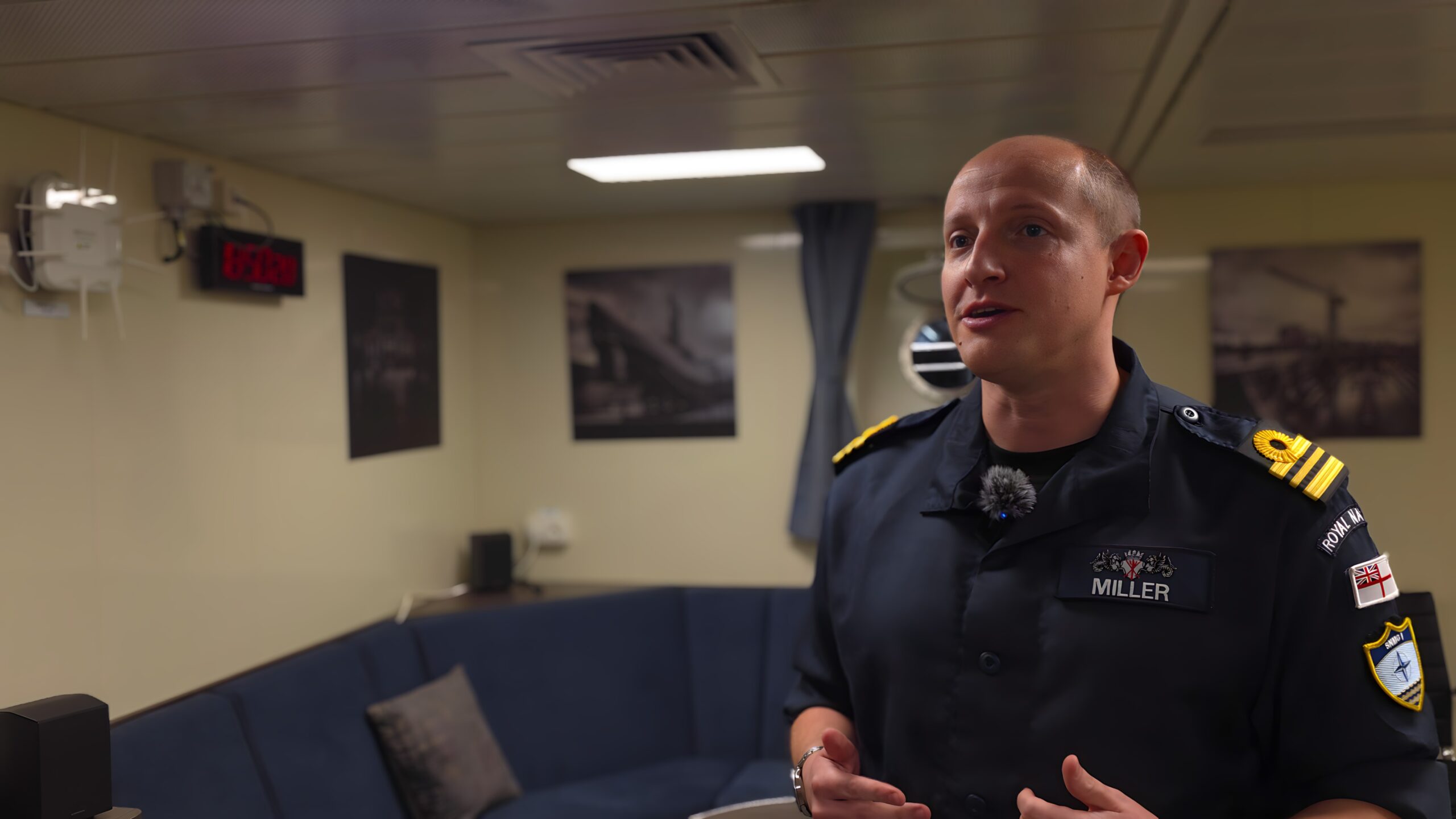
Lieutenant Commander Jonny Miller is the Royal Navy officer responsible for planning the training and exercises of Standing NATO Maritime Group One, one of the Alliance’s permanent naval task groups, working for its commander, French Rear Admiral Nicolas Molitor.
Speaking to the UK Defence Journal during Exercise Dynamic Merlin, NATO’s anti-submarine warfare exercise in the Baltic, he described a role that covers everything from formal exercises to training arranged on the move. “I am responsible to Admiral Molitor for ensuring that his task group is involved in exercises and training serials, whether that’s a formal organised exercise or just we’re moving around on our own steam from place to place,” he said, adding that his job was to make sure the training programme left the group “as ready as possible to conduct our duties and to respond to any situation” its higher command might require.
Groups like his are often described as NATO’s first responders at sea, and Miller was clear about what they are for. “Deterrence is really the keystone of what NATO does. It’s our ability to show that we have the capability to respond to situations and to protect the billion people that NATO’s umbrella covers,” he said. Formal exercises such as Dynamic Merlin, he said, are one of the few chances to bring a meaningful number of allies together in one place, noting that eight nations were involved out of NATO’s 32. They allow navies to practise both the basic drills and what he called the developmental side of NATO’s work, “whether that be autonomy, new tactics, new methods of integrating a new ally like Sweden, getting used to each other, learning from each other”, alongside the core standard operating procedures that allow ships from different nations to work as one.
The group brings together ships from five navies, those of the Netherlands, Germany, Canada, Denmark and Finland, with a staff drawn from eight nations. Bringing so many navies together might sound complicated, but Miller said decades of shared procedures make it surprisingly straightforward. “The great thing about NATO is we’ve been doing this together for 77 years,” he said, describing how lessons are learned and shared across the Alliance so that common training, tactics and manuals reflect best practice wherever the group operates.
That shared foundation, he said, means training can be arranged almost on the spot. “If I’m driving my task group through an open patch of water and I just encounter an ally, we have that ability to pick up the radio, get on the chat, and just say, ‘Hey, we’re going the same place. Do you want to do some training together?'” he said. “We just have that common playbook that we can open up and say, ‘Yep, I’ve got all these exercises. What do we want to do? What have I not trained recently? What do you guys want to train?’ And we can come up with value every time at short notice.”
“This is a team game”
Planning an exercise in some of the busiest waters and airspace in Europe, he said, goes far beyond the group’s own staff of 23 officers and ratings, requiring close coordination with NATO’s Maritime Command and Air Command as well as national authorities. “This is a team game. We have so many partner countries and so many partner agencies involved that really it’s quite incredible that it can come together quite so quickly, and we can achieve so much in such a short space of time,” he said.
The detail of the Dynamic Merlin scenario was kept under wraps, but Miller said one of its main aims was to keep strengthening ties with Sweden, NATO’s newest member and the local expert in Baltic waters. “We’ve integrated very, very quickly. We’ve learned a lot from each other very, very quickly, but we can always strengthen that,” he said. Ultimately, though, he said the exercise was about showing what the Alliance can see beneath the surface and what it is prepared to do about it, echoing the message of NATO’s submarine commander that it served as a deterrent.
“We can prove to an adversary, whoever that may be, exactly how we are able to recognise what is going on in the underwater environment, deter and ultimately react to what happens, because we’re a defensive organisation,” he said. “What we do is we react to things that happen around us. We have the ability to see what is going on. We are watching what is going on, and if necessary, we can respond to what’s going on.”